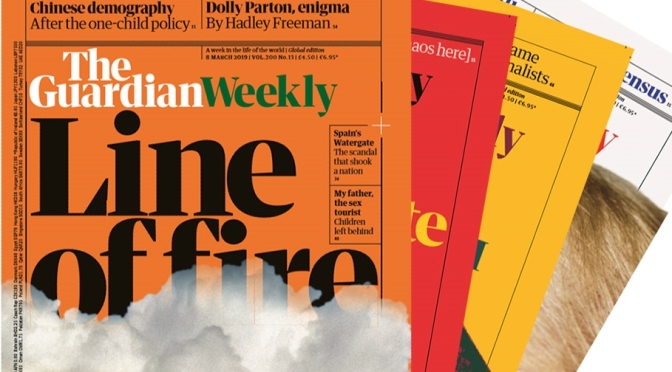
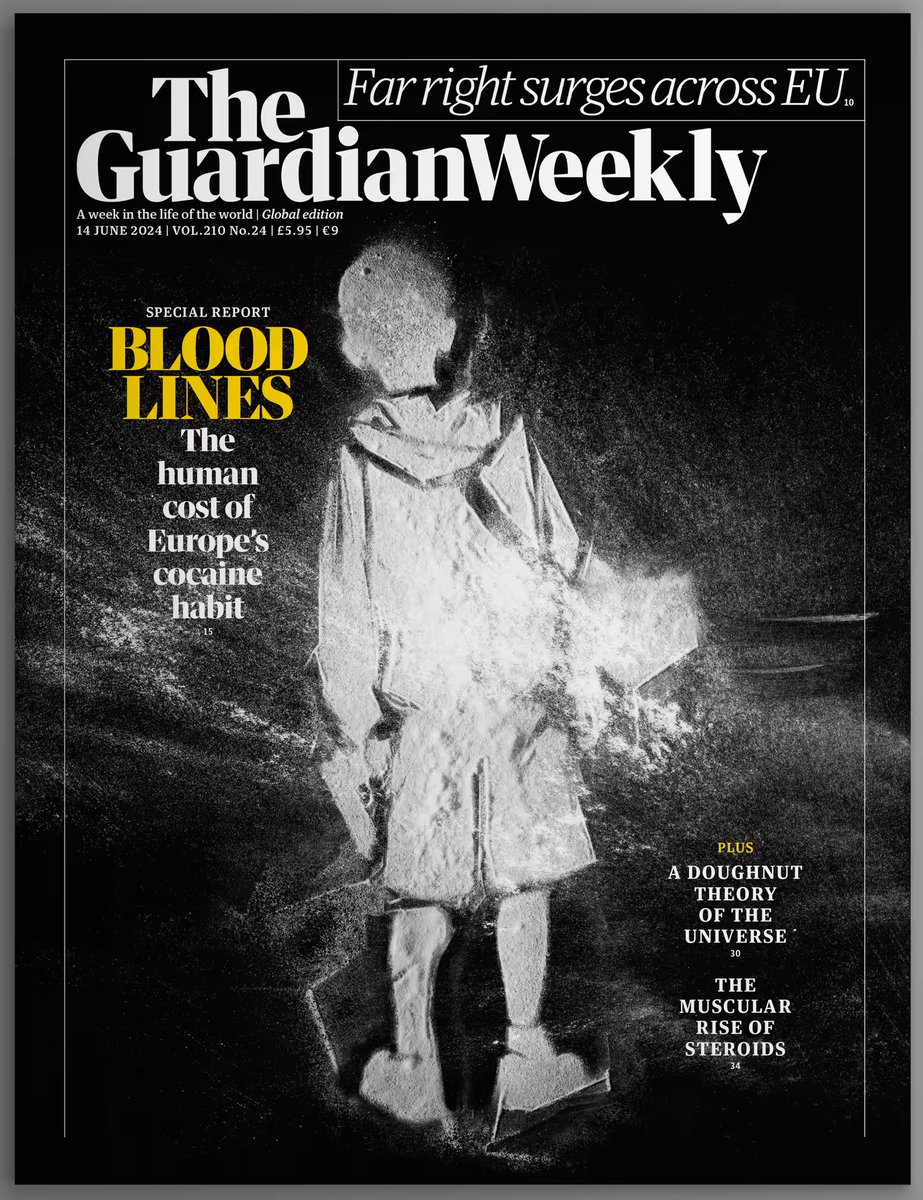
Tag Archives: Gaza

The Economist Magazine – June 1, 2024 Preview

Meet America’s most dynamic political movement

The Economist Magazine (May 30, 2024): The latest issue features ‘Meet America’s Most Dynamic Political Movement’ – A backlash against abortion bans is energizing the middle ground in America

The three women who will shape Europe

At a crucial moment they encapsulate the dilemma of how to handle populism

The pro-choice movement that could help Joe Biden win

A backlash against abortion bans is energising the middle ground in America

What penny-pinching baby-boomers mean for the world economy

They are saving like never before. But even that may not bring interest rates down

Sunday Morning: Stories, News And Analysis From London, Tokyo & Nairobi

Monocle on Sunday, May 26, 2024: Emma Nelson, Tina Fordham and Stephen Dalziel on the weekend’s biggest talking points.

We also speak to Monocle’s editorial director, Tyler Brûlé, in Tokyo, and Monocle’s Nairobi correspondent, Naveena Kottoor, joins to discuss the latest news from the region.

The Economist Magazine – May 25, 2024 Preview

Cash for kids: Why policies to boost birth rates don’t work

The Economist Magazine (May 23, 2024): The latest issue features ‘Cash for Kids’ – Why policies to boost birth rates don’t work…

Why paying women to have more babies won’t work

Baby's bottle filled with coins

Economies must adapt to baby busts instead

As birth rates plunge, many politicians want to pour money into policies that might lead women to have more babies. Donald Trump has vowed to dish out bonuses if he returns to the White House. In France, where the state already spends 3.5-4% of gdp on family policies each year, Emmanuel Macron wants to “demographically rearm” his country. South Korea is contemplating handouts worth a staggering $70,000 for each baby. Yet all these attempts are likely to fail, because they are built on a misapprehension.

Governments’ concern is understandable. Fertility rates are falling nearly everywhere and the rich world faces a severe shortage of babies. At prevailing birth rates, the average woman in a high-income country today will have just 1.6 children over her lifetime. Every rich country except Israel has a fertility rate beneath the replacement level of 2.1, at which a population is stable without immigration. The decline over the past decade has been faster than demographers expected.

Where next for Iran?

The death of the president changes the power dynamic

Meet Nvidia’s challengers

A new generation of AI chips is on the way

How to save South Africa

The rainbow nation needs an alternative to decline under the ANC

Britain’s election surprise

Rishi Sunak’s election call makes no sense, but is good news

Sunday Morning: Stories & News From Zürich, Malmö, Helsinki And London

Monocle on Sunday, May 12, 2024: Juliet Linley and Damita Pressl join Monocle’s editorial director, Tyler Brûlé, to discuss the weekend’s hottest topics.

We also speak to Monocle’s Helsinki correspondent, Petri Burtsoff, for the latest news from the Nordics and senior correspondent and music curator Fernando Augusto Pacheco joins us from Malmö to talk all things Eurovision. Plus: Monocle’s North Africa correspondent, Mary Fitzgerald, joins the programme to discuss speaking at the Beyond Words French literature festival event Taste of Marseille.

The Economist Magazine – May 11, 2024 Preview

The new economic order

The Economist Magazine (May 9, 2024): The latest issue features ‘The New Economic Order’….

The liberal international order is slowly coming apart

Kier Starmer holding a rose with his mouth

Its collapse could be sudden and irreversible

At first glance, the world economy looks reassuringly resilient. America has boomed even as its trade war with China has escalated. Germany has withstood the loss of Russian gas supplies without suffering an economic disaster. War in the Middle East has brought no oil shock. Missile-firing Houthi rebels have barely touched the global flow of goods. As a share of global gdp, trade has bounced back from the pandemic and is forecast to grow healthily this year.

“Judge-mandering” and how to cure it

The assignment of judges to cases should be random, not political

Singapore under new management

Under Lawrence Wong, the city-state has a new chance to change

China Shock II

Despite Xi Jinping’s protestations, China does have an overcapacity problem

Gangs on Latin America

How to pacify the world’s most violent region

Politics: The Guardian Weekly – May 10, 2024

The Guardian Weekly (May 8, 2024) – The new issue features ‘Nowhere to call home’ – Inside Europe’s housing crisis…

Elections for the European parliament are less than a month away and far-right parties are predicted to make significant gains in many of the bloc’s 27 member states. The dire shortage of housing, leading to rising rents and property prices, is becoming a unifying focus for voters’ discontent with their current political leaders.

The issue has sparked protests from Amsterdam to Prague and Milan, as the Guardian’s Europe correspondent, Jon Henley, reports. The data is undeniably worrying as young Europeans spend up to 10 times an average salary on rent and mortgage payments, and big cities from the Baltic states to the Iberian peninsula have registered average property price rises of close to 50%. As a result more EU residents live with their parents for longer and put off life-decisions later into adulthood.

While housing does not fall within MEPs’ remit, it is a visible locus for the sense of social unease that has beset the whole bloc and has become a pivot for the far right to turn on racialised minorities. But as European community affairs correspondent Ashifa Kassam discovers, it is those communities that are doubly penalised through discrimination from landlords who, research has shown, turn away potential renters with “foreign” surnames. The political and social ramifications of the housing crisis in Europe is mirrored elsewhere across the globe and is a subject we will return to in the Guardian Weekly in this year of elections.

Sunday Morning: Stories And News From Zürich, Ljubljana And London

Monocle on Sunday, May 5, 2024: Juliet Linley, Marcus Schögel, and Goran Filic join Monocle’s editorial director, Tyler Brûlé, to discuss the weekend’s hottest topics.

We also speak to Monocle’s Balkans correspondent, Guy De Launey, for the latest news from Ljubljana and design editor Nic Monisse joins us from London. Plus: Mathéo Malik, editor in chief of ‘Le Grand Continent’, joins us to discuss the latest edition.

The Economist Magazine – May 4, 2024 Preview

Europe in mortal danger: An interview with Emmanuel Macron

The Economist Magazine (May 3, 2024): The latest issue features ‘Europe in Mortal Danger’ – An interview with Emmanuel Macron…

Europe in mortal danger: An interview with Emmanuel Macron

The new science of disinformation

More co-ordination and better access to data are needed to fight lies

Uncle Sam’s fiscal profligacy

America’s reckless borrowing is a danger to its economy—and the world’s

Conflicts on campus

Should American universities call the cops on protesting students?

Feeling horny: dragons meet erotic fiction

Novels starring hot fairies are selling millions of copies

Read full edition

The Economist Magazine – April 27, 2024 Preview

How strong is India’s economy?

The Economist Magazine (April 25, 2024): The latest issue features ‘How Strong is India’s Economy?’; Campus Clashes and the Democrats; Where next in the Tech Wars; Ukraine – What $61bn will buy and Has Taylor Swift peaked?….

How strong is India’s economy?

Brechrit: another bad Tory idea

Why leaving the ECHR would be a bad idea for Britain

Where next in the tech wars?

America, China and the battle for supremacy

San Marino, Russia and spies

Intelligence sources are concerned about the country, which is surrounded by Italy

Has Taylor Swift peaked?

The musician is at the height of her commercial, but not her creative, power

Read full edition

Literary Preview: n+1 Magazine – Spring 2024

Image

@nplusonemag (April 23, 2024): The latest issue features ‘Passage’ – Fast fashion nation. Six months of genocide in Gaza. Human_Fallback_2: 2 Human 2 Fallback. Martin Amis, re-reassessed. Border stories by Nicholas Hamburger and Paul Soto.

Who Sees Gaza?

A genocide in images


OCTOBER 7 MARKED the beginning of a new economy of war imagery. At first there was a video of a bulldozer plowing through the border fence between Israel and Gaza—an astonishing image, captured in a familiar way. Then things turned horribly surreal. The events of that day were beamed to the world in real time via body-cam, dashcam, cell phone, drone. A Hamas fighter wearing a GoPro stalked the highway with his automatic rifle jutting up from the bottom of the frame, first-person-shooter style. A dashboard camera showed a car zooming forward as a bullet pierced its windshield and the car began to drift, veering left, until it crashed into the rear end of a parked Toyota; you knew exactly when the person behind the wheel could no longer drive, was probably dead.