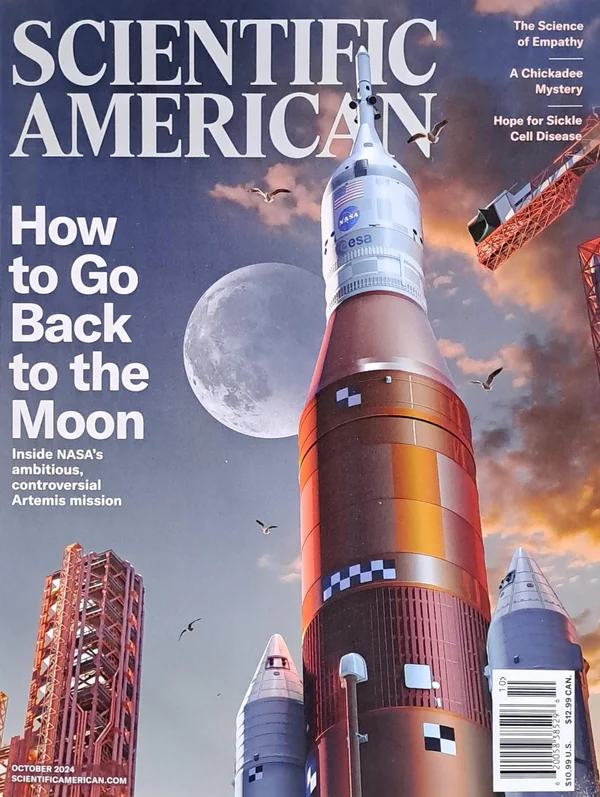

Scientific American (September 16, 2024): The October 2024 issue features ‘How To Go Back To The Moon’ – Inside NASA’s ambitious, controversial Artemis mission; The science of Empathy and Hope for Sickle Cell Disease…

Scientific American (September 16, 2024): The October 2024 issue features ‘How To Go Back To The Moon’ – Inside NASA’s ambitious, controversial Artemis mission; The science of Empathy and Hope for Sickle Cell Disease…
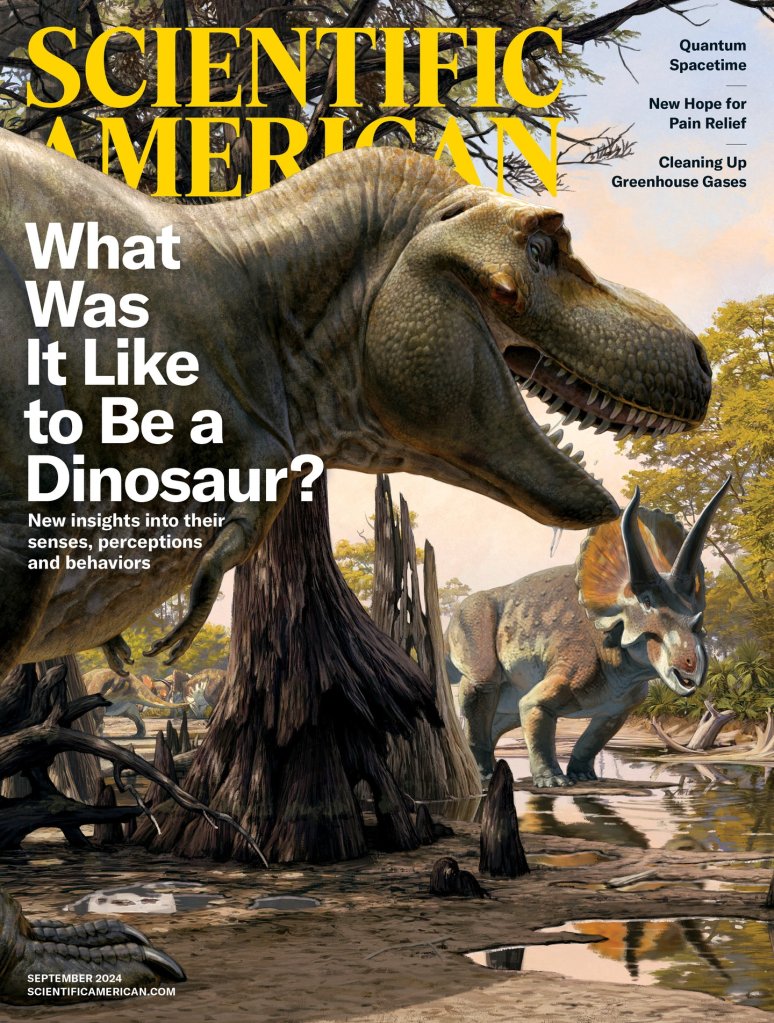
Scientific American (August 21, 2024): The September 2024 issue features ‘What Was It Like To Be A Dinosaur? – New insights into their senses, perceptions and behaviors…
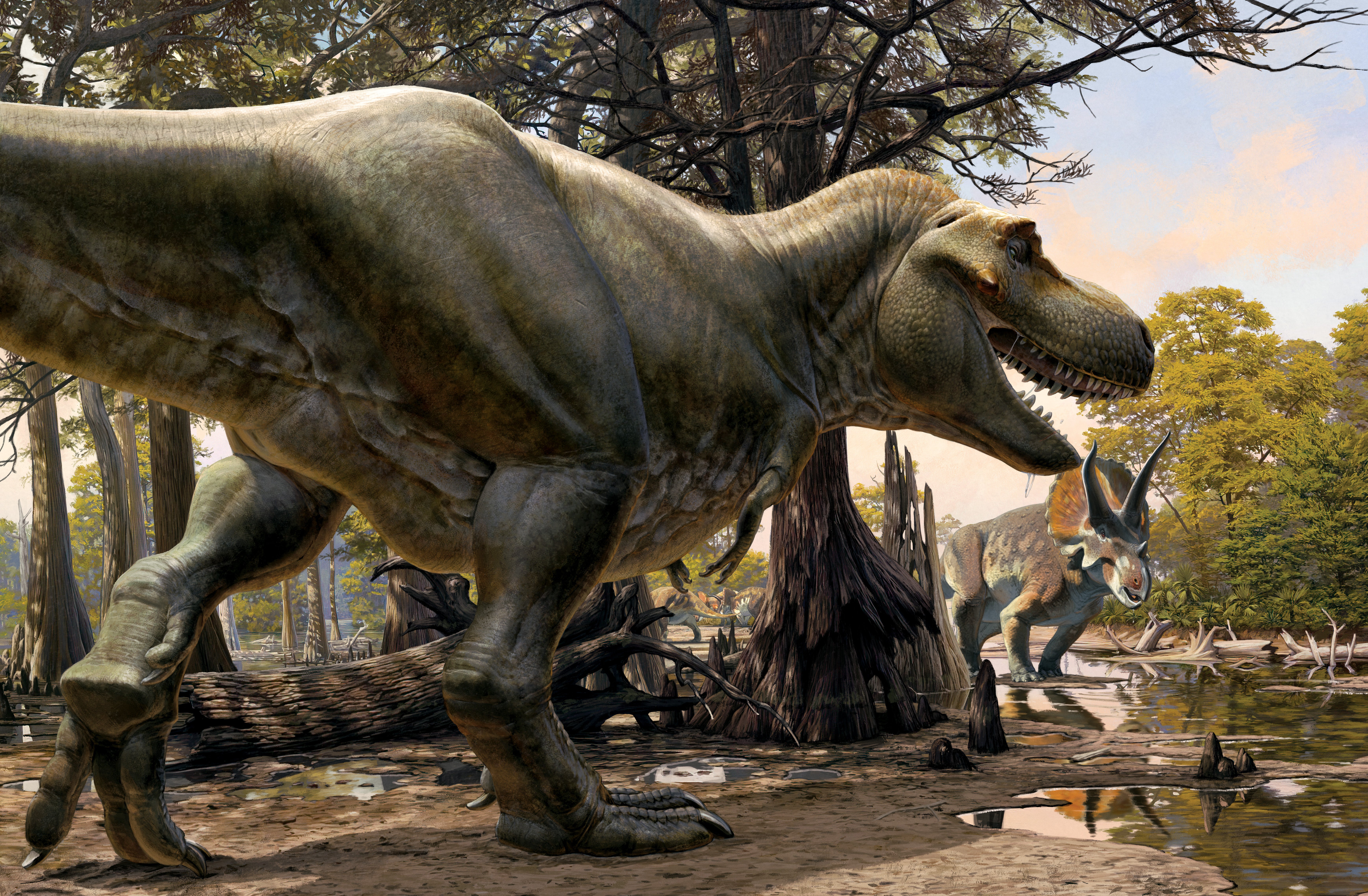
New fossils and analytical tools provide unprecedented insights into dinosaur sensory perception by Amy M. Balanoff, Daniel T. Ksepka
Alone Tyrannosaurus rexsniffs the humid Cretaceous air, scenting a herd of Triceratops grazing beyond the tree line. As the predator scans the floodplain, its vision suddenly snaps into focus. A single Triceratops has broken off from the herd and wandered within striking distance. Standing motionless, the T. rex formulates a plan of attack, anticipating the precise angle at which it must intersect its target before the Triceratops can regain the safety of the herd. The afternoon silence is shattered as the predator crashes though the low branches at the edge of the forest in hot pursuit.
T. rex has hunted Triceratops in so many books, games and movies that the encounter has become a cliché. But did a scene like this one ever unfold in real life? Would T. rex identify its prey by vision or by smell? Would the Triceratops be warned by a loudly cracking branch or remain oblivious because it was unable to locate the source of the sound? Could T. rex plan its attack like a cat, or would it lash out indiscriminately like a shark?

Dark matter has turned out to be more elusive than physicists had hoped by Tracy R. Slatyer, Tim M. P. Tait
Nick Huggett, Carlo Rovelli
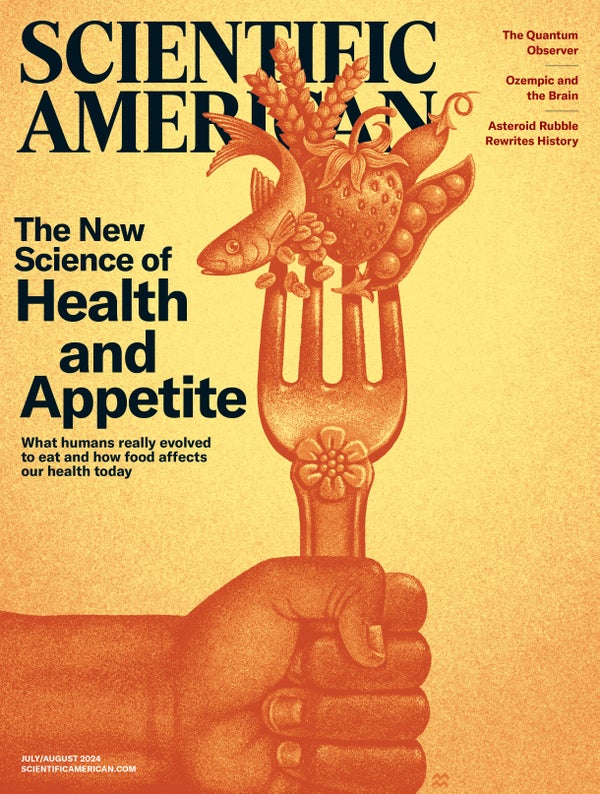
Scientific American (June 26, 2024): The July/August 2024 issue features The New Science of Health and Appetite – What humans really evolved to eat and how food affects our health today…
Nutrition influencers claim we should eat meat-heavy diets like our ancestors did. But our ancestors didn’t actually eat that way
“Heavy and healthy” can be a rare or common condition. But either way it may signal that some excess weight is just fine
Blockbuster weight-loss drugs are revealing how appetite, pleasure and addiction work in the brain
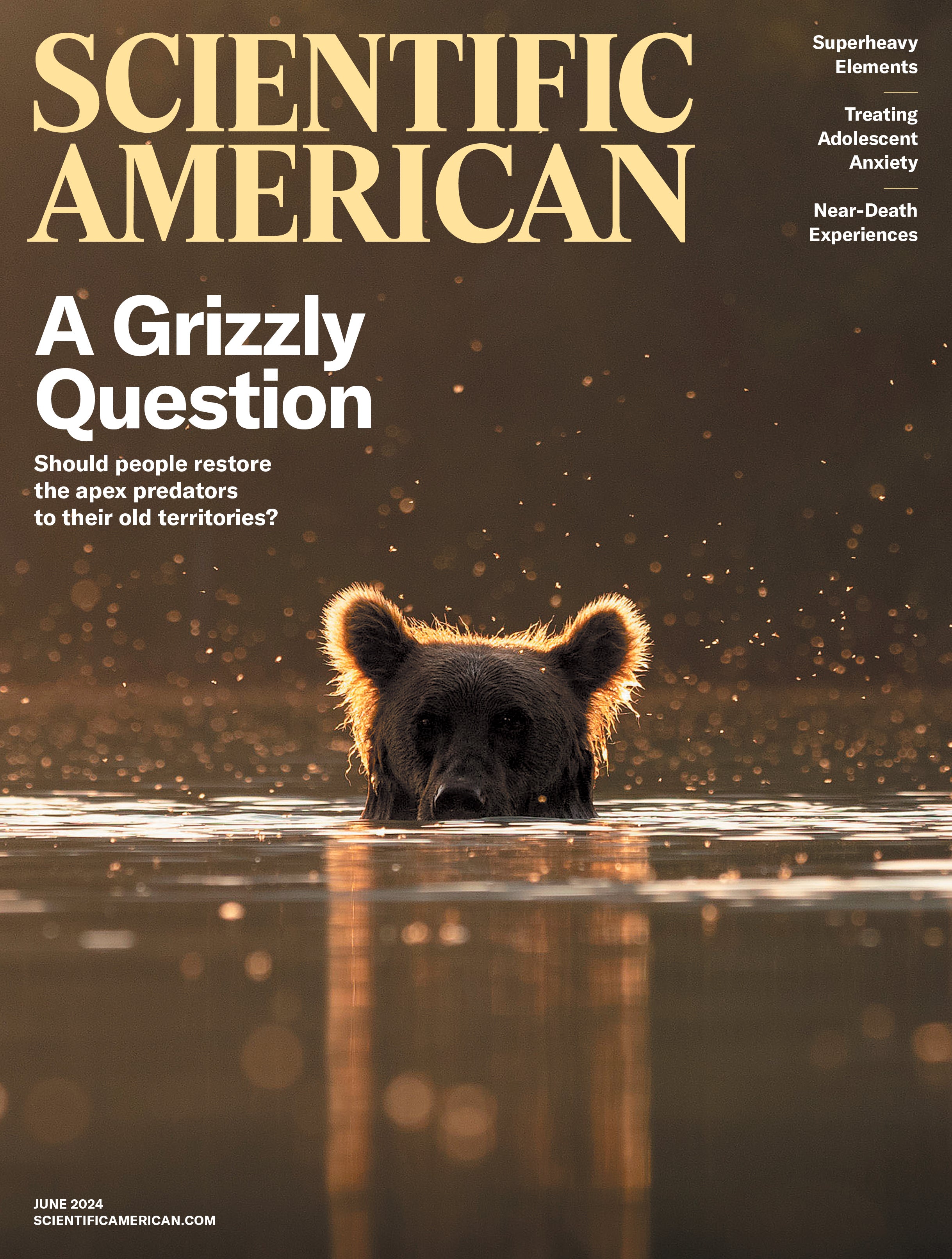
Scientific American (May 15, 2024): The June 2024 issue features:
BENJAMIN CASSIDY
RACHEL NUWER
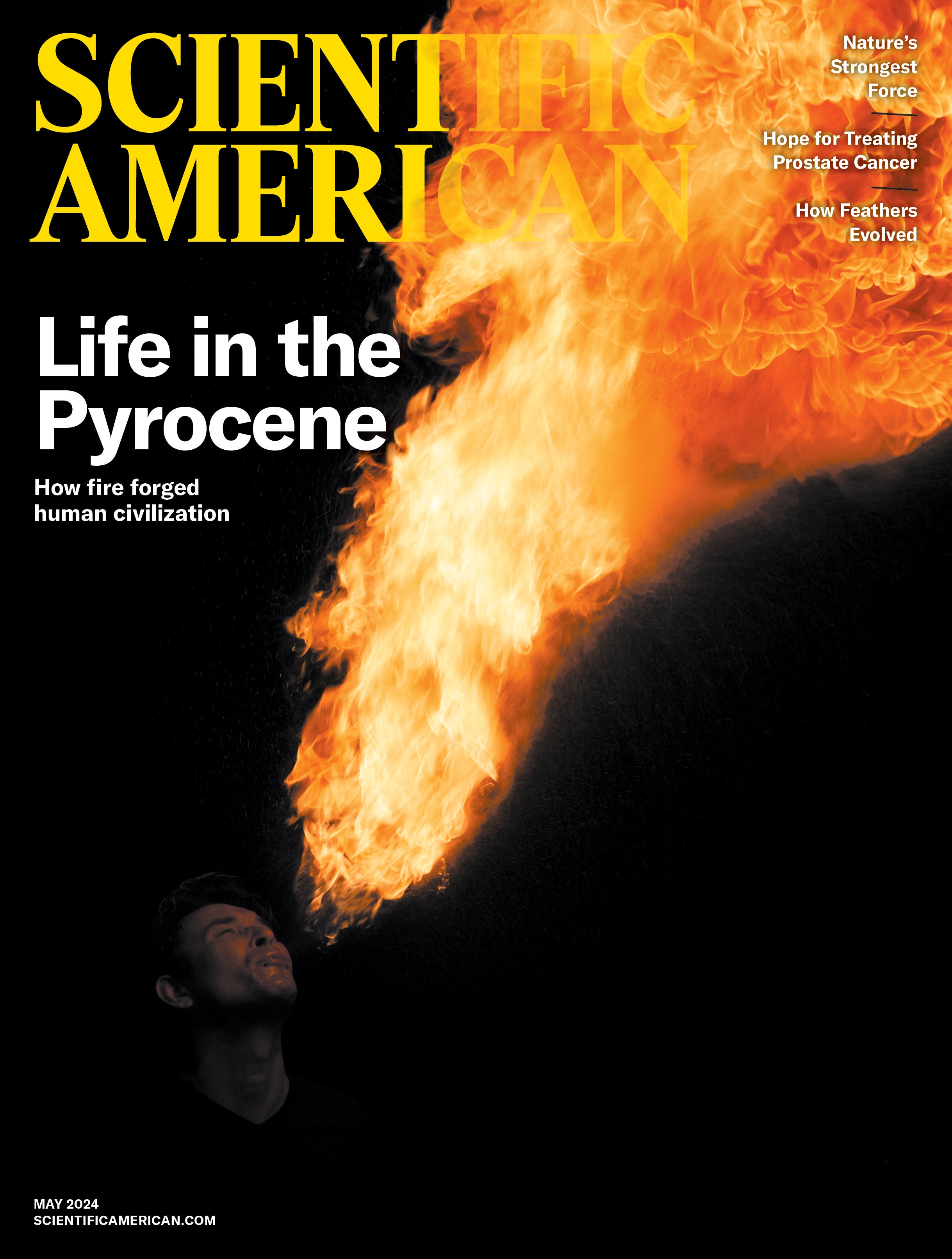
Ancient prophecies of worlds destroyed by fire are becoming realities. How will we respond?
New discoveries demystify the bizarre force that binds atomic nuclei together
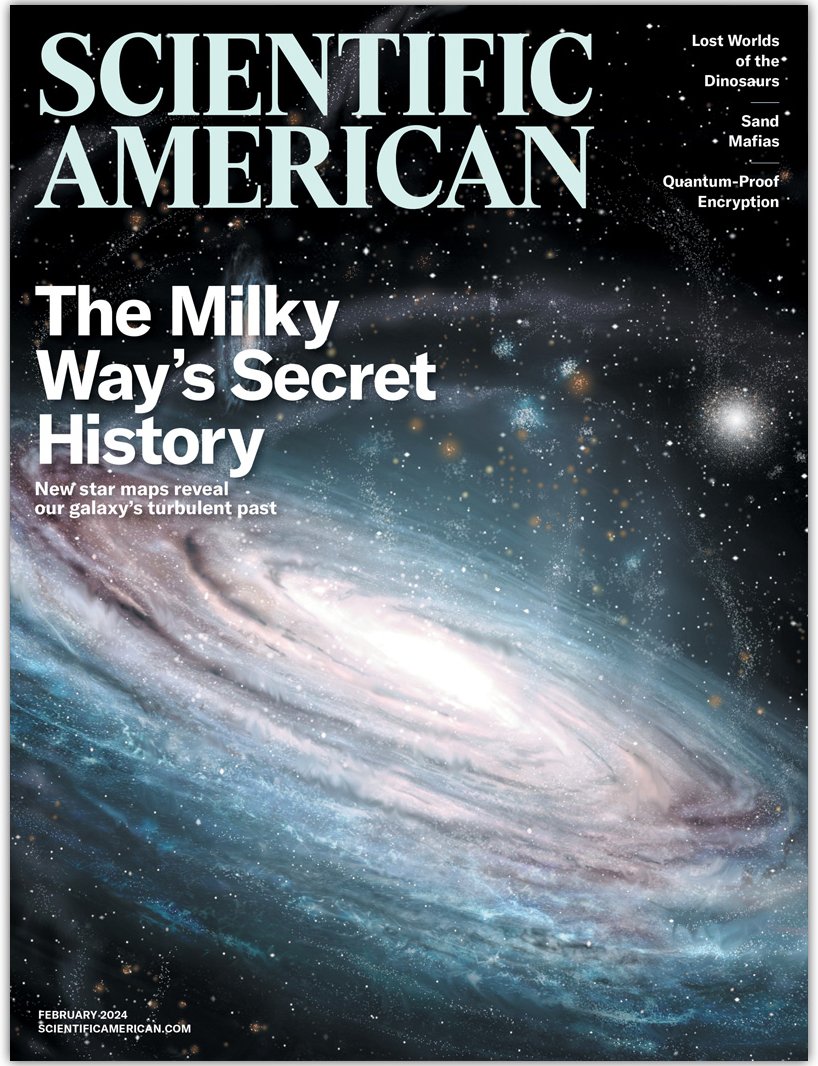
The latest star maps are rewriting the story of our Milky Way, revealing a much more tumultuous history than astronomers suspected
To understand why the universe is made of matter and not antimatter, physicists are looking for a tiny signal in the electron
Special assemblages of minuscule fossils bring dinosaur ecosystems to life
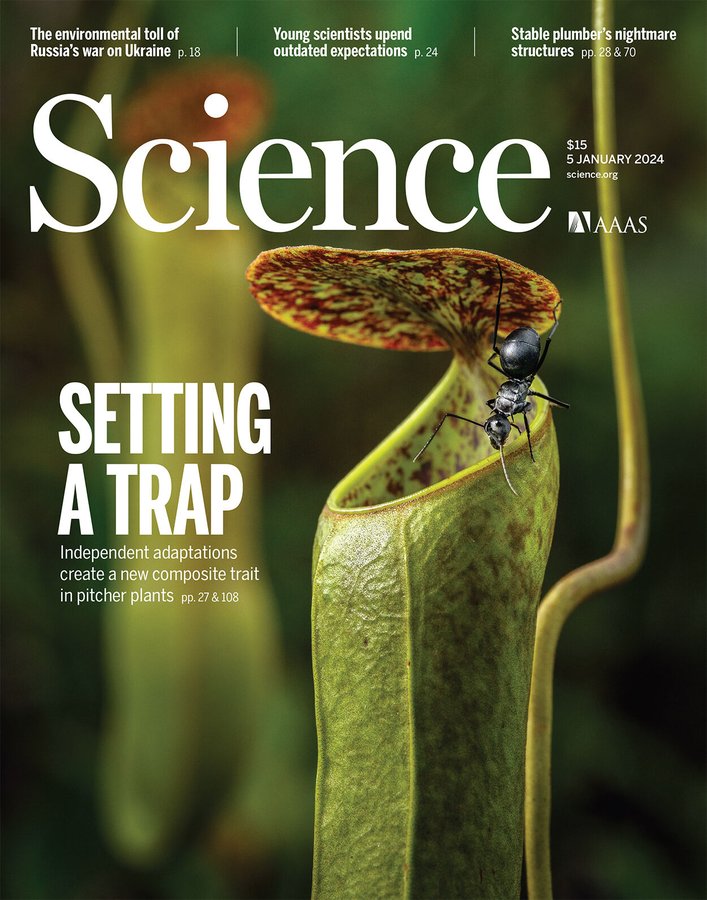

Specific brain pathways can lower or raise the willingness of monkeys to take risks
Rethink of familiar object may boost odds that its name, offensive to some, will be changed
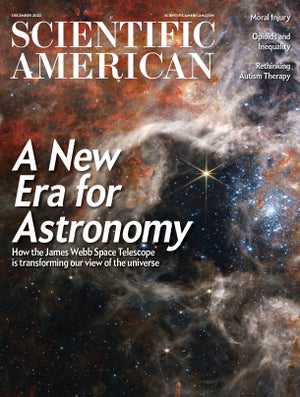

The James Webb Space Telescope has sparked a new era in astronomy
The James Webb Space Telescope’s first images of the distant universe shocked astronomers. Is the discovery of unimaginably distant galaxies a mirage or a revolution?
Deep-field images of “empty” regions of the sky from JWST and other space telescopes are revealing more of the universe than we ever thought possible
The first images from the James Webb Space telescope have been revealed. Incredibly clear images of the Carina Nebula, the Eight-Burst Nebula, a galaxy cluster called Stephan’s Quintet and an exoplanet named WASP-96b make up the first set of science data from JWST.
Dark matter makes up most of the matter in the Universe, and is thought to be needed for galaxies to form. But four years ago, astronomers made a perplexing, and controversial discovery: two galaxies seemingly devoid of dark matter.
This week the team suggests that a cosmic collision may explain how these, and a string of other dark-matter-free galaxies, could have formed.
Research article: van Dokkum et al
News and Views: Giant collision created galaxies devoid of dark matter
How fossil fuel burning has caused levels of helium to rise, and a high-efficiency, hybrid solar-energy system.
Research Highlight: Helium levels in the atmosphere are ballooning
Research Highlight: Flower power: ‘Sunflower’ system churns out useful energy
We hear the stories of scientists whose lives have been affected by Russia’s invasion of Ukraine, including researchers who have become refugees, soldiers and activists in the face of a horrifying conflict.
Nature Feature: How three Ukrainian scientists are surviving Russia’s brutal war
Last week, a team of researchers released an image of Sagittarius A*, the supermassive blackhole at the centre of our galaxy. We hear how they took the image and what it is revealing about these enormous objects.
Nature News: Black hole at the centre of our Galaxy imaged for the first time


 Boomers Daily