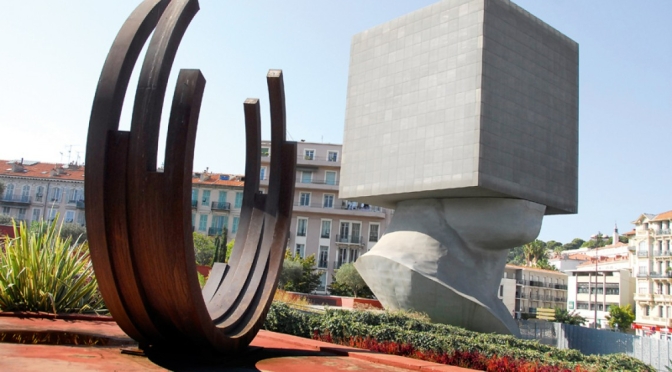
Approached to design the new municipal office in Nice, architect Sasha Sosno had a clear vision: a giant building shaped like the bust of a man with a solid box for a head. How to actually build it would require a brilliant blend of architectural innovation and improvisation.
La Tête Carrée Library, is a massive sculpture that stands at a staggering 85ft (or 28m) in height and was designed by French artist Sacha Sosno and made by two architects – Francis Chapus and Yves Bayard – for the Central Library in Nice. Entitled “Thinking Inside the Box,” the work is an accusatory and clear metaphor and hasn’t always been the most beloved work in the city, with locals often citing it as “ugly”. However, in spite of this, the building remains a fascinating tourist attraction and extraordinary structure, housing four storeys of offices and three storeys of book shelves.
Sosno, a sculptor and peer of other famous local artists such as Henri Matisse and Yves Klein, had long held hope to build such an unusual construction-sculpture but only got a chance to do so in 1997 when his idea was chosen for an administrative office of Louis Nucéra Library. Inaugurated in 2002, it was the first inhabited monumental sculpture in the world.
Located on the corner of Promenade des Arts, La Tête Carrée looks out over Place Yves Klein from the Jardin Maréchal Juin, a small public garden full of colourful flowers and a few more (albeit far, far smaller) sculptures. During the day, it simply looks like a massive sculpture of a head but, if you’re passing La Tête Carrée at night, it is lit from within by a lighting scheme devised by French light artist Yann Kersalé and you can make out the floors of the library inside.
In 1938 architect and designer Charlotte Perriand (1903-1999) designed a mountain shelter able to withstand the harsh elements of any mountaintop yet still light enough to be carried by hand.
The “Refuge Tonneau” (“barrel shelter”), her piece of nomadic architecture designed with Pierre Jeanneret, consists of just 12 main prefabricated panels light enough to be manually transported. Once on location, the panels lock together to resist wind, snow, and cold. The tiny barrel-shaped structure sleeps up to 10 people and while it was never constructed in Perriand’s lifetime it was just one of her many designs created for the masses.
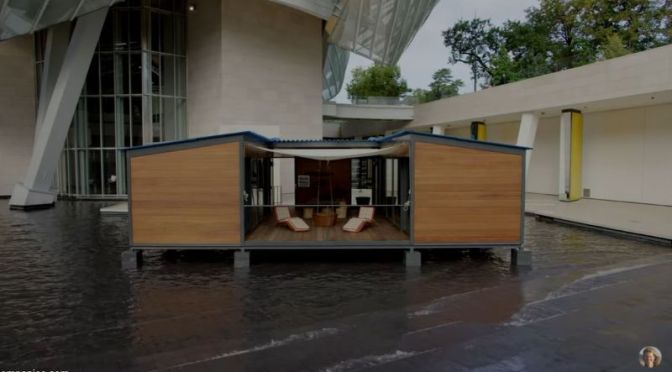
In 1934, after 7 years working with Le Corbusier, Perriand began a five-year study of minimal shelters, like the prefab aluminum Bivouac refuge and the affordable, elegant prefab “House at the Water’s Edge”. Hoping to improve upon her easily-transportable, aluminum Bivouac shelter she found inspiration in the merry-go-round. Counting on the dodecagon shape’s ability to withstand strong centrifugal loads (and high winds), she made it the basis for her Refuge Tonneau.
All her tiny shelters were works of studied elimination. “Her mission was to eliminate anything unnecessary,” explains her daughter Pernette Perriand-Barsac, “but always to concentrate on the flow of light and air. Then you can live in the smallest of spaces.” Sébastien Cherruet gave us a tour of Perriand’s minimal structures and apartment design at the Louis Vuitton Foundation’s exhibit he curated: “Charlotte Perriand: Inventing a New World”.
From reception pavilion to proper house, 2m26’s houses are unique pieces. They are produced made to measure, on demand. They absolutely fit to the landscape. The houses are made of pine planks, rough cuted. The structure is protected with linseed oil to resist to weather conditions and walnut stain can be added to obtain a dark color.
The building process / prefab gives the opportunity to prepare all the pieces at the Atelier. Moreover, it reduces on site time of construction, damages on plants and minimizes noise pollution. On site construction can be scheduled from a week to a month.
Techniques used are mostly cutting, drilling, screwing, so that the assembly work can be done together with the customer, reducing costs for him.
About 2m26: Born in 2015, 2m26 summarizes ten years of researches and experiments about inhabiting.
Proceeding between design and architecture, 2m26 offers tools for living / handmade, thrifty and luxury / unique pieces designed and produced on demand / raw materials, natural processings and mastered development / simple, handsome and functional.
The crew : mélanie heresbach / artist / architect. sébastien renauld / artist / architect.
“After 96 years on this earth, Yona has moved up to build a Spatial City and install some Space Chains in the sky. The Fonds de Dotation Denise and Yona Friedman, which he founded last year, will continue his work.”
From an Instagram post (02/21/20)
Yona Friedman (5 June 1923 – 21 February 2020) was a Hungarian-born French architect, urban planner and designer. He was influential in the late 1950s and early 1960s, best known for his theory of mobile architecture.
In 1958, Yona Friedman published his first manifesto : “Mobile architecture”. It described a new kind of mobility not of the buildings, but for the inhabitants, who are given a new freedom.
Mobile architecture is the “dwelling decided on by the occupant” by way of “infrastructures that are neither determined nor determining”. Mobile architecture embodies an architecture available for a “mobile society”. To deal with it, the classical architect invented “the Average Man”. The projects of architects in the 1950s were undertaken, according to Friedman, to meet the needs of this make-believe entity, and not as an attempt to meet the needs of the actual members of this mobile society.
The teaching of architecture was largely responsible for the “classical” architect’s under-estimation of the role of the user. Furthermore, this teaching did not embrace any real theory of architecture. Friedman proposed then teaching manuals for the fundamentals of architecture for the general public.
The spatial city, which is a materialization of this theory, makes it possible for everyone to develop his or her own hypothesis. This is why, in the mobile city, buildings should :
touch the ground over a minimum area
be capable of being dismantled and moved
and be alterable as required by the individual occupant.
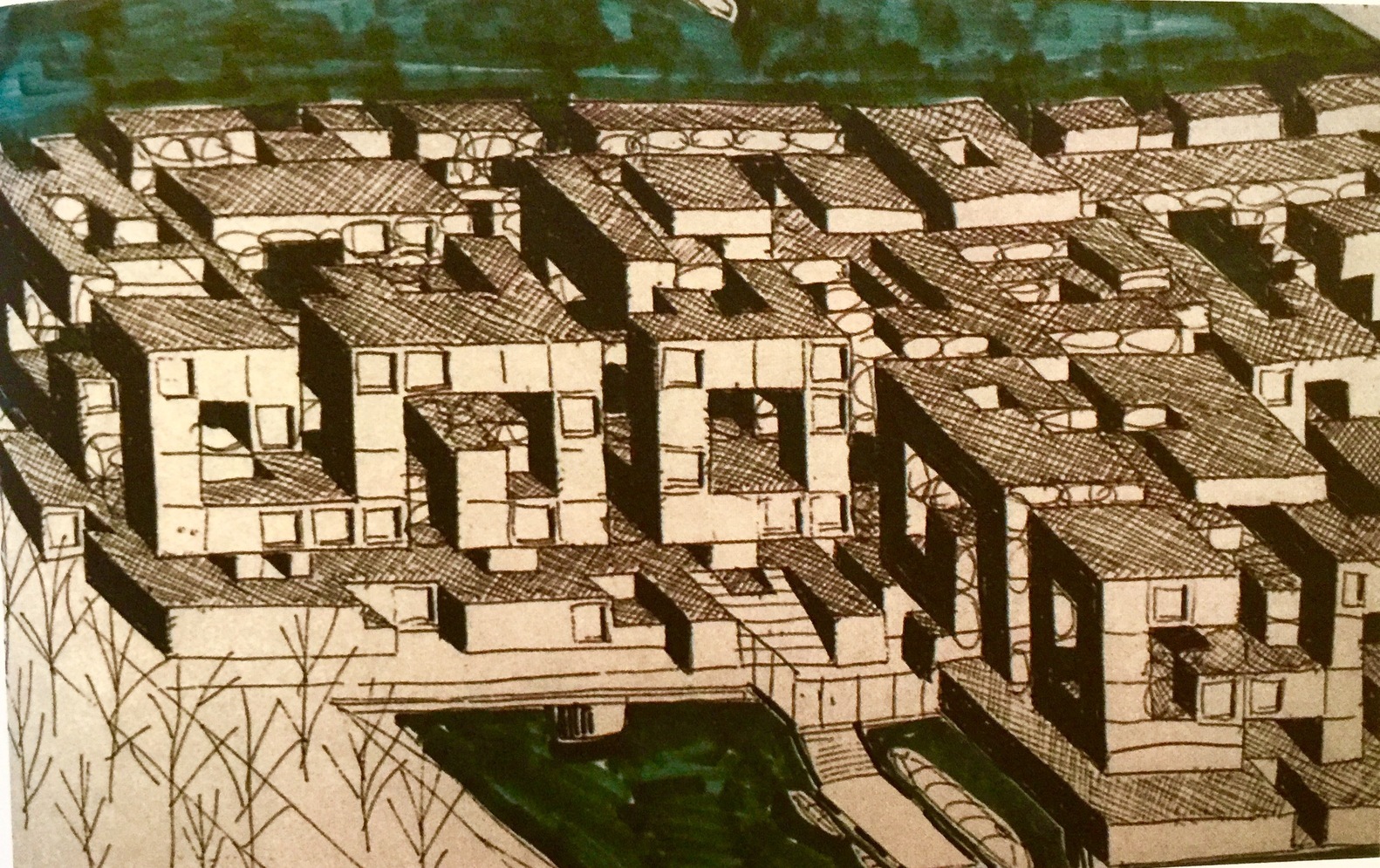
The Spatial City is the most significant application of “mobile architecture”. It is raised up on piles which contains inhabited volumes, fitted inside some of the “voids”, alternating with other unused volumes, making it look aesthetically pleasant. The basis of its design is that of trihedral elements which operate as “neighbourhoods” where dwellings are distributed without a price.
This structure introduces a kind of merger between countryside and city (compare to Paolo Soleri’s Arcology concept) and may span:
certain unavailable sites,
areas where building is not possible or permitted (expanses of water, marshland),
areas that have already been built upon (an existing city),
above farmland.
This spanning technique which includes container structures ushers in a new development in town-planning. Raised plans increase the original area of the city becoming three-dimensional. The tiering of the spatial city on several independent levels, one on top of the other, determines “spatial town-planning” both from the functional and from the aesthetic viewpoint. The lower level may be earmarked for public life and for premises designed for community services as well as pedestrian areas. The piles contain the vertical means of transport (lifts, staircases). The superposition of levels should make it possible to build a whole industrial city, or a residential or commercial city, on the same site. In this way, the Spatial City forms what Yona Friedman would call an “artificial topography”. This grid suspended in space outlines a new cartography of the terrain with the help of a continuous and indeterminate homogeneous network with a major positive outcome: this modular grid would authorize the limitless growth of the city.
The spaces in this grid are rectangular and habitable modular “voids”, with an average area of 25–35 square meters. Conversely, the form of the volumes included within the grid depends solely on the occupant, and their configuration set with a “Flatwriter” in the grid is completely free. Only one half of the spatial city would be occupied. The “fillings” which correspond to the dwellings only actually take up 50% of the three-dimensional lattice, permitting the light to spread freely in the spatial city. This introduction of elements on a three-dimensional grid with several levels on piles permits a changeable occupancy of the space by means of the convertibility of the forms and their adaptation to multiple uses.
In Yona Friedman’s own words “The city, as a mechanism, is thus nothing other than a labyrinth : a configuration of points of departure, and terminal points, separated by obstacles”.

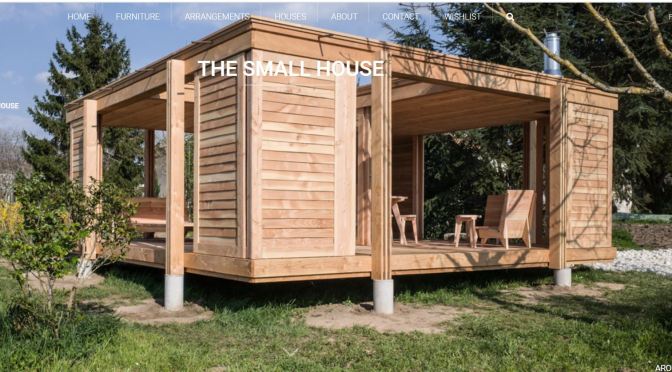
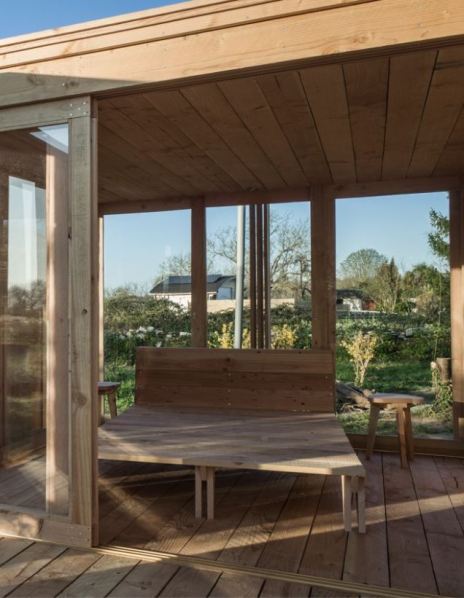 From reception pavilion to proper house, 2m26’s houses are unique pieces. They are produced made to measure, on demand. They absolutely fit to the landscape. The houses are made of pine planks, rough cuted. The structure is protected with linseed oil to resist to weather conditions and walnut stain can be added to obtain a dark color.
 The building process / prefab gives the opportunity to prepare all the pieces at the Atelier. Moreover, it reduces on site time of construction, damages on plants and minimizes noise pollution. On site construction can be scheduled from a week to a month.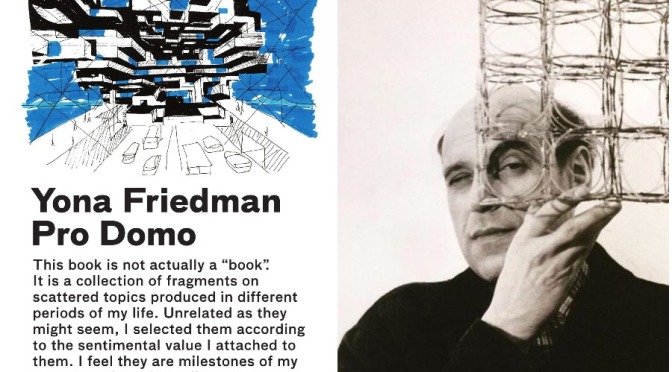
 Boomers Daily