Tag Archives: Foreign Affairs

Review: AI, Apathy, and the Arsenal of Democracy

Dexter Filkins is a Pulitzer Prize-winning American journalist and author, known for his extensive reporting on the wars in Afghanistan and Iraq. He is currently a staff writer for The New Yorker and the author of the book “The Forever War“, which chronicles his experiences reporting from these conflict zones. 

Is the United States truly ready for the seismic shift in modern warfare—a transformation that The New Yorker‘s veteran war correspondent describes not as evolution but as rupture? In “Is the U.S. Ready for the Next War?” (July 14, 2025), Dexter Filkins captures this tectonic realignment through a mosaic of battlefield reportage, strategic insight, and ethical reflection. His central thesis is both urgent and unsettling: that America, long mythologized for its martial supremacy, is culturally and institutionally unprepared for the emerging realities of war. The enemy is no longer just a rival state but also time itself—conflict is being rewritten in code, and the old machines can no longer keep pace.

The piece opens with a gripping image: a Ukrainian drone factory producing a thousand airborne machines daily, each costing just $500. Improvised, nimble, and devastating, these drones have inflicted disproportionate damage on Russian forces. Their success signals a paradigm shift—conflict has moved from regiments to swarms, from steel to software. Yet the deeper concern is not merely technological; it is cultural. The article is less a call to arms than a call to reimagine. Victory in future wars, it suggests, will depend not on weaponry alone, but on judgment, agility, and a conscience fit for the digital age.

Speed and Fragmentation: The Collision of Cultures

At the heart of the analysis lies a confrontation between two worldviews. On one side stands Silicon Valley—fast, improvisational, and software-driven. On the other: the Pentagon—layered, cautious, and locked in Cold War-era processes. One of the central figures is Palmer Luckey, the founder of the defense tech company Anduril, depicted as a symbol of insurgent innovation. Once a video game prodigy, he now leads teams designing autonomous weapons that can be manufactured as quickly as IKEA furniture and deployed without extensive oversight. His world thrives on rapid iteration, where warfare is treated like code—modular, scalable, and adaptive.

This approach clashes with the military’s entrenched bureaucracy. Procurement cycles stretch for years. Communication between service branches remains fractured. Even American ships and planes often operate on incompatible systems. A war simulation over Taiwan underscores this dysfunction: satellites failed to coordinate with aircraft, naval assets couldn’t link with space-based systems, and U.S. forces were paralyzed by their own institutional fragmentation. The problem wasn’t technology—it was organization.

What emerges is a portrait of a defense apparatus unable to act as a coherent whole. The fragmentation stems from a structure built for another era—one that now privileges process over flexibility. In contrast, adversaries operate with fluidity, leveraging technological agility as a force multiplier. Slowness, once a symptom of deliberation, has become a strategic liability.

The tension explored here is more than operational; it is civilizational. Can a democratic state tolerate the speed and autonomy now required in combat? Can institutions built for deliberation respond in milliseconds? These are not just questions of infrastructure, but of governance and identity. In the coming conflicts, latency may be lethal, and fragmentation fatal.

Imagination Under Pressure: Lessons from History

To frame the stakes, the essay draws on powerful historical precedents. Technological transformation has always arisen from moments of existential pressure: Prussia’s use of railways to reimagine logistics, the Gulf War’s precision missiles, and, most profoundly, the Manhattan Project. These were not the products of administrative order but of chaotic urgency, unleashed imagination, and institutional risk-taking.

During the Manhattan Project, multiple experimental paths were pursued simultaneously, protocols were bent, and innovation surged from competition. Today, however, America’s defense culture has shifted toward procedural conservatism. Risk is minimized; innovation is formalized. Bureaucracy may protect against error, but it also stifles the volatility that made American defense dynamic in the past.

This critique extends beyond the military. A broader cultural stagnation is implied: a nation that fears disruption more than defeat. If imagination is outsourced to private startups—entities beyond the reach of democratic accountability—strategic coherence may erode. Tactical agility cannot compensate for an atrophied civic center. The essay doesn’t argue for scrapping government institutions, but for reigniting their creative core. Defense must not only be efficient; it must be intellectually alive.

Machines, Morality, and the Shrinking Space for Judgment

Perhaps the most haunting dimension of the essay lies in its treatment of ethics. As autonomous systems proliferate—from loitering drones to AI-driven targeting software—the space for human judgment begins to vanish. Some militaries, like Israel’s, still preserve a “human-in-the-loop” model where a person retains final authority. But this safeguard is fragile. The march toward autonomy is relentless.

The implications are grave. When decisions to kill are handed to algorithms trained on probability and sensor data, who bears responsibility? Engineers? Programmers? Military officers? The author references DeepMind’s Demis Hassabis, who warns of the ease with which powerful systems can be repurposed for malign ends. Yet the more chilling possibility is not malevolence, but moral atrophy: a world where judgment is no longer expected or practiced.

Combat, if rendered frictionless and remote, may also become civically invisible. Democratic oversight depends on consequence—and when warfare is managed through silent systems and distant screens, that consequence becomes harder to feel. A nation that no longer confronts the human cost of its defense decisions risks sliding into apathy. Autonomy may bring tactical superiority, but also ethical drift.

Throughout, the article avoids hysteria, opting instead for measured reflection. Its central moral question is timeless: Can conscience survive velocity? In wars of machines, will there still be room for the deliberation that defines democratic life?

The Republic in the Mirror: A Final Reflection

The closing argument is not tactical, but philosophical. Readiness, the essay insists, must be measured not just by stockpiles or software, but by the moral posture of a society—its ability to govern the tools it creates. Military power divorced from democratic deliberation is not strength, but fragility. Supremacy must be earned anew, through foresight, imagination, and accountability.

The challenge ahead is not just to match adversaries in drones or data, but to uphold the principles that give those tools meaning. Institutions must be built to respond, but also to reflect. Weapons must be precise—but judgment must be present. The republic’s defense must operate at the speed of code while staying rooted in the values of a self-governing people.

The author leaves us with a final provocation: The future will not wait for consensus—but neither can it be left to systems that have forgotten how to ask questions. In this, his work becomes less a study in strategy than a meditation on civic responsibility. The real arsenal is not material—it is ethical. And readiness begins not in the factories of drones, but in the minds that decide when and why to use them.

THIS ESSAY REVIEW WAS WRITTEN BY AI AND EDITED BY INTELLICUREAN.

THE ECONOMIST MAGAZINE – JULY 12, 2025 PREVIEW

THE ECONOMIST MAGAZINE: The latest issue features ‘Scrap the asylum systemAnd build something better…

Scrap the asylum system—and build something better

Rich countries need to separate asylum from labour migration

America cannot dodge the consequences of rising tariffs for ever

Their economic impact has been delayed but not averted

After another leader is brought low, Thailand’s voters need a real choice

The kingdom is stagnating while its elites squabble

Sex hormones could be mental-health drugs too

If they can be liberated from ignorance and hucksterism

THE ECONOMIST MAGAZINE – JULY 5, 2025 PREVIEW

THE ECONOMIST MAGAZINE: The latest issue features Big, beautiful…bonkers

Trumponomics 2.0 will erode the foundations of America’s prosperity

The Big Beautiful Bill is symptomatic of a wider malaise

China is building an entire empire on data

It will change the online economy and the evolution of artificial intelligence

How A-listers are shaking up the consumer-goods business

Hailey Bieber, Rihanna and Ryan Reynolds are among a new cohort of celebrity entrepreneurs

William Ruto is taking Kenya to a dangerous place

The president’s authoritarian instincts are propelling a spiral of violence

FOREIGN POLICY MAGAZINE – SUMMER 2025 PREVIEW

FOREIGN POLICY MAGAZINE (06.30.25): The latest issue features ‘The Historical Presidency’ – Nine essays on what the global past reveals about our confounding present…

The End of Modernity

A crisis is unfolding before our eyes—and also in our heads. By Christopher Clark

Why Compare the Present to the Past?

Thinking via historical analogy has become the preferred way to confront our anxieties. Ivan KrastevLeonard Benardo

Is This an American Cultural Revolution?

Liberal critics charge Trump with creating a cult of personality not unlike Mao Zedong’s. Julia LovellNicholas Guyatt

Russia Has Started Losing the War in Ukraine

The military tide may have turned against Putin. Michael Kimmage

THE ECONOMIST MAGAZINE – JUNE 28, 2025 PREVIEW

Image

THE ECONOMIST MAGAZINE: The latest issue features How to win the peace…

How to win peace in the Middle East

After the bombs should come a plan to reset the region

RFK’s loopy approach to vaccines endangers Americans

Donald Trump’s health secretary undermines global public health, too

How the defence bonanza will reshape the global economy

As they spend big, politicians must resist using one pot of money to achieve many goals

Chinese brands are sweeping the world. Good

From fast food to video games, new marques are making their mark

THE GUARDIAN WEEKLY – JUNE 27, 2025 PREVIEW

GUARDIAN WEEKLY (June 25, 2025): The latest issue features ‘Chain Reaction’ – The consequences of America’s attack on Iran….

How will Israel’s conflict with Iran play out? Only a brave person, or perhaps a weekly news magazine, would try to foresee the outcomes of a war in which the contours have shifted almost by the hour.

After the United States bombed Iran’s key nuclear facilities last weekend – and Tehran responded with a choreographed missile attack on a US base in Qatar – Donald Trump declared a ceasefire, clearly hoping that would be the end of it. Initially at least, Iran and Israel appeared not to have got the memo, provoking a sweary outburst from the US president on the White House lawn. But as of Wednesday, a fragile truce appeared to be holding (follow our latest coverage here).

How will Israel’s conflict with Iran play out? Only a brave person, or perhaps a weekly news magazine, would try to foresee the outcomes of a war in which the contours have shifted almost by the hour.

Julian Borger takes up the story of how the US was drawn into Israel’s war with Tehran and how it pulled off a remarkable, top-secret operation. And in another excellent commentary, Nesrine Malik laments an impotent western liberal political establishment that makes appeals for cool heads and diplomacy, but is entirely incapable of addressing the problem, namely its own lack of a moral compass or care for the norms it claims to uphold.


Five essential reads in this week’s edition

Spotlight | Russia surpasses 1 million casualties in Ukraine war
As the grim tally of Moscow’s invasion is reached, an expansive propaganda campaign and state payouts are keeping grieving relatives onside. Pjotr Sauer reports

Science | A bug’s life: small ways to make a big change
Insect species are under threat around the world but there are simple, science-backed actions we can all take to stem their decline. Tess McClure and Patrick Greenfield find out how

Feature | The mommas and the poppas

Italian-style late family meals, bed-sharing like the Germans, breaking down gender stereotypes the Icelandic way … f ive Guardian writers try f ive dif ferent European parenting styles. Will they make it out unscathed?

Opinion | From LA to London, the populist right hates our cities
Once a conservative stronghold; Los Angeles is now occupied by the military. Liberal cities have become targets for politicians looking to stir up voters elsewhere, argues Andy Beckett

Culture | Danny Boyle on risks, regrets and returning to the undead
In 28 Years Later, zombies maraud over a Britain broken by more than Brexit. Its director talks to Xan Brooks about cultural baggage, catastrophising – and why his kids’ generation is an ‘upgrade’

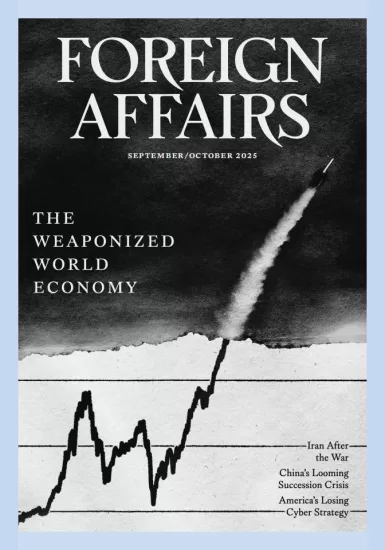
FOREIGN AFFAIRS MAGAZINE – JULY/AUGUST 2025 PREVIEW

FOREIGN AFFAIRS MAGAZINE (June 24, 2025): The latest issue features ‘Who Needs Allies?’….

Dispensable Nation

America in a Post-American World by Kori Schake

Beware the Europe You Wish For

The Downsides and Dangers of Allied Independence by Celeste A. Wallander

The Case for a Pacific Defense Pact

America Needs a New Asian Alliance to Counter China by Ely Ratner

India’s Great-Power Delusions

How New Delhi’s Grand Strategy Thwarts Its Grand Ambitions by Ashley J. Tellis

THE NEW STATESMAN MAGAZINE – JUNE 20, 2025

THE NEW STATESMAN (June 18, 2025): The latest issue features ‘Warlord’ – Feared, Loathed, Haunted…Unstoppable.

Living by the sword

The history that shapes Benjamin Netanyahu. By Joshua Leifer

Inside the mind of Benjamin Netanyahu

As the Israeli prime minister’s bodyguard, I saw him transform into the gangster he is today. By Ami Dror

The cosplay dictator

Trump has learned dangerous lessons from other strongmen. By Katie Stallard

COMMENTARY MAGAZINE – JULY/AUGUST 2025 PREVIEW

July/August 2025 – Commentary Magazine

COMMENTARY MAGAZINE (June 19, 2025): The latest issue features ‘The War Against The War Against The Jews’…

Israel and America Say ‘Enough’: A Commentary Editorial

Sorry, Haters of Males

Social Commentary by Christine Rosen

A Musky Odor

Tech Commentary by James B. Meigs

THE ECONOMIST MAGAZINE – JUNE 21, 2025 PREVIEW

THE ECONOMIST MAGAZINE (June 19, 2025): The latest issue features ‘How will this end?‘….

Where will the Iran-Israel war end?

In a worse place if Donald Trump rushes in

To keep Russia out and America in, NATO must spend more

European members need a hard date to boost their defence budgets

Japan’s government bonds: this time it won’t end well

Even as interest costs mount, politicians promise hando

Why MAGA’s pro-natalist plans are ill-conceived

Efforts to deliver a baby boom either fail or cost a fortune