

From a New York Times online review:
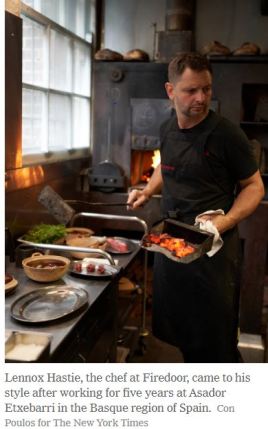 “Australian barbecue” is not, however, what Lennox Hastie, the chef at Firedoor, would use to describe his own cooking. Nor is it a term that’s been used much by anyone to describe any type of cooking. Here, the word “barbecue” is generally synonymous with the American term “cookout,” and, much like the cookout, it remains an integral part of Australia’s national identity.
Firedoor, which opened in 2015, is a prime example. 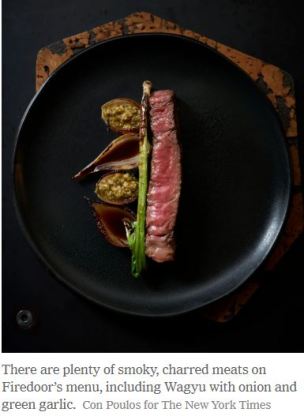 The kitchen is powered entirely by wood — there are no electric or gas ovens, burners or microwaves. Mr. Hastie came to this style after working five years at Asador Etxebarri in the Basque Country, where the chef Victor Arguinzoniz cooks local ingredients over fire using multiple types of wood. Mr. Hastie takes a similar approach, but with pointedly Australian ingredients.
One of the restaurant’s most thrilling dishes is a whole marron — a large freshwater crayfish native to Western Australia. The marron is grilled, split open and smothered in sea blite, a coastal plant related to samphire, and sunrise lime, a hybrid citrus created by crossing the native Australian finger lime with a calamondin (itself a cross between a mandarin and a kumquat). There are plenty of smoky, charred meats on the menu as well: pork chops, duck hearts and Wagyu all get their turn on one of the many grills.
To read more: https://www.nytimes.com/2019/12/05/dining/australian-barbecue.html
 “There’s really an Italian movement that has exploded over the last three years,” Mr. Imbroisi said.
 In April, the Right Bank welcomed an outlet of
 Every possible step is done online, and for most meals customers must reserve—and often pay—in advance, essentially buying tickets through a service called Tock that’s mostly used only by high-end restaurants. This means no host manning a podium, no reservation or PR teams, no extra staff on a slow night, almost no food waste, and better guest communications. It also allowed them to go from 20 employees to four full-time and three part-time workers.
 The 12,000-square-foot store is packed with in-store dining options, a scratch bakery, coffee bar and a curated assortment of fresh and local products. An additional 8,000 square feet is dedicated to prep space and a kitchen where employees make prepared foods and from-scratch items using Brothers Marketplace’s own recipes.
 Enjoy the fruits of their labor during dinner at Farmstead, the James Beard Award-winning restaurant, known for its hyper-seasonal dishes like thyme-basted golden beets and hen of the woods mushrooms drizzled with pine syrup.
 Unlike its European models or even local markets like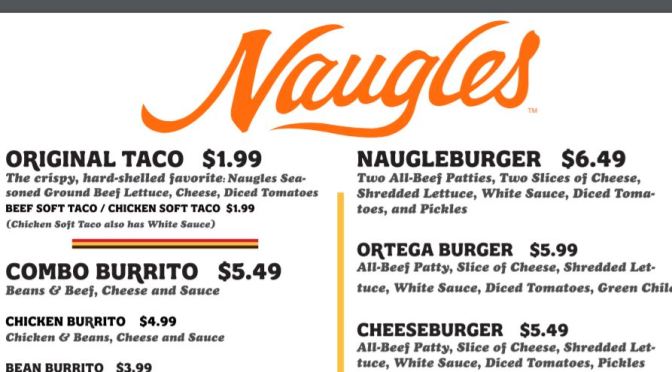
 It was a rival to Taco Bell and Del Taco in the fast-food Cal-Mex wars of the 1970s, until Del Taco acquired the company in 1995 and unceremoniously shut it down. The erasure was so complete that when food writer Christian Ziebarth petitioned the United States Patent and Trademark Office in 2012 to take control of Naugles’ trademark, arguing that Del Taco had done nothing with it for decades and he was therefore legally allowed to revive the chain, the feds sided with him (Del Taco is still fighting the ruling).
 “As the newly opened Coney Island and Brooklyn Railroad brought many more people to the seaside from Manhattan in the late 1860s, customers told Feltman that they wanted to eat hot food, not cold clams, according to Richard F Snow, the former editor of American Heritage Magazine. So in 1867, Feltman called on the wheelwright who’d originally made his cart and asked him to modify it. The craftsman built a custom charcoal brazier for cooking sausages and a metal box for warming bread.”
 Boomers Daily