
Tag Archives: Fiction

The New York Times Book Review — July 23, 2023

Image

THE NEW YORK TIMES BOOK REVIEW – JULY 23, 2023:

Colson Whitehead on ‘Crook Manifesto’ and Harlem in the ’70s

The Pulitzer-winning novelist discusses the sequel to his 2021 crime story “Harlem Shuffle.”

Roald Dahl Museum Calls Author’s Racism ‘Undeniable and Indelible’

A museum in England devoted to the best-selling children’s author, who died in 1990, condemned his antisemitic views.

The New York Times Book Review — July 16, 2023

Image

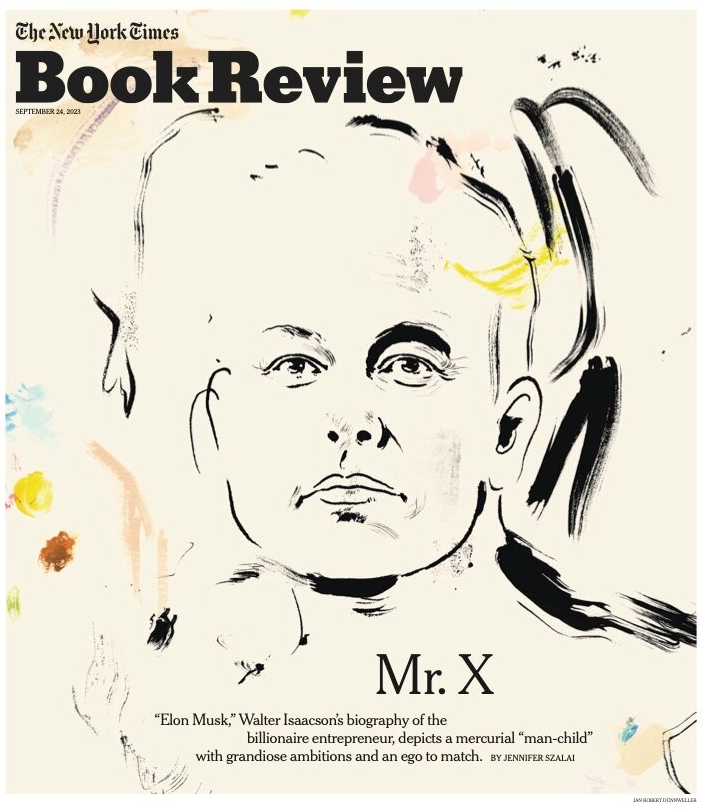
THE NEW YORK TIMES BOOK REVIEW – JULY 16, 2023: This week, Jeff Goodell’s “The Heat Will Kill You First,” feels particularly apt. “This is a propulsive book, one to be raced through; the planet is burning,” writes our critic Jennifer Szalai. But maybe you don’t want to think more than you already do about impending doom. We’ve got you covered: The issue brims with diversions — a charming novel about a reality TV show set on Mars,  fiction about complicated families and a slew of good memoirs, including ones from a senior intelligence officialthe war reporter Jane Ferguson and the actor Elliot Page.

Extreme Heat Is Here to Stay. Why Are We Not More Afraid?

This illustration depicts a large, bright purple iris, its petals on fire. Behind the flaming flower, we see a bright yellow, desert-like landsape, with low orange mesas and, above them, a sky that shifts from yellow to bright red — as if the sky itself is on fire.

In “The Heat Will Kill You First,” Jeff Goodell documents the lethal effects of rising temperatures and argues that we need to take hot weather a lot more seriously.

What Does It Even Mean to Be Real?

In Deborah Willis’s novel “Girlfriend on Mars,” a young woman enters a reality-TV contest to leave the planet, and her marijuana-farming boyfriend, behind.

GIRLFRIEND ON MARS, by Deborah Willis


Sometimes, a girlfriend needs space. Sometimes, she goes to space. That’s the — OK, obvious — premise of “Girlfriend on Mars,” a novel by the Canadian writer Deborah Willis, who knows what we’ve wished for from books all along, which is that they were TV instead.

Literary Preview: The Paris Review – Summer 2023

Image

The Paris Review – Summer 2023 Issue: The  Review  take an especial pleasure, as readers, in the diary form: that peculiar mixture of performance and unwitting self-revelation, of shapelessness and obsessive (occasionally deranged) selectivity; that sense of a narrative unfolding in real time, almost without the author’s permission. And while the Review doesn’t do themes, as we were putting together our new Summer issue, no. 244, it was hard not to notice our partiality peeking through.

In the issue, Lydia Davis shares selections from her 1996 journal, and they often read like warm-up scales for her exquisitely off-kilter stories. (“For lunch—a huge potato and a glass of milk.”) You’ll also find masterful uses of the diary as a fictional device. The Brazilian writer Juliana Leite’s “My Good Friend,” translated by Zoë Perry, is an elderly widow’s apparently unremarkable Sunday-evening entry—“About the roof repair, I have nothing new to report”—that turns into a story of mostly unspoken decadeslong love. And James Lasdun’s “Helen” features excerpts from the journal of a woman who lives in what the narrator describes as a “state of incandescent, almost spiritual horror,” and whose crippling self-consciousness doesn’t protect her from humiliations the reader can see coming.

Also in issue no. 244, John Keene, in an Art of Fiction interview with Aaron Robertson, describes how blogging heralded his recovery as a writer after losing drafts of several of the stories that eventually became Counternarratives. And Sharon Olds, in an Art of Poetry interview, tells Jessica Laser about the need to keep one’s art and biography separate, especially when they are clearly not. Keeping a diary might be therapeutic, Olds explains, but “writing a poem to understand yourself better would be like making a cup with no clay, or maybe like having the clay but not making the cup.” She concludes, “If I had to choose between a poem being therapeutic and it being a better poem, I’d want it to be a better poem.”

Literary Arts: Zyzzyva Magazine – Spring 2023

ZYZZYVA Magazine Spring 2023:

Fiction

  • The Mysteries of the Universe by Anna Badkhen:
    “I see now what this is about. I’m a professor and author in America, she’s in a war zone: to her, I’m rich and happy. How is she supposed to know about the cancer, the medical debt, Ksyusha’s student loans? So, I try to deflect.”
  • Encyclopedia of Botany by Jane Marchant:
    A daughter’s closely observed catalog of the flora around her Bay Area home, and of her family’s complex history of identity.
  • Glint of Sport by Angie Sijun Lou:
    “I don’t know if this story is true. You can’t divide truth from kitsch in this place…”
  • Eulogy by William Hawkins:
    In the wake of a funeral, a dead father’s legacy hangs over his surviving adult sons as they trudge into the lukewarm waters of the lake by the family pier.
  • The Eye by Elodie Saint-Louis:
    “When Theo spoke, she thought, you could see all of these places on his body. Vyros, Hymettus, Loutro, Parnitha. The land was in him. It was the river running out of his mouth. The words that bumped into each other gently but never spilled over, petering out into a gentle sway.”
  • Plus more fiction by Perry Janes, David Hayden (there be strange happenings in a dilapidated insurance building in Chicago), and Wendy Elizabeth Wallace.

Nonfiction

  • Jane Marchant on the flora around her Bay Area home—and her family’s complex history of identity.

Poetry

  • Jason Allen-Paisant, Dan Alter, Allison Benis White, Ricardo Cázares, E.G. Cunningham, Peter LaBerge, Joyce Mansour, Maria Zoccola

Art

  • Sofia Bonati

Arts & Literature: Kirkus Reviews – April 15, 2023

Image

Kirkus Reviews – April 15, 2023 Issue:

April’s Best Fiction Is Music to Our Ears

April’s Best Fiction Is Music to Our Ears

I recently returned to the Metropolitan Opera to see The Hours, based on Michael Cunningham’s novel. It was wonderful to be back in the glittering hall, after three long pandemic years, listening to Renee Fleming, Joyce DiDonato, and Kelli O’Hara bring Virginia Woolf and Cunningham’s other characters to life. That experience sent me looking for novels about music, and I was thrilled to see that Brendan Slocumb has a new one coming out only a year after his bestselling debut, 

Return Trip to Indieland

Return Trip to Indieland

In the fourth annual Indie Issue, we let the books speak for themselves in these excerpts from a trio of starred Indieland picks: a memoir by two sisters who survived the Holocaust; another memoir about a teen’s coming-of-age on a sailing-school ship; and a collection of short stories from a renowned Bengali author.

In Daniel Seymour’s From Auschwitz With Love, sisters Manci Grunberger Beran and Ruth Grunberger Mermelstein describe their arrival at the concentration camp:

Father realized that we didn’t have much time together. So, he said to us, “No matter what happens, I want you to remember three things.”

Preview: Iceland Review Magazine – April/May 2023

Image

ICELAND REVIEW MAGAZINE (APRIL/MAY 2023):

The Dip

FICTION the dip by Örvar Smárason

When my fingers started falling off, it became harder and harder to put my

From the Archive: The Changing Face of Iceland

historical map of iceland

From the archive: In this 1971 article from Iceland Review,

Haraldur Sigurðsson delves into the history of Icelandic cartography. Note

Frost

Individually, snowflakes are fragile, easily broken, dissolving into droplets of water at the mere touch of a finger or a breath of air, while en masse, they’re capable of wreaking havoc on the city streets and causing catastrophe when avalanching down a mountainside.

Most Anticipated Books: ‘The Pole’ By Nobel Prize Winner J. M. Coetzee (2023)

The Pole

LitHub (March 28, 2023): Literary Hub is very pleased to reveal the cover for Nobel Prize winner J. M. Coetzee’s new novel The Pole, which will be published by Liveright this September. Here’s more about the book from the publisher:

Exacting yet maddeningly unpredictable, J. M. Coetzee’s The Pole tells the story of Wittold Walccyzkiecz, a vigorous, “extravagantly white-haired” Polish pianist who becomes infatuated with Beatriz, a stylish patron of the arts, after she helps organize his Barcelona concert. Although Beatriz, a married woman, is initially unimpressed by Wittold, she soon finds herself pursued and ineluctably swept into the world of the journeyman performer. As he sends her letters, extends countless invitations to travel, and even visits her husband’s summer home in Mallorca, their unlikely relationship blossoms, though, it seems, only on her terms. The power struggle between them intensifies—Is it Beatriz who limits their passion by controlling her emotions? Or is it Wittold, trying to force into life his dream of love?

READ MORE AT LITHUB

Literary Preview: The Paris Review – Spring 2023

Image

The Paris Review – Spring 2023 Issue:

Camus’s New York Diary, 1946

March 1946. Albert Camus has just spent two weeks at sea on the SS Oregon, a cargo ship transporting passengers from Le Havre to New York City. He’s made several friends during this transatlantic passage. 

The Blk Mind Is a Continuous Mind

In his poem “After Avery R. Young,” the Pulitzer Prize–winning poet Jericho Brown writes, “The blk mind / Is a continuous mind.” These lines emerge for me as a guiding principle—as a mantra, even—when I consider the work of Black poetry in America, which insists upon the centrality of Black lives to the human story, and offers the terms of memory, music, conscience, and imagination that serve to counteract the many erasures and distortions riddling the prevailing narrative of Black life in this country.

Season of Grapes

As I was going to enter college that fall my parents felt that I should build myself up at a summer camp of some sort. They sent me down to a place in the Ozarks on a beautiful lake. It was called a camp but it was not just for boys. It was for both sexes and all ages. It was a rustic, comfortable place. But I was disappointed to find that most of the young people went to another camp several miles down the lake toward the dam. I spent a great deal of time by myself that summer, which is hardly good for a boy of seventeen.

Books: The New York Times Book Review – Jan 29, 2023

The New York Times Book Review – January 29, 2023:

Fleeing Slavery in a Top Hat and Cravat

“Master Slave Husband Wife,” by Ilyon Woo, relates the daring escape from bondage in Georgia to freedom in the North by an enslaved couple disguised as a wealthy planter and his property.

Think Screens Stole Our Attention? Medieval Monks Were Distracted Too.

In “The Wandering Mind,” the historian Jamie Kreiner shows that the struggle to focus is not just a digital-age blight but afflicted even those who spent their lives in seclusion and prayer.

‘Age of Vice’: A Lush Thriller Dives Into New Delhi’s Underworld

In Deepti Kapoor’s cinematic novel, a young man from the provinces falls in with a powerful crime syndicate.

Reviews: New York Times ’10 Best Books Of 2022′

NOVEMBER 29, 2022

The staff of The New York Times Book Review choose the year’s standout fiction and nonfiction.

You don’t need to have read Egan’s Pulitzer-winning “A Visit From the Goon Squad” to jump feet first into this much-anticipated sequel. But for lovers of the 2010 book’s prematurely nostalgic New Yorkers, cerebral beauty and laser-sharp take on modernity, “The Candy House” is like coming home — albeit to dystopia. This time around, Egan’s characters are variously the creators and prisoners of a universe in which, through the wonders of technology, people can access their entire memory banks and use the contents as social media currency. The result is a glorious, hideous fun house that feels more familiar than sci-fi, all rendered with Egan’s signature inventive confidence and — perhaps most impressive of all — heart. “The Candy House” is of its moment, with all that implies.

Read the review | Buy from local booksellers | Buy from Amazon | Buy from Barnes & Noble

Bennett, a British writer who makes her home in Ireland, first leaped onto the scene with her 2015 debut novel, “Pond.” Her second book contains all of the first’s linguistic artistry and dark wit, but it is even more exhilarating. “Checkout 19,” ostensibly the story of a young woman falling in love with language in a working-class town outside London, has an unusual setting: the human mind — a brilliant, surprising, weird and very funny one. All the words one might use to describe this book — experimental, autofictional, surrealist — fail to convey the sheer pleasure of “Checkout 19.” You’ll come away dazed, delighted, reminded of just how much fun reading can be, eager to share it with people in your lives. It’s a love letter to books, and an argument for them, too.

Read the review | Buy from local booksellers | Buy from Amazon | Buy from Barnes & Noble

Kingsolver’s powerful new novel, a close retelling of Charles Dickens’s “David Copperfield” set in contemporary Appalachia, gallops through issues including childhood poverty, opioid addiction and rural dispossession even as its larger focus remains squarely on the question of how an artist’s consciousness is formed. Like Dickens, Kingsolver is unblushingly political and works on a sprawling scale, animating her pages with an abundance of charm and the presence of seemingly every creeping thing that has ever crept upon the earth.

Read the review | Buy from local booksellers | Buy from Amazon | Buy from Barnes & Noble

After losing her brother when she was 12, one of the narrators of Serpell’s second novel keeps coming across men who resemble him as she works through her trauma long into adulthood. She enters an intimate relationship with one of them, who’s also haunted by his past. This richly layered book explores the nature of grief, how it can stretch or compress time, reshape memories and make us dream up alternate realities. “I don’t want to tell you what happened,” the narrator says. “I want to tell you how it felt.”

Read the review | Buy from local booksellers | Buy from Amazon | Buy from Barnes & Noble

Diaz uncovers the secrets of an American fortune in the early 20th century, detailing the dizzying rise of a New York financier and the enigmatic talents of his wife. Each of the novel’s four parts, which are told from different perspectives, redirects the narrative (and upends readers’ expectations) while paying tribute to literary titans from Henry James to Jorge Luis Borges. Whose version of events can we trust? Diaz’s spotlight on stories behind stories seeks out the dark workings behind capitalism, as well as the uncredited figures behind the so-called Great Men of history. It’s an exhilarating pursuit.

Read the review | Buy from local booksellers | Buy from Amazon | Buy from Barnes & Noble


Yong certainly gave himself a formidable task with this book — getting humans to step outside their “sensory bubble” and consider how nonhuman animals experience the world. But the enormous difficulty of making sense of senses we do not have is a reminder that each one of us has a purchase on only a sliver of reality. Yong is a terrific storyteller, and there are plenty of surprising animal facts to keep this book moving toward its profound conclusion: The breadth of this immense world should make us recognize how small we really are.

Read the review | Buy from local booksellers | Buy from Amazon | Buy from Barnes & Noble

In this quietly wrenching memoir, Hsu recalls starting out at Berkeley in the mid-1990s as a watchful music snob, fastidiously curating his tastes and mercilessly judging the tastes of others. Then he met Ken, a Japanese American frat boy. Their friendship was intense, but brief. Less than three years later, Ken would be killed in a carjacking. Hsu traces the course of their relationship — one that seemed improbable at first but eventually became a fixture in his life, a trellis along which both young men could stretch and grow.

Read the review | Buy from local booksellers | Buy from Amazon | Buy from Barnes & Noble

In this rich and nuanced book, Aviv writes about people in extreme mental distress, beginning with her own experience of being told she had anorexia when she was 6 years old. That personal history made her especially attuned to how stories can clarify as well as distort what a person is going through. This isn’t an anti-psychiatry book — Aviv is too aware of the specifics of any situation to succumb to anything so sweeping. What she does is hold space for empathy and uncertainty, exploring a multiplicity of stories instead of jumping at the impulse to explain them away.

Read the review | Buy from local booksellers | Buy from Amazon | Buy from Barnes & Noble

Through case histories as well as independent reporting, Villarosa’s remarkable third book elegantly traces the effects of the legacy of slavery — and the doctrine of anti-Blackness that sprang up to philosophically justify it — on Black health: reproductive, environmental, mental and more. Beginning with a long personal history of her awakening to these structural inequalities, the journalist repositions various narratives about race and medicine — the soaring Black maternal mortality rates; the rise of heart disease and hypertension; the oft-repeated dictum that Black people reject psychological therapy — as evidence not of Black inferiority, but of racism in the health care system.

Read the review | Buy from local booksellers | Buy from Amazon | Buy from Barnes & Noble

O’Toole, a prolific essayist and critic, calls this inventive narrative “a personal history of modern Ireland” — an ambitious project, but one he pulls off with élan. Charting six decades of Irish history against his own life, O’Toole manages to both deftly illustrate a country in drastic flux, and include a sly, self-deprecating biography that infuses his sociology with humor and pathos. You’ll be educated, yes — about increasing secularism, the Celtic tiger, human rights — but you’ll also be wildly, uproariously entertained by a gifted raconteur at the height of his powers.

Read the review | Buy from local booksellers | Buy from Amazon | Buy from Barnes & Noble