

Join Keith Christiansen, the John Pope-Hennessy Chairman of the Department of European Paintings, and guest curator Carlo Falciani, Professor of Art History at the Accademia di Belle Arti in Florence, for a tour of The Medici: Portraits and Politics, 1512–1570. This stunning exhibition features over 90 works in a wide range of mediums, from paintings, sculptural busts, medals, and carved gemstones to drawings, etchings, manuscripts, and armor. Included are works by the period’s most celebrated artists, from Raphael, Jacopo Pontormo, and Rosso Fiorentino to Benvenuto Cellini, Agnolo Bronzino, and Francesco Salviati. Learn more about the exhibition: https://www.metmuseum.org/exhibitions…
Tag Archives: Exhibition Videos
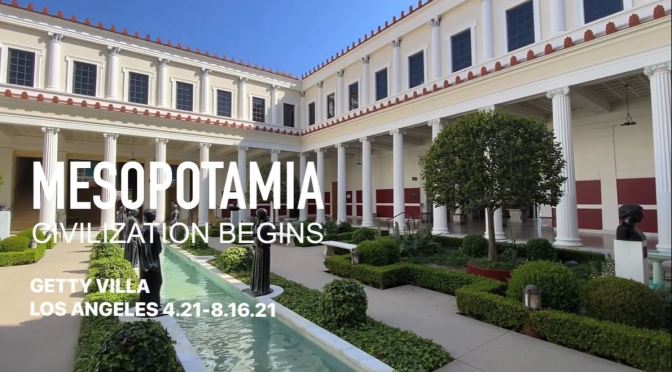
Exhibit View: ‘Mesopotamia – Civilization Begins’, The Getty Villa, Los Angeles
Mesopotamia—the land “between the rivers” in modern-day Iraq—was home to the ancient Sumerians, Babylonians, and Assyrians. Among their many achievements are the creation of the earliest known script (cuneiform), the formation of the first cities, the development of advanced astronomical and mathematical knowledge, and spectacular artistic and literary accomplishments. The exhibition covers three millennia, from the first cities in about 3200 BC to Alexander the Great’s conquest of Babylon in 331 BC.
Exhibition organized by the Musée du Louvre, Paris, and the J. Paul Getty Museum, Los Angeles.
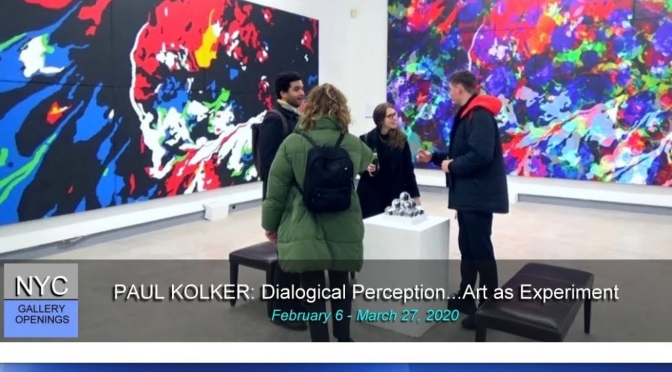
New Exhibitions: 84-Year Old Artist Paul Kolker – “Dialogical Perception…Art As Experiment” (Video)
Paul Kolker is pleased to present his seventy-third solo exhibition, Dialogical Perception… Art as Experiment at his studio, the PAUL KOLKER collection, 511 West 25th Street from February 6 through March 27, 2020.
Paul Kolker (b. 1935) is a New York-based artist with doctorate degrees in medicine and law. He began his career of painting and sculpture in the 1960s, illustrating his peer review medical journal articles and life-casting anatomical models. In the 1970s he treated his art production as a post-minimalist experiment questioning experience and using the viewer as the measuring instrument as well as the interpreter of the experiment’s results. Many of his early works are sculptures, each painted in an elemental color, black or white.
In 1975 Kolker developed a keen and hands on understanding of light optics when he purchased a first generation three tube front end television projector with an alignment grid. That grid became the infrastructure for his works, which involved fractionation of a photographic image and the use of modular panels and canvases to create large scale works. In the 1980s Kolker began making light sculptures using one-way mirror and LED message screens, reflecting ad infinitum. In 2001, when he moved into his studio in Chelsea, he created an algorithm for a process of painting minimal shapes, such as a dot or square, in elemental colors (never mixed with each other, but sometimes mixed with black and/or white to form tints and shades). This process is called ‘fracolor’ in attribution to Benoit Mandelbrot’s fractal geometry, wherein minimal shapes and forms are serially replicated, like branches on a tree, rectangles on a grid, or pixels and dots on a television display screen.
As a result, Kolker’s works have become reminiscent of our pixelated world of digital information transfer, as we see it up close as grids of colored dots on our television, computer and cell phone screens; and how more highly defined that screen becomes when viewed from afar. His works are observational experiments which cry out to us, “Because of biases of color, shapes, parallax and perspective relative to where we stand as the observer, a dot may be a universe; and a universe may be a dot.”
 Boomers Daily