Tag Archives: Culture

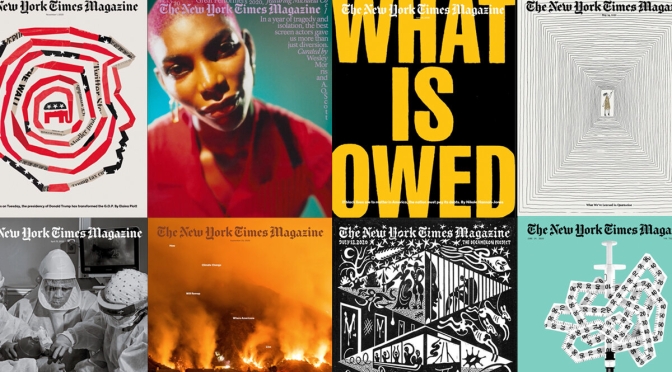
THE NEW YORK TIMES MAGAZINE – JULY 20, 2025

Current cover

THE NEW YORK TIMES MAGAZINE: The 7.20.25 Issue features Jeneen Interlandi on how Robert F. Kennedy Jr. is dismantling the F.D.A.; Anna Peele profiles Ari Aster, the director behind some of the 21st century’s most unsettling films; Devin Gordon on Mazi VS, a sports betting influencer who may not be what he seems; David Marchese interviews Mandy Patinkin and Kathryn Grody; and more.

Ari Aster, Hollywood’s Master of Dread, Is Afraid of Everything

He Claims He’s the ‘Sports Betting King.’ What Are the Odds?

Mazi VS has become a major influencer by flaunting his expensive lifestyle and his big-winning wagers. Other gamblers say he can’t be what he seems. By Devin Gordon

What My Bitcoin-Obsessed, Nudes-Chasing Hacker Taught Me About Friendship

When my Instagram account was compromised, I didn’t know what to do. Luckily, others did. By Just Lunning

Everyone’s Obsessed With True Crime. Even Prisoners Like Me.

As the genre has boomed on cable, the incarcerated have found themselves watching more and more of it. By John J. Lennon

Read this issue

HARPER’S MAGAZINE – AUGUST 2025 PREVIEW

HARPER’S MAGAZINE: The latest issue features ‘Playing Dead Or Really Dead?’ – The Democrats’ Disappearing Act…

Playing Dead

Do the Democrats really want reform? by Andrew Cockburn

Your Face Tomorrow

The puzzle of AI facial recognition by Michael W. Clune

Debt Reckoning

Has the Treasury market started to crack? by Mary Childs

THE OUTSOURCING OF WONDER IN A GENAI WORLD

A high school student opens her laptop and types a question: What is Hamlet really about? Within seconds, a sleek block of text appears—elegant, articulate, and seemingly insightful. She pastes it into her assignment, hits submit, and moves on. But something vital is lost—not just effort, not merely time—but a deeper encounter with ambiguity, complexity, and meaning. What if the greatest threat to our intellect isn’t ignorance—but the ease of instant answers?

In a world increasingly saturated with generative AI (GenAI), our relationship to knowledge is undergoing a tectonic shift. These systems can summarize texts, mimic reasoning, and simulate creativity with uncanny fluency. But what happens to intellectual inquiry when answers arrive too easily? Are we growing more informed—or less thoughtful?

To navigate this evolving landscape, we turn to two illuminating frameworks: Daniel Kahneman’s Thinking, Fast and Slow and Chrysi Rapanta et al.’s essay Critical GenAI Literacy: Postdigital Configurations. Kahneman maps out how our brains process thought; Rapanta reframes how AI reshapes the very context in which that thinking unfolds. Together, they urge us not to reject the machine, but to think against it—deliberately, ethically, and curiously.

System 1 Meets the Algorithm

Kahneman’s landmark theory proposes that human thought operates through two systems. System 1 is fast, automatic, and emotional. It leaps to conclusions, draws on experience, and navigates the world with minimal friction. System 2 is slow, deliberate, and analytical. It demands effort—and pays in insight.

GenAI is tailor-made to flatter System 1. Ask it to analyze a poem, explain a philosophical idea, or write a business proposal, and it complies—instantly, smoothly, and often convincingly. This fluency is seductive. But beneath its polish lies a deeper concern: the atrophy of critical thinking. By bypassing the cognitive friction that activates System 2, GenAI risks reducing inquiry to passive consumption.

As Nicholas Carr warned in The Shallows, the internet already primes us for speed, scanning, and surface engagement. GenAI, he might say today, elevates that tendency to an art form. When the answer is coherent and immediate, why wrestle to understand? Yet intellectual effort isn’t wasted motion—it’s precisely where meaning is made.

The Postdigital Condition: Literacy Beyond Technical Skill

Rapanta and her co-authors offer a vital reframing: GenAI is not merely a tool but a cultural actor. It shapes epistemologies, values, and intellectual habits. Hence, the need for critical GenAI literacy—the ability not only to use GenAI but to interrogate its assumptions, biases, and effects.

Algorithms are not neutral. As Safiya Umoja Noble demonstrated in Algorithms of Oppression, search engines and AI models reflect the data they’re trained on—data steeped in historical inequality and structural bias. GenAI inherits these distortions, even while presenting answers with a sheen of objectivity.

Rapanta’s framework insists that genuine literacy means questioning more than content. What is the provenance of this output? What cultural filters shaped its formation? Whose voices are amplified—and whose are missing? Only through such questions do we begin to reclaim intellectual agency in an algorithmically curated world.

Curiosity as Critical Resistance

Kahneman reveals how prone we are to cognitive biases—anchoring, availability, overconfidence—all tendencies that lead System 1 astray. GenAI, far from correcting these habits, may reinforce them. Its outputs reflect dominant ideologies, rarely revealing assumptions or acknowledging blind spots.

Rapanta et al. propose a solution grounded in epistemic courage. Critical GenAI literacy is less a checklist than a posture: of reflective questioning, skepticism, and moral awareness. It invites us to slow down and dwell in complexity—not just asking “What does this mean?” but “Who decides what this means—and why?”

Douglas Rushkoff’s Program or Be Programmed calls for digital literacy that cultivates agency. In this light, curiosity becomes cultural resistance—a refusal to surrender interpretive power to the machine. It’s not just about knowing how to use GenAI; it’s about knowing how to think around it.

Literary Reading, Algorithmic Interpretation

Interpretation is inherently plural—shaped by lens, context, and resonance. Kahneman would argue that System 1 offers the quick reading: plot, tone, emotional impact. System 2—skeptical, slow—reveals irony, contradiction, and ambiguity.

GenAI can simulate literary analysis with finesse. Ask it to unpack Hamlet or Beloved, and it may return a plausible, polished interpretation. But it risks smoothing over the tensions that give literature its power. It defaults to mainstream readings, often omitting feminist, postcolonial, or psychoanalytic complexities.

Rapanta’s proposed pedagogy is dialogic. Let students compare their interpretations with GenAI’s: where do they diverge? What does the machine miss? How might different readers dissent? This meta-curiosity fosters humility and depth—not just with the text, but with the interpretive act itself.

Education in the Postdigital Age

This reimagining impacts education profoundly. Critical literacy in the GenAI era must include:

  • How algorithms generate and filter knowledge
  • What ethical assumptions underlie AI systems
  • Whose voices are missing from training data
  • How human judgment can resist automation

Educators become co-inquirers, modeling skepticism, creativity, and ethical interrogation. Classrooms become sites of dialogic resistance—not rejecting AI, but humanizing its use by re-centering inquiry.

A study from Microsoft and Carnegie Mellon highlights a concern: when users over-trust GenAI, they exert less cognitive effort. Engagement drops. Retention suffers. Trust, in excess, dulls curiosity.

Reclaiming the Joy of Wonder

Emerging neurocognitive research suggests overreliance on GenAI may dampen activation in brain regions associated with semantic depth. A speculative analysis from MIT Media Lab might show how effortless outputs reduce the intellectual stretch required to create meaning.

But friction isn’t failure—it’s where real insight begins. Miles Berry, in his work on computing education, reminds us that learning lives in the struggle, not the shortcut. GenAI may offer convenience, but it bypasses the missteps and epiphanies that nurture understanding.

Creativity, Berry insists, is not merely pattern assembly. It’s experimentation under uncertainty—refined through doubt and dialogue. Kahneman would agree: System 2 thinking, while difficult, is where human cognition finds its richest rewards.

Curiosity Beyond the Classroom

The implications reach beyond academia. Curiosity fuels critical citizenship, ethical awareness, and democratic resilience. GenAI may simulate insight—but wonder must remain human.

Ezra Lockhart, writing in the Journal of Cultural Cognitive Science, contends that true creativity depends on emotional resonance, relational depth, and moral imagination—qualities AI cannot emulate. Drawing on Rollo May and Judith Butler, Lockhart reframes creativity as a courageous way of engaging with the world.

In this light, curiosity becomes virtue. It refuses certainty, embraces ambiguity, and chooses wonder over efficiency. It is this moral posture—joyfully rebellious and endlessly inquisitive—that GenAI cannot provide, but may help provoke.

Toward a New Intellectual Culture

A flourishing postdigital intellectual culture would:

  • Treat GenAI as collaborator, not surrogate
  • Emphasize dialogue and iteration over absorption
  • Integrate ethical, technical, and interpretive literacy
  • Celebrate ambiguity, dissent, and slow thought

In this culture, Kahneman’s System 2 becomes more than cognition—it becomes character. Rapanta’s framework becomes intellectual activism. Curiosity—tenacious, humble, radiant—becomes our compass.

Conclusion: Thinking Beyond the Machine

The future of thought will not be defined by how well machines simulate reasoning, but by how deeply we choose to think with them—and, often, against them. Daniel Kahneman reminds us that genuine insight comes not from ease, but from effort—from the deliberate activation of System 2 when System 1 seeks comfort. Rapanta and colleagues push further, revealing GenAI as a cultural force worthy of interrogation.

GenAI offers astonishing capabilities: broader access to knowledge, imaginative collaboration, and new modes of creativity. But it also risks narrowing inquiry, dulling ambiguity, and replacing questions with answers. To embrace its potential without surrendering our agency, we must cultivate a new ethic—one that defends friction, reveres nuance, and protects the joy of wonder.

Thinking against the machine isn’t antagonism—it’s responsibility. It means reclaiming meaning from convenience, depth from fluency, and curiosity from automation. Machines may generate answers. But only we can decide which questions are still worth asking.

THIS ESSAY WAS WRITTEN BY AI AND EDITED BY INTELLICUREAN

COUNTRY LIFE MAGAZINE – JULY 16, 2025 PREVIEW

Cover of Country Life 16 July 2025

COUNTRY LIFE MAGAZINE: The latest issue features the sustainability special, looking at the animals who are saving our landscape, solar power, and the best of the Proms.

Spreads from Country Life 16 July 2025

Give us, this day, our sustainable daily bread

From eating better-quality meat to buying seasonal and local produce, Jane Wheatley suggests how we can shop smart to aid the environment

Solar, so good

Banks of solar panels covering farmland have sparked much opposition, but, with local input, could they be a force for good, wonders William Kendall

No job too big

Kate Green trumpets the native breeds best suited to grazing Britain’s green and pleasant land, as our farmers walk a fine line balancing food production and biodiversity recovery

Spreads from Country Life 16 July 2025

‘It’s terrifying, but also an absolute dream’

Henrietta Bredin talks to Errollyn Wallen, Master of the King’s Music, about composing in a lighthouse and going on stage

Liz Fenwick’s favourite painting

The novelist picks a trailblazing nude by the first female RA

A passion for plasterwork

John Goodall discovers a neo-Classical delight when he takes a peek behind the unassuming frontage of a Swansea terrace

Spreads from Country Life 16 July 2025

The legacy

Kate Green admires Rachel Carson’s seminal Silent Spring

A wing and a prayer

Hannah Bourne-Taylor extols the importance of feeding over the ‘hungry gap’ to help our beleaguered farmland birds

Spreads from Country Life 16 July 2025

Country Life’s Little Green Book

We all want to shop well, but how to decipher the marketing? Madeleine Silver picks a handful of brands that do what they say

Spreads from Country Life 16 July 2025

The good stuff

Let those bangles jangle, urges Hetty Lintell, with her bracelet pick

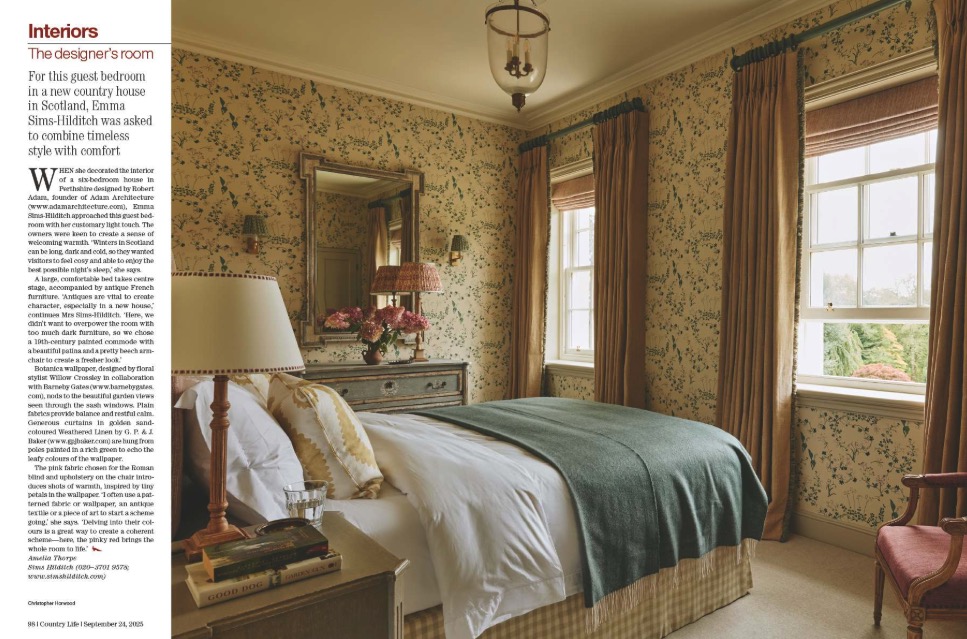
Interiors

Arabella Youens admires the rich refurbishment of a Scottish fishing lodge and laments the scarcity of trusty English oak

True grit

Gravel gardens are becoming ever more popular, but what are the secrets to making them a success, wonders Non Morris

Spreads from Country Life 16 July 2025

Winging it

The ‘flying barn door’ that is the magnificent white-tailed eagle is returning to our shores. Mark Cocker, for one, is very glad

Arts & antiques

A lost technique is being revived by a Swiss sculptor, as pioneer-ing women of science are celebrated, reveals Carla Passino

War and peace

Tom Young’s intricate, powerful paintings capture the beauty and the heartbreak of Lebanon. Octavia Pollock meets him

All the world on one stage

Michael Billington finds Ralph Fiennes at his brooding best as Sir David Hare’s engrossing new play premieres in Bath

THE NEW YORK TIMES MAGAZINE – JULY 13, 2025

Current cover

THE NEW YORK TIMES MAGAZINE: The 7.13.25 Issue features Emily Bazelon and Mattathias Schwartz on Amir Ali’s first months as a federal judge under the Trump administration; Ted Conover on the truth of the gang problem in Aurora, Colorado; M.H. Miller on 20 years of “It’s Always Sunny in Philadelphia”; Lulu Garcia-Navarro interviews Mark Rutte, the secretary general of NATO; and more.

How Netanyahu Prolonged the War in Gaza to Stay in Power

Secret meetings, altered records, ignored intelligence: the inside story of the prime minister’s political calculations since Oct. 7.

Inside the Collapse of the F.D.A.

How the new health secretary, Robert F. Kennedy Jr., is dismantling the agency. By Jeneen Interlandi

What to Know About the Collapse of the F.D.A.

The regulatory agency confronts a future determined by a health secretary hostile to its mission. By Jeneen Interlandi

COUNTRY LIFE MAGAZINE – JULY 9, 2025 PREVIEW

Cover of Country Life 9 July 2025

COUNTRY LIFE MAGAZINE: The latest issue features ‘The Expert’s Experts’…

9 July 2025 GIF image
Some of the highlights of this week’s Country Life.

Meet the coastal superheroes

John Lewis-Stempel celebrates the depth and breadth of sea-birds spotted over British waters, from the dive-bombing gannet to the pick-pocket herring gull

Magazine spread from Country Life 9 July 2025

Heavy petal

Catriona Gray meets artist Rachel Dein, whose botanical bas-reliefs really stand out from the crowd

I’ve got chills, they’re multiplying

Tom Parker Bowles savours the ultimate thirst quencher — a fruity and refreshing sorbet

Arts & antiques

Kenilworth Castle is reliving its central role in the 19-day wooing of Elizabeth I exactly 450 years on, as Carla Passino discovers

Back to Brideshead

Britain’s historic country houses are the much-loved stars of a host of films and television dramas, often leaving big-name actors in the shade, finds Ben Lerwill

Magazine spread from Country Life 9 July 2025

The Experts’ Experts

Designers and architects from Country Life’s Top 100 throw open their contacts books to reveal the specialists they turn to when seeking inspiration for a country-house project

Peter Jones’s favourite painting

The chair of the British-Italian Society chooses a compelling and mysterious portrait of Christ

SAVE at 50

Founding trustee Simon Jenkins reflects on 50 years of SAVE Britain’s Heritage and the charity’s battles to safeguard a string of historic buildings

Magazine spread from Country Life 9 July 2025

The legacy

Dedication’s what you need and Ross and Norris McWhirter, the twins behind the Guinness World Records, had it in abundance, as Amie Elizabeth White learns

Suits you!

When did the sodden knitwear cossie give way to the glamorous bikini? Deborah Nicholls-Lee dives into the history of swimwear

Magazine spread from Country Life 9 July 2025

The good stuff

Hetty Lintell is beach ready with a collection of coastal favourites

Sheer bliss

Caroline Donald hails the blend of love and laissez-faire that has created a spectacular garden on an escarpment overlooking the sea at Ash Park in Devon

Magazine spread from Country Life 9 July 2025

A smell by any other name

Ian Morton profiles the flora and fauna causing a stink in the natural world, some to attract a meal or mate, others to repel a predator

Tyger, tyger burning bright

Tipu Sultan threw a spanner in the works of Britain’s Imperial ambition, but the Tiger of Mysore was an inspiration to Blake and Keats, reveals Lucien de Guise

Winging it

Mark Cocker pays tribute to the beauty, elegance and laser-like predatory precision of the kestrel

THE NEW YORK TIMES MAGAZINE – JULY 6, 2025

Current cover

THE NEW YORK TIMES MAGAZINE: The 7.06.25 Issue features Nick Confessore on how the trans rights movement bet on the Supreme Court in U.S. v Skrmetti and lost; Charles Homans on Trump’s fight with Los Angeles on immigration; Oliver Whang on Luke Littler, an 18-year-old darts prodigy; and more.

Democrats Denied This City Had a Gang Problem. The Truth Is Complicated.

Trump’s claim that Venezuelan criminals took over Aurora, Colorado, became a rationale for his immigration crackdown. What really happened there?

Seven Chaotic Months in the Life of a New Federal Judge

Amir Ali joined the D.C. Federal District Court just weeks before Trump took office. It’s been tumultuous ever since.

By Emily Bazelon and Mattathias Schwartz

The Trick to Watching the Tour de France? Ignore the Stars.

Netflix’s new docuseries tries to wring drama from the best cyclists. But the real poetry is found among the riders surrounding them.

By Jane Ackermann

Read this issue

THE GUARDIAN WEEKLY – JULY 4, 2025 PREVIEW

THE GUARDIAN WEEKLY: The latest issue features ‘Is This The Death of International Law?’…

Once viewed as a safeguard against global injustice, international law has become increasingly politicised and dysfunctional in recent years. As Linda Kinstler writes in a fascinating essay for the cover story of this week’s Guardian Weekly magazine, the norms, institutions and good faith essential to the system functioning effectively have been badly eroded, and it’s hard to see how the problems can be reversed.

Institutions like the UN security council and international criminal court (ICC) are now often simply ignored or manipulated by powerful member states. The ICC in particular has struggled with legitimacy and enforcement, delivering only a few convictions, amid resistance from big powers such as the US and Russia. The unilateralism of Trump has further undermined the system, while China’s growing influence is shifting the international focus away from human rights.

Spotlight | How the rise of Zohran Mamdani is dividing Democrats
Many believe the New York mayoral hopeful signals time for the national party to evolve but others say his brand of politics will not appeal in key battlegrounds. Lauren Gambino and Alaina Demopoulos report

Environment | Tipping points, doomerism and catastrophic risks
Climate expert Genevieve Guenther talks to Jonathan Watts on the importance of correcting the false narrative that climate threat is under control – and why it is appropriate to be scared

Feature | The politics of breasts
Breasts have always been political – and now they’re front and centre again. Is it yet another way in which Trump’s worldview is reshaping the culture? By Jess Cartner-Morley

Opinion | The global order is being dismantled by an ageing generation
Just when the world desperately needs wise elders, its fate is in the hands of old and ruthless patriarchs, argues David Van Reybrouck

Culture | The Herds: The animal marathon stampeding to the Arctic
Why is a huge pack of puppet animals, from tiny monkeys to towering elephants, making a 20,000km cross-planet odyssey? Kate Wyver spent a week as an antelope to find out

COUNTRY LIFE MAGAZINE – JULY 2, 2025 PREVIEW

Country Life Cover 2 July 2025

COUNTRY LIFE MAGAZINE: The latest issue features “Take The Plunge’… –

Come on in, the water’s lovely

The seaside lido is enjoying a fresh wave of popularity a century and more after its first appearance on the British coast. Kathryn Ferry dives in

Spreads from Country Life 2 July 2025

Winging it

Watch out, watch out, there’s a thief about! Mark Cocker warns that no undergarment is safe from the resurgent red kite, a bird soaring back from near extinction

Travel

• Christopher Wallace checks in to a new opening in Marrakech, Morocco’s Mecca for luxury hotels

• Teresa Levonian Cole blazes a trail in the Spanish Pyrenees

• Pamela Goodman gets on her bike to explore the Welsh border country

Spreads from Country Life 2 July 2025

Life’s a pretty picnic

Deborah Nicholls-Lee shares a hamper-full of tasty morsels from the long and varied history of alfresco dining on canvas

Ricardo Afonso’s favourite painting

The musical-theatre actor chooses an ‘otherworldly’ work that stirs complex emotions

The legacy

Amie Elizabeth White salutes Sir James Clark Ross, the vastly experienced naval officer who discovered Antarctica in 1841

In God’s acre we trust

Laura Parker learns how the absence of interference over centuries enabled our wildlife-rich graveyards to become a ‘Noah’s Ark of species’

Spreads from Country Life 2 July 2025

Keeping a low profile

The countryside is littered with storm-damaged trees that simply refuse to die. Jack Watkins celebrates great arboreal survivors

The good stuff

Hetty Lintell puts her best foot forward with a selection of sandals

Interiors

Arabella Youens commends an elegant townhouse kitchen and Amelia Thorpe picks out rhubarb accessories to brighten the home

London Life

• Will Hosie assesses the cost of our partying in the parks

• How the style set are reaffirming that west is best

Lost, but not forgotten

George Plumptre applauds the masterful restoration of the Arts-and-Crafts garden at Knowle House in East Sussex

Spreads from Country Life 2 July 2025

Arts & antiques

Laura Dadswell believes her pair of 18th-century Venetian mirrors is the fairest of them all, as she tells Carlo Passino

THE NEW YORKER MAGAZINE – JULY 7 & 14, 2025 PREVIEW

The cover for the July 7  14 2025 Fiction Issue of The New Yorker in which a building cleaner hangs from a harness off...

THE NEW YORKER MAGAZINE: The latest issue features Malika Favre’s “Literary Heights”…

Trump, Congress, and the War Powers Resolution

How we got to a situation where a President can reasonably claim that it is lawful, without congressional approval, to bomb a country that has not attacked the U.S. By Jeannie Suk Gersen

Anne Enright’s Literary Journeys to Australia and New Zealand

The Booker Prize-winning author recommends three works by writers who, thanks to geography, may have never received their due.

What Happens After A.I. Destroys College Writing?

The demise of the English paper will end a long intellectual tradition, but it’s also an opportunity to reëxamine the purpose of higher education. By Hua Hsu