President Trump has both called for Iranians to rise up and oust the ruthless theocracy and then said that he’s fully prepared to deal with a new religious leader. By Robin Wright
The Zombie Regulator
As the cost of living continues to spiral upward, the Trump Administration is gutting the government agency built to protect Americans from financial ruin. By E. Tammy Kim
The Unmaking of the American University
For decades, research universities have relied on federal funding, with no guarantee that it will last. Now their survival may depend on compliance with the government. By Nicholas Lemann
THE NEW YORK TIMES MAGAZINE: The 3.8.26 Issue features Matthieu Aikins and Wesley Morgan on the former Zero Unit soldiers who are now living in the U.S.; Sophie Haigney on love addiction; Robert Draper on his experience taking ibogaine; and more.
His call to ‘freeze the rent’ galvanized the 69 percent of New Yorkers who don’t own their homes. But the city’s landlords claim the math doesn’t add up. By Jonathan Mahler
In the wake of the U.S. bombing of Iran and its dismissal of European allies, an anxious continent’s best chance at security runs through its largest economy. By Elisabeth Zerofsky
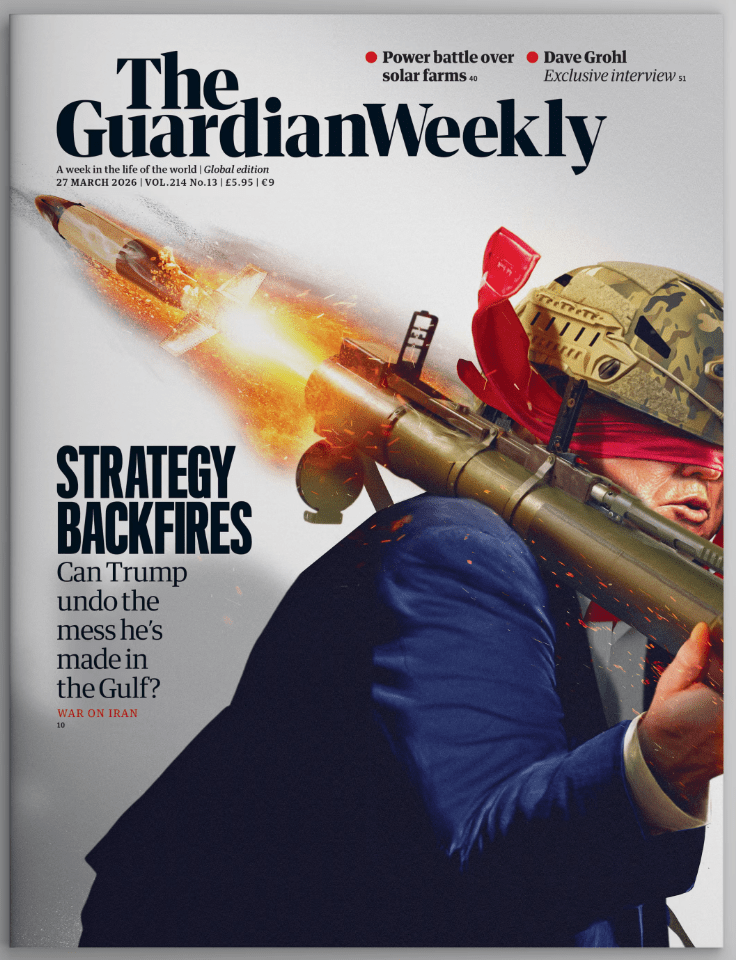
Some weeks I head out of the office on a Friday afternoon with an uneasy feeling that our best-laid plans for next week’s Guardian Weekly might not look quite the same by Monday. This was one of those weeks.
While the scope and power of the US-Israel attack on Iran – not least the successful targeting of Ayatollah Ali Khamenei and several other senior leaders – took many by surprise, the drums of war had been building for a while. With hindsight, last week’s failed nuclear talks may simply have been cover for what was to come.
As war unfurled dramatically across the Middle East, it was impossible to predict the consequences on a range of fronts, from the likelihood of regime change in Iran to the impact on America’s regional allies under attack, or the ripple effect on global energy prices and disruption to international travel.
Spotlight | Can the Louvre rediscover its joie de vivre? After a heist and the departure of its boss, the famous Paris museum is wrestling with repairs, strikes and a criticised renovation plan, reports Jon Henley
Science | Do lizards hold the key to how nature works? The emergence of a new group of common wall lizards offers an insight into how variety within nature can help conserve species, writes Roberto García-Roa
Interview | The world according to Gavin Newsom He’s the Democratic politician with movie-star looks, dogged by accusations of being a smooth‑talking elitist. But Gavin Newsom may just win the most powerful office in the world.Jonathan Freedlandfinds out why
Opinion | Labour needs to wake up to the dawning of a new political era After last week’s disastrous showing in a byelection, the government must accept voters no longer want two-party politics, argues John Harris
Culture | The wild and witty paintings of Rose Wylie Roaring into her 90s, the rebellious artistis now sought after by galleries worldwide and her works fetch huge sums. Melissa Denes visited her studio
The fight over the 2028 primary calendar is one of several proxies for a broader battle about the future of the Party—and the search for the best nominee. By Amy Davidson Sorkin
Scandal, Protest, Goofiness, and Grandeur at the U.S. Bicentennial
This year marks the two-hundred-and-fiftieth anniversary of the nation’s founding. The two hundredth wasn’t exactly smooth sailing. By Jill Lepore
The Tree House and the Oil Pipeline
In the fight against climate change, sometimes you have to go out on a limb. By Robert Moor
THE NEW YORK TIMES MAGAZINE: Thelatest issue features ‘The Victims Who Fought Back’ – A new law was supposed to help free women convicted of killing their abusers. Why are nearly all of them still in prison?
The arrest of Andrew Mountbatten-Windsor last week, after allegations he had shared confidential information with the late US sex offender Jeffrey Epstein, sent shock waves around the world.
What happens next is unclear, but the ramifications will go far beyond the former prince, who has consistently denied any wrongdoing related to Epstein. It was one of the most consequential days for Britain’s monarchy in generations, shattering the traditional aura of royal mystique and raising questions of accountability, deference and whether the royal family should have acted sooner.
In a powerful essay for our big story this week, Stephen Bates asks whether the royal family can survive the unfolding scandal.
Spotlight | The limits to the supreme court’s assent Last week’s declaration by the conservative-heavy court that Trump’s sweeping tariffs are unlawful is a major setback for the president, writes Ed Pilkington
Health | Why big pharma stands to gain from weight-loss pills Oral tablets could bring obesity treatment into the mainstream, with the sector predicted to be worth $200bn by the end of the decade. Julia Kollewe reports
Special report | The road to war in Ukraine In a remarkably detailed piece drawing on more than 100 interviews with senior intelligence officials and other insiders, Shaun Walker explains how the CIA and MI6 got hold of Putin’s Ukraine plans – and why nobody believed them
Opinion | A degree? A trade? Every rung for young people is a trap Is it to be a degree and heavy debt when graduate jobs are shrinking? Or forgoing a degree, knowing society still worships them? Confused, angry: who wouldn’t be, asks Jason Okundaye
Culture | Big in Beijing (but less so in Blackpool) James Balmont’s band, Swim Deep, plays to crowds of hundreds across the UK – but in China, they perform in front of tens of thousands. And they’re not the only ones
Ian McKellen Swings from Shakespeare to Gandalf to Virtual Reality
On a visit to New York, the actor reflected on mortality and coming out, and unleashed an Elizabethan anti-ICE monologue on “Colbert” that went viral. By Henry Alford
James Talarico Puts His Faith in Texas Voters
The Senate candidate believes that Democrats can win by appealing to higher values. Can he succeed in the age of Trump? By Tad Friend
Why the World Cup Can Feel Like War
Soccer stadiums can be dominated by violence, tribalism, chauvinism, and near-religious fervor‚ animated by the memory of old hostilities and the power of ritual. By Ian Buruma
The Trial of Gisèle Pelicot’s Rapists United France and Fractured Her Family
After fifty-one men were convicted, Pelicot became a feminist hero. But additional accusations left her children struggling to accept her new role. By Rachel Aviv
THE NEW YORK TIMES MAGAZINE:The 2.22.26 Issue features Lulu Garcia-Navarro interviews Gisèle Pelicot; Caitlin L. Chandler on Europe’s harsh new immigration policy; Reid Forgrave on the olympic cross-country skier Jesse Diggins; and more.
In 1994, the Olympics were rocked by a giant skating scandal. When it was all over, three athletes waited for their medals. Interviews by Charley Locke
The first shots of an infamous day were fired in Rio’s Complexo da Penha favela at 4.30am. It was 28 October 2025 and the deadliest police raid in Brazil’s history had just begun. By the end of the day, 122 people, including five police, were dead.
The raid, nicknamed Operation Containment, was intended to apprehend members of one of the country’s most powerful organised crime groups, the Red Command – and in particular its kingpin, Edgar Alves de Andrade, who is also known as “the Bear”.
But the list of 100 arrest warrants justifying the operation featured none of the 117 people killed, and at least one of the dead was not involved in organised crime at all. The Bear, meanwhile, remains at large. Activists, security experts and even Brazil’s president, Luiz Inácio Lula da Silva, have described the operation as a futile massacre.
Now, in a forensic investigation encompassing interviews with community leaders, lawyers, security specialists and bereaved relatives, the Guardian’s South America correspondents Tom Phillips and Thiago Rogero have pieced together the full, previously untold story of what happened.
The big story | Continental drift in Munich Europe’s leaders met to discuss the continent’s future safety at the Munich Security Conference, a gathering characterised by mistrust of the US Trump administration and divisions over Ukraine. Patrick Wintour was there
Spotlight | Pressure mounts for Andrew to talk to police As calls for the former prince to cooperate with the investigation become deafening, this may be the reckoning the British king’s brother cannot escape. Caroline DaviesandAlexandra Topping investigate
Interview | Tracey Emin on reputation and radical honesty She scandalised the art world in the 1990s with her unmade bed, partied hard in the 2000s – then a brush with death turned the artist’s life upside down. Now Tracey Emin is as frank as ever, as Charlotte Higgins discovered
Opinion | Iran’s 1979 revolution offers some present-day pointers The similarities between Iran’s current crisis and events preceding the shah’s exile are striking. The radical clerics benefited then – but, asks Jason Burke, who would prevail this time?
Culture | Thundercat on funk, lost friends and being fired by Snoop Dogg The genre-hopping bass virtuoso has backed Ariana Grande and Herbie Hancock, appeared in Star Wars and become a boxer. Stephen Bruner explains his polymath mindset to Alexis Petridis