To compose this piece in 1899, Maurice Ravel was inspired by the Princess of Polignac. The title refers to Ravel’s idea of describing “a pavana that a little princess may have danced in the old times at the Spanish court”. But It is also said that Ravel chose the title because he was fascinated by the sound of its pronunciation.
The piece is original for piano but the composer made an orchestral version too. We present our own transcription for guitar quartet, performed at the “Salone dell’Arengo” (Novara), a magical hall dating back to the 12th century. We hope you like It.
Deutsche Grammophon – DG (April 28, 2023) – A journey in three chapters to discover Chopin’s life through the sound of the cello.
CELLO Camille Thomas
PIANO Julien Brocal
The Chopin’s sonata for cello and piano was dedicated to his friend Auguste-Joseph Franchomme. Franchomme transcribed the Chopin’s piano pieces for cello after knowing Chopin found no objection to this.
The most ambitious project of the Franco-Belgian cellist Camille Thomas. Camille Thomas plays on the Franchomme’s mythical cello – the Stradivarius Feuermann.
Mulan: Sérgio Assad (dedicated to the Duo Chinoiserie)
La catedral: Agustín Barrios Mangoré
A Moonlit Night on the Spring River: Chinese classical work (arr. Jing Xia)
Danza ritual del fuego: Manuel de Falla (arr. Duo Chinoiserie)
“Duo Chinoiserie has found a unique voice, a new way of expressing music. Never before had I heard such a moving and impressive combination. They keep audiences in awe of their mastery and profound musicality. Their attractive phrasing of melodies is paired with an impressive level of technical difficulty. Their work demonstrates an instinctive understanding of the emotive and transformative power of a piece. They play with a strong finesse that produces a new, different sound to the conventional classical pieces.”
Omni Foundation (March 26, 2023) – The Omni Foundation presents Croatian guitar virtuoso Zoran Dukić. This performance was filmed in front of a live audience at St. Mark’s Lutheran Church in San Francisco on January 28, 2023.
PROGRAM:
Siciliana, BWV 1001 by Johann Sebastian Bach (1685 – 1750)
Invierno Porteño by Astor Piazzolla (1933-1990)
Andante, BWV 1003 by Johann Sebastian Bach (1685 – 1750)
Adios Nonino by Astor Piazzolla (1933-1990)
Largo, BWV 1005 by ohann Sebastian Bach (1685 – 1750)
La Muerte del Angel by Astor Piazzolla (1933-1990)
Sarabanda, BWV 1004 by Johann Sebastian Bach (1685 – 1750)
Omni Foundation (March 26, 2023) – The Omni Foundation presents 4 rising young stars of the guitar in concert for its 2nd edition to the Young Virtuosos Live from St. Mark’s series.
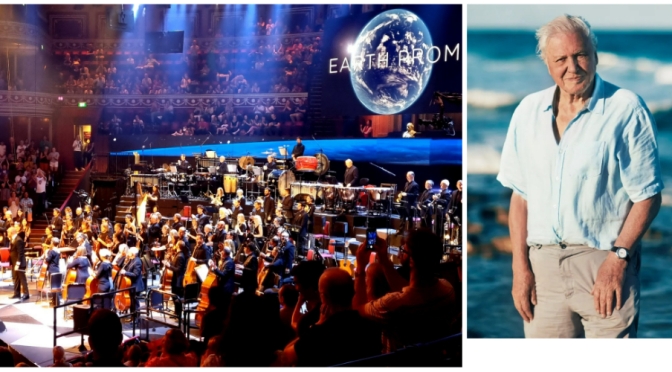
Ivor Novello Award winning and Emmy nominated composer, Ben Salisbury, is best known as one of the countries leading film and TV composers, with recent credits including the feature films ‘Ex Machina’, ‘Free Fire’ (both co-composed with Geoff Barrow) and ‘Beyonce: Life is But a Dream’. He is also a member of the bands ‘Drokk’ (with Geoff Barrow) and ‘Dolman’ (with Scott Hendy).
Ben is particularly well known in the field of Natural History, where he has scored over 50 films – including the last 3 of David Attenborough’s ‘Life Of…’ series. He has also formed a critically acclaimed writing partnership with Porstishead’s Geoff Barrow. The pair have so far released the album DROKK: Music Inspired By Mega City One, described by The Quietus as ‘jaw dropping.. one of the heaviest and most intensely atmospheric records of the year’. The soundtrack album to Ex Machina has been described by Louder Than War as ‘sensational’, and there are further plans to continue a collaboration which, according to screenwriter/director/producer Alex Garland ‘sets an incredibly high bar of creative skill and integrity’. Other recent co-written credits from Ben and Geoff include Ben Wheatly’s Free Fire (executively produced by Martin Scorsese) and Charlie Brooker’s Black Mirror: Men Against Fire.
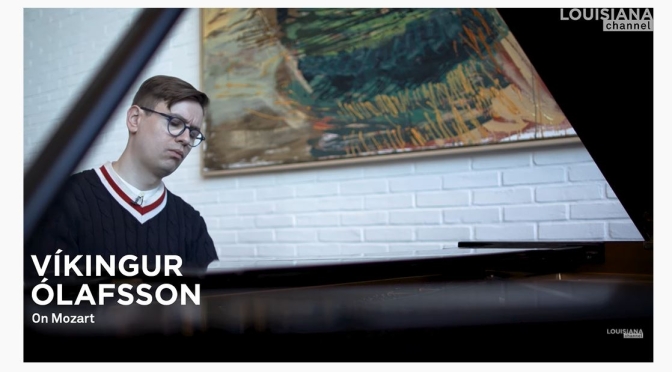
“Mozart really belonged to the 19th century”, says Icelandic star-pianist Víkingur Ólafsson about Wolfgang Amadeus Mozart “He belonged to a new area, where the artist was a free thinker. Image, if he had lived a little longer and would have had a dialogue with Ludwig van Beethoven.”
Ólafsson has no doubt that Mozart was a so-called Wunderkind. “He did have a divine gift.” But to Ólafsson another aspect of Mozart’s music is even more fascinating. According to Ólafsson Mozart wrote his best works after the age of 25, when his life was in deep crisis and the Vienna aristocracy had turned its back on him.
“The greater the music became, the less popularity he had.” To Ólafsson Mozart’s legacy must be seen in the light of the tragedy. Víkingur Ólafsson grew up in Reykjavík and started playing the piano at an early age under the tutelage of his mother, a piano teacher. He studied at the Juilliard School in New York, earning bachelor’s and master’s degrees under the supervision of Jerome Lowenthal and Robert McDonald. He also took lessons with Ann Schein.
In 2011, Ólafsson was the soloist in the opening concert of Harpa in Reykjavik, playing Edvard Grieg’s piano concerto with the Iceland Symphony Orchestra. Since he has developed into one of the most recognized and award-winning artists within classical and contemporary music.
In 2016, Víkingur signed an exclusive recording contract with the renowned label Deutsche Grammophon releasing four albums featuring the music of Philip Glass, Johann Sebastian Bach, Debussy & Rameau as well as Mozart & Contemporaries. Ólafsson has collaborated with many contemporary artists among them John Adams, Philipp Glass, Daniel Bjarnason and Icelandic singer Bjørk. He has also recorded the soundtrack of Darkest Hour, a film directed by Joe Wright, and released Bach Reworks, featuring six ‘remixed’ works by Johann Sebastian Bach from the likes of Ben Frost, Peter Gregson, Valgeir Sigurdsson as well as Ólafsson himself.
Víkingur Ólafsson was interviewed by Marc-Christoph Wagner at the Louisiana Museum of Modern Art in November 2021. Camera: Jarl Therkelsen Kaldan Edited by: Jarl Therkelsen Kaldan Produced by Marc-Christoph Wagner Copyright: Louisiana Museum of Modern Art, 2021 Louisiana Channel is supported by Den A.P. Møllerske Støttefond, Ny Carlsbergfondet and C.L. Davids Fond og Samling
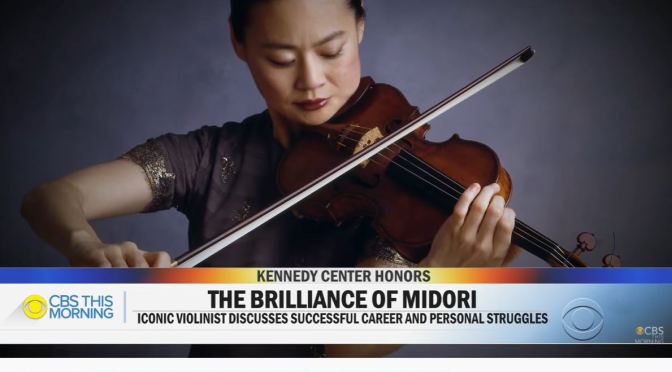
Violin virtuoso Midori, a former child prodigy compared to Mozart, is honored by the prestigious Kennedy Center. Her life of music is dedicated to teaching others, while she continues to learn herself. She speaks with Vladimir Duthiers about her career and the honor.
Midori Goto who performs under the mononym Midori, is a Japanese-born American violinist. She made her debut with the New York Philharmonic at age 11 as a surprise guest soloist at the New Year’s Eve Gala in 1982.
Music Ensemble: Il Giardino Armonico, Milano, Italy Dancer & Choreography: Margarita Ermachenko
Antonio Vivaldi
Antonio Vivaldi (1678–1741) grew up in Venice, Italy where his father, a professional violinist, taught him to play the violin and introduced him to some of the finest musicians and composers in the city. At the age of 15, he also began studying to become a priest. Because of his red hair, he was known as il Prete Rosso (“the Red Priest”). Vivaldi had to leave the clergy due to health issues, and he accepted several short-term musical positions funded by patrons in Mantua and Rome. It was in Mantua that he wrote his four-part masterpiece, The Four Seasons. He was also known for his operas, including Argippo and Bajazet. Vivaldi’s work, including nearly 500 concertos, influenced many later composers, including Bach.
The collection of Twelve Trio Sonatas Op. 1 was published by the Venetian house of Giuseppe Sala in 1705. Similarly to the other published collections by Vivaldi, it became known throughout Europe and reprinted four more times within the composer’s lifetime. It was dedicated to Count Annibale Gambara.
At the turn of the 17th and 18th centuries, the trio sonata was one of the most popular genres of instrumental music in Italy. The composers modelled their work on four sonata collections by Arcangelo Corelli. Mastery in the genre was generally seen as a test of composing talent, allowing a display of the ability to simultaneously shape the melody and the counterpoint.
Vivaldi, similarly to Albinoni and Caldara, made his debut with a collection of twelve trio sonatas. They were written for two violins and a cello (more precisely a violone) or a harpsichord. The earliest preserved Vivaldi pieces, they are characteristic in their individual and fully-formed style.
News, Views and Reviews For The Intellectually Curious






 Boomers Daily