

From a European Heart Journal study:
 When the five sleep factors were collapsed into binary categories of low risk vs. high risk (reference group), early chronotype, adequate sleep duration, free of insomnia, and no frequent daytime sleepiness were each independently associated with incident CVD, with a 7%, 12%, 8%, and 15% lower risk, respectively (Table 3). Early chronotype, adequate sleep duration, and free of insomnia were independently associated with a significantly reduced risk of CHD; while only adequate sleep duration was associated with stroke.
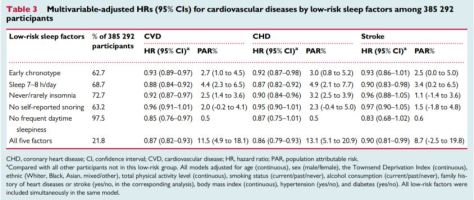 Cardiovascular disease (CVD), including coronary heart disease (CHD) and stroke, is among the leading causes of mortality globally.1 In addition to traditional lifestyle behaviours, emerging evidence has implicated several unhealthy sleep behaviours were important risk factors for CVD.2,3 For example, short or long sleep duration,4–9 late chronotype,10,11 insomnia,12–17 snoring,18,19 and excessive daytime sleepiness20,21 were associated with a 10–40% increased CVD risk.
To read more: https://academic.oup.com/eurheartj/advance-article/doi/10.1093/eurheartj/ehz849/5678714
From a Harvard news online release:
 “This study identifies a new molecular connection between exercise and inflammation that takes place in the bone marrow and highlights a previously unappreciated role of leptin in exercise-mediated cardiovascular protection,” said Michelle Olive, program officer at the National Heart, Lung, and Blood Institute Division of Cardiovascular Sciences. “This work adds a new piece to the puzzle of how sedentary lifestyles affect cardiovascular health and underscores the importance of following physical-activity guidelines.”
Scientists at Harvard-affiliated Massachusetts General Hospital (MGH) have identified a previously unknown biological pathway that promotes chronic inflammation and may help explain why sedentary people have an increased risk for heart disease and strokes.
In a study to be published in the November issue of Nature Medicine, MGH scientists and colleagues at several other institutions found that regular exercise blocks this pathway. This discovery could aid the development of new therapies to prevent cardiovascular disease.
To read more: https://news.harvard.edu/gazette/story/2019/11/exercise-found-to-block-chronic-inflammation-in-mice/
From The Lancet issue August 24, 2019:
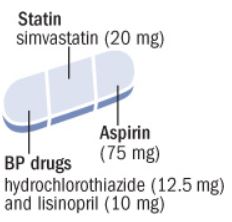 Use of polypill was effective in preventing major cardiovascular events. Medication adherence was high and adverse event numbers were low. The polypill strategy could be considered as an additional effective component in controlling cardiovascular diseases, especially in LMICs.
When restricted to participants in the polypill group with high adherence, the reduction in the risk of major cardiovascular events was even greater compared with the minimal care group…
A fixed-dose combination therapy (polypill strategy) has been proposed as an approach to reduce the burden of cardiovascular disease, especially in low-income and middle-income countries (LMICs). The PolyIran study aimed to assess the effectiveness and safety of a four-component polypill including aspirin, atorvastatin, hydrochlorothiazide, and either enalapril or valsartan for primary and secondary prevention of cardiovascular disease.
To read more click on the following link: https://www.thelancet.com/journals/lancet/article/PIIS0140-6736(19)31791-X/fulltext


 Boomers Daily