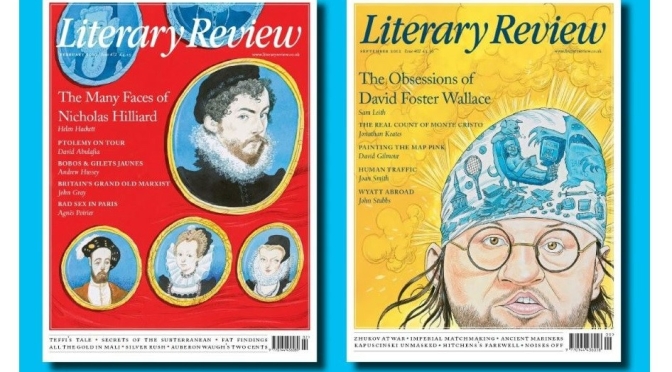

Literary Review – July 2023 Issue: Brushes with the Dutch Golden Age; @LauraCummingArt’s ‘Thunderclap’ – a remarkable experiment in form as well as a richly satisfying extended meditation on art, life and death’; Bismarck’s Great Gamble; Eden by Thames – The Infinite City: Utopian Dreams on the Streets of London…
The Other Pandemic: How QAnon Contaminated the World By James Ball
Back in the mists of time, great idealism surrounded social media. There was a sense that global interconnection would shift us into a more egalitarian and democratic age. How time makes fools of us all.
Thunderclap: A Memoir of Art & Life & Sudden Death By Laura Cumming
As a teenager with an interest in art, growing up on London’s Old Kent Road with a father whose mantra was ‘God gave you legs to walk’ (he didn’t believe in God but he did believe in walking), I often found myself on Sunday afternoons walking to the National Gallery in Trafalgar Square. I remember distinctly the day I discovered the Dutch painters. It wasn’t Rembrandt or Vermeer who caught my eye, but Hendrick Avercamp and, especially, Pieter de Hooch.
In the 1970s and ’80s, geographer Ken Martis mapped every congressional district and color-coded them by political party, going all the way back to the first Congress.
In the captivating survey “Comparative Hell: Arts of Asian Underworlds,” the damned are boiled alive. Writhing in pain, they are skewered, mauled by dogs, and devoured by ink-black birds. But the show is dotted throughout by charming reprieves: a lush jade-green garden, creamy-white blossoms, and whirling clouds. This is a hell that delights as much as it punishes.
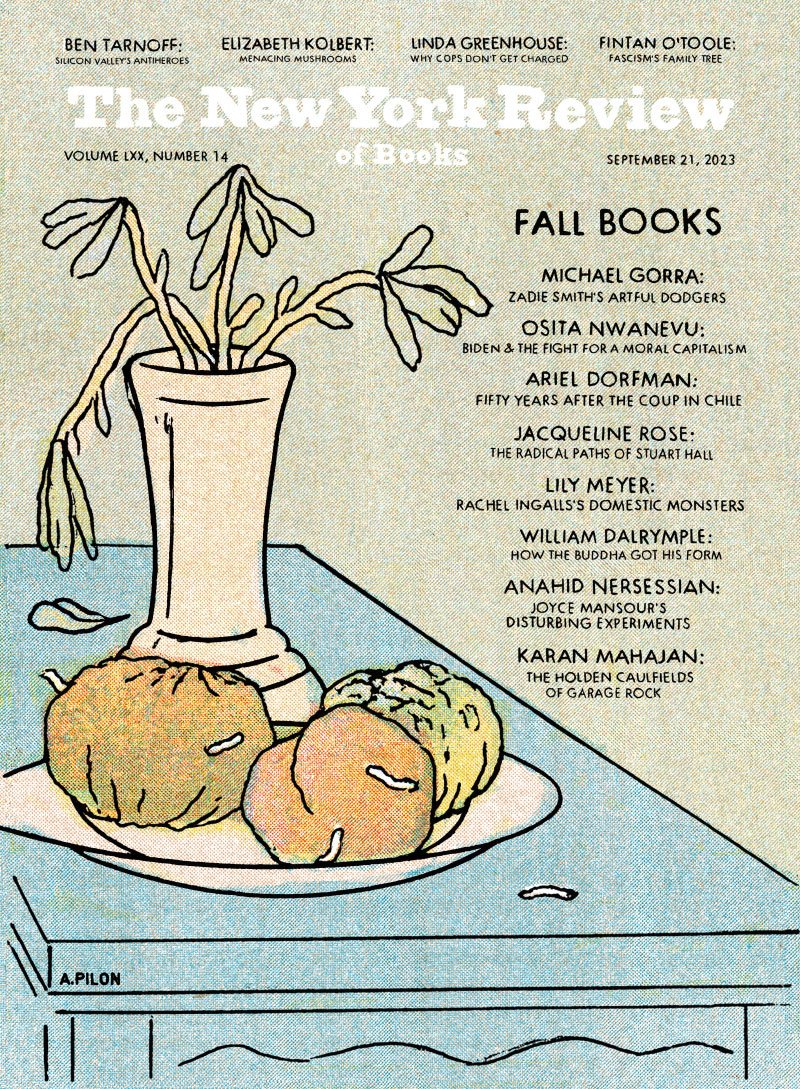
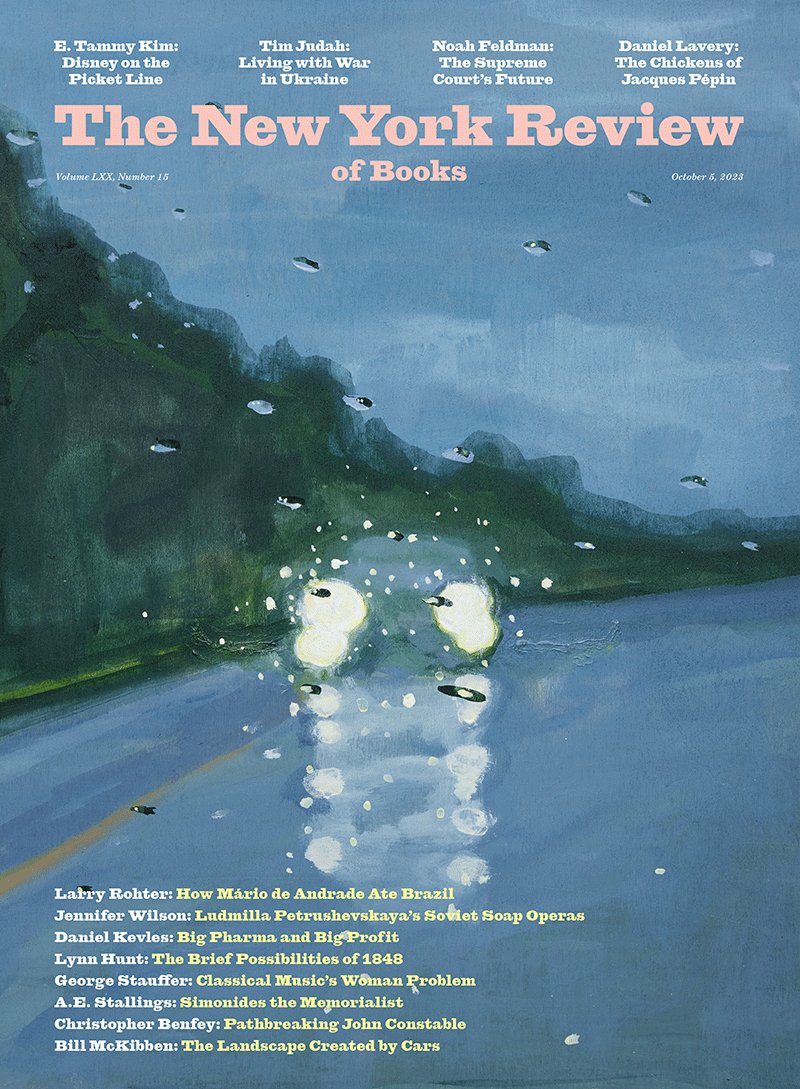
The New York Review of Books – July 20, 2023 issue: The Fiction Issue features Adam Thirlwell on Emmanuel Carrère, Carolina Miranda on contemporary Caribbean art, Darryl Pinckney on a new reissue of a classic of American vernacular literature, Fintan O’Toole on Mike Pence’s pallid pomp, Daniel Mendelsohn on Bob Gottlieb, and more.
Emmanuel Carrère’s new book, Yoga, has been the subject of gossipy debate about its veracity, but it is seductively open about its own anxiety as a work of fiction.
Johannes Vermeer, one of the most intimate and quiet of artists, who is celebrated for the silence and light of his paintings, has become, paradoxically, a crowd-pleaser.
Wall Street Journal Books & Art (June 28, 2023) – A country music outsider’s journey, the uprising that tested a young America, the true story of a psychotherapy cult and more standouts from the month in books.
Shaw’s life force, Freud’s libido, Bergson’s ‘élan vital’—all are expressions of a spark that eludes the control of civilized modernity. Review by Jeremy McCarter.
“All history is the history of longing,” Jackson Lears has written.
The history of the British empire is really the history of ‘venture colonialism,’ developed by bold entrepreneurs, savvy investors—and some shady characters too. Review by Tunku Varadarajan.
The continuing appeal of Mozart’s music may lie in the contradictory nature of the composer, balancing elegance with challenging originality. Review by Lloyd Schwartz.
Are great writers and brilliant mathematicians really so far apart? Within the structures of literary works of all kinds, numbers are hiding. Review by Timothy Farrington.
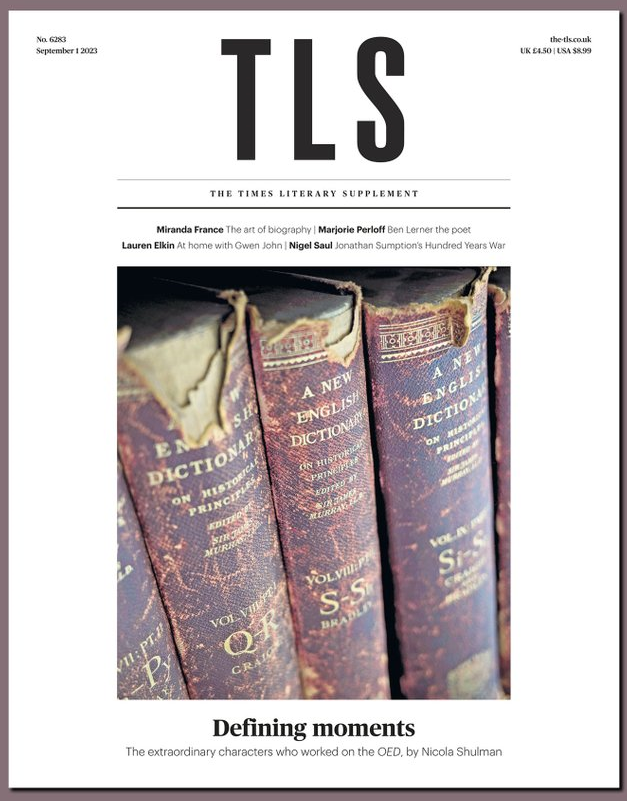
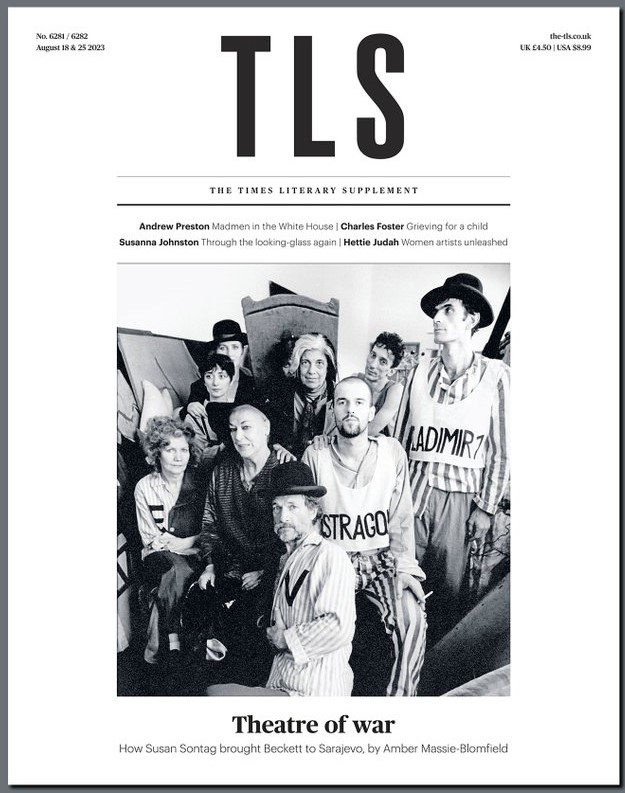
Times Literary Supplement (June 30, 2023): Evelyn Waugh’s failed marriage and spiritual crisis; The police on trial; Grotesque, unbelievable murder; Lorrie Moore’s road trip; Levity in death and more….
Few scientific subjects are so vast, and yet oceans “often seem invisible”, remarks physicist and broadcaster Helen Czerski; the workings of the seas got no mention in her physics training. Her profound, sparkling global ocean voyage mingles history and culture, natural history, geography, animals and people, to understand the “blue machine”: the ocean engine powered by sunlight that shunts energy from Equator to poles.
The Science of Reading
By Adrian Johns (2023)
Starting in the 1880s with US psychologist James Cattell, the experimental study of reading dealt in extremes, notes information historian Adrian Johns in his intriguing analysis. Researchers devised mechanical ways to measure quantities that were nearly imperceptible, such as pauses in motion as an eye scans prose. Today, scanners can measure brain activity, but the reading process remains mostly imponderable.
Meetings with Moths
By Katty Baird (2023)
Ecologist Katty Baird’s fly-specialist friend grumbles that butterflies should be renamed ‘butter-moths’. Butterflies and moths belong to one order, and are not always easy to tell apart. However, most butterflies rest with wings shut, whereas resting moths display theirs. The garden tiger moth (Arctia caja), for example, has “forewings a mosaic of darkest brown and white which conceal shocking scarlet underwings spotted with denim blue”.
A History of Ancient Egypt, Volume 3
By John Romer (2023)
This deeply informed history by Egyptologist John Romer focuses on the New Kingdom, 1550–1185 bc, including rulers Nefertiti, Tutankhamun and Ramesses II: crucial figures in popular perception. Calling it the “most fantasized period in all of ancient history”, Romer criticizes much scholarship on the era for being “firmly stuck” in the nineteenth-century European vision of ancient Egypt, launched by Jean-François Champollion in the 1820s.
In the Herbarium
By Maura C. Flannery (2023)
London’s Royal Botanic Gardens at Kew are open to all. Not so Kew’s Herbarium, a collection of more than seven million plant specimens reserved for academic visitors. Access to most herbaria is restricted: biologist Maura Flannery knew “almost nothing” about them until 2010, when a US curator took her behind the scenes at one and she fell in love with them.
Times Literary Supplement (June 23, 2023): Twenty-two TLS writers’ choices for best Summer 2023 Books, Anna Della Subin on Mary Magdalene; Kojo Koram on global capitalism; Zachary Leader on Joyce and Léon and illustrating Victorian classics
Working on Capital in the British Museum, plagued by creditors and carbuncles, Karl Marx complained not only that nobody had ever written so much about money and had so little of it, but that ‘this economic crap’ was keeping him from writing his big book on Balzac. His work is studded with allusions to Homer, Sophocles, Rabelais, Shakespeare, Cervantes, Goethe and scores of other authors, though he was less enthralled by ‘Elizabeth’s arse-kissing poet’ Edmund Spenser, an advocate of state terror in Ireland.
Most of us would find it horrible to be told that we aren’t worth engaging with, that our views are socially unacceptable or merely a function of demography. But that it is painful to be on the receiving end of such remarks doesn’t mean that one’s own rights to ‘free speech’ are thereby imperilled; it might simply be a reminder that speech can wound.
Killingly by Katharine Beutner In 1897 Bertha Mellish, a student at Mount Holyoke College in Massachusetts, disappeared. She was never found. Katharine Beutner uses this real-life mystery as the foundation for her second novel, Killingly (Corvus £14.99). Her focus is on those who were left behind, making what sense they can of Bertha’s exit from their lives. Agnes, her closest friend on campus, harbours knowledge she has vowed not to reveal; Florence, Bertha’s much older sister, is also keeping secrets from the past that have shaped her life; Henry Hammond, an arrogant medical man who believes he was destined to marry Bertha, uncovers truths for which he is unprepared. Beutner creates an impressive, multistranded story of pain, loss, and women’s struggle to escape the restrictions that are imposed on them.
Radical Love by Neil Blackmore Neil Blackmore’s Radical Love (Hutchinson £16.99) also takes a historical event — the Vere Street Coterie of 1810, which resulted in the hanging and pillorying of gay men — as the basis for its story. The narrator, John Church, is a minister who believes that love of all kinds should be religion’s motivating force. He takes this message to a molly house in Vere Street, where he offers same-sex marriages to the drag queens and rent boys who gather there. At the same time, he is driven by his own passion for Ned, a young former slave. Both a celebration of the erotic lives of long-dead gay Londoners and a lament for past persecutions, Radical Love is a powerful story of desire flourishing amid danger.
The Fascination by Essie Fox The Fascination (Orenda £16.99) is the fifth novel by Essie Fox, in which she once again makes skilful use of the tropes of Victorian gothic fiction. Keziah Lovell, 15, is an unwilling accomplice in her father’s schemes to sell his quack elixir to gullible punters. She is assisted by her twin sister, Tilly, a petite beauty who stopped growing at the age of five. Then their father sells them to an enigmatic Italian man known only as “Captain”. Surrounded by the “freaks” of his tribe, they face unexpected threats in a story of society’s outsiders seeking acceptance and redemption.
Morgan Is My Name by Sophie Keetch There has been no shortage recently of feminist retellings of Greek myths. New versions of the Arthurian stories have been less common, but Sophie Keetch’s Morgan Is My Name (Magpie £16.99) is the first volume of a promised trilogy that has Morgan Le Fay as its narrator. Usually cast as the villain in the Arthurian tradition, here she is a fiery, intelligent woman who refuses to play the roles expected of her and determines to take control of her life. Turning the legends on their heads, Keetch finds new potential in them.
Flatlands by Sue Hubbard Taking its inspiration from Paul Gallico’s novella The Snow Goose, Sue Hubbard’s Flatlands (Pushkin £16.99) explores the wartime relationship that develops between Freda, a 12-year-old evacuee from the East End of London, and Philip Rhayader, a troubled conscientious objector, who are both exiled to the East Anglian fenlands. Precise in its historical detail and admirable in its evocation of the large skies and isolation of its setting, this is a moving study of an unlikely friendship and the healing power of the natural world.
News, Views and Reviews For The Intellectually Curious