

From a Cotswold Life online interview/review:
 “I suppose I started off with a fairly literal view of the world,” he says. “But, quite early on, it became clear to me that there was much more going on than simply the picture I was seeing; that the natural world had an agenda of its own; that it was going to live out life, regardless of how we viewed it and how we used it; and, indeed, regardless of the fancy metaphors that we used.”
Oh my goodness. Where to begin?
I could start with the ‘Praying Beech’ – a tree whose (‘whose’? The human possessive feels simultaneously wrong and yet just right) two branch stubs clasped each other like hands. Once, when the rain fell in an apocalyptic burst, Richard Mabey watched its bark melt in front of his eyes. It was, of course, no stranger to extremes of weather: one summer past, the tree had been split by lightning, bees hunkering down in its newly-created hollows. Sometime later, a storm had toppled it, leaving fungi free to colonise its delicious surfaces: knobbly coral spots; dead man’s fingers rising corpse-like from the tree’s own rot; white porcelain tufts, like Royal Worcester plates awaiting a delicate slice of egg-yellow sponge.

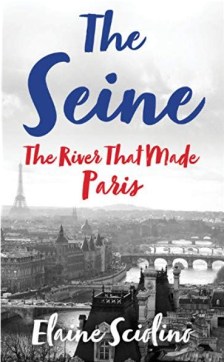 Sciolino’s keen eye and vivid prose bring the river to life as she discovers its origins on a remote plateau of Burgundy, where a pagan goddess healed pilgrims at an ancient temple. She follows the Seine to Le Havre, where it meets the sea. Braiding memoir, travelogue, and history through the Seine’s winding route, Sciolino offers a love letter to Paris and the river at its heart and invites readers to explore its magic.
 In “Unto This Last and Other Essays on Art and Political Economy” (1860), which gives the exhibition its title, Ruskin “sees” interconnected social injustices. He attacks economic inequality. Later, he sets out to establish a utopian community in working-class Sheffield, England. In one gallery we see his influence on “progressive thinkers worldwide.” Gandhi said that reading “Unto This Last” in 1904 transformed his life and ideas.
 ‘If you can paint one leaf,” John Ruskin once declared, “you can paint the world.” And in “Unto This Last: Two Hundred Years of John Ruskin”—the hypnotically potent (though flawed) exhibition at the Yale Center for British Art marking the bicentennial of his birth—we see how wonderfully he kept trying.
 The acclaimed biographer Edmund Morris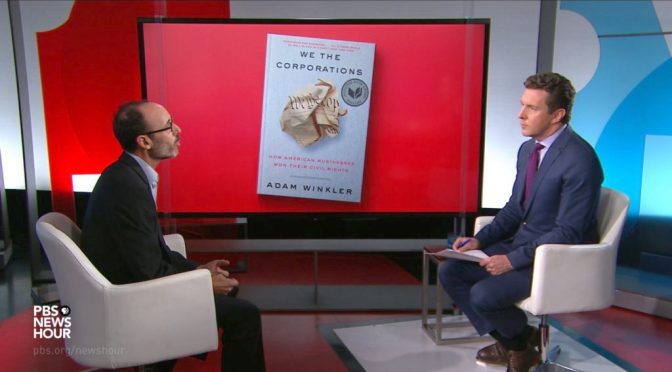
 Adam Winkler, author of our October pick for the NewsHour-New York Times book club, Now Read This, joins William Brangham to discuss “We the Corporations,” and William announces the November book selection.
 This week in Science,
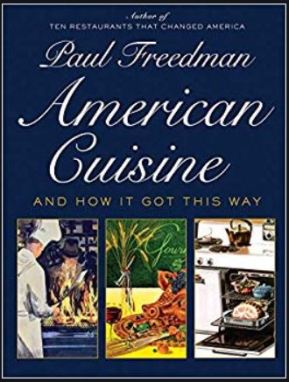 One way to understand American cuisine is through its regions — and the regional traditions that underlie the history of American cuisine. New England, the South, and New Orleans Creole are the regional cuisines of America. Examples of New England cuisine are “Yankee Pot Roast,” the lobster roll, and clam chowder. Southern favorites include grits, collard greens, okra, fried tomatoes, and sweet potato pie. Louisiana’s signature creole dishes are jambalaya, gumbo, and étouffée.
 A Booklover’s Guide to New York, by Cleo Le-Tan, with drawings by Pierre Le-Tan (Rizzoli)
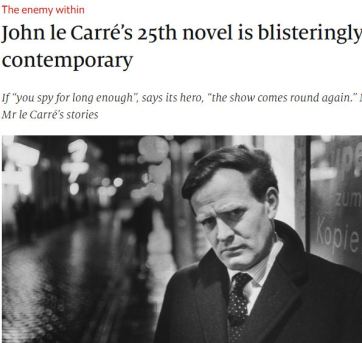 “Agent Running in the Field” is narrated by Nat, a 47-year-old spy for British intelligence—known not as “the Circus” of yore but, more prosaically, as “the Office”.
 Whereas most Wright biographies build from one structure to the next, this one caroms from one digression to the next. Mr. Hendrickson spins miniature biographies of the people who commissioned Wright to build their homes and office buildings. An array of midcentury figures appears: e.g., Glenway Wescott, the novelist and poet who rubbed shoulders with Gertrude Stein in Paris and whose sister commissioned one of Wright’s homes; and Clarence Darrow, the renowned lawyer, who waded into the murk of Wright’s personal life when a disgruntled housekeeper attempted to use the Mann Act to have Wright arrested. We also meet the little-known residents of various structures. Seth Peterson, for instance, dreamed of living in a Wright home so powerfully that he camped out in the one he commissioned as it was being built.
  Boomers Daily