
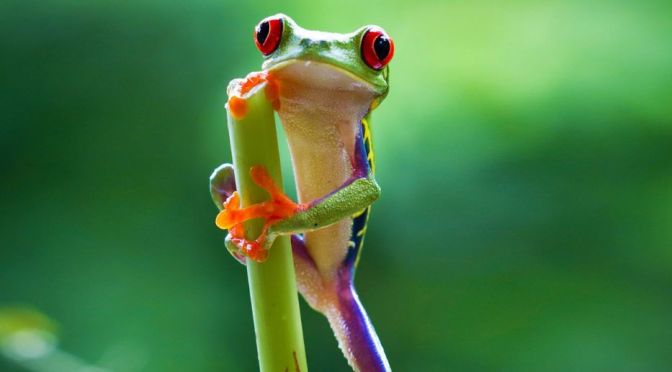
From the world’s smallest cat to death-defying impalas; these are some of BBC Earth’s most loved animal moments from the last year.
Tag Archives: Animals
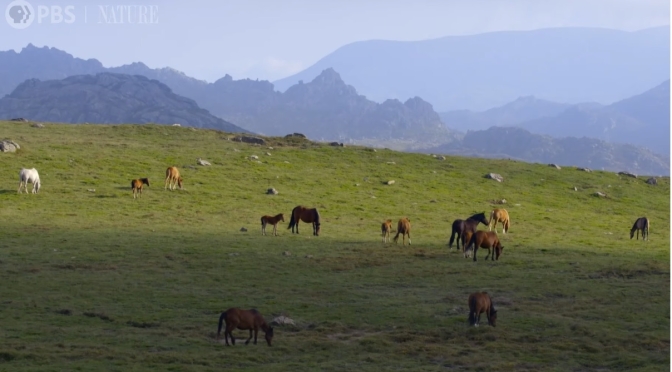
Portugal: Wild Garrano Horses Of Peneda-Gerês
The wild Garrano horses in Portugal’s Peneda-Gerês National Park are not newcomers.

Previews: Science News Magazine – April 9, 2022
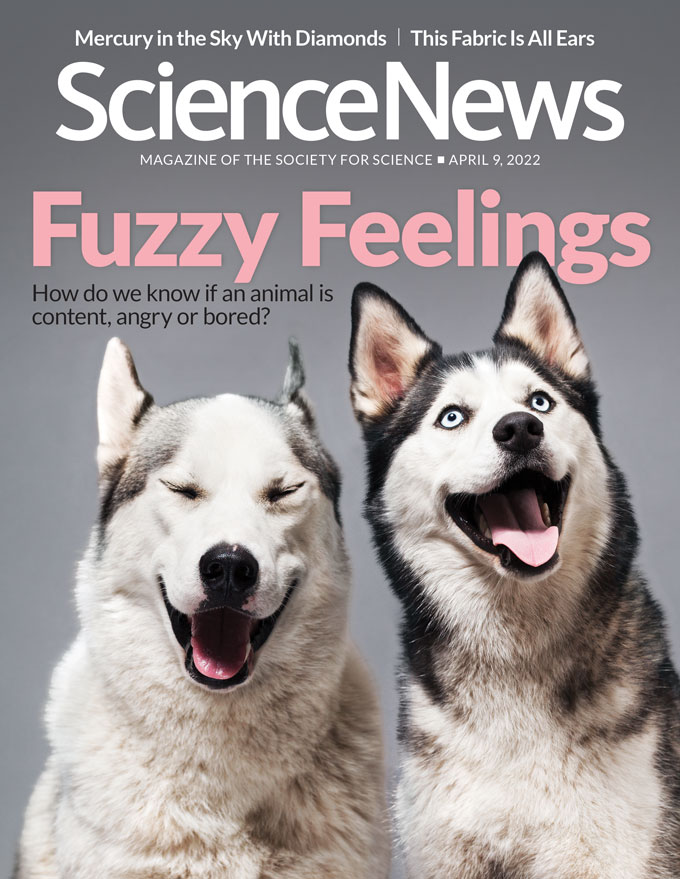
COVER STORY
How do we know what emotions animals feel?
Animal welfare researchers are studying the feelings and subjective experiences of horses, octopuses and more.
Diamonds may stud Mercury’s crust
By Nikk Ogasa
This fabric can hear your heartbeat

Views: ‘Primal Survivor – Escape The Amazon’ (2022)
Survivalist Hazen Audel embarks on a risky journey to escape the Amazon rainforest and travel 500 miles to the Atlantic coast. Of course his voyage won’t be easy and he encounters some of the jungle’s most fascinating and frightening wildlife. From an Anteater and Anaconda to a Tarantula and Tailless Whip Scorpion, this thrilling journey will be one to remember. Join Hazen on this remarkable adventure in Primal Survivor: Escape The Amazon, premieres Thursday 14th April at 9pm, on National Geographic UK.
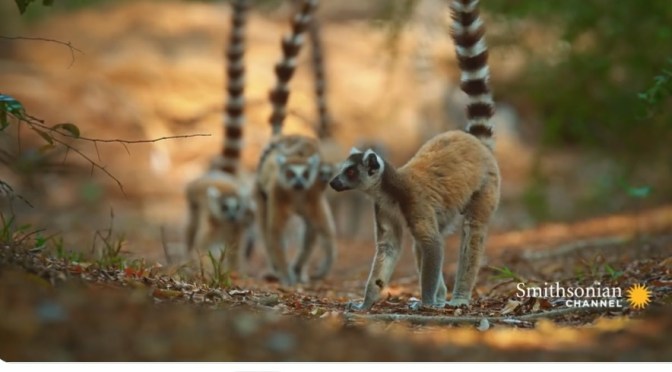
Island Views: The ‘Lemur Gangs’ Of Madagascar
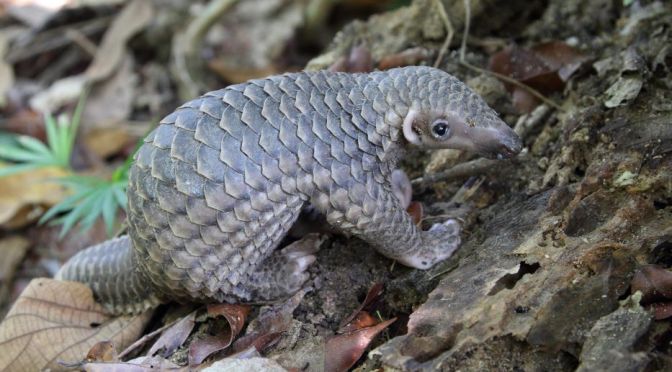
BBC Earth: The Movement To Protect Pangolins
In China, Maria joins forces with Angelababy, one of the country’s biggest megastars. She is taking a bold approach to addressing the demand for pangolin products.
Pangolins, sometimes known as scaly anteaters, are mammals of the order Pholidota. The one extant family, the Manidae, has three genera: Manis, Phataginus, and Smutsia. Manis comprises the four species found in Asia, while Phataginus and Smutsia include two species each, all found in sub-Saharan Africa.
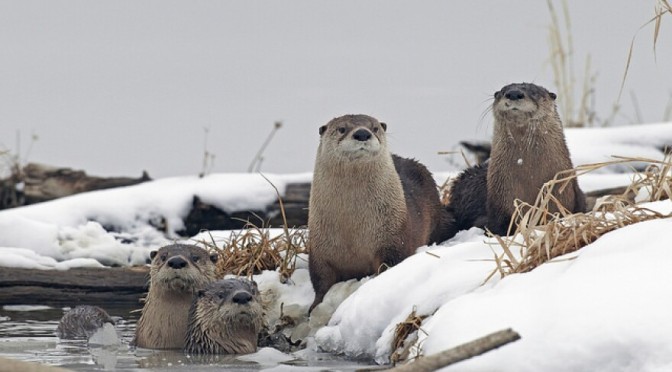
Views: North American River Otters In Maine
“Sunday Morning” visits otters on the hunt for fish at a pond in Portland, Maine. Videographer: Mauricio Handler.
The North American River Otter (Lontra canadensis) is the species of otter found in Maine, and you’ll find lots of them along the entire coast (and probably inland as well). River otters are mostly nocturnal members of the weasel family (Mustelidae) and rather large, growing up to 3.5 feet long and weighing around 30 pounds. They are referred to as “semi-aquatic,” since they spend most of their waking hours in water and come to land when denning, moving from one body of water to another, or marking a territory.
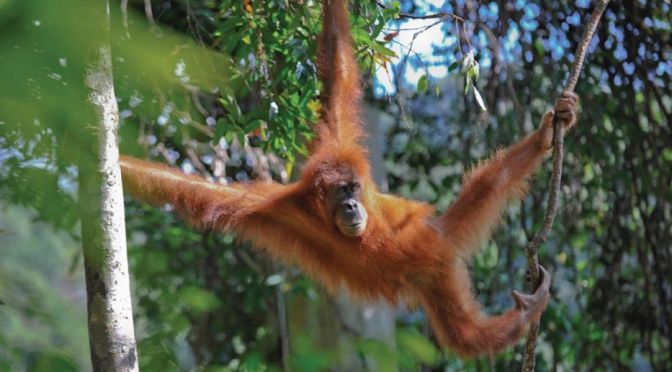
Wildlife: Orangutans On The Island Of Borneo
Learning survival skills is a must for baby orangutans to live in the rainforest among their predators, however, not all of them are natural acrobats!
The Bornean orangutan is a species of orangutan endemic to the island of Borneo. Together with the Sumatran orangutan and Tapanuli orangutan, it belongs to the only genus of great apes native to Asia.
Borneo, a giant, rugged island in Southeast Asia’s Malay Archipelago, is shared by the Malaysian states of Sabah and Sarawak, Indonesian Kalimantan and the tiny nation of Brunei. It’s known for its beaches and ancient, biodiverse rainforest, home to wildlife including orangutans and clouded leopards. In Sabah is 4,095m-tall Mount Kinabalu, the island’s highest peak, and, offshore, the famed dive site Sipadan Island.

Travel Tours: Namibia In Southwest Africa (4K)
Namibia, a country in southwest Africa, is distinguished by the Namib Desert along its Atlantic Ocean coast. The country is home to diverse wildlife, including a significant cheetah population. The capital, Windhoek, and coastal town Swakopmund contain German colonial-era buildings such as Windhoek’s Christuskirche, built in 1907. In the north, Etosha National Park’s salt pan draws game including rhinos and giraffes.
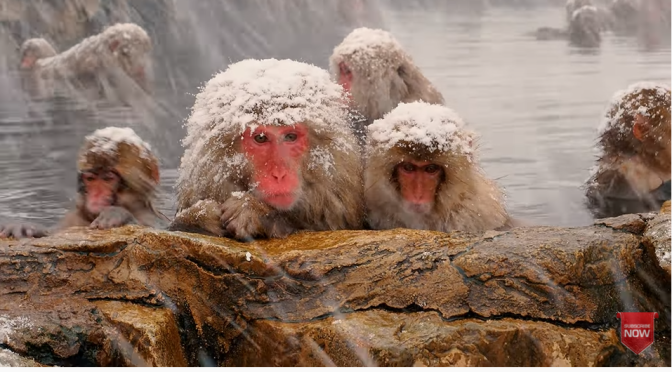
Japan Views: Snow Monkey Park In Heavy Snowfall
Located at the base of Joshinetsu Kogen National Park, the Jigokudani Monkey Park – often referred to as the Snow Monkey Park – is home to a very special troop of monkeys. Created in 1964, the park was established as a conservation area in which the monkeys, Japanese macaques to be exact, would have a refuge within what was already their natural habitat. Once in the park, the naturally-curious monkeys observed humans using the hot spring of a nearby guesthouse and before long, started copying the behaviour. The rest as they say, is history.
 Boomers Daily