
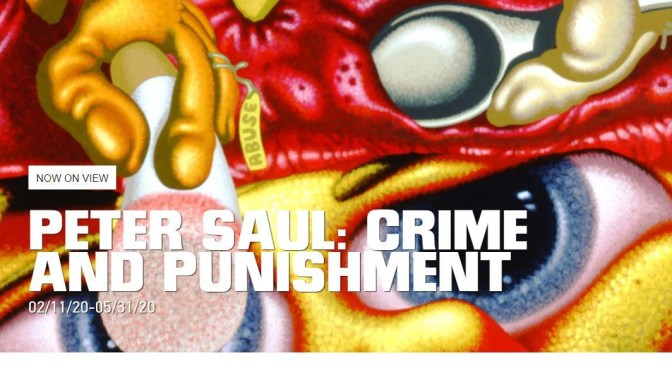
 Beginning in the early 1960s, Peter Saul began to incorporate imagery borrowed from a range of pop-cultural sources into his exuberant, brightly colored paintings, adopting a style that has proven to be far ahead of its time. His work developed independently from concurrent art historical movements like Pop art, with which it shares some superficially similar concerns. Instead of the cool detachment of Andy Warhol and Roy Lichtenstein, however, Saul crafted his own unique blend of Surrealism, history painting, vernacular illustration, and the real-life shock and horror of current events.
Marking the artist’s first New York museum survey, this exhibition will bring together approximately sixty paintings from across his long career.
Saul’s earliest paintings, which he created in Paris, demonstrate a loose, gestural style of abstraction, yet he began to incorporate text, recognizable characters, and consumer products into his works as early as 1960. Around this time, he plucked figures like Donald Duck and Superman from the pages of comic books and deposited them into chaotic scenes representative of the avarice and violence of America. In the late 1960s and early 1970s, Saul created some of his most shocking and indelible works in response to the Vietnam War, with a series that captured the conflict’s grotesque brutality, racism, and destruction. A later group of paintings, which examines the chaotic sociopolitical fabric of urban life in California, reflects the dissolution of 1960s counterculture and the corruption, racism, and greed of US politics.
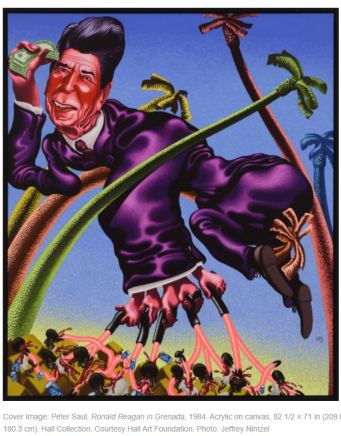
Saul extended his interrogation of American history in his portraits of infamous criminals like John Wayne Gacy, archetypes like cowboys and businessmen, and US presidents such as Ronald Reagan, George W. Bush, and Donald Trump, whom Saul depicts with disdain and condemnation. He has also looked further back to reimagine supposedly triumphant scenes from America’s past—including Columbus’s arrival in America, Washington crossing the Delaware, and Custer’s Last Stand—as moments of comical failure or disgrace. With a caustic sense of humor, Saul has continuously skewered America’s leaders, rendering their stretched, distorted bodies in Day-Glo colors. His disparate influences range from MAD magazine comics to Surrealist fantasies and American social realist painting from the 1930s.
Peter Saul is an American painter. His work has connections with Pop Art, Surrealism, and Expressionism. His early use of pop culture cartoon references in the late 1950s and very early 1960s situates him as one of the fathers of the Pop Art movement. He realised about 800 paintings during his career.
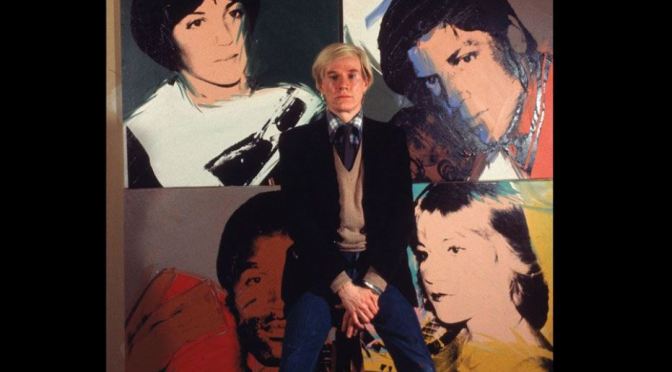
 ‘The sports stars of today are the movie stars of yesterday,’ proclaimed the artist. It was true; thanks to rapid advances in TV broadcasting, sporting champions in the 1970s were starting to achieve the same level of popularity as other entertainers.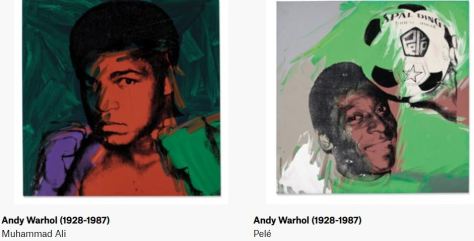


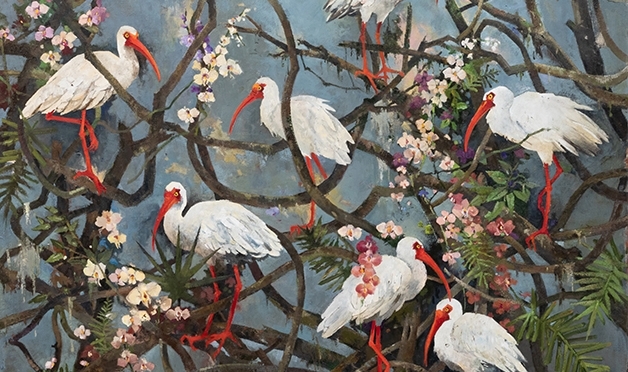
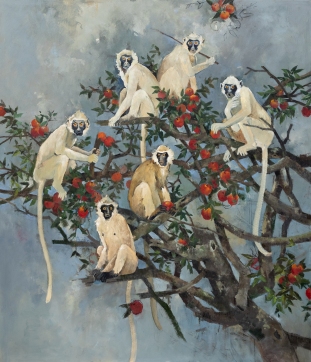 Berggruen Gallery is proud to present John Alexander: Landscape and Memory, an exhibition of recent paintings and drawings by Texas-born, New York-based artist John Alexander. This show marks Alexander’s second solo exhibition with the gallery and will be on view January 9 through February 15, 2020. The gallery will host an opening reception for the artist on Thursday, January 16 from 5:00 to 7:00pm.
 The introspective nature of Alexander’s work is revealed through the artist’s keen observations of his surrounding environment and the vivid way in which he paints it. Employing bold, painterly strokes, Alexander maintains an acute sensibility of his subject matter – whether it be the detailed rendering of the spiny lobster, an expressive portrayal of grackles and ibises perched in branches, or more expansive, floating florals. The artist also injects elements of whimsy; the playful monkeys he paints peer out of their canvases to almost directly engage the viewer. And thus each work is imbued with an authentic, raggedly pristine, emotional sense of the earth we all inhabit. In this way, Alexander creates scenes that are deeply personal, yet also shared…nostalgic yet ongoing…exotic yet familiar…of the world yet otherworldly. Saturating his landscapes with humor, sentimentality, and veneration, Alexander reveals as much about himself as he does about nature.
 Boomers Daily