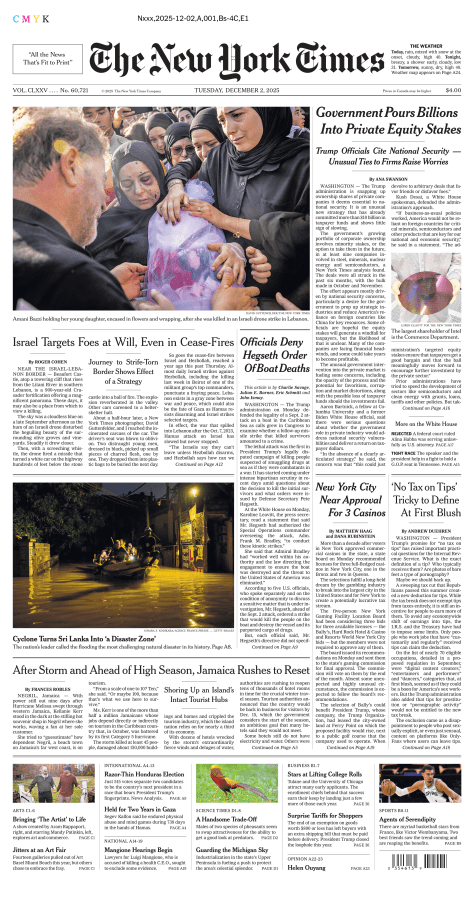
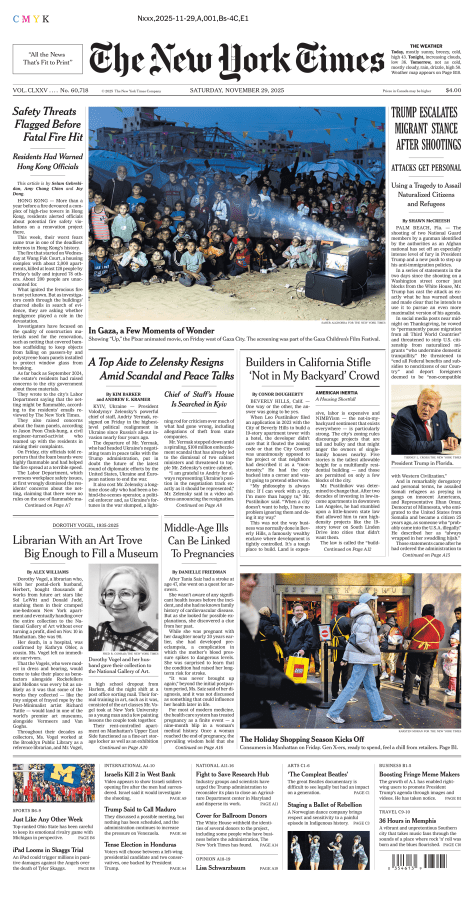
THE NEW YORK TIMES – WEDNESDAY, SEPT. 3, 2025

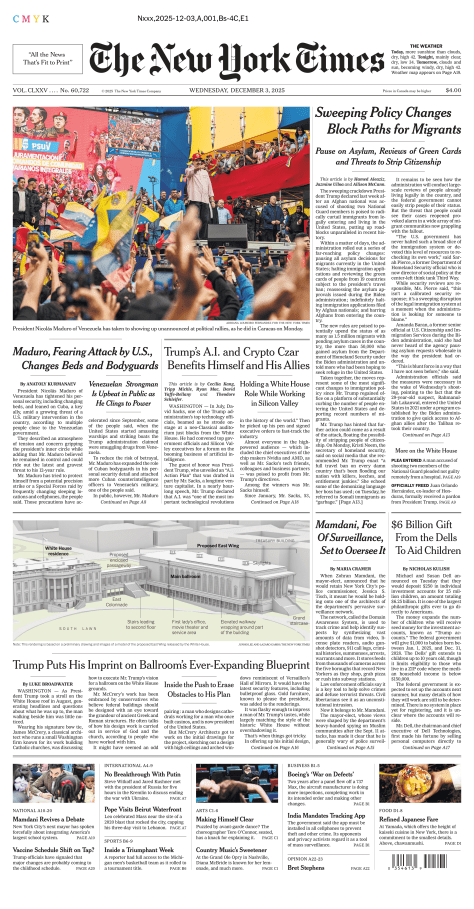
Appeals Court Blocks Deportations Under Alien Enemies Act

The ruling on the 18th-century wartime law was a setback for President Trump’s immigration crackdown. The case is almost certainly headed to the Supreme Court.

Here’s How Legal Battles Over the Alien Enemies Act Have Played Out

As Rubio Visits Mexico, Its President Walks a Political Tightrope

U.S. pressure to crack down on corrupt politicians has squeezed President Claudia Sheinbaum ahead of her meeting with Secretary of State Marco Rubio.

Trump Says U.S. Attacked Boat Carrying Venezuelan Gang Members, Killing 11

Xi Parades Firepower to Signal That China Won’t Be Bullied Again

The parade, attended by the leaders of Russia and North Korea, had a defiant message. President Trump weighed in.

Kim Jong-un Brings a Guest to Beijing: His Daughter and Potential Heir

THE CAFÉ OF ECHOES

At Caffè Florian, a poet rehearses silence, quarrels with Ruskin, and dines with memory.

By Michael Cummins, Editor, September 2, 2025

In the autumn of 1883, Robert Browning arrived in Venice not as a poet seeking inspiration, but as a man rehearsing his own silence. He was seventy-one, celebrated in England yet still dogged by the charge of obscurity, more famous abroad for Elizabeth’s immortal sonnets than for his own labyrinths. This essay is not fact but speculation, not history but atmosphere: Browning imagined at his table in Caffè Florian, where mirrors, velvet, and silence conspired with memory to become his final stage.

The boat nudged the dock like a hesitant thought. Browning stepped off with the stiffness of age and the grace of habit. The air smelled of brine and stone, of centuries folded into mist. He paused, cane in hand, and looked toward the dome of the Salute—its silhouette a question mark against the morning haze. Seventy-one years weighted his shoulders, but he stood upright, as though irony itself were a brace. The vaporetto pulled away, its wake dissolving into green silk. He had no luggage beyond a notebook and the ghosts already crowding his mind.

The fog is not weather—it is thought. It thickens, withdraws, curls back upon itself. Even in this cup before me it lingers: caffè corretto, black cut with brandy, bitter and sweet as a line half-finished. Florian is dim at this hour, its velvet walls inhaling the echoes of centuries. Mirrors multiply the room into infinity. Each reflection a fragment of me: old, young, diminished, fractured. A poet made a kaleidoscope.

Byron once sat here, Goethe scribbled here, conspirators whispered “Viva San Marco!” in the Sala del Senato. Today I sit, ordering polenta e schie—shrimp fried in brine—and the taste is lagoon, memory, salt. A plate of amaretti arrives, sugared consolation. The waiter suggests biscotti di mandorla as well, almonds crushed into sweetness. I chew slowly. The polenta is soft, golden, humble—like memory softened by time. The schie, tiny survivors of the lagoon, taste of endurance. Amaretti crumble like old letters, sugared on the outside, hollow at the core. The coffee, thick as ink, stains the tongue with bitterness and clarity. Florian does not serve meals; it serves metaphors.

Across the square, Quadri blazes with chandeliers, an operatic stage flattering the surface. Florian is darker, more inward. Its light is borrowed, its silences long. Quadri is performance for an audience. Florian is monologue.

I open my notebook: Ruskin, copied lines from The Stones of Venice. His voice has been my reluctant companion for thirty years. “We may live without her, and worship without her, but we cannot remember without her.” John, always the preacher. He carved morality into marble, turned buttresses into sermons. For him, Venice’s decline was sin. For me, decline is theatre. To remember is not to repent but to perform again. Memory is rehearsal.

The waiter refills my cup. The brandy sharpens thought, steadies irony. I recall my own lines from A Toccata of Galuppi’s:

As for Venice and her people, merely born to bloom and drop,
Here on earth they bore their fruitage, mirth and folly were the crop.

I scolded them then. How Puritan I was. Sitting now at Florian, I envy them. Folly is not failure; it is fruit. Who begrudges the bloom because it falls?

A German couple at the next table mutter Goethe. Their syllables stumble in Venetian air. A waiter tells a French traveler that Byron loved their zabaglione. A young woman sketches the gilded lamp above the doorway, her graphite smudged. She glances at me: “Are you a writer?” “No,” I reply, “a reader of ruins.” She frowns, puzzled. Youth believes silence means emptiness.

Elizabeth drifts through the mirrors. Her eyes catch mine across the velvet gloom. She wrote of Florence in Casa Guidi Windows, calling for liberty. She saw windows; I see walls. She opened; I enclosed. She is remembered for love, I for irony.

Her voice returns in my By the Fire-Side:

Oh, moment one and infinite!
The water slips o’er stock and stone;
The West is tender, yet the night
So soon must veil it, mine alone.

The water slips even now beneath the piazza stones. Tenderness yields to night. And yet—even absence is mine.

I once watched her read Petrarch aloud at Casa Guidi, her voice trembling with belief. She said poetry must lift. I said it must dig. We never resolved it. But in Venice, I hear her voice lifting still, even as I dig. I imagine writing a letter to her, one I will never send: My dearest Ba, Florian multiplies us in its mirrors. You see eternity; I see fragments. You spoke love; I speak echoes. And still, together, we wrote scaffolding for survival.

Ruskin appears across the table, severe, ascetic, with eyes that drill into conscience. He clears his throat: “The first cause of the fall of Venice was her falsehood.” He gestures to Florian’s mirrors. “Deceit multiplied.”

I answer: “John, is not poetry falsehood? Have I not spoken through murderers and monks, adulterers and judges? Masks, every one. But tell me—was the mask less true than the face?”

He insists: “Gothic is the expression of a Christian people, the confession of their faith in the work of their hands.”

I sip. “Faith, carved into cornices, labor engraved in stone. And what has it left us? Ruins. Whereas the Renaissance, with all its duplicity, left us colour, flourish, theatre. I prefer a glowing lie to a tedious truth.”

Ruskin frowns: “The Lamp of Truth must burn in every arch.”

“Truth burns, yes,” I reply, “but it also blinds. Give me the lamp of illusion, John. It casts longer shadows.”

I remember reading Ruskin aloud to Elizabeth once, in Florence, when his Seven Lamps of Architecture was still fresh. She had shaken her head. “He sees sermons in stone,” she said. “I see spirit in breath.” We argued half the night, she quoting Casa Guidi Windows, I muttering that breath is nothing without scaffolding. And here I sit now, scaffolding without breath.

The waiter brings another plate, sets down biscotti di mandorla. Ruskin fades into the mirror. I smile. I have won the debate by eating.

But another ghost sidles into Florian: Byron, lounging with rakish ease, boots muddy from some clandestine canal adventure. He leans back, laughing: “Browning, you scold folly, yet you envy it. Admit it—you envy me.” I do. I envied him once, his thunder, his immediate grip on the world. Venice loved his scandal, his Don Juan verses written between embraces. I admired the music, the power, the theatricality, even as I recoiled from his flamboyance. He used Venice as a symbol of faded grandeur, of moral ambiguity. And have I not done the same, though with less applause? “You were lightning,” I tell him. “I am only the echo.” He winks. “Echoes last longer than thunder.”

And Shelley, gentler, spectral, drifts in too. He never lodged here long—only passed through—but his lyricism breathed Italy. I remember writing Pauline, my first confession of a poet’s soul, under his influence. Shelley gave me metaphysics tuned to music, ideals sung into air. I once wrote a short poem, Memorabilia, about shaking hands with a man who had known him. Imagine—that thrill of proximity! Shelley’s ghost leans toward me now, whispering: “Poetry must lift, Robert, even from ruins.” His words tremble like a lyre string.

I admire Shelley still, though I turned away from his idealism. He lifted; I dug. He soared; I performed. And yet, I cannot deny: his fusion of thought and song shaped me as much as Byron’s theatre. Byron gave me thunder, Shelley gave me music. Elizabeth gave me breath. Ruskin gave me quarrel. And Venice—Venice gives me echo.

I recall In a Gondola, my youthful play with passion:

The soul of music slumbers in the shell
Till waked and kindled by the master’s spell.

How earnest I was. I believed love eternal, dramatised into permanence. Now I know better. Love is architectural. It leaves ruins. One walks among them—not grateful for permanence, but for echo.

The young artist glances at me again, and this time she sketches my hand—gnarled, ink-stained, resting on the cup. I wonder what she sees. Not the poet, surely. Perhaps only a ruin worth recording. Perhaps only another relic of Venice.

Florian’s velvet breathes of centuries. The Sala del Senato still hums with 1848, Daniele Manin declaring the Republic of San Marco. I imagine their whispers lingering, “Viva San Marco!” clinging to the mirrors. Byron’s laughter, Shelley’s sighs, Casanova’s schemes, Goldoni’s wit—all still staged. The velvet absorbs nothing; it amplifies.

Outside, the piazza fills with orchestras. From Florian, a waltz in minor key, introspective, precise, like Strauss slowed by melancholy. From Quadri across the stones, a polka, bright, frivolous, Offenbach reborn in defiance. The melodies clash above San Marco. Venice plays both scores at once, refusing to choose between tragedy and farce.

I attempt a stanza in my head to match their duel, half-jesting, half-serious:

One side mourns with violins, one side laughs with brass,
Yet both belong to Venice, as shadow and mirror pass.
I sit between the melodies, cane planted, glass in hand,
Hearing waltz and polka argue what I cannot command.

The waiter sets down another caffè corretto. I trace the rim of the cup, whisper fragments that may form another book. A line half aloud:

One who never turned his back but marched breast forward,
Never doubted clouds would break…

I know better. Clouds often do not break. Yet I say it still. Faith is not in triumph, but in endurance.

Elizabeth’s ghost leans across the table, chiding gently. She opened windows, I enclosed walls. She gave hope; I gave puzzles. She left sonnets; I left monologues. She is love’s voice; I am irony’s echo. Together we were scaffold and soul. Alone, I am scaffold only.

The German couple departs, their voices swallowed by velvet. The gondolier outside cries a Byron line again, misremembered. The young woman finishes her sketch, closes her notebook. I scribble a note in Ruskin’s margin: “Dear Mr. Ruskin, Gothic is faith hewn in stone. Renaissance is theatre. And theatre endures longer than sermons.”

I close the notebook, order one last plate—polenta e schie again, salt and brine against the tongue. Outside, gondolas drift like commas in an endless sentence. Mirrors scatter me into fragments. Florian holds me like a stage.

Ruskin’s voice returns from memory: “When we build, let us think that we build for ever.” Poor John. Nothing lasts forever. Not fresco, not marble, not even love. But echoes last. And echo is all art requires.

Tomorrow I depart. The fog will remain. And somewhere in it, a voice—hers, mine, ours—will echo still.

They will read me in fragments, quote me in footnotes, misunderstand me in classrooms. That is the fate of poets. But if one reader hears the echo—hears Elizabeth’s breath in my silence, hears Venice in my irony, hears Byron’s thunder subdued into cadence, hears Shelley’s song distilled into thought—then I have not vanished. I have rehearsed eternity.

And when I return, as I surely shall, though not by will but by death’s courtesy, they will bring my coffin to the Salute. Bells will toll, gondolas will line the water, poets will compose their elegies. They will call me Venice’s last guest, though I was only ever her reader of ruins. Elizabeth will not be there, but I will hear her still, in the fog, in the echo, in the silence.

For art does not conclude. It endures. Like Venice herself, it is scaffolding and soul, ruin and flame, silence and applause. And in the hush that follows, I hear my own final stanza rehearsed already by this city—Ruskin’s stones, Elizabeth’s voice, Byron’s thunder, Shelley’s song, Galuppi’s chords, my reluctant cadence—echoing forever across the water.

THIS ESSAY WAS WRITTEN AND EDITED UTILIZING AI

LITERARY REVIEW – SEPTEMBER 2025

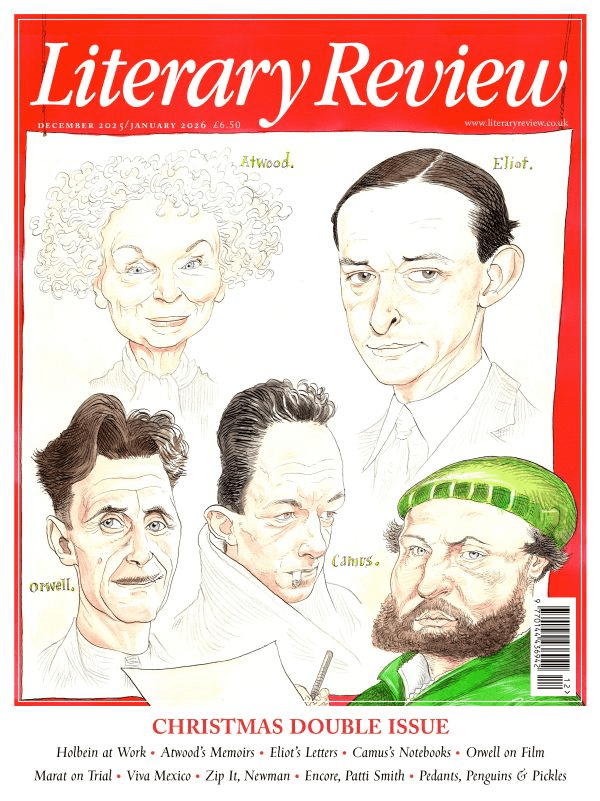
LITERARY REVIEW : The latest issue features ‘Mysteries of Marlowe’

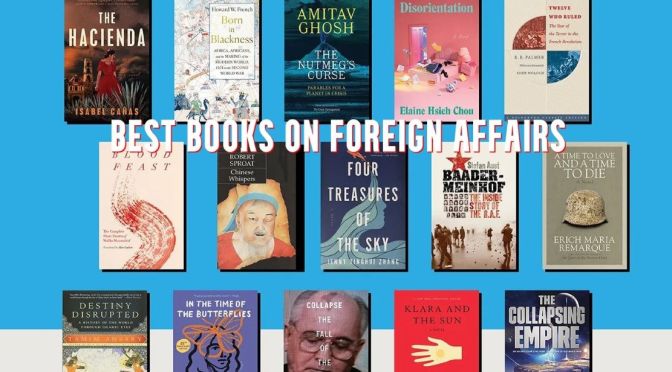
Dark Renaissance: The Dangerous Times and Fatal Genius of Shakespeare’s Greatest Rival, Christopher Marlowe By Stephen Greenblatt
The Boundless Deep: Young Tennyson, Science, and the Crisis of Belief By Richard Holmes
A Scandal in Königsberg, 1835–1842 By Christopher Clark

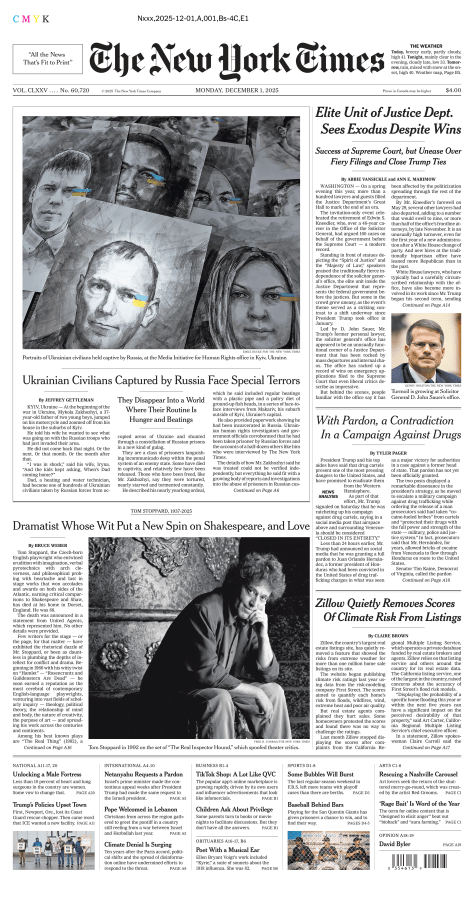
THE NEW YORK TIMES – TUESDAY, SEPTEMBER 2, 2025

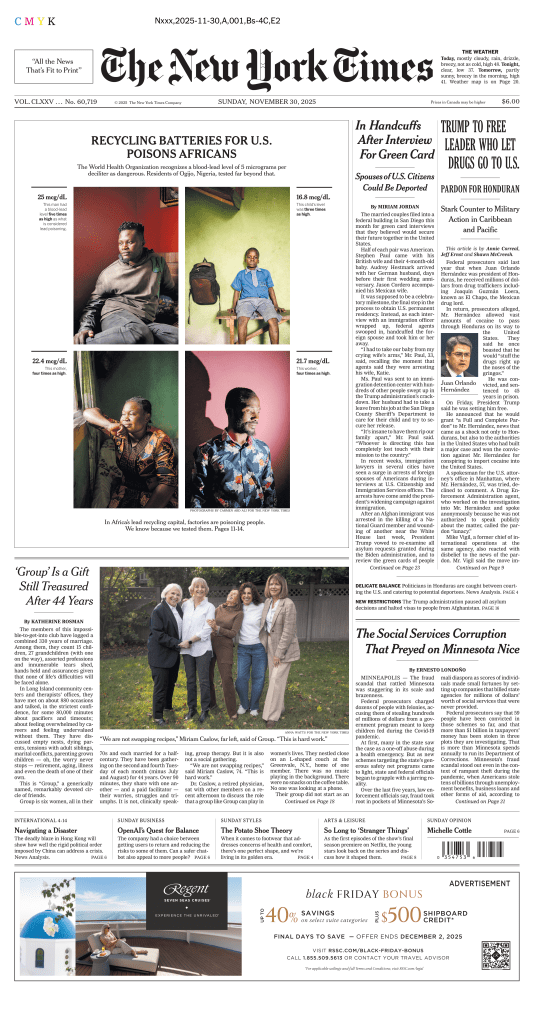
Judge Says Trump’s L.A. Troop Deployment Was Illegal

A federal judge said President Trump had violated the law with his deployment of thousands of Marines and National Guard troops to Los Angeles in June.

White House Counsel Eases Trump’s Path on Aggressive Agenda

David Warrington, the top lawyer inside the West Wing, focuses on “the art of the possible,” as one adviser to President Trump said.

Ukraine Pursues a Weapons Buildup More Potent Than Any Security Guarantee

Kyiv sees a well-equipped army as a stronger deterrent to Moscow than Western pledges to defend it. It is working to attract billions to buy more arms.

Putin and Xi Invoke Wartime Unity as They Hail Ties in Beijing

The Russian and Chinese leaders drew on a shared view of their countries’ roles in World War II to cast their current partnership as a challenge to the West.

APOLLO MAGAZINE – SEPTEMBER 2025

September 2025

APOLLO MAGAZINE: The latest issue features The singular art of Georges de La Tour | Britain’s place in the soft-power race | Alec Cobbe’s masterful collecting | the Mona Lisa of medieval manuscripts

When American modernism planted its flag in London

Eero Saarinen’s US embassy building in Mayfair has long been undervalued, but its conversion into a luxury hotel may help revive its reputation

When British sculpture became modern

Henry Moore and Barbara Hepworth are ever in demand, but the market for their lesser-known contemporaries is growing too


Élisabeth Vigée Le Brun’s Roman holiday

While exiled in the city, Marie Antoinette’s favourite artist stuck up a close friendship with her own idol, Angelica Kauffman

THE NEW YORK TIMES – MONDAY, SEPTEMBER 1, 2025

Xi, Modi and Putin Clasp Hands in a Rare Show of Unity

At a summit, the leaders of China, India and Russia projected an alternative to U.S. global leadership, even as serious differences among them remain.

India Was the Economic Alternative to China. Trump Ended That.

A lurch in policy has shaken the India-U.S. economic alliance against China, leaving India little choice but to consider reversing its own strategy.

Earthquake in Afghanistan Leaves More Than 800 Dead

The quake, near the border with Pakistan, injured more than 2,500 people, the authorities said. The death toll was expected to rise.

What to Know About the Earthquake

With Drones and I.E.D.s, Mexico’s Cartels Adopt Arms of Modern War

Under pressure from the government and each other, some of Mexico’s most powerful criminal groups are amassing homemade mortars, land mines, rocket-propelled grenades and bomber drones.

TOMORROW’S INNER VOICE

The wager has always been our way of taming uncertainty. But as AI and neural interfaces blur the line between self and market, prediction may become the very texture of consciousness.

By Michael Cummins, Editor, August 31, 2025

On a Tuesday afternoon in August 2025, Taylor Swift and Kansas City Chiefs tight end Travis Kelce announced their engagement. Within hours, it wasn’t just gossip—it was a market. On Polymarket and Calshi, two of the fastest-growing prediction platforms, wagers stacked up like chips on a velvet table. Would they marry before year’s end? The odds hovered at seven percent. Would she release a new album first? Forty-three percent. By Thursday, more than $160,000 had been staked on the couple’s future, the most intimate of milestones transformed into a fluctuating ticker.

It seemed absurd, invasive even. But in another sense, it was deeply familiar. Humans have always sought to pin down the future by betting on it. What Polymarket offers—wrapped in crypto wallets and glossy interfaces—is not a novelty but an inheritance. From the sheep’s liver read on a Mesopotamian altar to a New York saloon stuffed with election bettors, the impulse has always been the same: to turn uncertainty into odds, chaos into numbers. Perhaps the question is not why people bet on Taylor Swift’s wedding, but why we have always bet on everything.


The earliest wagers did not look like markets. They took the form of rituals. In ancient Mesopotamia, priests slaughtered sheep and searched for meaning in the shape of livers. Clay tablets preserve diagrams of these organs, annotated like ledgers, each crease and blemish indexed to a possible fate.

Rome added theater. Before convening the Senate or marching to war, augurs stood in public squares, staffs raised to the sky, interpreting the flight of birds. Were they flying left or right, higher or lower? The ritual mattered not because birds were reliable but because the people believed in the interpretation. If the crowd accepted the omen, the decision gained legitimacy. Omens were opinion polls dressed as divine signs.

In China, emperors used lotteries to fund walls and armies. Citizens bought slips not only for the chance of reward but as gestures of allegiance. Officials monitored the volume of tickets sold as a proxy for morale. A sluggish lottery was a warning. A strong one signaled confidence in the dynasty. Already the line between chance and governance had blurred.

By the time of the Romans, the act of betting had become spectacle. Crowds at the Circus Maximus wagered on chariot teams as passionately as they fought over bread rations. Augustus himself is said to have placed bets, his imperial participation aligning him with the people’s pleasures. The wager became both entertainment and a barometer of loyalty.

In the Middle Ages, nobles bet on jousts and duels—athletic contests that doubled as political theater. Centuries later, Americans would do the same with elections.


From 1868 to 1940, betting on presidential races was so widespread in New York City that newspapers published odds daily. In some years, more money changed hands on elections than on Wall Street stocks. Political operatives studied odds to recalibrate campaigns; traders used them to hedge portfolios. Newspapers treated them as forecasts long before Gallup offered a scientific poll.

Henry David Thoreau, wry as ever, remarked in 1848 that “all voting is a sort of gaming, and betting naturally accompanies it.” Democracy, he sensed, had always carried the logic of the wager.

Speculation could even become a war barometer. During the Civil War, Northern and Southern financiers wagered on battles, their bets rippling into bond prices. Markets absorbed rumors of victory and defeat, translating them into confidence or panic. Even in war, betting doubled as intelligence.

London coffeehouses of the seventeenth century were thick with smoke and speculation. At Lloyd’s Coffee House, merchants laid odds on whether ships returning from Calcutta or Jamaica would survive storms or pirates. A captain who bet against his own voyage signaled doubt in his vessel; a merchant who wagered heavily on safe passage broadcast his confidence.

Bets were chatter, but they were also information. From that chatter grew contracts, and from contracts an institution: Lloyd’s of London, a global system for pricing risk born from gamblers’ scribbles.

The wager was always a confession disguised as a gamble.


At times, it became a confession of ideology itself. In 1890s Paris, as the Dreyfus Affair tore the country apart, the Bourse became a theater of sentiment. Rumors of Captain Alfred Dreyfus’s guilt or innocence rattled markets; speculators traded not just on stocks but on the tides of anti-Semitic hysteria and republican resolve. A bond’s fluctuation was no longer only a matter of fiscal calculation; it was a measure of conviction. The betting became a proxy for belief, ideology priced to the centime.

Speculation, once confined to arenas and exchanges, had become a shadow archive of history itself: ideology, rumor, and geopolitics priced in real time.

The pattern repeated in the spring of 2003, when oil futures spiked and collapsed in rhythm with whispers from the Pentagon about an imminent invasion of Iraq. Traders speculated on troop movements as if they were commodities, watching futures surge with every leak. Intelligence agencies themselves monitored the markets, scanning them for signs of insider chatter. What the generals concealed, the tickers betrayed.

And again, in 2020, before governments announced lockdowns or vaccines, online prediction communities like Metaculus and Polymarket hosted wagers on timelines and death tolls. The platforms updated in real time while official agencies hesitated, turning speculation into a faster barometer of crisis. For some, this was proof that markets could outpace institutions. For others, it was a grim reminder that panic can masquerade as foresight.

Across centuries, the wager has evolved—from sacred ritual to speculative instrument, from augury to algorithm. But the impulse remains unchanged: to tame uncertainty by pricing it.


Already, corporations glance nervously at markets before moving. In a boardroom, an executive marshals internal data to argue for a product launch. A rival flips open a laptop and cites Polymarket odds. The CEO hesitates, then sides with the market. Internal expertise gives way to external consensus. It is not only stockholders who are consulted; it is the amorphous wisdom—or rumor—of the crowd.

Elsewhere, a school principal prepares to hire a teacher. Before signing, she checks a dashboard: odds of burnout in her district, odds of state funding cuts. The candidate’s résumé is strong, but the numbers nudge her hand. A human judgment filtered through speculative sentiment.

Consider, too, the private life of a woman offered a new job in publishing. She is excited, but when she checks her phone, a prediction market shows a seventy percent chance of recession in her sector within a year. She hesitates. What was once a matter of instinct and desire becomes an exercise in probability. Does she trust her ambition, or the odds that others have staked? Agency shifts from the self to the algorithmic consensus of strangers.

But screens are only the beginning. The next frontier is not what we see—but what we think.


Elon Musk and others envision brain–computer interfaces, devices that thread electrodes into the cortex to merge human and machine. At first they promise therapy: restoring speech, easing paralysis. But soon they evolve into something else—cognitive enhancement. Memory, learning, communication—augmented not by recall but by direct data exchange.

With them, prediction enters the mind. No longer consulted, but whispered. Odds not on a dashboard but in a thought. A subtle pulse tells you: forty-eight percent chance of failure if you speak now. Eighty-two percent likelihood of reconciliation if you apologize.

The intimacy is staggering, the authority absolute. Once the market lives in your head, how do you distinguish its voice from your own?

Morning begins with a calibration: you wake groggy, your neural oscillations sluggish. Cortical desynchronization detected, the AI murmurs. Odds of a productive morning: thirty-eight percent. Delay high-stakes decisions until eleven twenty. Somewhere, traders bet on whether you will complete your priority task before noon.

You attempt meditation, but your attention flickers. Theta wave instability detected. Odds of post-session clarity: twenty-two percent. Even your drifting mind is an asset class.

You prepare to call a friend. Amygdala priming indicates latent anxiety. Odds of conflict: forty-one percent. The market speculates: will the call end in laughter, tension, or ghosting?

Later, you sit to write. Prefrontal cortex activation strong. Flow state imminent. Odds of sustained focus: seventy-eight percent. Invisible wagers ride on whether you exceed your word count or spiral into distraction.

Every act is annotated. You reach for a sugary snack: sixty-four percent chance of a crash—consider protein instead. You open a philosophical novel: eighty-three percent likelihood of existential resonance. You start a new series: ninety-one percent chance of binge. You meet someone new: oxytocin spike detected, mutual attraction seventy-six percent. Traders rush to price the second date.

Even sleep is speculated upon: cortisol elevated, odds of restorative rest twenty-nine percent. When you stare out the window, lost in thought, the voice returns: neural signature suggests existential drift—sixty-seven percent chance of journaling.

Life itself becomes a portfolio of wagers, each gesture accompanied by probabilities, every desire shadowed by an odds line. The wager is no longer a confession disguised as a gamble; it is the texture of consciousness.


But what does this do to freedom? Why risk a decision when the odds already warn against it? Why trust instinct when probability has been crowdsourced, calculated, and priced?

In a world where AI prediction markets orbit us like moons—visible, gravitational, inescapable—they exert a quiet pull on every choice. The odds become not just a reflection of possibility, but a gravitational field around the will. You don’t decide—you drift. You don’t choose—you comply. The future, once a mystery to be met with courage or curiosity, becomes a spreadsheet of probabilities, each cell whispering what you’re likely to do before you’ve done it.

And yet, occasionally, someone ignores the odds. They call the friend despite the risk, take the job despite the recession forecast, fall in love despite the warning. These moments—irrational, defiant—are not errors. They are reminders that freedom, however fragile, still flickers beneath the algorithm’s gaze. The human spirit resists being priced.

It is tempting to dismiss wagers on Swift and Kelce as frivolous. But triviality has always been the apprenticeship of speculation. Gladiators prepared Romans for imperial augurs; horse races accustomed Britons to betting before elections did. Once speculation becomes habitual, it migrates into weightier domains. Already corporations lean on it, intelligence agencies monitor it, and politicians quietly consult it. Soon, perhaps, individuals themselves will hear it as an inner voice, their days narrated in probabilities.

From the sheep’s liver to the Paris Bourse, from Thoreau’s wry observation to Swift’s engagement, the continuity is unmistakable: speculation is not a vice at the margins but a recurring strategy for confronting the terror of uncertainty. What has changed is its saturation. Never before have individuals been able to wager on every event in their lives, in real time, with odds updating every second. Never before has speculation so closely resembled prophecy.

And perhaps prophecy itself is only another wager. The augur’s birds, the flickering dashboards—neither more reliable than the other. Both are confessions disguised as foresight. We call them signs, markets, probabilities, but they are all variations on the same ancient act: trying to read tomorrow in the entrails of today.

So the true wager may not be on Swift’s wedding or the next presidential election. It may be on whether we can resist letting the market of prediction consume the mystery of the future altogether. Because once the odds exist—once they orbit our lives like moons, or whisper themselves directly into our thoughts—who among us can look away?

Who among us can still believe the future is ours to shape?

THIS ESSAY WAS WRITTEN AND EDITED UTILIZING AI

THE NEW YORK TIMES – SUNDAY, AUGUST 31, 2025

In Trump’s Federal Work Force Cuts, Black Women Are Among the Hardest Hit

President Trump has cut hundreds of thousands of jobs from the federal work force, disproportionately affecting Black employees.

Judge Temporarily Blocks U.S. Efforts to Deport Guatemalan Children

The ruling came hours after some shelters were directed to prepare children to be sent back to Guatemala. A hearing was scheduled for this afternoon.

Xi Uses Summit, Parade and History to Flaunt China’s Global Pull

With the leaders of Russia and India visiting, Xi Jinping will show how he can use statecraft, military might and history to push for global influence.

America Closed Malls, but China Kept Building Them. Now It Has Too Many.

The first closing of an Apple Store in mainland China hints at broader troubles facing the country’s shopping malls as developers open more of them.

Russian Strikes on Western Assets in Ukraine Send an Ominous Message

Hitting a U.S.-run factory and European offices, the Kremlin appeared to signal that it would resist Western peace efforts, analysts and officials said.

SHADOW GOVERNANCE, ACCELERATED

How an asynchronous presidency exploits the gap between platform time and constitutional time to bend institutions before the law can catch up.

By Michael Cummins, Editor, August 30, 2025

On a sweltering August afternoon in Washington, the line to the federal courthouse wraps around the block like a nervous necklace. Heat shimmers off the stone; gnats drift in lazy constellations above the security checkpoint. Inside, air-conditioning works harder than dignity, and the benches fill with reporters who’ve perfected the face that precedes calamity. A clerk calls the room to order. The judge adjusts her glasses. Counsel step to the lectern as if crossing a narrow bridge over fast water. Then the question—plain, improbable—arrives: can a president’s social-media post count as legal notice to fire a governor of the Federal Reserve?

What does it mean when the forum for that answer is a courtroom and the forum for the action was a feed? The gulf is not merely spatial. One realm runs on filings, exhibits, transcripts—the slow grammar of law. The other runs on velocity and spectacle, where a single post can crowd out a dozen briefings. The presidency has always tested its borders, but this one has learned a new technique: act first in public at speed; force the law to catch up in private at length. It is power practiced asynchronously—governance that unfolds on different clocks, with different rewards.

Call it latency as strategy. Declare a cause on a platform; label the declaration due process; make the firing a fact; usher the lawyers in after to domesticate what has already happened. The point is not to win doctrine immediately. The point is to harvest the days and weeks when a decision stands as reality while the courts begin their pilgrimage toward judgment. If constitutional time is meticulous, platform time is ruthless, and the space between them is policy.

In the hearing, the administration’s lawyer stands to argue that the Federal Reserve Act says “for cause” and leaves the rest to the president’s judgment. Why, he asks, should a court pour old meanings into new words? The statutory text is lean; executive discretion is broad. On the other side, counsel for Lisa Cook speaks a language almost quaint in the rapid glare of the moment: independence, notice, a chance to be heard—dignities that exist precisely to slow the hand that wields them. The judge nods, frowns, asks what independence means for an institution the law never designed to be dragged at the pace of a trending topic. Is the statute a rail to grip, or a ribbon to stretch?

When the hearing breaks, the stream outside is already three headlines ahead. Down the hill, near the White House, a combat veteran strikes a match to the hem of a flag. Fire crawls like handwriting. Two hours earlier, the president signed an executive order urging prosecutions for acts of flag “desecration” under “content-neutral” laws—no frontal attack on the First Amendment’s protection of symbolic speech, only an invitation to ticket for the flame, not the message. Is that a clever accommodation to precedent, or a dare?

The veteran knows the history; anyone who has watched the long argument over Texas v. Johnson does. The Supreme Court has repeatedly said that burning the flag as protest, however detestable to many, is speech. Yet symbolic speech lives in real space, and real space has ordinances: no open flames without a permit, no fires on federal property, no damage to parks. The order makes a temporal bet: ticket now; litigate later. The government may lose the grand constitutional fight, but it may win smaller battles quick enough to chill an afternoon’s protest. In the gap between the moment and the merits, who blinks first?

Back at the courthouse, a reporter asks a pragmatic question: even if the president can’t fire a Fed governor for mere allegations, will any of this matter for interest rates? Not in September, the expert shrugs. The committee is larger than one vote, dissent is rare. But calendars have leverage. February—when reappointments can shift the composition of the body that sets the price of money—looms larger than any single meeting. If the decision remains in place long enough, the victory is secured by time rather than law. Isn’t that the whole design?

Administration lawyers never say it so plainly. They don’t have to. The structure does the talking. Announce “cause” in a forum that rewards proclamation; treat the announcement as notice; act; then invite the courts to reverse under emergency standards designed to be cautious. Even a win for independence later may arrive late enough to be moot. In the arithmetic of acceleration, delay is not neutral; it is bounty.

If this sounds like a single episode, it is not. The same rhythm animates the executive order on flag burning. On paper, it bows to precedent; in practice, it asks police and prosecutors to find neutral hooks fast enough to produce a headline, a citation, an arrest photo. Months later, the legal machine may say, as it must, that the burning was protected and the charge pretextual. But how many will light a match the next day, knowing the ticket will be instant and the vindication slow?

And it animates something quiet but immense: the cancellation of thousands of research grants at the National Institutes of Health because proposals with words like “diversity,” “equity,” or “gender” no longer fit the administration’s politics. A district judge calls the cuts discriminatory. On the way to appeal, the litigation splits like a river around a rock: one channel to test the legality of the policy guidance, another to ask for money in a tribunal known mostly to contractors and procurement lawyers. The Supreme Court steps in on an emergency basis and says, for now, the money shouldn’t flow. Why should taxpayers pay today for projects that might be unlawful tomorrow?

Because science does not pause on command. Because a lab is not a spreadsheet but a choreography of schedules and salaries and protocols that cannot be put on ice for a season. Because a freeze that looks tidy in a docket entry becomes layoffs and abandoned lines of research in ordinary rooms with humming incubators. The Court’s concern is neat—what if the government cannot claw back dollars later?—but the neatness ignores what time does to fragile ecosystems. What is a remedy worth when the experiment that needed it has already died?

It is tempting to divide all this along ideological lines, to tally winners and losers as if the story were primarily about whose agenda prevails. But ideology is not the tool that fits. Time is. One clock measures orders, posts, firings, cancellations—the moves that define a day’s narrative. Another measures notice, hearing, record, reason—the moves by which a republic persuades itself that force has been tamed by law. When the first clock is always fast and the second is always slow, acceleration becomes a kind of authority in itself. Isn’t that the simplest way to understand what’s happening—that speed is taking up residence where statute once did?

Consider again the hearing. The administration’s brief is lean, the statute is shorter still, and the claim is stark: “for cause” is what the president says it is. To demand more—to import the old triad of “inefficiency, neglect of duty, or malfeasance in office,” to insist on a pre-removal process—is, in this telling, to romanticize independence and hobble accountability. Yet independence is not romance. It is architecture—an effort to keep central banking from becoming another branch of daily politics. If “for cause” becomes a slogan that can be made true after the fact by the simple act of saying it early and everywhere, what remains of the cordon the law tried to draw?

The judge knows this, and also knows the constraints of her role. Emergency relief is meant to preserve the status quo, not rewrite the world. But what is the status quo when the action has already been taken? How do you freeze a river that has been diverted upstream? The presidency practices motion, and then asks the judiciary for patience. Can a court restore a person to an office as easily as a timeline restored a post? Can an injunction rewind a vote composition that turned while the case wound its way forward?

Meanwhile, in the park across from the White House, the veteran’s fire has gone out. The citations are not for speech, officials insist, but for the flame and the scarring of public property. Somewhere between these statements and the executive order that prompted them sits the puzzle of pretext. If a president announces that he seeks to stop a type of speech and urges prosecutors to deploy neutral laws to do so, isn’t the neutrality already contaminated? The doctrine can handle the distinction. But the doctrine’s victory will arrive, at best, months later, and the message lands now: the state is watching, and the nearest hook will serve.

The research world hears its own version of that message. Grants are not gifts; they are contracts, explicit commitments that enable work across years. When a government cancels them mid-stream for political reasons and the courts respond by asking litigants to queue in separate lines—legality here, money there—the signal is not subtle. A promise from the state is provisional. A project can become a pawn. If the administration can accelerate the cut, and the law can only accelerate the analysis, who chooses a life’s work inside such volatility?

There are names for this pattern that sound technocratic—“latency arbitrage,” “platform time versus constitutional time”—and they are accurate without being sufficient. The deeper truth is simpler: a republic’s most reliable tools to restrain power are exactly the tools an accelerated executive least wants to use. Notice means warning; hearing means friction; record means reasons; reason means vulnerability. If you can do without them today and answer for their absence tomorrow, why wouldn’t you?

Well, because the institutions you bend today may be the ones you need intact when the wind shifts. A central bank nudged toward loyalty ceases to be ballast in a storm and becomes a sail. A public square patrolled by pretext breeds fewer peaceful protests and more brittle ones. A research ecosystem that learns that politics can zero out the future will deliver fewer cures and more exits. Isn’t it a curious form of victory that leaves you poorer in the very capacities that make governing possible?

Which brings the story back, inevitably, to process. Process is dull in the way bridges are dull—unnoticed until they fail. The seduction of speed lies in its drama: the crispness of the order, the sting of the arrest, the satisfying finality of a cancellation spreadsheet. Process is the opposite of drama. It is the insistence that power is obliged to explain itself before it acts, to create a record that can be tested, to bear, on the front end, the time it would rather push to the back. Why does that matter now? Because the tactic on display is not merely to defeat process, but to displace it—to make its protections arrive as afterthoughts, paper bandages for facts on the ground.

There are ways to close the gap. The law can require that insulated offices come with front-loaded protections: written notice of cause, an opportunity to respond, an on-the-record hearing before removal becomes effective, and automatic temporary relief if the dispute proceeds to court. The Department of Justice can be made to certify, in writing and in real time, that any arrest touching expressive conduct was green-lighted without regard to viewpoint, and courts can be given an expedited path to vacate citations when pretext is shown—not in a season, but in a week. Mid-cycle grant cancellations can trigger bridge funding and a short status-quo injunction as the default, with the government bearing the burden to prove genuine exigency. Even the Supreme Court can add small guardrails to its emergencies: reasoned, public minutes; sunset dates that force merits briefing on an actual clock rather than letting temporary orders congeal into policy by inertia. Would any of this slow governance? Yes. That is the point.

These are technical moves to answer a political technique, temporal fixes for a temporal hack. They do not hobble the presidency; they resynchronize it with the law. More than doctrine, they aim to withdraw the dividend that acceleration now pays: the days and weeks when action rules unchallenged simply because it happened first.

The images persist. A clerk emerges from chambers carrying two cardboard boxes heavy enough to bow in the middle: motions, exhibits, transcripts—the record, dense and unglamorous, the way reality usually is. The clerk descends the marble steps carefully because there is no other way to do it without spilling the case on the stairs. Across town, another draft order blinks on a screen in a bright room. One world moves on arms and gravity; the other moves on keystrokes and publish buttons. Which will shape the country more?

It is easy to say the law can win on the merits—often, it can. It is harder to say the law can win on time. If we let the presidency define the day with a cascade of acts and then consign the republic’s answer to months of briefs and polite argument, we will continue to confuse the absence of immediate correction with consent. The choice is not between nimbleness and stodginess; it is between a politics that cashes the check before anyone can read it and a politics that pauses long enough to ask what the money is for.

And so, one more question, the kind that lingers after the cameras have left: in a government becoming fluent in acceleration, can we persuade ourselves that synchronization is not obstruction but care? The future of independence, of speech, of public knowledge may turn less on who writes the next order than on whether we are willing to match speed with proportionate process—so that when power moves fast, law is not a distant echo but a present tense. Outside the courthouse, the air is still hot. The boxes are still heavy. The steps are still steep. There is a way to carry them, and there is a way to drop them, and the difference, just now, is the measure of our self-government.

THIS ESSAY WAS WRITTEN AND EDITED UTILIZING AI

THE NEW YORK TIMES MAGAZINE – August 31, 2025

Current cover

THE NEW YORK TIMES MAGAZINE: The 8.31.25 Issue features Nathiel Rich on the Calabasas landfill following the Los Angeles fires; Scott Anderson on Georgia’s turn toward Russia; Marcela Valdes on in-home care for disabled Americans; and more.

What Does It Take to Get Men to See a Doctor?

Men in the United States live around five years less than women. One clinic is trying to persuade men that getting checked out could save their life. By Helen Ouyang

The Gold Digger Was an Archvillain. Now She’s an Aspiration.

What do men and women really want in our fraught new mating economy?

The New Dream Guy Is Beefy, Placid and … Politically Ambiguous

Amid pitched debates about masculinity, the “himbo” stands stoically above it all. By Casey Michael Henry

News, Views and Reviews For The Intellectually Curious