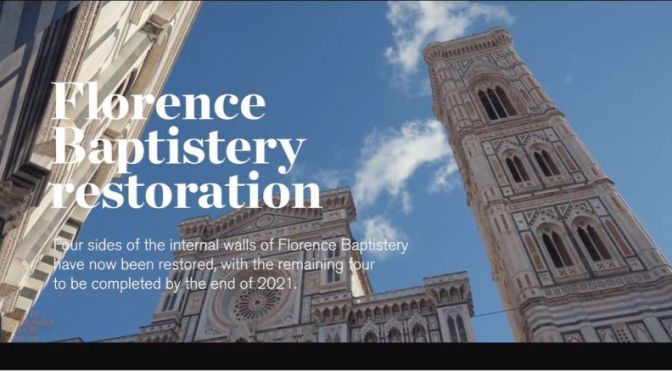
Travel & Architecture: 14th Century Florence Baptistery Restoration

Four sides of the internal walls of Florence Baptistery have been restored, with the remaining four to go by the end of 2021. “Here come all those who wish to see admirable things” is the English translation of the words set in the marble inlay of the floor of Florence’s baptistery, as visitors enter through the Gates of Paradise.

These worthy items include the fourteenth-century mosaics depicting prophets, bishops and cherubs, which are enjoying renewed vigour after the restoration of four of the eight sides of Florence’s oldest monument. The internal walls of the baptistery began to be restored towards the end of 2017 following a restoration campaign on the external walls and roof.

Many discoveries emerged from the diagnostics, the first of their kind to be conducted on the monument, including the original technique used in the parietal mosaics; the presence of a pigmented wax on the green Prato marble, used to cover the white limestone that had formed due to water coming in through the roof, now removed to reveal the stone’s natural hue; and traces of gold leaf on one of the capitals of the matroneum, which could form evidence that the capitals were all originally covered in gold leaf.

In the first couple of decades of the fourteenth century, having completed the colossal feat of the mosaics inside the baptistery’s dome, the decision was made to extend the technique to the parietal sides, something that wasn’t part of the original plans.

It was a solution that allowed the mosaics to be superimposed over the marble covering and solve the issue of the monument’s static nature. Made-to-measure hollow terracotta tiles were used, cut and fixed to the marble on the baptistery’s walls with central iron linchpins driven back and welded in a straight line.

“A hurried sinopia was then conducted on the tiles and later the mosaic with a direct method and over days, which can still be identified and interpreted today,” explained Beatrice Agostini, planner and head of the restoration campaign of Opera di Santa Maria del Fiore. “Even the mixture used to apply the mosaic tiles is absolutely unique. Ordinary mortar wasn’t used. Instead it was more of a glue, and it’s the decline of this compound that has caused the most problems in this restoration.”
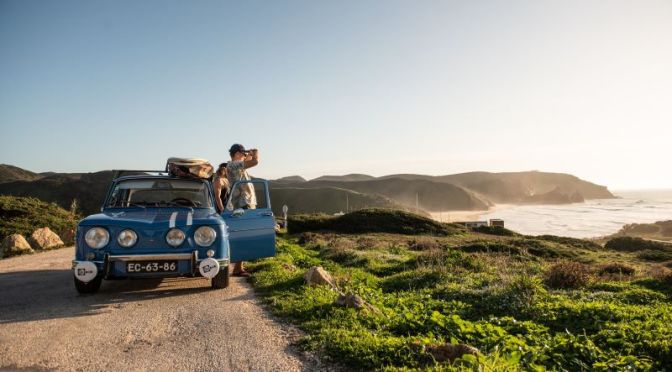

Classic Car Roadtrip: 1968 Renault 8 Gordini – Lisbon To Algarve In Portugal

In the late 1960s, Portuguese racing driver Heitor de Moraes took his Renault 8 Gordini from Corsica to Poland, rallying all across Europe. Now, the ocean blue car has found a new owner and a new sportive duty – carrying surfboards in style from Lisbon to the Algarve.

22 January 2021

The year was 1968: six years before the so-called ‘Carnation Revolution’. Life in Portugal at that time could be tough. Not for Heitor de Moraes, though: this was the year he became the first owner of a pretty special blue car. Fast-forward to 2020, and another chapter of the car’s history was written, with its third owner also driving it along the curving roads of southern Portugal. Only this time, with surfboards on the roof.

The car was purchased from Timeless Garage in Lisbon (which had carried out a full restoration) and that’s why the story you see in the pictures starts there. A few days later, after some small mechanical corrections and a surfboard roof rack installation, the real mission began: the blue car hit the curves of the Algarve once again. It quickly became clear that even after more than 50 years, Amédée Gordini’s great engineering talent still shines through.

Read full article in Classic Driver

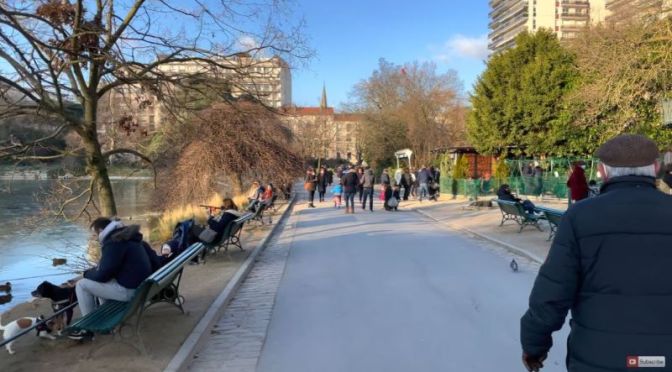
Walks: ‘Parc Montsouris’ In South Paris (4K Video)

Filmed in January 2021 with Iphone 12 Pro.

The Parc Montsouris covers 15 hectares and is built on top of a labyrinth of former gypsum quarries from the Montrouge mines.

These quarries were made into catacombs at the end of the 18th century and filled with 5-6 million bones from discontinued cemeteries of Paris.

The name of the park is derived from the old name of the area “Moquesouris” translated as “mock mouse”. It was a place of mills which generally attract mice. Later, these mills were abandoned.

The area is also the place of the 13th century legend of the giant Isoire being slain by Guillaume d’Aquitaines.

Ocean Wildlife: ‘Marine Iquanas’ Of The Galápagos Islands (BBC Earth Video)

This sea-diving lizard only has 30 minutes to search for food before his muscles seize up.

The marine iguana, also known as the sea iguana, saltwater iguana, or Galápagos marine iguana, is a species of iguana found only on the Galápagos Islands. Unique among modern lizards, it is a marine reptile that has the ability to forage in the sea for algae, which makes up almost all of its diet. 

The Galápagos Islands is a volcanic archipelago in the Pacific Ocean. It’s considered one of the world’s foremost destinations for wildlife-viewing. A province of Ecuador, it lies about 1,000km off its coast. Its isolated terrain shelters a diversity of plant and animal species, many found nowhere else. Charles Darwin visited in 1835, and his observation of Galápagos’ species later inspired his theory of evolution.

Extreme Views: Skydivers Fly Down ‘The Streif’ In Kitzbuhel, Austria (Video)

Red Bull Skydive Team flies over the world’s most difficult downhill ski slope: The Streif in Kitzbuhel, Austria!


Speeding over the legendary downhill course of the Streif, the Red Bull Skydive Team, of Max Manow, Felix Seifert, Marco Fürst and Marco Waltenspiel, executed a world first flight over the revered track. They all knew it from watching the ski race as children and having now experienced its steepness and dramatic turns from above, their respect for the ski pros that ride it has grown exponentially. “The fact that we were able to fly past the Mausefalle and Hausbergkante with the Wingsuit shows how steep it must be there,” says Marco Fürst enthusiastically after the flight. “That must be just brutal to ski down. It’s not the hardest race in the world for nothing!”

Timelapse: ‘Mountains Of Northern Norway’ (4K)

Filmed and Edited by: Night Light Films

What makes northern Norway so unique, mystical and fairy-tale like? It is undeniably its mountains. ‘Fjellan’ means ‘the mountain’ or ‘the mountains’ in local dialect. I wanted to pay a tribute to some of the most iconic peaks of this part of the country.

You can find all types of mountains in northern Norway. While some are more like rolling hills, others are jaw-dropping, sharply triangular peaks that rise directly from the bottom of fjords. But what they all have in common is their ability to feed our imagination. People usually see many shapes and figures in them, including animals, soldiers, sleeping giants or even trolls!

This short film consists of a mixture of timelapse and real-time sequences taken over the past 3 years in the Troms area. 

Train Travel: Countryside Around ‘Mt. Fuji, Japan’

Take a trip back in time and trace the paths of past travelers in the post towns and sacred spaces found in the majestic mountains of the Japanese countryside.

Japan’s Mt. Fuji is an active volcano about 100 kilometers southwest of Tokyo. Commonly called “Fuji-san,” it’s the country’s tallest peak, at 3,776 meters. A pilgrimage site for centuries, it’s considered one of Japan’s 3 sacred mountains, and summit hikes remain a popular activity. Its iconic profile is the subject of numerous works of art, notably Edo Period prints by Hokusai and Hiroshige.

Walks: ‘Mittenwald’ In Bavaria, Germany (Video)

Mittenwald is a town amid the Alpine peaks of Bavaria, Germany. It’s known for its colorful painted houses and its violin-making history, documented in the central Geigenbaumuseum. The 18th-century St. Peter and St. Paul Church is famed for its colorful frescoes. To the west, forested paths pass Lautersee Lake and the Laintal waterfall. In the northwest, Hoher Kranzberg’s slopes have trails and lookouts.

Timeline: 0:00​ Train Station 1:20​ Towards the Town Centre 6:00​ Mittenwald Town Centre – Obermarkt Southern Direction 12:00​ Mittenwald Town Centre – Obermarkt Northern Direction 17:30​ Northern Mittenwald 25:40​ Around the Violin Museum 28:50​ Outer Town Centre

Walks: ‘Thames Town’ In Shanghai, China (4K Video)

Thames Town is a new town in Songjiang District, about 30 kilometres from central Shanghai. It is named after the River Thames in London, United Kingdom. The architecture is themed according to classic British market town styles. There are cobbled streets, Victorian terraces, corner shops and red telephone boxes.

Filmed on January 2nd, 2020.

Video timeline: 00:00​ Preview 00:24​ Starting Point 00:32​ Songjiang District / 松江区 00:38​ Thames Town / 泰晤士小镇

News, Views and Reviews For The Intellectually Curious