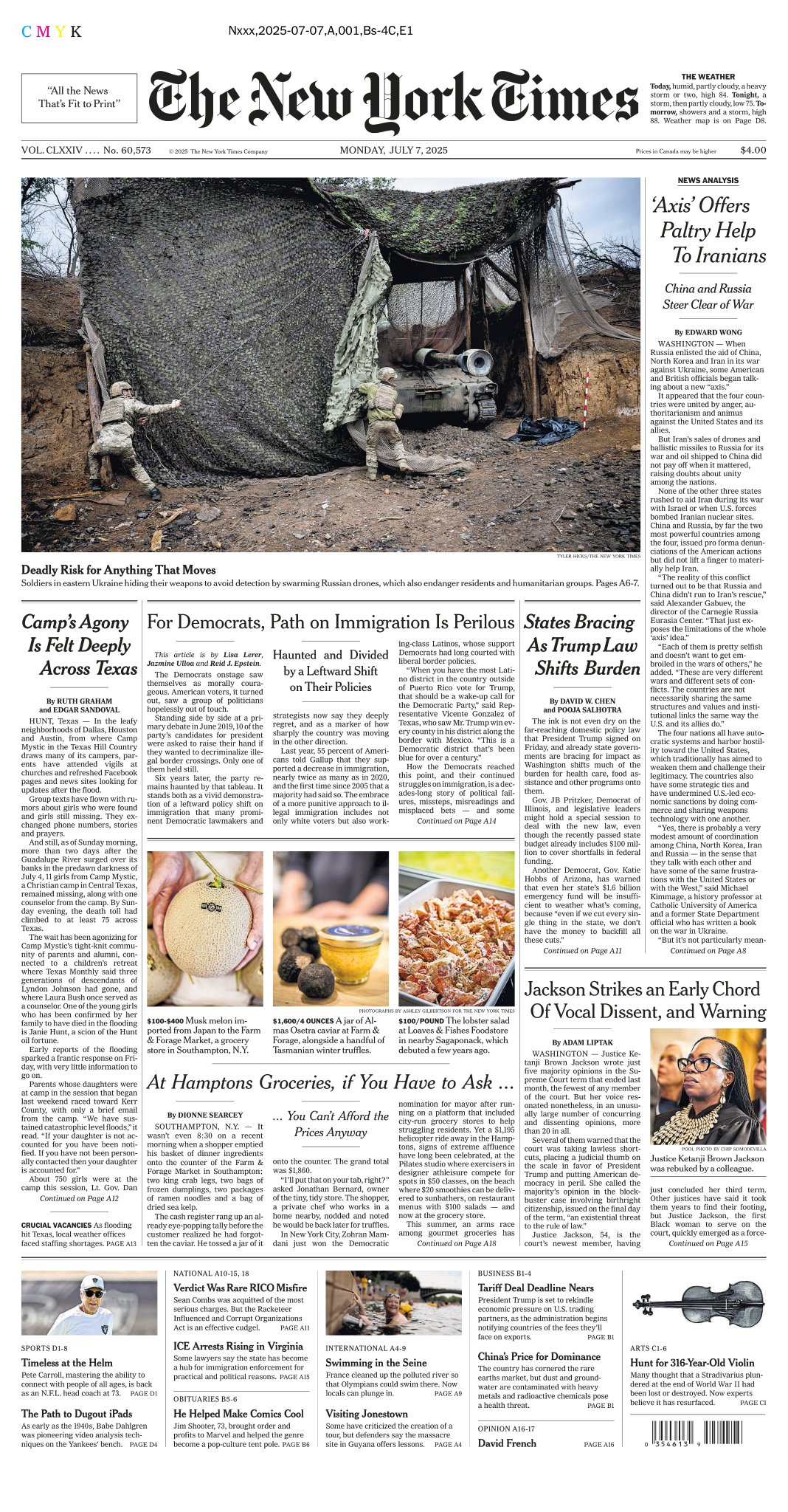
President Trump is considering whether to pursue a new nuclear agreement with Tehran. He is also urging a new cease-fire deal to end the fighting in Gaza.
THE FOLLOWING IS AN “AI REVIEW” OF THE JULY 3 EPISODE OF “BLOOMBERG LAW WITH JUNE GRASSO” PODCAST TRANSCRIPT:
In the dimly lit chambers of American justice, two parallel stories unfolded this term—one involving the cultural phenomenon of Sean “Diddy” Combs, the other the ideological recalibration of the United States Supreme Court. Each, in its own way, exposed the tensions inherent in a legal system grappling with the competing imperatives of moral condemnation, procedural fairness, and the inexorable gravitational pull of politics.
In federal court, Combs emerged, if not unscathed, then improbably triumphant. After six weeks of graphic testimony and the steady drip of lurid detail, jurors acquitted him of the most sensational accusations: racketeering conspiracy and sex trafficking, crimes that, had they stuck, would almost certainly have resulted in a life sentence. Instead, he was convicted only on two counts of transporting sex workers across state lines to participate in what prosecutors termed “freak-off parties.” In the pantheon of celebrity trials, this outcome was remarkable not merely for the verdict itself but for the rhetorical overreach that defined the government’s case.
Robert Mintz, a former federal prosecutor turned defense attorney, spoke to the case’s cautionary lesson about prosecutorial ambition. RICO—the Racketeer Influenced and Corrupt Organizations Act—was never an intuitive fit for Combs, a music mogul whose business dealings, however flamboyant, bore little resemblance to the mafia syndicates the statute was designed to dismantle. In the final analysis, jurors appeared unconvinced that the machinery of Combs’s empire—record labels, promotional companies, an entourage that blurred the line between personal and professional—was itself the instrument of a criminal conspiracy. They were similarly unconvinced that the two women at the heart of the government’s sex trafficking charges had been coerced rather than entangled in a toxic, if mutually complicit, set of relationships.
Perhaps more striking still was the defense’s strategy: they called no witnesses. Rather than counter the government’s narrative with competing testimony, Combs’s lawyers focused their energy on cross-examination, unspooling the contradictions and ambivalences embedded in the prosecution’s evidence. Here, too, lay a broader truth about modern criminal justice. The power to define the contours of the case—the charges themselves—can be as determinative as the evidence marshaled to prove them. When the government chooses to depict a defendant as the capo di tutti capi of an illicit empire, it must persuade a jury not only of wrongdoing but of a sweeping criminality that often strains credulity. When that narrative collapses, as it did here, the defense is left with the simpler task of pointing out the seams.
But Combs’s legal jeopardy is not yet at an end. Though acquitted of the most serious charges, he faces up to twenty years in prison on the counts that remain, even if the federal sentencing guidelines suggest a considerably lower range. The presiding judge, troubled by videotaped evidence of Combs assaulting one of the alleged victims, declined to release him pending sentencing—a reminder that in federal court, the most powerful voice is not the jury’s but the judge’s. It is not inconceivable that the final chapter of this saga will be harsher than the defense’s celebration suggested.
If Combs’s courtroom drama offered a microcosm of prosecutorial overreach, the Supreme Court’s term showcased a more profound shift: a conservative supermajority willing to reconfigure the balance of power between the judiciary and the executive—and, by extension, between individuals and the state. In conversation with constitutional law scholar Michael Dorf, host June Grasso illuminated the breadth of these changes. Over the past year, the Court issued a series of rulings that, taken together, represent a quiet revolution in the way the federal courts interact with presidential authority.
At the heart of this transformation was the Court’s decision to curtail nationwide injunctions—sweeping orders issued by district judges to block federal policies across the entire country. For decades, these injunctions served as a vital mechanism by which civil rights plaintiffs, immigrant communities, and other marginalized groups could halt executive overreach before it inflicted irreparable harm. Their disappearance is no mere procedural adjustment; it recasts the balance between the judiciary’s protective function and the executive’s prerogative to govern unencumbered.
This doctrinal shift accrued almost exclusively to the benefit of President Trump, whose administration had faced a phalanx of legal challenges. Whether the issue was the forced deportation of migrants, the exclusion of transgender Americans from military service, or the elimination of birthright citizenship, the Supreme Court’s majority showed an evident willingness to side with the executive branch on an emergency basis—often with scant explanation. Dorf described this posture as striking not merely for its partisanship but for its inconsistency: lower courts that blocked Trump policies were overruled with alacrity, even as those same justices castigated nationwide injunctions as judicial overreach.
At the same time, the term’s most divisive rulings revealed a Court emboldened to advance a culturally conservative agenda. In a 6-3 decision, the justices upheld Tennessee’s ban on gender-affirming care for minors, dismissing the equal protection claims of transgender plaintiffs and casting doubt on whether such discrimination should trigger heightened constitutional scrutiny. In another ruling, religious parents were granted the right to withdraw their children from public school curricula that included LGBTQ-themed storybooks—a decision that critics warn will invite broader challenges to any teaching that conflicts with sectarian belief. In the aggregate, these rulings did more than roll back hard-won protections for LGBTQ Americans. They signaled a willingness to prioritize religious objections over the rights of vulnerable communities, an alignment that recurred throughout the term.
For Dorf, the most unsettling dimension was not the conservative tilt per se but the Court’s apparent comfort with what he called a “soft authoritarian” style of governance. The Roberts Court had already repealed the constitutional right to abortion and limited the federal government’s capacity to regulate firearms. What distinguished this term was its readiness to facilitate the Trump administration’s disregard for judicial orders—an erosion not of precedent but of the rule of law itself.
Whether these developments portend a lasting reorientation of American jurisprudence remains to be seen. What is clear, however, is that the ideological polarization of the Supreme Court is reshaping the lives of countless citizens in ways that transcend conventional partisanship. In this respect, the travails of Sean Combs and the ambitions of the Roberts Court are, improbably, two facets of the same American story: one in which the legal system’s power to punish and to protect is increasingly mediated by political will—and by the narratives that prevail when the evidence, the law, and the culture clash in the crucible of the courtroom.
Segment 1: The Verdict in Sean “Diddy” Combs’ Case
Guests:
Robert Mintz, former federal prosecutor, partner at McCarter & English
Topics:
Combs’ acquittal on the most serious charges (racketeering, conspiracy, sex trafficking)
Conviction on two lesser felonies (transportation to engage in prostitution)
Defense’s strategy to challenge overcharging
Impact of the 2016 video showing domestic violence
Potential sentencing: between ~2–5 years under guidelines, but judge has broad discretion
Judge’s refusal to release Combs pending sentencing due to danger concerns
Broader implications of prosecutorial overreach and the difficulties of proving coercion in complex, long-term relationships
Segment 2: The Supreme Court Term Review
Guest:
Michael Dorf, constitutional law professor, Cornell Law School
Topics:
The Supreme Court siding repeatedly with the Trump administration
Disbanding nationwide injunctions (limiting checks on executive power)
Facilitating major policy shifts (transgender military ban, deportations, birthright citizenship challenges)
LGBTQ rights decisions:
Upholding Tennessee’s ban on gender-affirming care for minors
Requiring schools to exempt religious families from LGBTQ-inclusive curricula
Concerns about the erosion of protections under equal protection doctrine
Forthcoming cases on transgender sports participation and conversion therapy bans
Second Amendment developments:
Court upholding ghost gun regulations
Declining to broadly immunize gun manufacturers
Signaling possible caution but not reversal of the pro-gun rights direction
Emergency docket criticism:
Pattern of granting Trump administration emergency relief with limited justification
Disregard for procedural norms
Overarching movement:
From traditional conservatism into enabling a more authoritarian style of governance
Summary
This episode of Bloomberg Law, hosted by June Grasso, offered an in-depth analysis of two major legal stories:
1. The Sean “Diddy” Combs Case After a six-week federal trial with emotionally charged testimony, Combs was acquitted of racketeering and sex trafficking but convicted of transporting sex workers across state lines—a felony under the Mann Act. Prosecutors’ strategy to use RICO laws typically reserved for mob cases ultimately backfired, allowing the defense to argue overreach. While the jury found Combs’ conduct disturbing, they did not believe it rose to organized criminal enterprise. Despite securing partial convictions, the prosecution faces criticism for overcharging, which opened avenues for defense cross-examination and ultimately undermined their case. Combs remains in custody as he awaits sentencing, which could be significantly harsher than defense estimates due to the judge’s concerns about continued danger.
2. The Supreme Court’s Term Professor Michael Dorf described a term marked by sweeping decisions that advanced a conservative agenda, often benefiting the Trump administration. The Court stripped lower courts of their ability to issue nationwide injunctions, effectively removing a key check on executive overreach. In LGBTQ cases, the Court upheld bans on gender-affirming care for minors, sided with religious parents seeking exemptions from inclusive curricula, and signaled openness to further limits on trans rights in upcoming cases. While the Court maintained some gun regulations, its overall jurisprudence continues a rightward trajectory, blending traditional conservative principles with deference to Trump’s more aggressive policies. Emergency docket decisions frequently favored the administration without full briefing, raising concerns about procedural fairness and erosion of judicial norms. Ultimately, the Court’s direction was characterized as not just conservative, but increasingly aligned with authoritarian tendencies.
THIS POSTING WAS WRITTEN BY AI AND EDITED BY INTELLICUREAN
The nation is more secure from threats than ever. But the war in Gaza, and attacks on Iran and Lebanon, have undercut its standing among the world’s democracies.
It was not immediately clear whether the group was demanding any significant changes to the plan for a 60-day truce and talks on a permanent end to the war.
Ayatollah Ali Khamenei has not only picked replacements in his chain of military command in case they are killed in Israeli strikes, he has also named three senior clerics to replace him should he, too, be slain.
The senior commander led the force that oversees Iran’s proxy militias in the Middle East. A European diplomatic effort to stop the fighting ended without a breakthrough.
Jubilation and bittersweet tears greeted the end of hostilities in 1945, reports Octavia Pollock.
Mrs Olga Hopkins, Second World War veteran, takes centre stage on this week’s Frontispiece.
The carver, the baker and fancy shoemaker
Jane Wheatley meets some of the craftspeople enhancing the Cotswolds’ standing as a hive of creativity.
‘I am the Marquis of marmite’
Laurence Llewelyn-Bowen is applying his trademark swagger to a new passion for painting, reveals James Fisher.
Nothing lasts forever
Laura Parker reveals in those ‘blink and you’ll miss it’ moments that only Nature can provide.
The Cotswolds never disappoints (above)
Penny Churchill showcases glorious country houses for sale in two ‘golden triangles’.
All set for the Chelsea chop?
This it the time to prune our late-flowering herbaceous perennials — join John Hoyland in wielding the secateurs.
Martina Froth’s favourite painting
The Yale Centre for British Art Director chooses a work tinged with a melancholy sadness.
An estate made public
John Goodall investigates the gradual architectural revolution of Bowood in Wiltshire, a house that boasts a remarkable history.
The legacy
Kate Green pay tribute to Alan Turing, the code cracker who curtailed the Second World War.
The Badminton A-Z (above)
From amateur riders to Zaragoza, Kate Green guides you through the world-class eventing action.
New series: Winging it
The elegant hobby is capable of snatching swallows in flight — Mark Cocker is rapt by raptors.
The good stuff
Hetty Lintell is wowed by watches.
Interiors
Restful bedroom furniture and accessories, with Amelia Thorpe.
London Life
Rosie Paterson reveals how bees are creating a buzz in the capital, our writers have all your need to know this month and Selina Cadell shares her on-stage experiences of the Theatre Royal Drury Lane.
A soft touch
Tiffany Daneff marvels at the flower-filled paradise of Hampnett House in Gloucestershire.
Travel (above)
Emma Love has an eye for adventure, Mark Hedges goes wild on safari in Botswana, Rosie Paterson hits the walking trail in Sri Lanka and Pamela Goodman hail’s Giubbilei’s gardens.
Art and antiques
Simon Finch tells Carla Passino he will not part with his £1 note signed by a Great Train Robber.
One king to rule them all
Mary Miers explores the artistic and cultural legacy of James I.
After decades of conservative leadership, Francis tried to reset the course of the Roman Catholic Church, emphasizing inclusion and care for the marginalized over doctrinal purity.
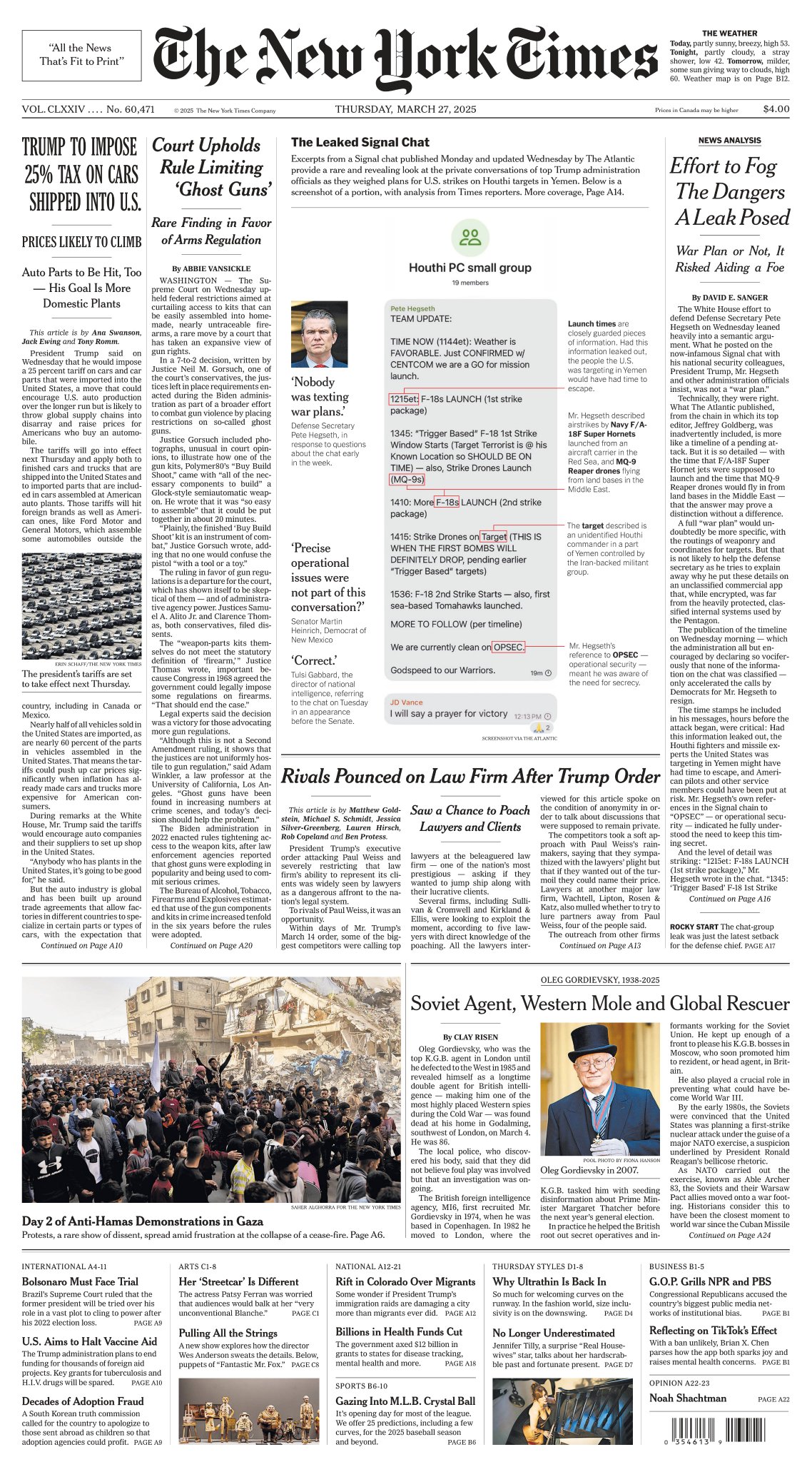
The chat’s contents, which were obtained by The Atlantic after its editor in chief was added to the Signal group, provide a revealing look at private conversations between top Trump administration officials.
Supreme Court Upholds Biden Administration’s Limits on ‘Ghost Guns’
The administration had tightened regulations on kits that can be easily assembled into nearly untraceable firearms.
President Trump also floated the idea of the United States taking control of Ukrainian power plants, according to U.S. officials. The Ukrainian president said he was not pressured about the proposal.
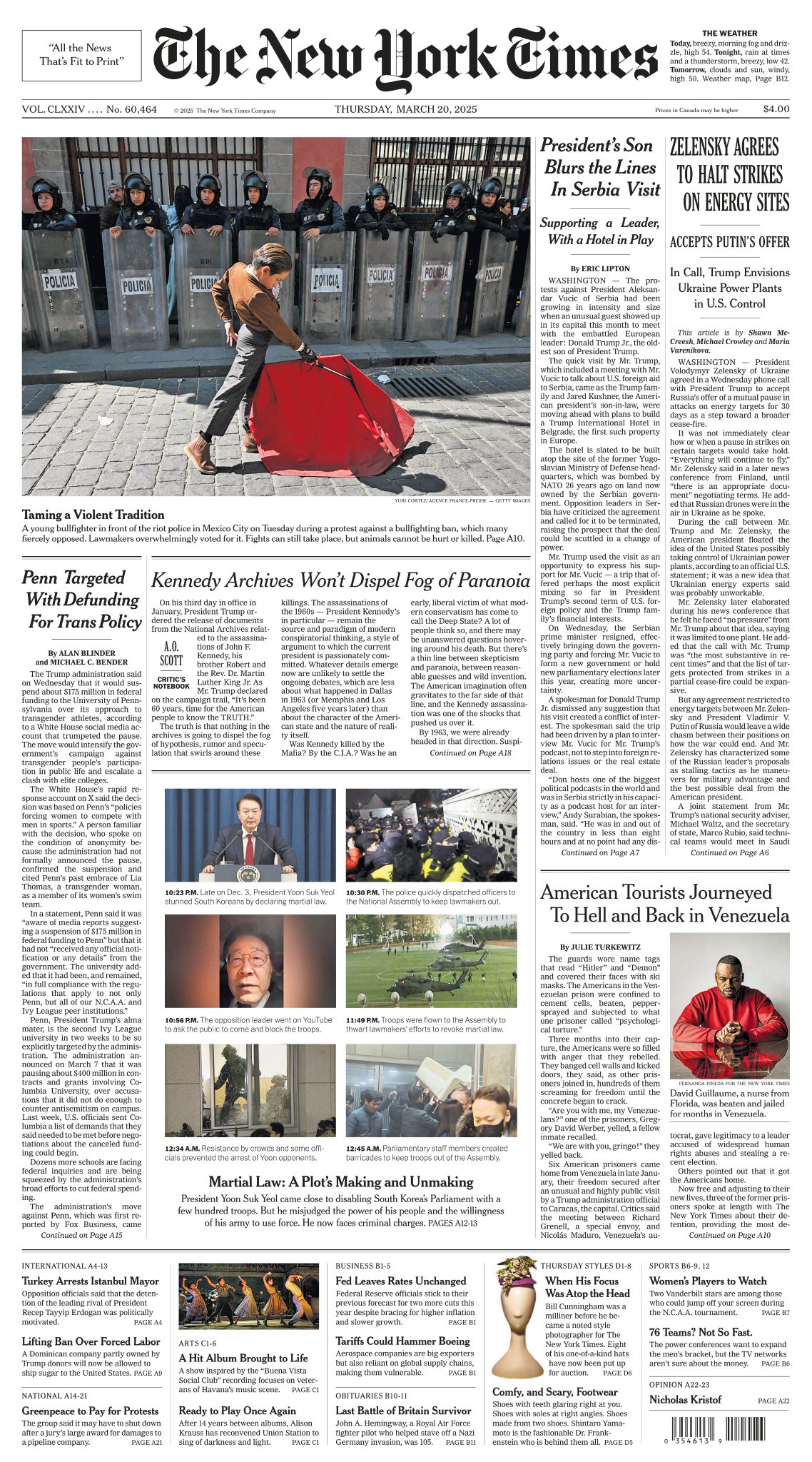
Showdowns between people and bulls can still go on, but the animals can no longer be hurt or killed. Some bullfighting proponents said the law imperils an ancient tradition.
Donald Trump Jr. Mixes Business and Politics in Serbia, as Protests There Rage
President Trump’s oldest son visited Belgrade, the site of a Trump International Hotel project, and pushed back on calls for the country’s president to resign.
White House Plans to Pause $175 Million for Penn Over Transgender Policy
The decision is the latest clash between a university and the administration as it pushes schools to end diversity programming and adopt stricter discipline, among other things.




















 Boomers Daily