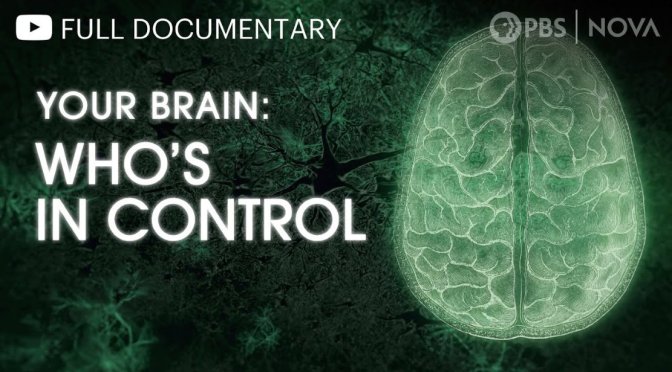

NOVA PBS Official (May 31, 2023) – Are you in control, or is your brain controlling you? Dive into the latest research on the subconscious with neuroscientist Heather Berlin. Sleepwalking, anesthesia, game theory, and more reveal surprising insights in this eye-opening journey to discover what’s really driving the decisions you make.
Chapters: 00:00 Introduction 03:22 Sleepwalking and the Brain 08:36 Anesthesia and the Brain 14:18 Results of Split Brain Surgery 22:23 Emotions and the Brain 30:01 How Does Trauma Affect the Brain? 35:39 How Much Control Do We Have of Our Brain? 45:44 Creativity and the Brain 50:17 Conclusion
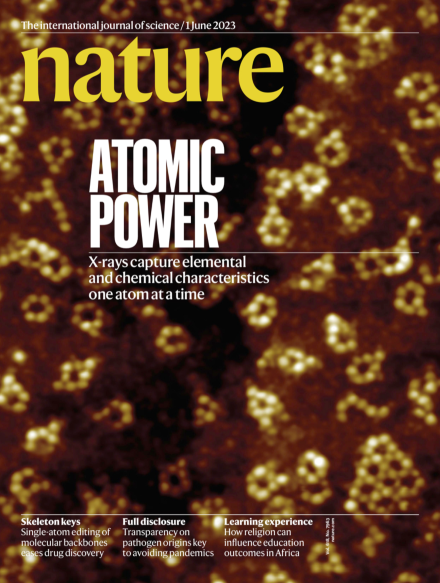
nature Magazine – June 1, 2023 issue: X-rays are widely used to characterize materials, but samples still require a reasonably high number of atoms for success. In this week’s issue, Saw-Wai Hla and his colleagues report that they have used synchrotron X-rays to characterize the elemental and chemical state of an individual atom. The team was able to detect X-ray-excited currents generated from an iron and a terbium atom in molecular hosts.
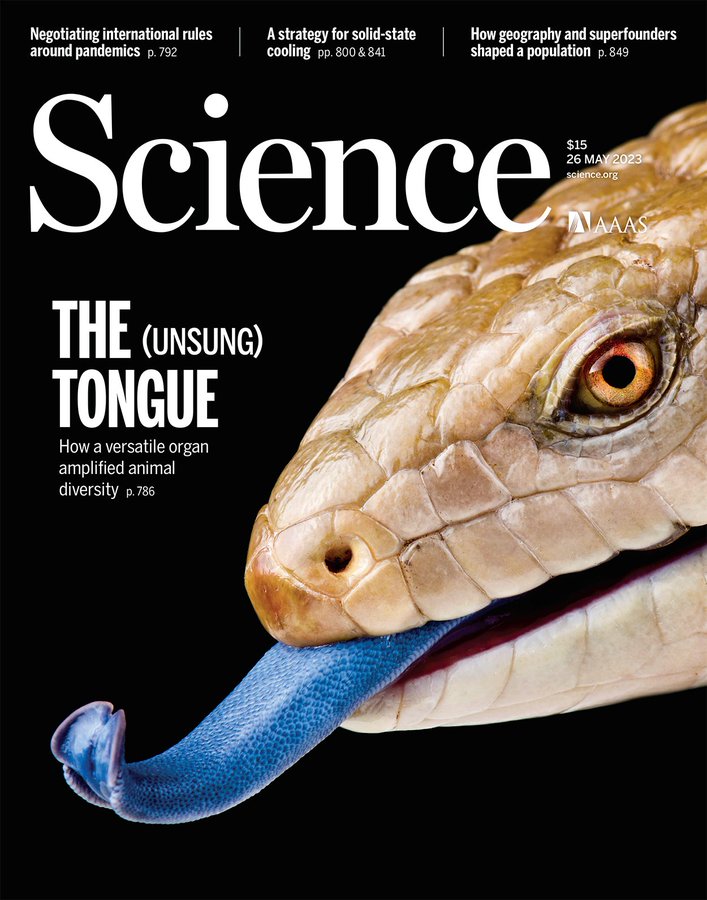
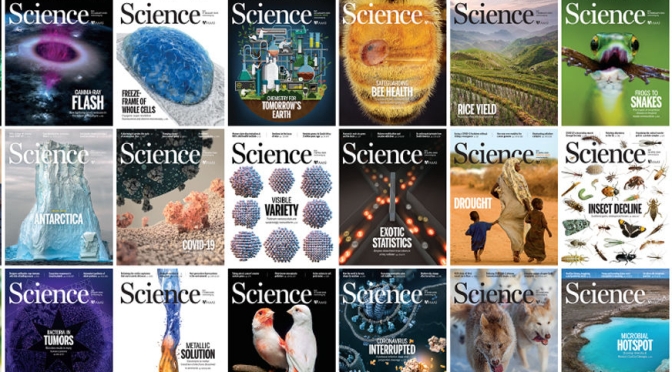
Science Magazine – May 26, 2023 issue: Tongues are thought to have evolved when vertebrates first moved onto land and could no longer rely on suction to ingest food. Since then, they have helped drive animal diversification by adopting functions as varied as pumping nectar, snagging prey, shaping speech, and, in the case of Australia’s northern blue-tongued skink (Tiliqua scincoides intermedia), startling enemies.
Since first evolving 350 million years ago, the tongue has taken myriad forms, unlocking new niches and boosting the diversity of life
Twice, quarterback Patrick Mahomes has led the Kansas City Chiefs to victory in the Super Bowl, the pinnacle of U.S. football. Although most fans have their eyes on the ball as Mahomes prepares to throw, his tongue does something just as interesting.
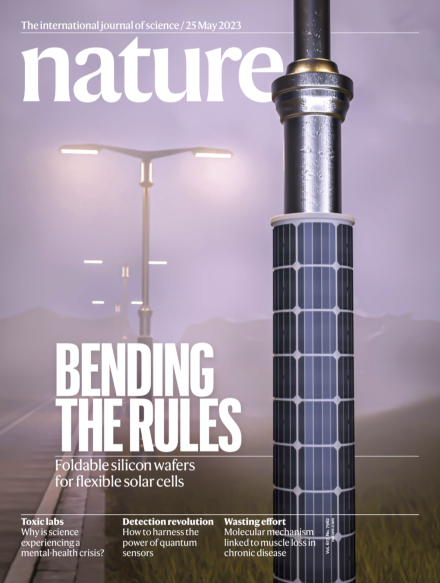
nature Magazine – May 25, 2023 issue: In this week’s issue, Wenzhu Liu and colleagues present a way to make foldable silicon wafers that can be used in flexible solar cells. The secret to success was to blunt the edges of the silicon wafers, thereby stopping them from undergoing brittle fracturing. As a result, the researchers were able to make 15-centimetre solar cells with a bending angle of more than 360°.
DW Documentary (May 19, 2023) – Human pollution is increasing worldwide. The overexploitation of nature is endangering biodiversity and plastics and chemicals are destroying many of humanity’s nature-based livelihoods.
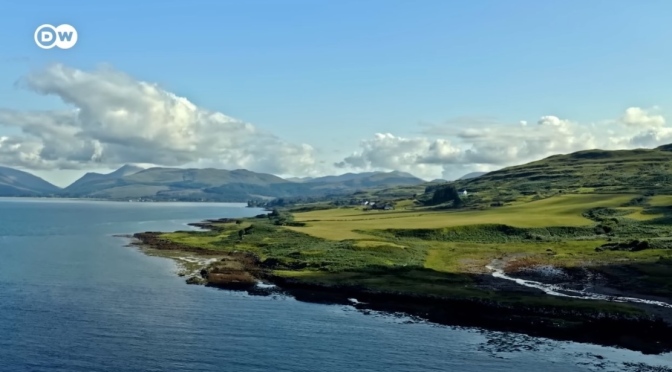
But there is hope. The UK is not exactly known for its stringent environmental policy and following Brexit, many fear that standards are likely to deteriorate. But the UK is also home to coastal regions and islands characterized by wild beauty — and breathtaking diversity. The documentary takes us through some of the most remote landscapes of the country, from the Shetland Islands to Cornwall, the Hebrides and many other areas.
In each location, the film shows the amazing biodiversity of fauna and flora present. The Pembrokeshire Coast National Park in Wales is known for large breeding colonies of many seabird species. Few people live on the Hebrides, located off Scotland. These wild islands are still a natural paradise of rocks, sand and moor. As such, they are biotopes for exotic species such as puffins and guillemots.
In this cinematic journey to the most beautiful natural sites in Britain, viewers meet the people who are trying to protect species threatened by extinction by preserving their habitats. It is a story of hope, one that indicates that a change in people’s thinking is taking place.
Science Magazine – May 19, 2023 issue: More than half of the world’s largest lakes have declined over the past three decades. Human water consumption, warming climate, and sedimentation are largely responsible. Lake Powell, shown here, with its once-submerged walls that now appear as whitened surfaces, exemplifies this drying trend.
Cloning vigorous crops, and finding the first romantic kiss First up this week, building resilience into crops. Staff Writer Erik Stokstad joins host Sarah Crespi to discuss all the tricks farmers use now to make resilient hybrid crops of rice or wheat and how genetically engineering hybrid crop plants to clone themselves may be the next step. After that we ask: When did we start kissing? Troels Pank Arbøll is an assistant professor of Assyriology in the department of cross-cultural and regional studies at the University of Copenhagen. He and Sarah chat about the earliest evidence for kissing—romantic style—and why it is unlikely that such kisses had a single place or time of origin.
NOVA PBS Official (May 17, 2023) – Neuroscientists discover the tricks and shortcuts the brain takes to help us survive. Is what you see real?
Chapters:00:00 Introduction 03:59 The Science of Optical Illusions and Blind Spots 13:48 Is the Dress Blue and Black or White and Gold? 21:06 Yanny or Laurel? Auditory Illusions 24:46 Is Pain an Illusion? 30:28 What is Consciousness? Blind Spots and Babies 41:35 How is Consciousness Measured? 45:32 How the Brain Affects Memories 50:14 Conclusion
Join neuroscientist Heather Berlin on a quest to understand how your brain shapes your reality, and why you can’t always trust what you perceive. In the first hour of this two-part series, learn what the latest research shows about how your brain processes and shapes the world around you, and discover the surprising tricks and shortcuts your brain takes to help you survive.
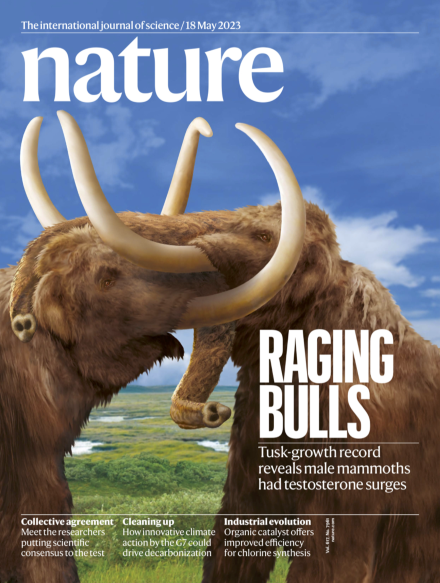
nature Magazine – May 18, 2023 issue: The cover shows an artist’s impression of two male mammoths fighting. During episodes of musth, adult male elephants undergo periods of elevated testosterone levels associated with aggression and competition for mating. In this week’s issue, Michael Cherney and his colleagues show that male woolly mammoths (Mammuthus primigenius) experienced similar episodes of musth.
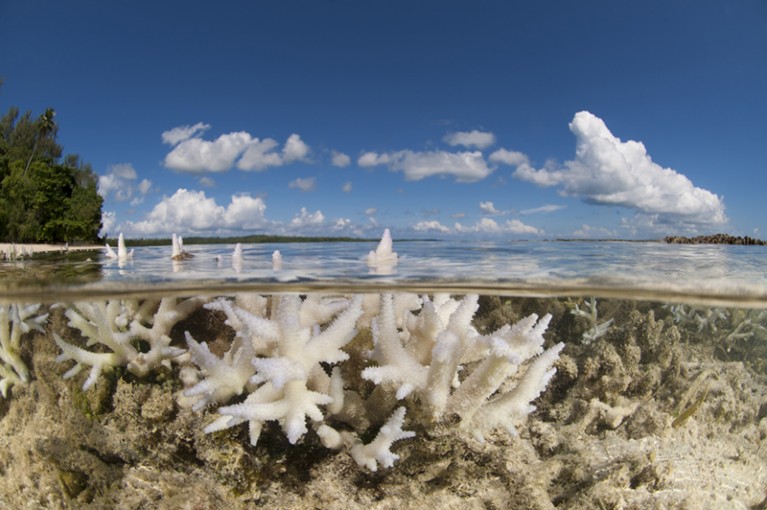
Record temperature combined with an anticipated El Niño could devastate marine life and increase the chances of extreme weather.
The global ocean hit a new record temperature of 21.1 ºC in early April, 0.1 ºC higher than the last record in March 2016. Although striking, the figure (see ‘How the ocean is warming’) is in line with the ocean warming anticipated from climate change. What is remarkable is its occurrence ahead of — rather than during — the El Niño climate event that is expected to bring warmer, wetter weather to the eastern Pacific region later this year.
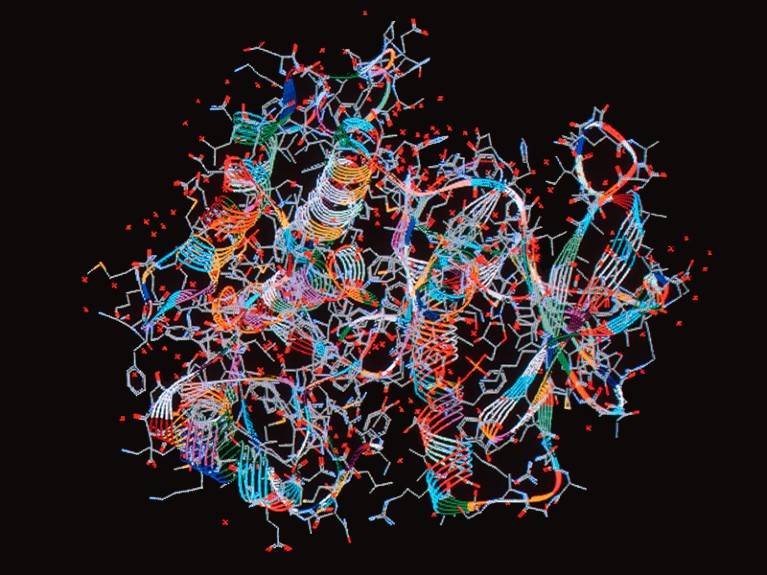
Machine-learning systems in chemistry need accurate and accessible training data. Until they get it, they won’t achieve their potential.
Many people are expressing fears that artificial intelligence (AI) has gone too far — or risks doing so. Take Geoffrey Hinton, a prominent figure in AI, who recently resigned from his position at Google, citing the desire to speak out about the technology’s potential risks to society and human well-being.
PBS NewsHour (May 15, 2023) -At a time when the public teaching of science is again being fought over, the largest museum of natural history in the U.S. just extended its reach. Jeffrey Brown got a look inside the American Museum of Natural History’s stunning new expansion in New York for our arts and culture series, CANVAS.
News, Views and Reviews For The Intellectually Curious