


Category Archives: Science
Science Podcasts: Radio Bursts In Milky Way, Covid-19 In Schools & Octopuses

Astronomers pin down the likely origins of mysterious fast radio bursts, Covid-19 in schools, octopuses taste with touch and the latest on what the US election means for science.
In this episode:
00:46 The origins of mysterious fast radio bursts
The detection of a brief but enormously-powerful radio burst originating from within the Milky Way could help researchers answer one of astronomy’s biggest mysteries.
Research article: Bochenek et al.; News: Astronomers spot first fast radio burst in the Milky Way
07:59 Coronapod
At the start of the pandemic, there were fears that schools could become hotspots for infections. We discuss the evidence suggesting that this is unlikely to be the case, and the rates of infection in children of different ages.
News: Why schools probably aren’t COVID hotspots
18:34 Research Highlights
Octopuses taste with touch, and a tool to watch dangerously-reactive metals grow.
Research Highlight: How octopuses taste with their arms — all eight of them; Research Highlight: How to make violently reactive metals and watch them grow
21:28 An update on the US election
Although the winner of this year’s US election is unclear, we discuss the current situation and what it might mean for science.
28:58 Briefing Chat
We discuss some highlights from the Nature Briefing. This time, ancient genomes reveal the migration of man’s best friend, and a new polio vaccine looks set to receive emergency approval.
News: Ancient dog DNA reveals 11,000 years of canine evolution; News: New polio vaccine poised to get emergency WHO approval
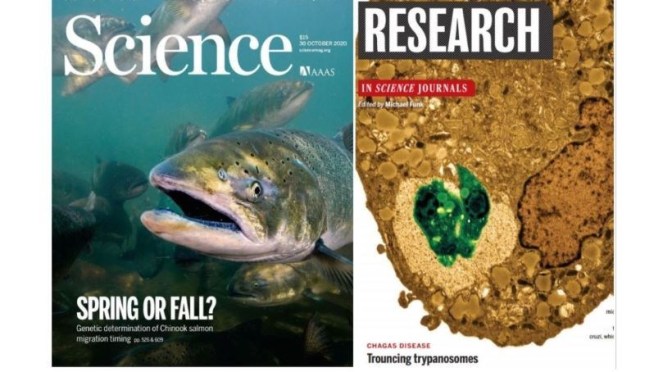
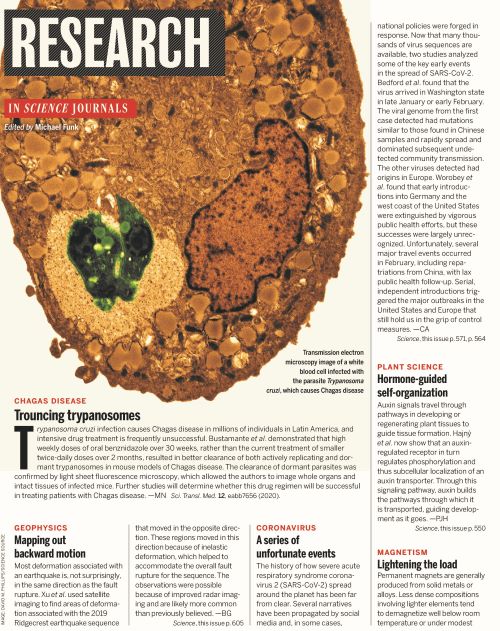
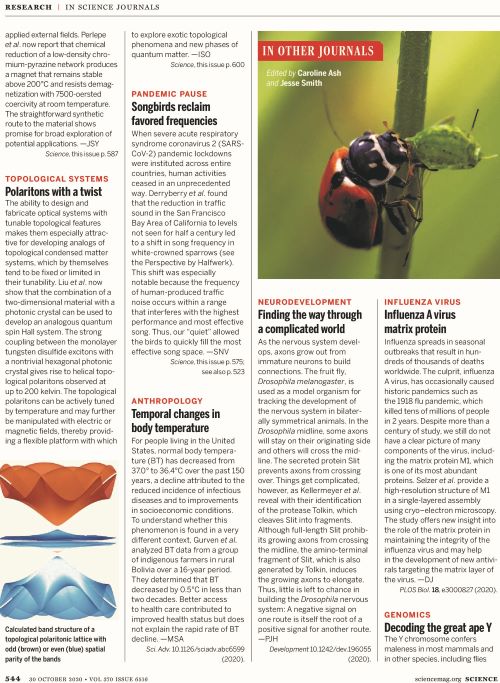
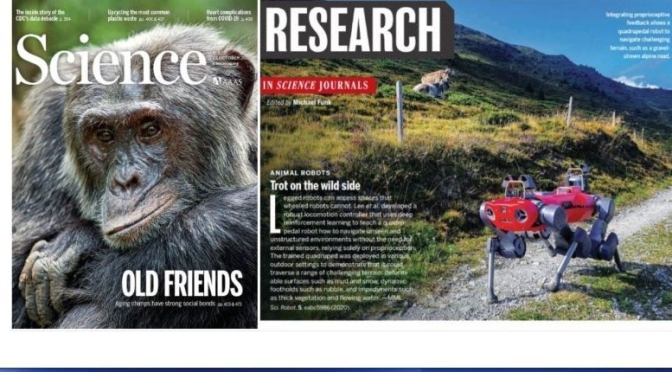
TOP JOURNALS: RESEARCH HIGHLIGHTS FROM SCIENCE MAGAZINE (OCT 30, 2020)
Science Podcasts: Citizen ‘Minipublics’, Zoologist Charles Turner & Cooking

First up, host Sarah Crespi talks to News Intern Cathleen O’Grady about the growing use of citizens’ assemblies, or “minipublics,” to deliberate on tough policy questions like climate change and abortion. Can random groups of citizens do a better job forming policy than politicians?
Next, we feature the latest of a new series of insight pieces that revisit landmark Science papers. Sarah talks with Hiruni Samadi Galpayage Dona, a Ph.D. student at Queen Mary University of London, about Charles Turner, a Black zoologist who published multiple times in Science in the early 1900s. Despite being far ahead of his time in his studies of animal cognition, Turner’s work was long overlooked—due in large part to the many difficulties facing a Black man in academia at the turn of the century. Finally, in our monthly books segment, host Kiki Sanford chats with author Pia Sorensen about her new book: Science and Cooking: Physics Meets Food, From Homemade to Haute Cuisine.
New Science Podcast: Lab-Grown Mini Brains, Herd Immunity & Bat Dinosaurs
The chances of mini brains becoming sentient, herd immunity, bat-like dinosaurs, and a UK government decision threatens gender diversity in academia.
In this episode:
00:59 The ethics of creating consciousness
Brain organoids, created by culturing stem cells in a petri dish, are a mainstay of neuroscience research. But as these mini-brains become more complex, is there the chance they could become conscious, and if so, how could we tell?
News Feature: Can lab-grown brains become conscious?
09:01 Coronapod
So called ‘herd immunity’ is claimed by some as a way to break the chain of infection and curtail the pandemic. However epidemiologists say that this course of action is ineffective and will lead to large numbers of infections and deaths.
News Explainer: The false promise of herd immunity for COVID-19
20:59 Research Highlights
Volcanic ash degrades ancient art in Pompeii, and the aerial ineptitude of two bat-like dinosaurs.
Research Highlight: The volcanic debris that buried Pompeii wreaks further destruction; Research Highlight: A dead end on the way to the sky
23:22 How cutting red-tape could harm gender diversity in UK academia
The Athena SWAN scheme, designed to boost gender-equality in UK academia, has proved effective, and has been exported to countries around the world. But now a decision by the UK government to cut bureaucracy could mean that institutions pay less heed to schemes like this and threaten future efforts to increase gender diversity in UK academia.
Editorial: Equality and diversity efforts do not ‘burden’ research — no matter what the UK government says
31:00 Briefing Chat
We discuss some highlights from the Nature Briefing. This time, oncologists discover a potential new human organ, and how re-examined fossils have given new insights into the size of baby tyrannosaurs.
TOP JOURNALS: RESEARCH HIGHLIGHTS FROM SCIENCE MAGAZINE (OCT 23, 2020)


Science Podcasts: Covid-19 Vaccine Ethical Issues, Upcycling Plastic Bags
First up, host Sarah Crespi talks with Staff Writer Jon Cohen about some tricky ethical questions that may arise after the first coronavirus vaccine is authorized for use in the United States. Will people continue to participate in clinical trials of other vaccines? Will it still be OK to give participants placebo vaccines?
Next, producer Meagan Cantwell talks with Bert Weckhuysen, a professor at Utrecht University, about a process for taking low-value plastic like polyethylene (often used for packaging and grocery bags) and “upcycling” it into biodegradable materials that can be used for new purposes.
Science Podcasts: Beetle’s Strong Exoskeleton Helps Engineers, Covid-19 Trials
The structure of a beetle’s super-strong exoskeleton could open up new engineering applications, and efforts to address diversity and equality imbalances in academia.
In this episode:
01:17 Insights into an armoured insect
The diabolical ironclad beetle has an exoskeleton so strong, it can survive being run over by a car. Researchers have identified how the structure of the exoskeleton provides this strength, and show that mimicking it may lead to improved aerospace components.
Research Article: Rivera et al.; News and Views: Diabolical ironclad beetles inspire tougher joints for engineering applications
10:42 Coronapod
This week, the UK government announced plans to run a ‘human challenge trial’, where healthy volunteers are deliberately infected with the SARS-CoV-2 virus. We talk about the process, the ethical and procedural hurdles, and whether such an approach will provide any useful data.
News: Dozens to be deliberately infected with coronavirus in UK ‘human challenge’ trials
22:46 Research Highlights
A method to assess the age of RNA, and how southern elephant seals helped to identify supercooled seawater.
Research article: Rodriques et al.; Research article: Haumann et al.
25:20 Efforts to address equity in science
Julie Posselt has been investigating the efforts of academic institutions to assess ingrained imbalances in diversity and equality. We talk to her about these efforts and her new book on the subject.
Book review: How to get more women and people of colour into graduate school — and keep them there
31:43 Briefing Chat
We discuss some highlights from the Nature Briefing. This time, back pay for female professors at Princeton, and a newly uncovered superpower for the tiny tardigrade.

Energy Of The Future: ‘Powering Cities With A Virutual Power Plant’
Residential solar panels and battery backups are becoming more and more popular as efficiency rises and costs sink. This explosion in distributed solar makes a new idea possible: virtual power plants, or a smart network of individual solar panels that can act like a big power plant when electricity is needed most. And as extreme weather threatens many communities, this idea is arriving in the nick of time.
Learn more: https://www.theverge.com/e/21288017

Mountain Science: ‘Mount Everest Weather – Data Is In The Clouds’ (Video)
In 2019, members of the National Geographic and Rolex Perpetual Planet Everest Expedition set out to install five new weather stations on Mt. Everest, including the highest weather station on Earth. Follow along as the team climbs into the mountain’s “death zone” to complete the network of weather stations in order to improve our understanding of climate change.
 Boomers Daily