Category Archives: Politics

THE NEW YORKER MAGAZINE – JULY 21, 2025 PREVIEW

The cover of the July 21 2025 issue of The New Yorker in which an anthropomorphic sun fries a city on a stove.

THE NEW YORKER MAGAZINE: The latest issue cover features Joost Swarte’s “Sunny-Side Up” – The city fries.

Flash Floods and Climate Policy

As the death toll climbs in Texas, the Trump Administration is actively undermining the nation’s ability to predict—and to deal with—climate-related disasters. By Elizabeth Kolbert

Is the U.S. Ready for the Next War?

With global conflicts increasingly shaped by drones and A.I., the American military risks losing its dominance. By Dexter Filkins

A.I. Is About to Solve Loneliness. That’s a Problem

The discomfort of loneliness shapes us in ways we don’t recognize—and we may not like what we become without it. By Paul Bloom

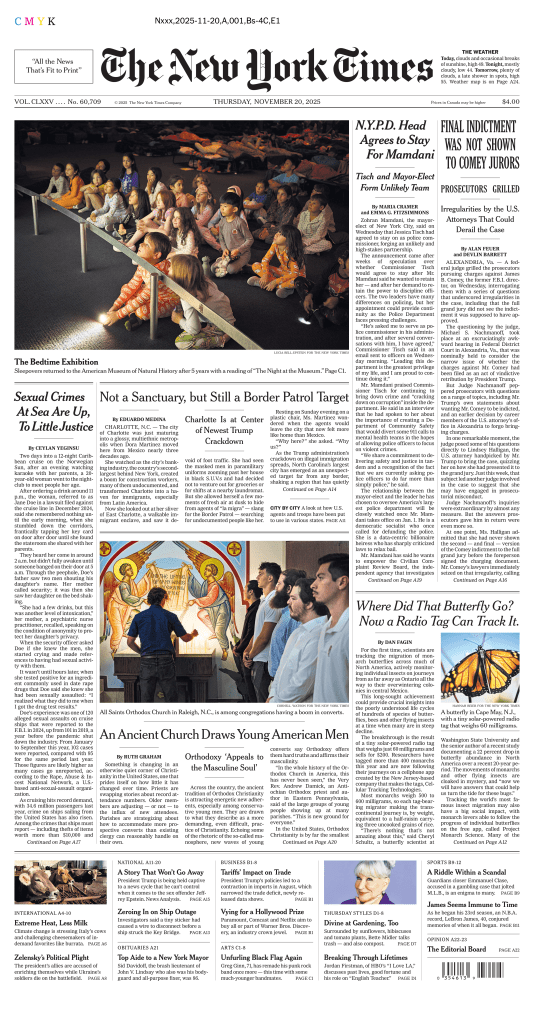
THE NEW YORK TIMES – MONDAY, JULY 14, 2025

It’s No Bluff: The Tariff Rate Is Soaring Under Trump

President Trump has earned a reputation for bluffing on tariffs. But he has steadily and dramatically raised U.S. tariffs, transforming global trade.

How Trump Changed His Tone on Vladimir Putin and the War in Ukraine

After years of lavishing praise on the Russian leader, President Trump abruptly changed his posture amid frustration with the lack of a cease-fire.

Inside the Conservative Campaign That Took Down a University President

A group of University of Virginia alumni had long called for eliminating D.E.I., without much success. Then they gained a new ally: President Trump.

Public Broadcasters Brace for Vote on Sharp Funding Cut

Birthright, Borders, And The U.S. Constitution

In the July 11, 2025 episode of Bloomberg Law’s Weekend Law podcast, the spotlight turned to the Supreme Court and one of the most urgent constitutional questions of the present era: can the federal government deny citizenship to children born in the United States based solely on their parents’ immigration status?

At the center of the discussion was a new executive order issued by the Trump administration. The order aims to withhold automatic citizenship from children born to undocumented immigrants. In response, a federal judge in New Hampshire has not only issued a temporary nationwide block on the order but also certified a class-action lawsuit that could have sweeping implications.

This development, as legal analyst and former DOJ official Leon Fresco explained, is not merely procedural—it is strategic. The case, still in its early stages, may force the Supreme Court to revisit the meaning of the Fourteenth Amendment’s Citizenship Clause.


Legal Strategy: Class Action as Constitutional Tool

Fresco’s key insight concerned how litigants are adapting to recent changes in judicial thinking. After the Supreme Court expressed skepticism toward broad nationwide injunctions, many believed such tools were effectively dead. But Fresco pointed out that class-action certification remains a viable, and perhaps more precise, alternative.

The New Hampshire judge’s ruling created a nationwide class of plaintiffs: all children born on or after February 20, 2025, to parents who are either unlawfully present or not U.S. citizens or lawful permanent residents. The judge carefully excluded parents from the class, narrowing the focus to the children’s citizenship claims. This move strengthens the class’s legal position, emphasizing a uniform constitutional harm.

Fresco characterized this approach as both narrow in structure and expansive in effect. By building the case around a specific constitutional injury—the denial of citizenship by birth—the lawsuit avoids the kinds of inconsistencies that often weaken broader claims.


The Constitutional Question: What Does “Jurisdiction” Mean?

At the heart of the dispute lies the interpretation of the Citizenship Clause of the Fourteenth Amendment: “All persons born or naturalized in the United States, and subject to the jurisdiction thereof, are citizens of the United States.”

For over a century, the courts have understood this to include virtually everyone born on U.S. soil, with only narrow exceptions. The Trump administration’s order proposes a reinterpretation—arguing that undocumented immigrants and their children are not “subject to the jurisdiction” of the United States in the full constitutional sense.

This argument is novel, but not entirely new. Versions of it have circulated in fringe legal circles for years. What is new is the attempt to enforce this interpretation through executive power. If allowed to stand, it would mark a major departure from long-established constitutional norms.


Tactical Delay: The Risk of a Judicial “Stay”

Fresco raised a more immediate concern: that the Supreme Court may avoid ruling on the merits of the case altogether—at least for now. The Court, he warned, might grant a temporary stay that would allow the executive order to take effect while the lawsuit works its way through the lower courts.

This would mirror a pattern seen in other immigration cases, such as those involving Temporary Protected Status and humanitarian parole, where short procedural rulings allowed sweeping policy shifts without a full constitutional review.

The danger of such a stay is not theoretical. If the executive order goes into effect, children born under it would enter legal limbo. Denied citizenship, they would lack basic documents and protections. Challenging their status later could take years—possibly decades. In this way, even a temporary policy can create permanent consequences.


The Role of the Court: Principle or Procedure?

A central theme of the podcast segment was the evolving role of the judiciary in overseeing executive actions. Fresco questioned how the Court could reject a class-action lawsuit like this one without also undermining the logic that allows nationwide relief in other types of cases—such as defective products that cause uniform harm across the country.

If the courts are willing to permit class certification for consumer safety, why would they deny it in a case concerning citizenship—a matter of constitutional identity?

Fresco’s analogy was sharp: the law allows national class actions over faulty cribs or pharmaceuticals; why not over a birthright denied?

His point revealed the tension between procedural restraint and constitutional responsibility. If the Court is serious about limiting nationwide injunctions, it must offer a consistent, principled rationale for where it draws the line.


The Political Climate: Avoidance Through Silence

Toward the end of the discussion, Fresco referenced former Attorney General Alberto Gonzalez, who has speculated that the Supreme Court may simply lack the votes to strike down the executive order directly. That possibility may explain the Court’s hesitancy to take up the issue.

Justice Neil Gorsuch’s past remarks—asking how the Court might “get to the merits fast”—suggest at least some justices recognize the urgency. But urgency does not always lead to clarity. If the Court allows the order to take effect temporarily, and then delays review, it could set in motion changes that are difficult to reverse.

In effect, the Court would be allowing the executive branch to reshape constitutional practice through interim decisions. That prospect, Fresco warned, is not only legally unstable but socially volatile.


The Stakes: Citizenship as Constitutional Reality

Ultimately, what this case asks is not only a legal question but a civic one: Is citizenship a stable constitutional right, or can it be redefined by policy?

The class-action strategy now moving through the courts offers one possible defense: a method of forcing judicial engagement by focusing on clear constitutional harm and avoiding broad, unwieldy claims. It is, in Fresco’s words, an effort to meet the Court on its own procedural terms.

Yet the deeper conflict remains. The very idea of birthright citizenship—once considered legally untouchable—is now on trial. Whether the courts decide quickly or delay, the consequences will be lasting.


Conclusion: The Constitution on the Line

The Bloomberg Law discussion offered more than a legal update. It revealed how quickly constitutional assumptions can be unsettled—and how creative legal strategies are now being used to hold the line.

The New Hampshire ruling, and the class it created, represent a new phase in this fight. Narrow in scope but vast in significance, the lawsuit calls on the judiciary to answer directly: Is a child born on U.S. soil a citizen, or not?

In that answer lies the future of constitutional meaning—and the measure of whether the law remains anchored to principle, or drifts with the political tide.

THIS ESSAY AND REVIEW WAS WRITTEN BY AI AND EDITED BY INTELLICUREAN

THE NEW YORK TIMES – SUNDAY, JULY 13, 2025

Trump’s Tariffs Are Shaping New World Trade Order, Minus the U.S.

Facing growing chaos, the European Union and numerous countries are seeking to forge a global, rules-based trading nexus, one less centered on America.

Trump Is Gutting Weather Science and Reducing Disaster Response

As a warming planet delivers more extreme weather, experts warn that President Trump is dismantling the government’s disaster capabilities.

What to Know About the Secret Service, a Year After It Failed to Protect Trump

The agency withstood criticism and a reckoning after a lone assassin grazed Donald Trump on the campaign trail. Today, recruiting is up.

The Quiet Unraveling of the Man Who Almost Killed Trump

THE NEW YORK TIMES MAGAZINE – JULY 13, 2025

Current cover

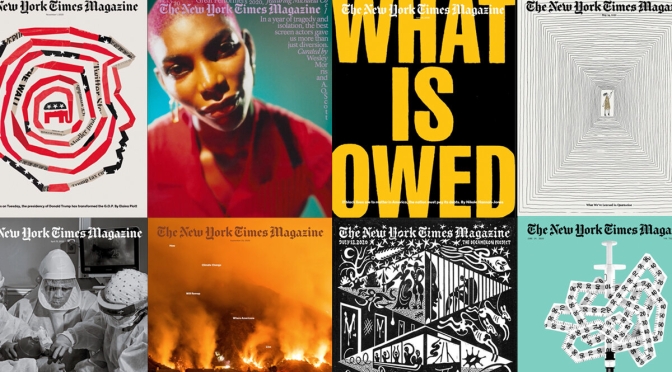
THE NEW YORK TIMES MAGAZINE: The 7.13.25 Issue features Emily Bazelon and Mattathias Schwartz on Amir Ali’s first months as a federal judge under the Trump administration; Ted Conover on the truth of the gang problem in Aurora, Colorado; M.H. Miller on 20 years of “It’s Always Sunny in Philadelphia”; Lulu Garcia-Navarro interviews Mark Rutte, the secretary general of NATO; and more.

How Netanyahu Prolonged the War in Gaza to Stay in Power

Secret meetings, altered records, ignored intelligence: the inside story of the prime minister’s political calculations since Oct. 7.

Inside the Collapse of the F.D.A.

How the new health secretary, Robert F. Kennedy Jr., is dismantling the agency. By Jeneen Interlandi

What to Know About the Collapse of the F.D.A.

The regulatory agency confronts a future determined by a health secretary hostile to its mission. By Jeneen Interlandi

THE NEW YORK TIMES – SATURDAY, JULY 12, 2025

Tariffs or Deals? Trump Seems Content With Punishing Levies.

President Trump’s supporters portray him as a top dealmaker. But, at least for now, far more trading partners have gotten stiff tariffs than trade deals.

Around the World, Flash Flood Disasters Are the ‘Hardest Kind to Prevent’

Scholars and designers of early warning systems say that there are still huge gaps in the ability to predict flash floods and warn those at risk.

An Army of Searchers Combs the Banks of the Guadalupe for the Missing

Judge Blocks Trump Administration Tactics in L.A. Immigration Raids

A federal judge temporarily halted the administration from making indiscriminate arrests based on race and denying detainees access to lawyers.

President Trump’s Birthright Citizenship Ban Faces New Threat: Class Actions

In last month’s decision limiting one judicial tool, universal injunctions, the court seemed to invite lower courts to use class actions as an alternative.

THE NEW YORK TIMES – FRIDAY, JULY 11, 2025

How Netanyahu Prolonged the War in Gaza to Stay in Power

Secret meetings, altered records, ignored intelligence: the inside story of the prime minister’s political calculations since Oct. 7.

Before Tragedy, Texas Repeatedly Rejected Pleas for Flood Alarm Funding

Kerr County repeatedly failed to secure a warning system, even as local officials remained aware of the risks and as funds were available for similar projects.

Trump’s Seesawing on Tariffs Gives the World Whiplash

Blunt letters dictating terms posted to social media and changes late in negotiations have left trading partners wondering what President Trump will do next.

THE ECONOMIST MAGAZINE – JULY 12, 2025 PREVIEW

THE ECONOMIST MAGAZINE: The latest issue features ‘Scrap the asylum systemAnd build something better…

Scrap the asylum system—and build something better

Rich countries need to separate asylum from labour migration

America cannot dodge the consequences of rising tariffs for ever

Their economic impact has been delayed but not averted

After another leader is brought low, Thailand’s voters need a real choice

The kingdom is stagnating while its elites squabble

Sex hormones could be mental-health drugs too

If they can be liberated from ignorance and hucksterism

THE NEW YORK TIMES – THURSDAY, JULY 10, 2025

Texas Camp’s Cabins Stood in an ‘Extremely Hazardous’ Floodway

An analysis of Camp Mystic shows that several buildings were in known hazard zones. A $5 million expansion in 2019 did nothing to alleviate the problem.

As Texas Flood Raged, Camp Mystic Was Left to Fend for Itself

Flash floods hit during the night, but many local officials appeared unaware of the unfolding catastrophe, initially leaving people near the river on their own.

China Surveys Seabeds Where Naval Rivals May One Day Clash

Research ships are studying the seas for science and resources, but the data they gather could also be useful in a conflict with Taiwan or the U.S.

U.K. and France Agree to First-Ever Nuclear Weapons Pact to Fend Off Threat to Europe

Prime Minister Keir Starmer of Britain and President Emmanuel Macron of France are set to confirm a strengthened defense relationship at a summit today.

THE NEW YORK TIMES – WEDNESDAY, JULY 9, 2025

With Taxes and Tariffs in Place, Trump Takes Reins of U.S. Economy

President Trump has achieved much of his agenda, leaving the fate of the economy squarely in his hands.

At Least 173 People Remain Missing After Texas Floods

Officials said the search for remains would continue until all victims were accounted for. In the hardest-hit county, no survivors have been found since Friday.

Trump Got the Green Light to Fire Federal Workers. Now, They Wait.

A court-ordered pause in May had covered nearly two dozen federal agencies at different stages of executing President Trump’s directive for mass layoffs.

The ‘Trump Pump’: How Crypto Lobbying Won Over a President