The Globalist (April 5, 2024): Benjamin Netanyahu’s main rival and member of the war cabinet, Benny Gantz, calls for early elections, Myanmar’s opposition carries out a drone attack on junta-controlled Naypyidaw, Moscow declares that Russia and Nato are now in “direct confrontation” and we celebrate the life and legacy of Gaetano Pesce.
Plus: Andrew Mueller takes a look at what we learned this week.
The Globalist (April 4, 2024): Today marks the 75th anniversary of Nato. We assess the alliance’s future at a worrying time for global security. Then we hear why the Philippines’ navy is preparing for the worst-case scenario in the South China Sea and discuss the future of UK and US arms sales to Israel.
Plus: McKinsey experts on the future of the urban environment, and the life and legacy of Guadeloupe’s grand storyteller Maryse Condé, who has died at the age of 90.
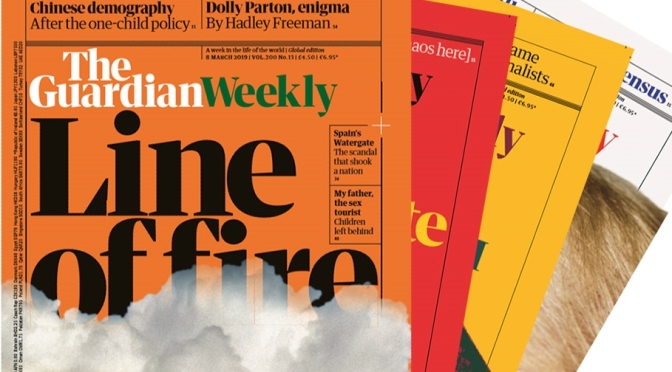
The Guardian Weekly (April 5, 2024) – The new issue features ‘Lone Star’ – Have the UN vote and questions about its conduct in Gaza left Israel isolated?; Liz Truss bids for political resurrection; Will IS strike again?; Nick Cave’s devilish change of direction…
Spotlight | IS affiliates could launch new wave of terror on the west
Islamic State has stalled in Iraq and Syria but officials believe it has been planning new attacks on the west for years, reports Jason Burke; while Angelique Chrisafis writes that France’s interior minister has met intelligence services to assess the terrorist threat to the country ahead of this summer’s Olympic Games
Environment | True cost of a city built from scratch
Nusantara is billed as a state-of-the-art capital city that will coexist with nature – but not all residents of Borneo’s Balikpapan Bay are happy, find. By Rebecca Ratcliffe and Richaldo Hariandja
Feature | 49 days later
Liz Truss trashed the economy as Britain’s shortest-serving prime minister. But she is back, launching a new conservative movement and spreading her ideology across the world. You just can’t keep a bad politician down, argues David Runciman
Culture | The devil in the details
In the past nine years, Nick Cave has lost two sons – an experience he explores in a deeply personal new ceramics project. He discusses mercy, forgiveness, making and meaning with Simon Hattenstone
Architecture | A Māori-built environment
A new wave of Indigenous architects are behind a series of stunning buildings embracing tribal identity in Aotearoa New Zealand, Oliver Wainwright discovers
The Globalist (April 3, 2024): Emmanuel Macron hosts Antony Blinken in Paris for talks on Ukraine and Gaza, and EU leaders head to Lithuania while Belarus conducts military drills near its border.
Plus: we discuss Bassirou Diomaye Faye as he is sworn in as Senegal’s youngest president and explore the world of Heath Ceramics with studio director Tung Chiang. Also in the programme: the first politician generated by artificial intelligence.
The Globalist (April 2, 2024): Join Monocle’s Emma Nelson as she goes through the current affairs stories of the day, including Portugal’s new prime minister being sworn in and a review of the front pages with analyst Charles Hecker.
Plus: aviation news with FlightGlobal’s Greg Waldron in Singapore.
The New Yorker (April 1, 2024): The new issue‘s cover features Pascal Campion’s “Into the Light” – The artist depicts stepping out of the subway into the overwhelming glow of the city.
When Leah started dating her first serious boyfriend, as a nineteen-year-old sophomore at Ohio State, she had very little sense that sex was supposed to feel good. (Leah is not her real name.) In the small town in central Ohio where she grew up, sex ed was basically like the version she remembered from the movie “Mean Girls”: “Don’t have sex, because you will get pregnant and die.”
It’s now thought that they could illuminate fundamental questions in physics, settle questions about Einstein’s theories, and even help explain the universe.
Black holes are, of course, awesome. But, for scientists, they are more awesome. If a rainbow is marvellous, then understanding how all the colors of the rainbow are present, unified, in ordinary white light—that’s more marvellous. (Though, famously, in his poem “Lamia,” John Keats disagreed, blaming “cold philosophy” for unweaving the rainbow.) In recent years, the amount of data that scientists have discovered about black holes has grown exponentially. In January, astronomers announced that the James Webb Space Telescope had observed the oldest black hole yet—one present when the universe was a mere four hundred million years old. (It’s estimated that it’s now 13.8 billion years old.) Recently, two supermassive black holes, with a combined mass of twenty-eight billion suns, were measured and shown to have been rotating tightly around each other, but not colliding, for the past three billion years. And those are just the examples that are easiest for the public to make some sense of. To me, a supermassive black hole sounds sublime; to a scientist, it can also be a test of wild hypotheses. “Astrophysics is an exercise in incredible experiments not runnable on Earth,” Avery Broderick, a theoretical physicist at the University of Waterloo and at the Perimeter Institute, told me. “And black holes are an ideal laboratory.”
The Globalist (April 1, 2024): Voters head to the polls in Turkey to vote in local and mayoral elections in what’s being seen as a test for President Reccep Tayyip Erdogan.
Plus: the return of Isis, Australia’s diplomatic deficit and Austria’s vacancy tax.
A new, high-tech approach called ECPR can restart more hearts and save more lives. Why aren’t more hospitals embracing it?
By Helen Ouyang
Greg Hayes, an emergency first responder in Chanhassen, Minn., was picking up takeout sushi when a 911 call came in: A 61-year-old had stopped breathing at home. Hayes and his team jumped in their ambulance and were soon pulling up in front of a suburban two-story house, where paramedics and other first responders were also arriving. All of them grabbed their equipment and raced through the open garage to find a man, gray and still, on the living-room floor with his wife and stepdaughter nearby.
When people think about stages of life that can strain relationships, they often reflect on the first sleepless years of child rearing or the phase of parenting that involves rebellious teens. Retirement, typically anticipated as a time of relaxation, might not come to mind, but this transition away from work can also be stressful, coinciding with reinventions and re-evaluations that can cause couples to suddenly experience new tensions. It can also be a time of renewed connection and relationship growth. Often, it’s both at once.
Monocle on Sunday, March 31, 2024: Emma Nelson, Charles Hecker and Yossi Mekelberg on the weekend’s biggest talking points.
We also speak to Monocle’s editorial director, Tyler Brûlé, in Zürich and get the latest on Turkey’s local elections with Monocle’s Istanbul correspondent, Hannah Lucinda Smith.
News, Views and Reviews For The Intellectually Curious

















 Boomers Daily