Category Archives: News

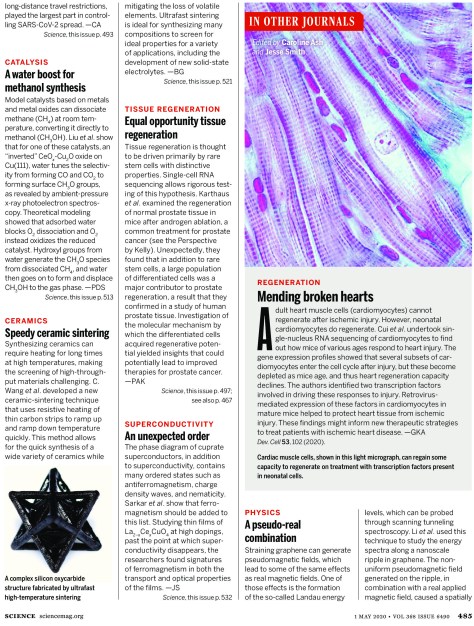
Top New Science Podcasts: Blood Tests For Multiple Cancers, Our Quiet Sun

science-magazine-podcastsStaff Writer Jocelyn Kaiser joins Sarah to talk about a recent Science paper describing the results of a large study on a blood test for multiple types of cancer. The trial’s results suggest such a blood test combined with follow-up scans may help detect cancers early, but there is a danger of too many false positives. 

And postdoctoral researcher Timo Reinhold of the Max Planck Institute for Solar System Research joins Sarah to talk about his paper on how the Sun is a lot less variable in its magnetic activity compared with similar stars—what does it mean that our Sun is a little bit boring?

Covid-19: “Who’s Really Immune?” (Prognosis)

Prognosis PodcastAs states grapple with the question of when it will be safe to reopen businesses and relax social distancing, there’s increasing urgency to better understand who’s immune to Covid-19. Does having the virus and recovering mean you can’t get it again, or at least that you can’t be reinfected for some time?

No one yet has good answers to these questions. Kristen V. Brown looked into what we do, and don’t, know about the science of coronavirus immunity.

Top New Science Podcasts: ‘Sniff-Response’, Carbon Dioxide And Vaccinations Replacing Antibiotics

nature-podcastsThis week, how the ‘sniff-response’ can help clinicians determine a patient’s state of consciousness, and how vaccines could help drive down antibiotic use.

In this episode:

00:45 Sniffing out consciousness

Researchers have found that the sniff reflex can indicate whether a patient is in a vegetative state, and even the likelihood that they will recover consciousness. Research Article: Arzi et al.

08:37 Research Highlights

The stupefying effect of carbon dioxide, and a chameleon gemstone that tricks your eyes. Research Highlight: Rising carbon dioxide levels will make us stupiderResearch Highlight: How a chameleon gemstone changes from red to green

11:12 Vaccination and antibiotic usage

Looking at data from low- and middle-income countries, researchers have determined that vaccination could prevent millions of infections currently treated by antibiotics. Research Article: Lewnard et al.

16:49 Pick of the Briefing

We pick our highlights from the Nature Briefing, including the forgotten mother of climate change science, and a new global study on insect declines. Chemistry World: Eunice Foote: the mother of climate changeScience: Meta-analysis reveals declines in terrestrial but increases in freshwater insect abundances

Subscribe to Nature Briefing, an unmissable daily round-up of science news, opinion and analysis free in your inbox every weekday.

Politics Monday: Amy Walter And Tamara Keith On Coronavirus Task Force, 2020 Election (PBS)

NPR’s Tamara Keith and Amy Walter of the Cook Political Report join Judy Woodruff to discuss the latest political news, including the evolution of the White House Coronavirus Task Force briefing, President Trump’s shifting approval ratings and possible electoral implications for Senate races this fall.

Global News: Covid-19’s Legacy, Power Grabs And Netflix (The Economist)

The Economist Editors Picks Podcast logoA selection of three essential articles read aloud from the latest issue of The Economist. This week, how will governments cope with the expensive legacy of covid-19? (11:05), unscrupulous autocrats in the pandemic of power grabs (17:52), and, why Netflix’s success will continue. Zanny Minton Beddoes hosts.
Politics: “Shields & Brooks” On The Pandemic, Government Responses

Syndicated columnist Mark Shields and New York Times columnist David Brooks join Judy Woodruff to discuss the week’s news, including President Trump’s controversial medical commentary, the respective roles of federal and state governments in the crisis, American public opinion on pandemic restrictions, congressional pandemic relief and how they’re handling social distancing.

Coronavirus: Dire Health Consequences Of Using Ventilators (Prognosis)

Prognosis PodcastVentilators have become prized in hospitals across the U.S. and beyond because they are desperately needed to treat very ill Covid-19 patients. But they are also feared for the damage they can inflict, and for the slim odds of survival they offer. 

Michelle Fay Cortez and Olivia Carville report that it’s not yet clear what the long-term consequences ventilators have for those lucky enough to recover after having been on one.

Coronavirus: Race To Expand Antibody Testing And Investing In Public Health (Nature Podcast)

Coronapod ReportBenjamin Thompson, Noah Baker, and Amy Maxmen discuss the role of antibody tests in controlling the pandemic, and how public-health spending could curtail an economic crisis. Also on the show, the open hardware community’s efforts to produce medical equipment.

In this episode:

02:08 Betting on antibodies

Antibody tests could play a key role in understanding how the virus has spread through populations, and in ending lockdowns. We discuss concerns over their reliability, how they could be used, and the tantalising possibility of immunity.

News: The researchers taking a gamble with antibody tests for coronavirus

10:25 Economy vs public health, a false dichotomy

Jim Yong Kim, former president of the World Bank, argues that strong investment in public health is crucial to halt the ongoing pandemic and to prevent a global financial crisis. We discuss his work with US governors to massively increase contact tracing, and his thoughts on how researchers can help steer political thinking.

News Q&A: Why the World Bank ex-chief is on a mission to end coronavirus transmission

19:00 One good thing this week

Our hosts talk about staying positive, and pick a few things that have made them smile in the last 7 days, including a tiny addition to the team, a newspaper produced by children in lockdown, and a gardening update.

Six Feet of Separation, the newspaper staffed by kids

22:51 Open hardware

Researchers are stepping up efforts to design and produce ventilators and personal protective equipment for frontline medical staff. We hear how the open hardware movement is aiding these efforts, and the regulations that teams need to consider if their designs are to make it into use.