Category Archives: History

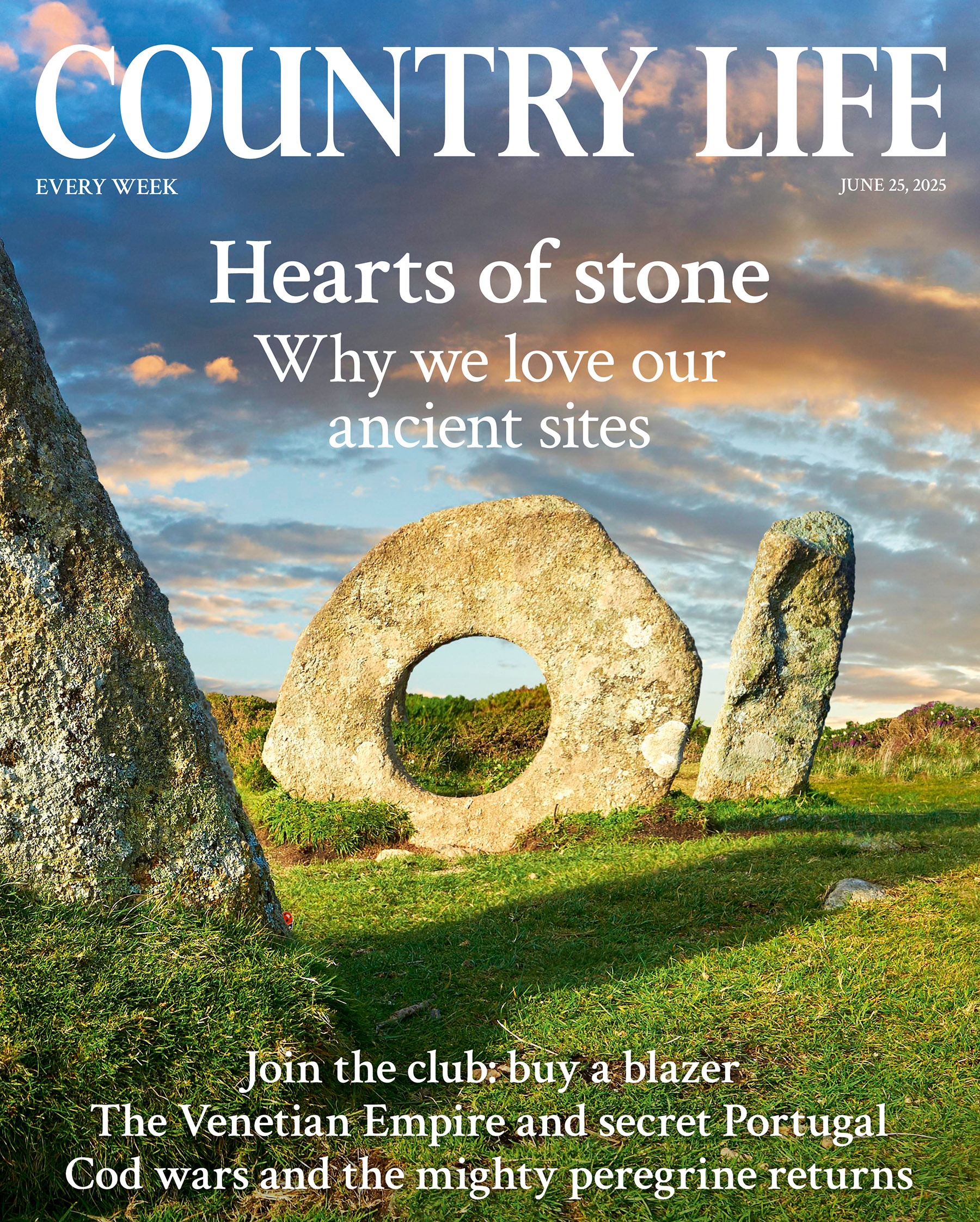
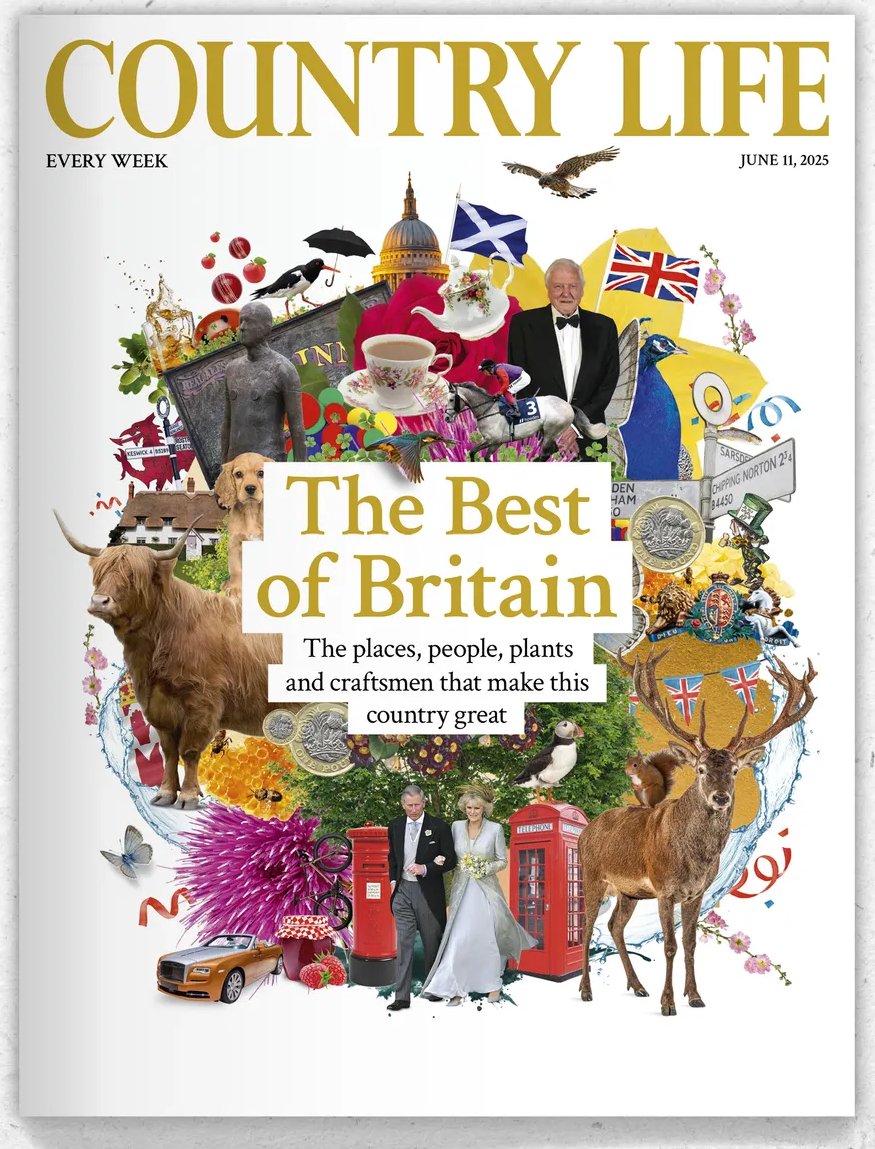
COUNTRY LIFE MAGAZINE – January 29, 2025 Issue

COUNTRY LIFE MAGAZINE (January 28, 2025): The latest issue features ‘Ready, Steady, Go!’ – The wonderful thing about Springers…

Full of the joys of spring(ers)

The non-stop English springer is still our number one working spaniel, reveals Matthew Dennison, as he delves into this enthusiastic, energetic breed

Snake, rattle and roll

Rob Crossan investigates the deeply spiritual origins of that enduring family board-game favourite Snakes and Ladders

Heard it on the radio

The wireless broke new ground as the first form of home-based mass entertainment and is still going strong in the age of the smart speaker, finds Ben Lerwill

Friends with benefits

Nematodes are a natural way to halt the march of all manner of garden pests and Charles Quest-Ritson is a convert

Mould and behold

Josiah Wedgwood was a brilliant businessman with a remarkable social conscience. Tristram Hunt assesses his life and legacy

Catch us if you can

Owain Jones sizes up six of the best as he picks out the players to watch in this year’s Guinness Six Nations rugby extravaganza

Roger Morgan-Grenville’s favourite painting

The conservation campaigner selects a work that inspired his lifelong obsession with seabirds

A Palladian premonition

Richard Hewlings offers a fresh analysis of the architecture at Bramham Park, a highly original West Yorkshire country house

The legacy

Kate Green remembers Robert FitzRoy, the founder of the Met Office whose name lives on in the BBC’s Shipping Forecast

Dear country diary

Paul Fleckney flicks through The Guardian’s Country Diary, which has offered a snapshot of rural life for more than 120 years

Interiors

The best stoves and fireplaces picked by Amelia Thorpe, plus the alternatives to burning logs

Luxury

Hetty Lintell’s top timepieces and James Haskell’s favourite things

Magnificent mahonias

Charles Quest-Ritson makes the case for mahonias, arguing that their pleasantly scented flowers are a seasonal delight

Kitchen garden cook

Melanie Johnson pairs peppery horseradish with salmon fillets

Ring-dove beauteous!

John Lewis-Stempel coos over the much-maligned wood pigeon, that canny, keen-eyed and fast-flying stalwart of our countryside

Travel: An Historical Tour Of The Bronx, New York

SUNDAY MORNING (January 26, 2025): Comedian and actress Susie Essman was a kid from the Bronx, and maintains a devotion to this monumental, magical and, at times, maligned slice of the Big Apple.

She takes “Sunday Morning” viewers on a tour, joined by such Bronx luminaries as writer and humorist Ian Frazier, astrophysicist Neil deGrasse Tyson, actor and playwright Chazz Palminteri, rapper and entrepreneur Fat Joe, and Bronx Borough President Vanessa Gibson.

History Today Magazine — February 2025 Preview

History Today | The World's Leading Serious History Magazine

HISTORY TODAY MAGAZINE (January 23, 2025): The latest issue features the destruction of medieval England’s Jews, British soldiers in the American Revolutionary War, unreported murder in East Germany, ‘mad duchess’ Elizabeth Cavendish, and more.

Portugal, the Mamluks, and the Age of Discovery

For the Portuguese empire to rise, an old world had to give way. Rivals in Europe’s lucrative spice trade, how much did they know about the powerful Mamluk sultanate?


Behind Donald Trump’s Palace Walls

The vagaries of palace politics are notoriously difficult to record. Historians should pay attention to rumour.

Who to Blame for Early Modern Climate Change?

The changing climate of the Little Ice Age forced radical thinkers to reconsider humanity’s place in the universe.


‘Man-Devil’ by John J. Callanan review

Man-Devil: The Mind and Times of Bernard Mandeville, the Wickedest Man in Europe by John J. Callanan revels in the making of the controversial satirist and philosopher.

Smithsonian Magazine – January 2025 Preview

Image

SMITHSONIAN MAGAZINE (December 30, 2024): The latest issue features ‘In Search of the World’s Smallest Monkey’ – A journey into Ecuador’s remote forests to spy on adorable, and suprisingly chatty, pygmy marmosets.

Seventy-Seven Fascinating Finds Revealed in 2024, From a Mysterious ‘Anomaly’ Near the Great Pyramid of Giza to a Missing Portrait of Henry VIII

How an Experiment to Amplify Light in Hospital Operating Rooms Led to the Accidental Invention of the Snow Globe

The origins of the decoration lie in Vienna’s 17th district, where the inventor’s descendants are still making them for collectors around the world

Hoover Institution: Best Books On Politics In 2024

Hoover Year in Review Books

Hoover Institution (December 22, 2024): The depth of Hoover’s scholarship is reflected in the numerous books published by our fellows on a broad variety of topics and issues.

The Boiling Moat: Urgent Steps to Defend Taiwan

Boiling Moat by Matt Pottinger


Edited by Matt Pottinger (Hoover Institution Press) Publication Date: July 1, 2024

Chinese leader Xi Jinping has openly expressed his intention to annex Taiwan to mainland China, even threatening the use of force. An invasion or blockade of Taiwan by Chinese forces would be catastrophic, with severe consequences for democracies worldwide. In The Boiling Moat, Matt Pottinger and a team of scholars and distinguished military and political leaders urgently outline practical steps for deterrence.

the full proceedings from this conference—the presentations, responses, and discussions. In it, participants debate the meaning of getting monetary policy “back on track,” the significance of recent bank failures, and how to improve forecasting and oversight.

The End of Everything: How Wars Descend into Annihilation

The End of Everything: How Wars Descend into Annihilation


By Victor Davis Hanson (Basic Books)
Publication Date: May 7, 2024

In The End of Everything, military historian Victor Davis Hanson narrates a series of sieges and sackings that span centuries, from the age of antiquity to the conquest of the New World, to show how societies descend into barbarism and obliteration. In the stories of Thebes, Carthage, Constantinople, and Tenochtitlan, he depicts war’s drama, violence, and folly. Highlighting the naivete that plagued the vanquished and the wrath that justified mass slaughter, Hanson delivers a sobering call to contemporary readers to heed the lessons of obliteration lest we blunder into catastrophe once again.

At War with Ourselves: My Tour of Duty in the Trump White House

At War with Ourselves


By H.R. McMaster (HarperCollins Publishers)
Publication Date: August 27, 2024

At War with Ourselves is the story of helping a disruptive president drive necessary shifts in US foreign policy at a critical moment in history. H.R. McMaster entered an administration beset by conflict and the hyperpartisanship of American politics. With the candor of a soldier and the perspective of a historian, McMaster rises above the fray to lay bare the good, the bad, and the ugly of Trump’s presidency and give readers insight into what a second Trump term might look like.

Documenting Communism: The Hoover Project to Microfilm and Publish the Soviet Archives

Documenting Communism: The Hoover Project to Microfilm and Publish the Soviet Archives


By Charles G. Palm (Hoover Institution Press) Foreword by Condoleezza Rice, Introduction by Stephen Kotkin
Publication Date: June 1, 2024

In late 1991, the Soviet Union was officially dissolved. Over the next 12 years, the Hoover Institution microfilmed and published the newly opened records of the Soviet Communist Party and the Soviet State. Charles Palm, who led this mission, details how he and his colleagues secured a historic agreement with the Russian Federation, then launched and successfully carried out the joint project with the Russian State Archives and their partner, Chadwyck-Healey Ltd.

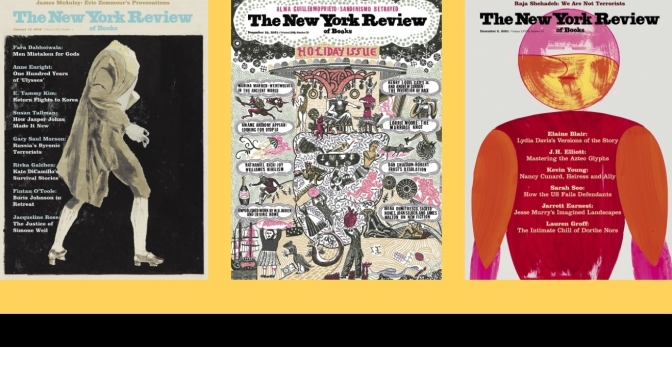
Book Reviews: The Best Scholarly Books Of 2024

Collage of covers of The Review's best books of 2024

THE CHRONICLE OF HIGHER EDUCATION (December 20, 2024): The Best Scholarly Books of 2024 from Michael Clune, Jessica Riskin, Fara Dabhoiwala, and others on their favorites of the year.

Fragile Insights

By Michael Clune

Charles Taylor’s revelatory Cosmic Connections: Poetry in the Age of Disenchantment (Harvard University Press, 2024) draws together different strands from Taylor’s storied philosophical career to present a new account of Romantic poetry. “Philosophy moves us because it convinces us; poetry convinces us because it moves us.” Taylor asks what it would mean to take seriously poetry’s ambition to reveal new dimensions of the world through the resources of image and symbol. Readers of Friedrich Hölderlin or William Wordsworth are familiar with the feeling that a poem is true or right in some deep sense, without being able to defend or even describe that rightness in philosophical terms. Consider the climax of Wordsworth’s “Lines Composed a Few Miles Above Tintern Abbey,” which serves as Taylor’s central example. The poet discerns

A motion and a spirit, that impels
All thinking things, all objects of thought,
And rolls through all things.

A New Theory of Evolution

By Jessica Riskin

Evolution Evolving: The Developmental Origins of Adaptation and Biodiversity (Princeton University Press, 2024) makes for an exhilarating reading. It is not just a book but an intellectual revolution. The authors show that the experiences and behaviors of living beings shape the course of evolution. You might find it strange that this would be a revolutionary idea. You might wonder how it could possibly be otherwise: How could the experiences and behaviors of living beings have no bearing whatsoever on the course of evolution?

Adventures With Books

By Priya Satia

Debate about the role of Western education in Britain’s colonies and former colonies (including the United States) is as old as the British empire itself. Those ever-evolving debates have, in turn, been studied for decades by historians, literary scholars, sociologists, and other scholars trained in the Western system that has become a global inheritance. Saikat Majumdar’s The Amateur: Self-Making and the Humanities in the Postcolony (Bloomsbury Academic, 2024) opens up a startlingly fresh perspective on these debates, attending to the unexpected and agonistic ways in which this education system shaped particular individuals whose work has had profound impact around the world.

Psychedelic Rabbit Holes

By Susan Stryker

I came for the acid, and stayed for the deep roots of gender theory that I found in Benjamin Breen’s Tripping on Utopia: Margaret Mead, the Cold War, and the Troubled Birth of Psychedelic Science (Grand Central Publishing, 2024). Admittedly, gender is not the main focus of Breen’s book. But in using the personal, professional, and intellectual partnership of Margaret Mead and Gregory Bateson to structure the narrative of this work of breathtaking originality, Breen reveals the kernel of a far-flung constellation of ideas and contexts that has rewired my brain’s understanding of the gender concept’s origins.

Read more…

Back to Top

Reality in Revolution

By Hal Foster

What does political revolution require of writers, artists, photographers, and filmmakers? How do they transform their ways of making in order to keep pace with such upheaval? In Soviet Factography: Reality Without Realism (University of Chicago Press, 2024), Devin Fore uncovers an entire archive of radical responses to these questions in the wake of the Russian Revolution of 1917, revealing a fascinating array of original strategies to record a world turned upside down. We follow all manner of “factographic” authors and artists (writer Sergei Tret’iakov and filmmaker Dziga Vertov are only the best known) as they scramble to register the revolution as immediately as possible. Their aim is not to arrest this transformation but, on the contrary, to dynamize it anew, to carry it forward into all areas of life, private and public, subjective and social. This riveting study of “reality in revolution” pressures our understanding of both terms; it also shows us how a reordering of any society involves a refashioning of its individuals.

Read more…

Back to Top

Landscapes of Empire

By Fara Dabhoiwala

Corinne Fowler’s enjoyable and thought-provoking The Countryside: Ten Rural Walks Through Britain and Its Hidden History of Empire (Scribner, 2024) achieves many things with an admirably light touch. Combining her lifelong passion for walking with her pathbreaking work linking England’s buildings and landscapes to the nation’s imperial past, she explores the many ways in which rural Britain was indelibly shaped by its overseas endeavors. She highlights how money, people, and rural industries closely connected the Cotswolds to Calcutta, the Scottish Highlands to Jamaica, Cornwall to West Africa and the Americas, and so on.

Ego, Redux

By Jonathan Lear

It surprised me to discover that The Revised Standard Edition of the Complete Psychological Works of Sigmund Freud (Rowman & Littlefield, 2024) is distinguished by its fidelity to two authors, not just one. Over 30 years in the making — though time was wasted with in-fighting among psychoanalysts — The Revised Standard Edition (RSE) aims to reanimate the distinctive translation into English of James Strachey. This is striking because so many of Strachey’s choices — for example, translating Ich as “Ego,” or Besetzung as “cathexis” — have been the subject of intense criticism. Why, the criticism goes, translate the wonderfully colloquial German that Freud used into a Latinized, “scientific” English? And why not use the occasion of a revised edition to make corrections?

Read more…

Back to Top

Life on the Street

By Shamus Khan

Neil Gong’s Sons, Daughters, and Sidewalk Psychotics: Mental Illness and Homelessness in Los Angeles (University of Chicago Press, 2024) does what the best ethnographies do: provide the reader with an empathetic understanding of its subject. Gong’s comparative work provides a portrait of “sidewalk psychotics” in Los Angeles and compares their experiences to the children of elite families who have similar mental-health struggles.

For those on the street, the aim of most social programs begins with getting them housed. Gong follows people from homelessness into apartments and finds that our social programs of “tolerant containment” do little to tackle mental-health challenges. Policies and programs that focus on housing first are meant to provide a wider range of services, and through detailed observations Gong shows that this rarely happens. The mantra seems to be: get housed, and hopefully the rest will take care of itself. Once housed, people are quite free from intervention or monitoring, including free from programs that might help them address their mental health.

Read more…

Back to Top

The Letters of a Master

By Julianne Werlin

In 1660, the first national post was established in England. By the Victorian age, there were 12 mail deliveries a day in London; friends could dash off a letter in the morning and expect to continue an exchange until late at night. Today, the personal letter in its physical form is largely extinct. But in the era of WhatsApp chats and exchanges on X, its legacy has never been more obvious. Far more than the novel, confession, or diary, the letter is the literary genre at the origins of the modern self: social rather than solitary, reactive rather than reflective, on the cusp of public and private life.

Read more…

Back to Top

Globalism’s Failures

By David Singh Grewal

Wolfgang Streeck’s Taking Back Control?: States and State Systems After Globalism (Verso, 2024) may not make for particularly cheerful reading for the holidays. But it is essential for any scholar seeking to make sense of a range of current trends: the ongoing retreat from 1990s-style globalization, the crisis of liberal democracy, and the rapid return of hot wars, cold wars, and trade wars to a world that just yesterday claimed to have overcome them all. It was written before Donald Trump was re-elected as president of the United States, but it helps make sense not only of the recent U.S. election but the broad trend of elections over the last decade and a half, from roughly the start of the financial crisis of 2007-8 down to the present, and not only in the United States but around the world.

Read more…

Back to Top

Shards of a Life

By Marisa Anne Bass

It is a bold move to write a biography in 2024 of an artist like Josiah Wedgwood, a British man of the 18th century. Iris Moon knows as much. She describes her book Melancholy Wedgwood (The MIT Press, 2024) as an “experimental biography,” by which she implies something more than defiance of the genre’s conventions. Wedgwood is most familiar today as the name attached to your grandmother’s prized vase. To a narrower audience, he is known as the ceramics entrepreneur whose successful factory embodies the emergence of modern capitalism in England. Neither of those stories is at the heart of Melancholy Wedgwood.

Read more…

Back to Top

Researching in Community

By Adia Benton

The circumstances that you bring to read — that bring you to read — shape how you receive a text. It just so happens that I was reviewing a stack of grant applications and planning an ethnographic writing course for next term when I stumbled upon The Ethnographer’s Way: A Handbook for Multidimensional Research Design (Duke University Press, 2024), by the anthropologists Kristin Peterson and Valerie Olson. This research-design manual, whose title is a play on Julia Cameron’s The Artist’s Way, is unconventional in many ways: It eschews a linear, hierarchically constructed style of formulating “scientific” research proposals and encourages a collective, creative, and conceptual approach to research design that pushes back against the demands of the neoliberal university and the idea of the “lone, isolated anthropologist.” It’s even a little woo-woo. (The authors admit as much). Peterson and Olson’s model for building and working in community from the inception of a research project aims to “mitigate disheartening experiences of disconnection that occur throughout institutionalized landscapes, such as those between professors and students, people working inside and outside of bounded organizations, and those with expertise versus those with experience.”

Read more…

National Geographic Magazine – January 2025

National Geographic (December 16, 2024): The latest issue features….

Finding The Endurance

On the hunt for Shackleton’s lost ship

The Ancient Art of Tea

A journey to the mountain forests of China

Saving New Zealand’s Birds

Inside one of the world’s boldest conservation plans

Secrets of Arctic Caves

Searching for climate clues in Greenland

Reviews: Best Books On Foreign Affairs Of 2024

Foreign Policy Magazine (December 8, 2023): The Best of Books 2024  on international politics, economics, and history that were featured in the magazine this year, selected by Foreign Affairs’ editors and book reviewers.

Underground Empire: How America Weaponized the World Economy

by Henry Farrell and Abraham Newman

In a revelatory book, Farrell and Newman describe how the United States has turned its control over information networks into a hidden tool of economic domination—and warn of the risks of Washington’s weaponization of data power for ordinary people, as well as for the global financial system.read the review

To Run the World: The Kremlin’s Cold War Bid for Global Power

by Sergey Radchenko

In a major reconsideration of Cold War history, Radchenko examines the Soviet Union’s competing ambitions for revolution, security, and legitimacy—and how Soviet leadership, blinded by its own hubris and aggression, set the stage for the downfall of the USSR. read the review

Freedom From Fear: An Incomplete History of Liberalism

by Alan S. Kahan

Kahan argues that what unifies liberals across the centuries, including those involved in building and defending liberal democracy today, are their efforts to build societies free from the fear of arbitrary power. He sculpts a masterful and beautifully written history of liberalism’s long intellectual journey. read the review

Tyranny of the Minority: Why American Democracy Reached the Breaking Point

by Steven Levitsky and Daniel Ziblatt

In this sobering study, Levitsky and Ziblatt demonstrate how the United States’ enduring constitutional order—one forged in a pre-democratic age—increasingly thwarts the will of an expanding multicultural majority in favor of a shrinking rural white minority.read the review

Autocracy, Inc.: The Dictators Who Want to Run the World

by Anne Applebaum

Focused on the sophisticated and networked world of autocracy, dictatorship, and tyranny, Applebaum argues that what separates hardcore autocratic states, such as China and Russia, from softer illiberal and authoritarian regimes, such as those in Hungary, India, and Turkey, is the ruthlessness and reach of their dictatorial power and their deep hostility to the Western-led democratic world.read the review

Culture: The American Scholar – Winter 2025

THE AMERICAN SCHOLAR (December 2, 2024): The latest issue featuresFrom Atop The Magic Mountain’ – One-Hundred years later, Thomas Mann’s epic remains as prophetic as ever.

Under a Spell Everlasting

Thomas Mann’s Magic Mountain, published a century ago, tells of a world unable to free itself from the cataclysm of war By Samantha Rose Hill

Aging Out

Many of us do not go gentle into that good night

The Fair Fields

Only rarely did the outside world intrude on an idyllic Connecticut childhood, but in the tumultuous 1960s, that intrusion included an encounter with evil