With the right changes, it can continue as an engine of global growth, say Arjun Ramani and Thomas Easton
The consecration of the Ram temple in Ayodhya, a city in Uttar Pradesh, in January was a matter of supreme importance to Narendra Modi, India’s prime minister; attendance was thus de rigueur for those seeking his approval. The attendant courtiers included not just politicians, officials and foreign dignitaries but also India’s biggest corporate bosses. Uttar Pradesh is not their normal stamping ground, and Ayodhya has not until recently been much of a destination for tycoons. Now it has 115 hotels under construction, and some of those January visitors may soon be finding reasons to return.
Artificial intelligence holds huge promise in health care. But it also faces massive barriers
Better diagnoses. Personalised support for patients. Faster drug discovery. Greater efficiency. Artificial intelligence (ai) is generating excitement and hyperbole everywhere, but in the field of health care it has the potential to be transformational. In Europe analysts predict that deploying ai could save hundreds of thousands of lives each year; in America, they say, it could also save money, shaving $200bn-360bn from overall annual medical spending, now $4.5trn a year (or 17% of gdp). From smart stethoscopes and robot surgeons to the analysis of large data sets or the ability to chat to a medical ai with a human face, opportunities abound.
‘Editor’s Picks’ Podcast (March 25, 2024): A selection of three essential articles read aloud from the latest issue of The Economist. This week, as the death toll climbs in Israel’s war on Gaza, we argue that the country looks deeply vulnerable. Plus, we consider Britain as an unexpected beacon of immigration. And finally, as Elon Musk’s Starship reaches space, we examine SpaceX’s approach to rocket development.
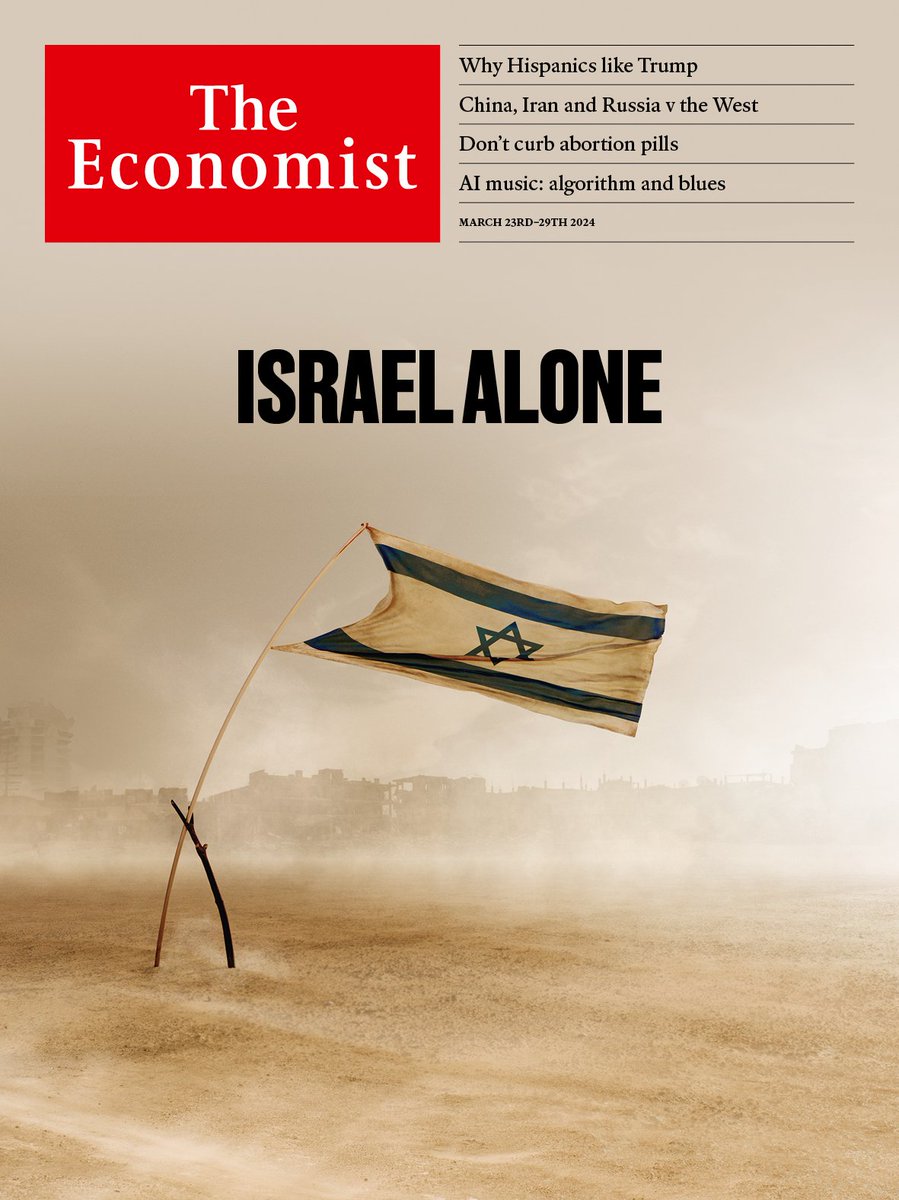
The Economist Magazine (March 21, 2024): The latest issue features ‘Israel Alone’ – At a moment of military might, Israel looks deeply; ‘How To Trade An Election’ – It is getting harder for investors to ignore politics; China, Iran and Russia versus The West – Assessing the economic threat posed by the anti-Western axis…
There is still a narrow path out of the hellscape of Gaza. A temporary ceasefire and hostage release could cause a change of Israel’s government; the rump of Hamas fighters in south Gaza could be contained or fade away; and from the rubble, talks on a two-state solution could begin, underwritten by America and its Gulf allies. It is just as likely, however, that ceasefire talks will fail. That could leave Israel locked in the bleakest trajectory of its 75-year existence, featuring endless occupation, hard-right politics and isolation. Today many Israelis are in denial about this, but a political reckoning will come eventually. It will determine not only the fate of Palestinians, but also whether Israel thrives in the next 75 years.
It is becoming harder for investors to ignore politics
Investors differ in their approach to elections. Some see politics as an edge to exploit; others as noise to block out. Even for those without a financial interest, markets offer a brutally frank perspective on the economic stakes. As elections approach in America and Britain, as well as plenty of other countries, that is especially valuable.
The Economist Magazine (March 7, 2024): The latest issue features Three big risks that might tip America’s presidential election – Third parties, the Trump trials and the candidates’ age introduce a high degree of uncertainty; Xi Jinping’s hunger for power is hurting China’s economy; How to fix the Ivy League – Its supremacy is being undermined by bad leadership…










 Boomers Daily