Tag Archives: September 2025

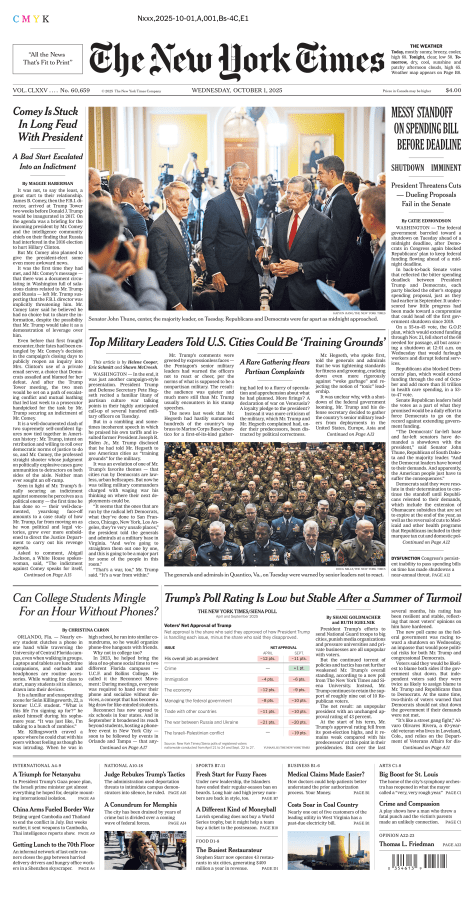
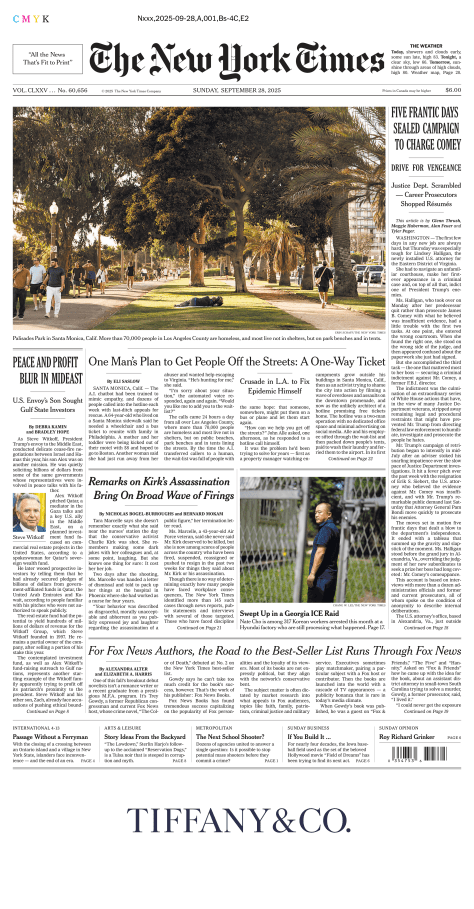
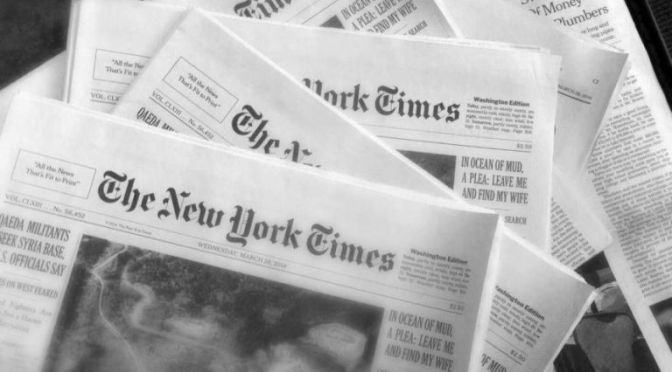
THE NEW YORK TIMES – WEDNESDAY, OCT, 1, 2025

Shutdown Grinds Many Government Services to a Halt

A bitter deadlock between President Trump and Democrats in Congress over federal spending is expected to disrupt services and leave many workers furloughed, and possibly cause mass job losses.

Gaza City Exodus Is Overwhelming Relief Efforts, Aid Agencies Say

Hospitals are overflowing, water is low and diseases are spreading as hundreds of thousands of Palestinians flee south to escape Israel’s expanded ground offensive.

Moscow Indicates Retaliation if Europe Uses Russian Assets for Ukraine

Amid a plan to lend $165 billion to Ukraine using Russian state assets, European officials are mindful of the possibility of Russian blowback.

Trump Gave the Military’s Leaders a Rehashed Speech, Until Minute 44

Almost daily, thousands of words pour forth from President Trump’s mouth. Sometimes, he tucks in a revealing insight about the direction he is taking the U.S.

THE LONELINESS BET

How microgambling apps turn male solitude into profit.

By Michael Cummins, Editor, September 30, 2025

The slot machine has left the casino. Now, with AI precision, it waits in your pocket—timing its ping to the hour of your despair.

The ghost light of the television washes the room, a half-forgotten Japanese baseball game murmuring from the corner. Alex sits in the dark with his phone held at the angle of prayer, the glass an altar, an oracle, a mirror. A ping sounds, small and precise, like a tuning fork struck in his palm. Next pitch outcome—strikeout or walk? Odds updated live. Numbers flicker like minnows. The bet slip breathes. He leans forward. The silence is not merely the absence of sound, but the pressure of who isn’t there—a vacuum he has carried for years.

The fridge hums behind him, its light flickering like a faulty heartbeat. On the counter, unopened mail piles beside a half-eaten sandwich. His last real conversation was three days ago, a polite nod to the barista who remembered his name. At work, Zoom windows open and close, Slack messages ping and vanish. He is present, but not seen.

He is one of the nearly one in three American men who report regular loneliness. For him, the sportsbook app isn’t entertainment but companionship, the only thing that demands his attention consistently. The ping of the odds is the sound of synthetic connection. Tonight he is wagering on something absurdly small: a late-night table tennis serve in an Eastern European hall he’ll never see. Yet the stakes feel immense. Last year in Oregon, bettors wagered more than $100 million on table tennis alone, according to reporting by The New York Times. This is the new American pastime—no stadium, no friends, just a restless man and a glowing rectangle. The algorithm has found a way to commodify the quiet desperation of a Sunday evening.

This isn’t an evolution in gambling; it’s a fundamental violation of the natural pace of risk. Pregame wagers once demanded patience: a pick, a wait, a final score. Microbetting abolishes the pause. It slices sport into thousands of coin-sized moments and resolves them in seconds. Behavioral scientists call this variable-ratio reinforcement: rewards arriving unpredictably, the most potent engine of compulsion. Slot machines use it. Now sports apps do too. The prefrontal cortex, which might otherwise whisper caution, has no time to speak. Tap. Resolve. Tap again.

The shift is from the calculated risk of an investment to the pure reflex of a hammer hitting a knee. Fifty-two percent of online bettors admit to “chasing a bet”—the desperate reflex to wager more after losing. One in five confess to losing more than they could afford. The harm isn’t accidental; it’s engineered. Rachel Volberg, who has studied problem gambling for four decades, told The New York Times that live betting is “much more akin to a slot machine rather than a lottery ticket.” It bypasses deliberation, keeping the brain trapped in a continuous, chemical loop.

And it isn’t marginal to the industry. Live wagers already account for more than half of all money bet on DraftKings and FanDuel. The slot machine has left the casino. It is now in the pocket, always on, always glowing.

The uncanny efficiency of the app lies not in predicting what Alex will bet, but when he will be weakest. After midnight. After a loss. After a deposit he swore not to make. DraftKings’ $134 million purchase of Simplebet, as reported by The New York Times, wasn’t just a business deal; it was the acquisition of a behavioral engine. These models are trained not only on the game but on the gambler himself—how quickly he scrolls, when he logs on, whether his bets swell after defeat, whether his activity spikes on holidays.

DraftKings has gone further, partnering with Amazon Web Services to refine its predictive architecture. At a recent engineering summit in Sofia, engineers demonstrated how generative AI and AWS tools could enhance the personalization of wagers. The same anticipatory logic that once powered retail nudges—“this user is hovering over a product, send a discount”—is now recalibrated to detect emotional vulnerability. In betting apps, the purchase is a wager, the discount is a boost, and the timing is everything: late at night, after a loss, when silence settles heaviest.

The AI’s profile of Alex is more precise than any friend’s. It has categorized his distress. Recent surveys suggest men in the lowest income brackets report loneliness at twice the rate of wealthier peers—a demographic vulnerability the models can detect and exploit through the timing and size of his wagers. Loneliness among men overall has risen by more than thirty percent in the past decade. An algorithm that watches his patterns doesn’t need to imagine his state of mind. It times it.

The profile is not a dashboard; it’s a lever. It logs his loneliest hours as his most profitable. It recognizes reckless bets after a gut-punch loss and surfaces fast, high-variance markets promising a chemical reset. Then comes the nudge: “Yankees boost—tap now.” “Next serve: Djokovic by ace?” To Alex it feels like telepathy. In truth, the system has mapped and monetized his despair. As one DraftKings data scientist explained at a gambling conference, in remarks quoted by The New York Times: “If we know a user likes to bet Yankees games late, we can send the right notification at the right time.” The right time, of course, is often the loneliest time.

Microbetting doesn’t just gamify sport—it gamifies emotion. The app doesn’t care if Alex is bored, anxious, or heartbroken. It cares only that those states correlate with taps. In this system, volatility is value. The more erratic the mood, the more frequent the bets. In this economy of emotional liquidity, feelings themselves become tradable assets. A moment of heartbreak, a restless midnight, a twinge of boredom—all can be harvested. Dating apps convert longing into swipes. Fitness trackers translate guilt into streaks. Robinhood gamified trading with digital confetti. Sportsbooks are simply the most brazen: they turn solitude into wagers, despair into deposits.

Beneath the betting slips lies a hunger for competence. Only forty-one percent of men say they can confide in someone about personal problems. Men without college degrees report far fewer close friendships. Many describe themselves as not meaningfully part of any group or community. In that vacuum, the interface whispers: You are decisive. You are strategic. You can still win. Microbetting offers a synthetic agency: decisiveness on demand, mastery without witness. For men whose traditional roles—provider, protector, head of household—have been destabilized by economic precarity or cultural drift, the app provides the illusion of restored mastery.

The sheer volume of micro-choices acts as a placebo for real-world complexity. Where a career or relationship requires slow, uncertain effort, the app offers instant scenarios of risk and resolution. The system is perfectly aligned with the defense mechanism of isolation: self-soothing through hyper-focus and instant gratification. The product packages loneliness as raw material.

The genius of the app is its disguise. It feels less like a gambling tool than an unjudging confidant, always awake, always responsive, oddly tender. Welcome back. Boost unlocked. You might like… A digital shadow that knows your rhythms better than any friend.

“The clients I see gamble in the shower,” says counselor Harry Levant. “They gamble in bed in the morning.” The app has colonized spaces once reserved for intimacy or solitude. Men and women report similar levels of loneliness overall, but men are far less likely to seek help. That gap makes them uniquely susceptible to a companion that demands nothing but money.

FanDuel actively recruits engineers with backgrounds in personalization, behavioral analytics, and predictive modeling—the same skills that fine-tuned retail shopping and streaming recommendations. There is no direct pipeline from Amazon’s hover-prediction teams to the sportsbooks, but the resemblance is unmistakable. What began as an effort to predict which blender you might buy has evolved into predicting which late-inning pitch you’ll gamble on when you’re most alone.

Some apps already track how hard you press the screen, how fast you scroll, how long you hesitate before tapping. These aren’t quirks—they’re signals. A slower scroll after midnight? That’s loneliness. A rapid tap after a loss? That’s desperation. The app doesn’t need to ask how you feel. It knows. What looks like care is in fact surveillance masquerading as intimacy.

For Alex, the spiral accelerates. Fifty. Then a hundred. Then two-fifty. No pause, no friction. Deposits smooth through in seconds. His body answers the staccato pace like it’s sprinting—breath shallow, fingers hot. Loss is eclipsed instantly by the next chance to be right. This is not a malfunction. It is maximum efficiency.

In Phoenix, Chaz Donati, a gambler profiled by The New York Times, panicked over a $158,000 bet on his hometown team and tried to counter-bet his way back with another $256,000. Hundreds of thousands vanished in a single night. After online sportsbooks launched, help-seeking searches for gambling addiction surged by sixty percent in some states. The pattern is unmistakable: the faster the bets, the faster the collapse. The app smooths the path, designed to be faster than his conscience.

In Vancouver, Andrew Pace, a professional bettor described by The New York Times, sits before three monitors, scanning Finnish hockey odds with surgical calm. He bets sparingly, surgically, explaining edges to his livestream audience. For him, the app is a tool, not a companion. He treats it as a craft: discipline, spreadsheets, controlled risk. But he is the exception. Most users aren’t chasing edges—they’re chasing feelings. The sportsbook knows the difference, and the business model depends on the latter.

Meanwhile, the sport itself is shifting. Leagues like the NBA and NFL own equity in the data firms—Sportradar, Genius Sports—that provide the feeds fueling microbets. They are not neutral observers; they are partners. The integrity threat is no longer fixing a whole game but corrupting micro-moments. Major League Baseball has already investigated pitchers for suspicious wagers tied to individual pitches. When financial value is assigned to the smallest, most uncertain unit of the game, every human error becomes suspect. The roar of the crowd is drowned out by the private vibration of phones.

Lawmakers have begun to stir. In New Jersey, legislators have proposed banning microbets outright, citing research from Australia showing nearly eighty percent of micro-bettors meet the criteria for problem gambling. Representative Paul Tonko has pushed for national standards: deposit caps, affordability checks, mandatory cool-off periods. “We regulate tobacco and alcohol,” he said. “Why not emotional risk?” Public health advocates echo him, warning of “a silent epidemic of digital compulsion.” The industry resists. Guardrails, they insist, would ruin the experience—which, of course, is the point.

The deeper question is not consumer choice; it is algorithmic ethics. Loneliness is already a recognized risk factor for cardiovascular disease and dementia. What happens when the same predictive infrastructure used to ship packages anticipatorily or recommend movies is redeployed to time despair? The failure to regulate is a failure to acknowledge that algorithmic harm can be as corrosive as any toxin.

At 2:03 a.m., Alex finally closes the app. The screen goes dark. The room exhales. The silence returns—not as peace, but as pressure. The television murmurs on, but the game is long over. What remains is residue: the phantom buzz of a notification that hasn’t arrived, the muscle memory of a finger poised to tap, the echo of odds that promised redemption.

He tells himself he’s done for the night. But the algorithm doesn’t need urgency. It waits. It knows his hours, his teams, the emotional dip that comes after a loss. It will tap him again, softly, precisely, when the silence grows too loud.

One in four young men will feel this same loneliness tomorrow night. The casino will be waiting in their pockets, dressed as a companion, coded for their cravings. Outside, dawn edges the blinds. Somewhere a stadium will fill tomorrow, a crowd roaring in unison. But in apartments like Alex’s, the roar has been replaced by a private buzz, a vibration against the skin. The app is patient. The silence is temporary. The house never sleeps.

Because in this new emotional economy, silence is never a stop. It is only a pause. And the algorithm waits for the ping.

THIS ESSAY WAS WRITTEN AND EDITED UTILIZING AI

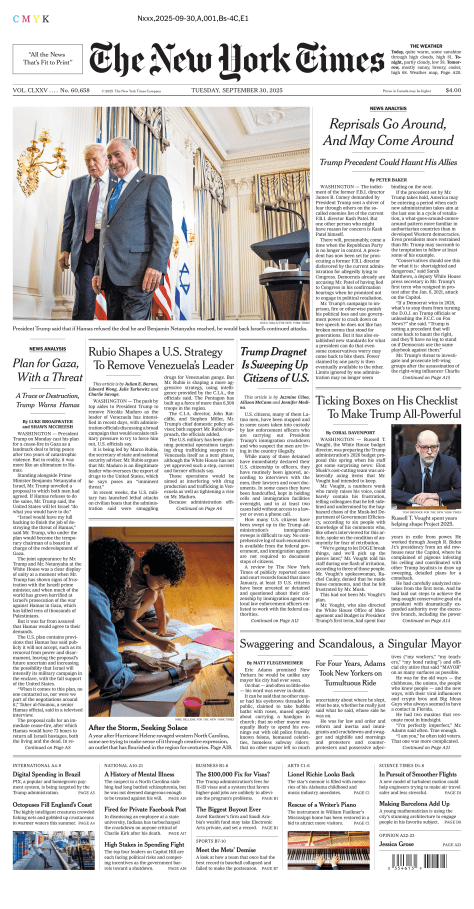
THE NEW YORK TIMES – TUESDAY, SEPT. 30, 2025

Government Shutdown Could Delay Economic Data at a Critical Moment

“Flying blind amidst heavy fog is a dangerous proposition,” one economist said about the risks of a lapse in official statistics.

Trump’s Meeting With Democrats Yields No Progress, With Shutdown a Day Away

U.S. Deports Planeload of Iranians After Deal With Tehran, Officials Say

The deportation flight to Iran is the most stark push yet by the Trump administration to deport migrants even to places with harsh human rights records.

With New U.S. Deal to End Gaza War, a Rare Moment of Triumph for Netanyahu

Prime Minister Benjamin Netanyahu of Israel got almost everything he hoped for, despite mounting international isolation.

After Volatile Summer, Trump’s Approval Remains Low but Stable, Poll Finds

THE NEW YORK TIMES – MONDAY, SEPT. 29, 2025

Trump and Netanyahu to Discuss Plans for Postwar Gaza

President Trump and Prime Minister Benjamin Netanyahu are set to meet today in Washington after a week in which Israel grew more isolated internationally.

New Ideas Emerge to End Gaza Conflict and Govern After War

The Man Behind the All-Powerful Presidency

Russell Vought spent years drawing up plans for a “unitary executive” with ultimate authority over the government. He is on the brink of making it happen.

The Rise and Fall of Eric Adams

Mr. Adams has suspended his re-election campaign, becoming the first mayor of New York City to fail to win a second term since David Dinkins.

At Least 4 Dead in Attack on Michigan Church

The police said they believed the attacker opened fire on the congregation and intentionally set fire to the church near Flint, Michigan.

HOWL AND HUSH

Jack London and Ernest Hemingway meet in a speculative broadcast, sparring over wolves, wounds, and the fragile myths of survival.

By Michael Cummins, Editor, September 28, 2025

In a virtual cabin where the fire crackles on loop and wolves pace behind the glass, London and Hemingway return as spectral combatants. One howls for the wild, the other hushes in stoic silence. Between them, an AI referee calls the fight—and reveals why, in an age of comfort and therapy, we still burn for their myths of grit, grace, and flame.

The lights dim, the crowd hushes, and Howard McKay’s voice rises like a thunderclap from another century. He is no man, not anymore, but an aggregate conjured from the cadences of Cosell and Jim McKay, the echo of every broadcast booth where triumph and ruin became myth. His baritone pours into the virtual cabin like an anthem: “From the frozen Yukon to the burning Gulf Stream, from the howl of the wolf to the silence of the stoic, welcome to the Wild World of Men. Tonight: Jack London and Ernest Hemingway. Two titans of grit. One ring. No judges but history.”

The myths of rugged manhood were supposed to have thawed long ago. We live in an age of ergonomic chairs, curated therapy sessions, artisanal vulnerability. Masculinity is more likely to be measured in softness than in stoicism. And yet the old archetypes remain—grinning, wounded, frostbitten—appearing on gym walls, in startup manifestos, and in the quiet panic of men who don’t know whether to cry or conquer. We binge survival shows while sipping flat whites. We stock emergency kits in suburban basements. The question is not whether these myths are outdated, but why they still haunt us.

Jack London and Ernest Hemingway didn’t invent masculinity, but they branded its extremes. One offered the wolf, the sled, the primordial howl of instinct. The other offered silence, style, the code of the wounded stoic. Their ghosts don’t just linger in literature; they wander through the way men still imagine themselves when no one is watching. So tonight, in a cabin that never was, we summon them.

The cabin is an elaborate fiction. The fire crackles, though the sound is piped in, a looped recording of combustion. The frost on the window is a pixelated map of cold, jagged if you stare too long. Wolves pace beyond the glass, their movements looping like a highlight reel—menace calculated for metaphor. This is not the Yukon but its simulacrum: ordeal rendered uncanny, broadcast for ratings. McKay, too, belongs to this stagecraft. He is the voice of mediated truth, a referee presiding over existential dread as if it were the third round of a heavyweight bout.

London arrives first in the firelight, massive, broad-shouldered, his beard glistening as though it remembers brine. He smells of seal oil and smoke, authenticity made flesh. Opposite him sits Hemingway, compressed as a spring, scars arranged like punctuation, his flask gleaming like a ritual prop. His silences weigh more than his words. McKay spreads his hands like a referee introducing corners: “London in the red—frostbitten, fire-eyed. Hemingway in the blue—scarred, stoic, silent. Gentlemen, touch gloves.”

Civilization, London growls, is only veneer: banks, laws, manners, brittle as lake ice. “He had been suddenly jerked from the heart of civilization and flung into the heart of things primordial,” he says of Buck, but it is himself he is describing. The Yukon stripped him bare and revealed survival as the only measure. Hemingway shakes his head and counters. Santiago remains his emblem: “A man can be destroyed but not defeated.” Survival, he argues, is not enough. Without grace, it is savagery. London insists dignity freezes in snow. Hemingway replies that when the body fails, dignity is all that remains. One howls, the other whispers. McKay calls it like a split decision: London, Nietzsche’s Overman; Hemingway, the Stoic, enduring under pressure.

The fire cracks again, and they move to suffering. London’s voice rises with the memory of scurvy and starvation. “There is an ecstasy that marks the summit of life, and beyond which life cannot rise.” Agony, he insists, is tuition—the price for truth. White Fang was “a silent fury who no torment could tame,” and so was he, gnawing bacon rinds until salt became torment, watching his gums bleed while his notebook filled with sketches of men and dogs broken by cold. Pain, he declares, is refinement.

Hemingway will not romanticize it. Fossalta remains his scar. He was nineteen, a mortar shell ripping the night, carrying a wounded man until his own legs gave out. “I thought about not screaming,” he says. That, to him, is suffering: not the ecstasy London names, but the composure that denies agony the satisfaction of spectacle. Santiago’s wasted hands, Harry Morgan’s quiet death—pain is humility. London exults in torment as crucible; Hemingway pares it to silence. McKay leans into the mic: “Suffering for London is capital, compounding into strength. For Hemingway, it’s currency, spent only with composure.”

Violence follows like a body blow. For London, it is honesty. The fang and the club, the law of the trail. “The Wild still lingered in him and the wolf in him merely slept,” he reminds us, violence always waiting beneath the surface. He admired its clarity—whether in a sled dog’s fight or the brutal marketplace of scarcity. For Hemingway, violence is inevitable but sterile. The bull dies, the soldier bleeds, but mortality is the only victor. The bullfight—the faena—is ritualized tragedy, chaos given rules so futility can be endured. “One man alone ain’t got no bloody chance,” Harry Morgan mutters, and Hemingway nods. London insists that without violence, no test; without test, no truth. Hemingway counters that without style, violence is only noise.

Heroism, too, divides the ring. London points to Buck’s transformation into the Ghost Dog, to the pack’s submission. Heroism is external dominance, myth fulfilled. Hemingway counters with Santiago, who returned with bones. Heroism lies not in conquest but in fidelity to one’s own code, even when mocked by the world. London scoffs at futility; Hemingway scoffs at triumph that cheats. McKay narrates like a replay analyst: London’s hero as Ozymandias, monument of strength; Hemingway’s as Sisyphus, monument of effort. Both doomed, both enduring.

McKay breaks in with the cadence of a mid-bout analyst: “London, born in Oakland, forged in the Yukon. Fighting weight: one-ninety of raw instinct. Signature move: The Howl—unleashed when civilization cracks. Hemingway, born in Oak Park, baptized in war. Fighting weight: one-seventy-five of compressed silence. Signature move: The Shrug—delivered with a short sentence and a long stare. One man believes the test reveals the truth. The other believes the truth is how you carry the test. And somewhere in the middle, the rest of us are just trying to walk through the storm without losing our flame.”

Biography intrudes on myth. London, the socialist who exalted lone struggle, remains a paradox. His wolf-pack collectivism warped into rugged individualism. The Yukon’s price of entry was a thousand pounds of gear and a capacity for starvation—a harsh democracy of suffering. Hemingway, by contrast, constructed his trials in realms inaccessible to most men. His code demanded a form of leisure-class heroism—the freedom to travel to Pamplona, to chase big game, to transform emotional restraint into a portable lifestyle. London’s grit was born of necessity; Hemingway’s was an aesthetic choice, available to the wealthy. Even their sentences are stances: London’s gallop like sled dogs, breathless and raw; Hemingway’s stripped to the bone, words like punches, silences like cuts. His iceberg theory—seven-eighths submerged—offered immense literary power, but it bequeathed a social script of withholding. The silence that worked on the page became a crushing weight in the home. McKay, ever the showman, raises his arms: “Form is function! Brawn against compression! Howl against hush!”

Then, with the shameless flourish of any broadcast, comes the sponsor: “Tonight’s bout of the Wild World of Men is brought to you by Ironclad Whiskey—the only bourbon aged in barrels carved from frozen wolf dens and sealed with Hemingway’s regrets. Not for sipping, for surviving. With notes of gunpowder, pine smoke, and frostbitten resolve, it’s the drink of men who’ve stared down the void and asked it to dance. Whether you’re wrestling sled dogs or your own emotional repression, Ironclad goes down like a fist and finishes like a scar. Distilled for the man who doesn’t flinch.” The fire hisses as if in applause.

Flashbacks play like highlight reels. London chewing frozen bacon rinds, scribbling by the dim flare of tallow, every line of hunger an autobiography. Hemingway at Fossalta, nineteen, bleeding into dirt, whispering only to himself: don’t scream. Even the piped-in fire seems to know when to hold its breath.

Their legacies wander far beyond the cabin. Krakauer’s Chris McCandless chased London’s frozen dream but lacked his brutal competence. His death in a bus became the final footnote to To Build a Fire: will alone does not bargain with minus sixty. Hollywood staged The Revenant as ordeal packaged for awards. Reality shows manufacture hardship in neat arcs. Silicon Valley borrows their vocabulary—“grit,” “endurance,” “failing forward”—as if quarterly sprints were marlin battles or Yukon trails. These echoes are currency, but counterfeit.

McKay drops his voice into a near whisper. “But what of the men who don’t fit? The ones who cry without conquest, who break without burning, who survive by asking for help?” London stares into looped frost; Hemingway swirls his glass. Their silence is not absence but tension, the ghosts of men unable to imagine another myth.

The danger of their visions lingers. London’s wolf, applied carelessly, becomes cruelty mistaken for competence, capitalism as fang and claw. Hemingway’s stoic, misused, becomes toxic silence, men drowning in bottles or bullets. One myth denies compassion; the other denies expression. Both are powerful; both exact a cost.

And yet, McKay insists, both are still needed. London growls that the man who forgets the wolf perishes when the cold comes. Hemingway replies that the man who forgets dignity perishes even if he survives. The fire glows brighter, though its crackle is only a recording. London’s flame is a blast furnace, demanding constant fuel. Hemingway’s is a controlled burn, illuminating only if tended with restraint. Both flames are fragile, both exhausting.

The wolves fade to shadow. The storm eases. The fire loops, oblivious. McKay lowers his voice into elegy, his cadence a final sign-off: “Man is nothing, and yet man is flame. That flame may be survival or silence, howl or whisper. But it remains the work of a lifetime to tend.”

The cabin collapses into pixels. The wolves vanish. The storm subsides. The fire dies without ash. Only the coals of myth remain, glowing faintly. And somewhere—in a quiet room, in a frozen pass—another man wonders which flame to keep alive.

The myths don’t just shape men; they shape nations. They echo in campaign slogans, locker-room speeches, the quiet panic of fathers trying to teach strength without cruelty. Even machines, trained on our stories, inherit their contours. The algorithm learns to howl or to hush. And so the question remains—not just which flame to tend, but how to pass it on without burning the next hand that holds it.

THIS ESSAY WAS WRITTEN AND EDITED UTILIZING AI

THE NEW YORK TIMES – SUNDAY, SEPTEMBER 28, 2025

Inside the Trump Administration’s Push to Prosecute James Comey

President Trump’s campaign of retribution hit a fever pitch over the last week, culminating in the indictment of one of his foremost enemies.

The Testimony at the Heart of the Comey Indictment, Examined

Greene, Straying From Trump, Reflects an Emerging MAGA Split

The right-wing Republican congresswoman from Georgia has grown disillusioned with her own party and with President Trump, and increasingly willing to say so.

Des Moines Schools Superintendent Arrested by ICE Is Placed on Leave

School Board members made the decision one day after immigration officials accused the superintendent, Ian Roberts, of being in the country illegally.

Nikole Hannah-Jones on What Public Memory Around Charlie Kirk Has Revealed

For those who felt denigrated by his rhetoric, the bipartisan tributes to him as a champion of free speech augured something dangerous: the mainstreaming of formerly extremist views.

TENDER GEOMETRY

How a Texas robot named Apollo became a meditation on dignity, dependence, and the future of care.

This essay is inspired by an episode of the WSJ Bold Names podcast (September 26, 2025), in which Christopher Mims and Tim Higgins speak with Jeff Cardenas, CEO of Apptronik. While the podcast traces Apollo’s business and technical promise, this meditation follows the deeper question at the heart of humanoid robotics: what does it mean to delegate dignity itself?

By Michael Cummins, Editor, September 26, 2025


The robot stands motionless in a bright Austin lab, catching the fluorescence the way bone catches light in an X-ray—white, clinical, unblinking. Human-height, five foot eight, a little more than a hundred and fifty pounds, all clean lines and exposed joints. What matters is not the size. What matters is the task.

An engineer wheels over a geriatric training mannequin—slack limbs, paper skin, the posture of someone who has spent too many days watching the ceiling. With a gesture the engineer has practiced until it feels like superstition, he cues the robot forward.

Apollo bends.

The motors don’t roar; they murmur, like a refrigerator. A camera blinks; a wrist pivots. Aluminum fingers spread, hesitate, then—lightly, so lightly—close around the mannequin’s forearm. The lift is almost slow enough to be reverent. Apollo steadies the spine, tips the chin, makes a shelf of its palm for the tremor the mannequin doesn’t have but real people do. This is not warehouse choreography—no pallets, no conveyor belts. This is rehearsal for something harder: the geometry of tenderness.

If the mannequin stays upright, the room exhales. If Apollo’s grasp has that elusive quality—control without clench—there’s a hush you wouldn’t expect in a lab. The hush is not triumph. It is reckoning: the movement from factory floor to bedside, from productivity to intimacy, from the public square to the room where the curtains are drawn and a person is trying, stubbornly, not to be embarrassed.

Apptronik calls this horizon “assistive care.” The phrase is both clinical and audacious. It’s the third act in a rollout that starts in logistics, passes through healthcare, and ends—if it ever ends—at the bedroom door. You do not get to a sentence like that by accident. You get there because someone keeps repeating the same word until it stops sounding sentimental and starts sounding like strategy: dignity.

Jeff Cardenas is the one who says it most. He moves quickly when he talks, as if there are only so many breaths before the demo window closes, but the word slows him. Dignity. He says it with the persistence of an engineer and the stubbornness of a grandson. Both of his grandfathers were war heroes, the kind of men who could tie a rope with their eyes closed and a hand in a sling. For years they didn’t need anyone. Then, in their final seasons, they needed everyone. The bathroom became a negotiation. A shirt, an adversary. “To watch proud men forced into total dependency,” he says, “was to watch their dignity collapse.”

A robot, he thinks, can give some of that back. No sigh at 3 a.m. No opinion about the smell of a body that has been ill for too long. No making a nurse late for the next room. The machine has no ego. It does not collect small resentments. It will never tell a friend over coffee what it had to do for you. If dignity is partly autonomy, the argument goes, then autonomy might be partly engineered.

There is, of course, a domestic irony humming in the background. The week Cardenas was scheduled to sit for an interview about a future of household humanoids, a human arrived in his own household ahead of schedule: a baby girl. Two creations, two needs. One cries, one hums. One exhausts you into sleeplessness; the other promises to be tireless so you can rest. Perhaps that tension—between what we make and who we make—is the essay we keep writing in every age. It is, at minimum, the ethical prompt for the engineering to follow.

In the lab, empathy is equipment. Apollo’s body is a lattice of proprietary actuators—the muscles—and a tangle of sensors—the nerves. Cameras for eyes, force feedback in the hands, gyros whispering balance, accelerometers keeping score of every tilt. The old robots were position robots: go here, stop there, open, close, repeat until someone hit the red button. Apollo lives in a different grammar. It isn’t memorizing a path through space; it’s listening, constantly, to the body it carries and the moment it enters. It can’t afford to be brittle. Brittleness drops the cup. And the patient.

But muscle and nerve require a brain, and for that Apptronik has made a pragmatic peace with the present: Google DeepMind is the partner for the mind. A decade ago, “humanoid” was a dirty word in Mountain View—too soon, too much. Now the bet is that a robot shaped like us can learn from us, not only in principle but in practice. Generative AI, so adept at turning words into words and images into images, now tries to learn movement by watching. Show it a person steadying a frail arm. Show it again. Give it the perspective of a sensor array; let it taste gravity through a gyroscope. The hope is that the skill transfers. The hope is that the world’s largest training set—human life—can be translated into action without scripts.

This is where the prose threatens to float away on its own optimism, and where Apptronik pulls it back with a price. Less than a luxury car, they say. Under $50,000, once the supply chain exists. They like first principles—aluminum is cheap, and there are only a few hundred dollars of it in the frame. Batteries have ridden down the cost curve on the back of cars; motors rode it down on the back of drones. The math is meant to short-circuit disbelief: compassion at scale is not only possible; it may be affordable.

Not today. Today, Apollo earns its keep in the places compassion is an accounting line: warehouses and factories. The partners—GXO, Mercedes—sound like waypoints on the long gray bridge to the bedside. If the robot can move boxes without breaking a wrist, maybe it can later move a human without breaking trust. The lab keeps its metaphors comforting: a pianist running scales before attempting the nocturne. Still, the nocturne is the point.

What changes when the machine crosses a threshold and the space smells like hand soap and evening soup? Warehouse floors are taped and square; homes are not. Homes are improvisations of furniture and mood and politics. The job shifts from lifting to witnessing. A perfect employee becomes a perfect observer. Cameras are not “eyes” in a home; they are records. To invite a machine into a room is to invite a log of the room. The promise of dignity—the mercy of not asking another person to do what shames you—meets the chill of being watched perfectly.

“Trust is the long-term battle,” Cardenas says, not as a slogan but like someone naming the boss level in a game with only one life. Companies have slogans about privacy. People have rules: who gets a key, who knows where the blanket is. Does a robot get a key? Does it remember where you hide the letter from the old friend? The engineers will answer, rightly, that these are solvable problems—air-gapped systems, on-device processing, audit logs. The heart will answer, not wrongly, that solvable is not the same as solved.

Then there is the bigger shadow. Cardenas calls humanoid robotics “the space race of our time,” and the analogy is less breathless than it sounds. Space wasn’t about stars; it was about order. The Moon was a stage for policy. In this script the rocket is a humanoid—replicable labor, general-purpose motion—and the nation that deploys a million of them first rewrites the math of productivity. China has poured capital into robotics; some of its companies share data and designs in a way U.S. rivals—each a separate species in a crowded ecosystem—do not. One country is trying to build a forest; the other, a bouquet. The metaphor is unfair and therefore, in the compressed logic of arguments, persuasive.

He reduces it to a line that is either obvious or terrifying. What is an economy? Productivity per person. Change the number of productive units and you change the economy. If a robot is, in practice, a unit, it will be counted. That doesn’t make it a citizen. It makes it a denominator. And once it’s in the denominator, it is in the policy.

This is the point where the skeptic clears his throat. We have heard this promise before—in the eighties, the nineties, the 2000s. We have seen Optimus and its cousins, and the men who owned them. We know the edited video, the cropped wire, the demo that never leaves the demo. We know how stubborn carpets can be and how doors, innocent as they seem, have a way of humiliating machines.

The lab knows this better than anyone. On the third lift of the morning, Apollo’s wrist overshoots with a faint metallic snap, the servo stuttering as it corrects. The mannequin’s elbow jerks, too quick, and an engineer’s breath catches in the silence. A tiny tweak. Again. “Yes,” someone says, almost to avoid saying “please.” Again.

What keeps the room honest is not the demo. It’s the memory you carry into it. Everyone has one: a grandmother who insisted she didn’t need help until she slid to the kitchen floor and refused to call it a fall; a father who couldn’t stand the indignity of a hand on his waistband; the friend who became a quiet inventory of what he could no longer do alone. The argument for a robot at the bedside lives in those rooms—in the hour when help is heavy and kindness is too human to be invisible.

But dignity is a duet word. It means independence. It also means being treated like a person. A perfect lift that leaves you feeling handled may be less dignified than an imperfect lift performed by a nurse who knows your dog’s name and laughs at your old jokes. Some people will choose privacy over presence every time. Others want the tremor in the human hand because it’s a sign that someone is afraid to hurt them. There is a universe of ethics in that tremor.

The money is not bashful about picking a side. Investors like markets that look like graphs and revolutions that can be amortized—unlike a nurse’s memory of the patient who loved a certain song, which lingers, resists, refuses to be tallied. If a robot can deliver the “last great service”—to borrow a phrase from a theologian who wasn’t thinking of robots—it will attract capital because the service can be repeated without running out of love, patience, or hours. The price point matters not only because it makes the machine seem plausible in a catalog but because it promises a shift in who gets help. A family that cannot afford round-the-clock care might afford a tireless assistant for the night shift. The machine will not call in sick. It will not gossip. It will not quit. It will, of course, fail, and those failures will be as intimate as its successes.

There are imaginable safeguards. A local brain that forgets what it doesn’t need to know. A green light you can see when the camera is on. Clear policies about where data goes and who can ask for it and how long it lives. An emergency override you can use without being a systems administrator at three in the morning. None of these will quiet the unease entirely. Unease is the tax we pay for bringing a new witness into the house.

And yet—watch closely—the room keeps coaching the robot toward a kind of grace. Engineers insist this isn’t poetry; it’s control theory. They talk about torque and closed loops and compliance control, about the way a hand can be strong by being soft. But if you mute the jargon, you hear something else: a search for a tempo that reads as care. The difference between a shove and a support is partly physics and partly music. A breath between actions signals attention. A tiny pause at the top of the lift says: I am with you. Apollo cannot mean that. But it can perform it. When it does, the engineers get quiet in the way people do in chapels and concert halls, the secular places where we admit that precision can pass for grace and that grace is, occasionally, a kind of precision.

There is an old superstition in technology: every new machine arrives with a mirror for the person who fears it most. The mirror in this lab shows two figures. In the first: a patient who would rather accept the cold touch of aluminum than the pity of a stranger. In the second: a nurse who knows that skill is not love but that love, in her line of work, often sounds like skill. The mirror does not choose. It simply refuses to lie.

The machine will steady a trembling arm, and we will learn a new word for the mix of gratitude and suspicion that touches the back of the neck when help arrives without a heartbeat. It is the geometry of tenderness, rendered in aluminum. A question with hands.

THIS ESSAY WAS WRITTEN AND EDITED UTILIZING AI
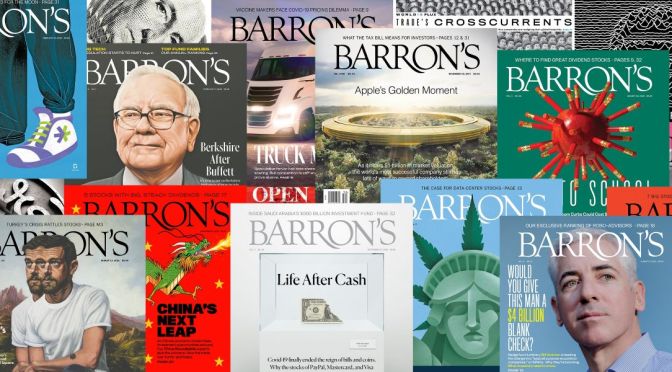
BARRON’S MAGAZINE – SEPTEMBER 29, 2025

BARRON’S MAGAZINE: The latest issue features ‘A Year of Tumult’ – Policy shifts have thrown the U.S. healthcare industry into turmoil and scared investors. Our panelists find 16 stocks with promising prospects.

Washington Is Disrupting Healthcare. 16 Stocks From Roundtable Pros That Can Win.

Our annual Healthcare Roundtable sizes up the risks and opportunities as public policy shifts. 16 stocks to buy now.

Ukraine Is Upending the Global Oil Market. Here’s Who Benefits.

Drone attacks on Russian refineries are curbing output. Sizing up the impact on U.S. refiners.

Trump Has Exerted Control Over Major Companies. How Their Stocks Have Fared.

Companies that need something from the White House have found the help comes with strings attached.

There’s a New Tax Break for ‘Concierge Medicine.’ Should You Go for It?

Republicans’ health policies may shift more patients and doctors to concierge practices. Should you join the club?

The Stock Market Is Up, but the Dollar Is Down. What It Means for You.

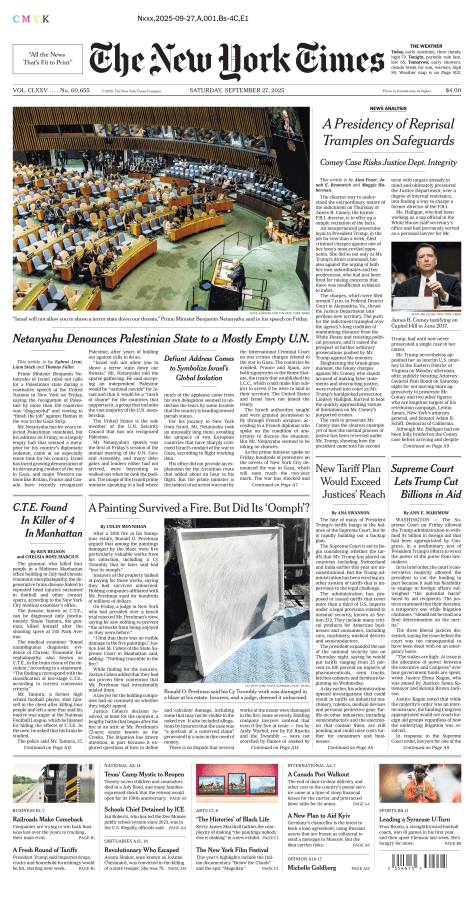
THE NEW YORK TIMES – SATURDAY, SEPT. 27, 2025

Comey Indictment Isn’t About Revenge, Trump Says. His Words Suggest Otherwise.

President Trump has made clear that he expects the Justice Department to mete out punishment to his perceived enemies.

Justice Department Seeks Information on Georgia D.A. Who Prosecuted Trump

Federal investigators have subpoenaed records related to travel they believe Fani Willis took around the time of last year’s election, but it was not immediately clear why.

Netanyahu’s Defiant U.N. Speech Was Aimed at Home as Well as the World

Benjamin Netanyahu faced walkouts and protests at the U.N., but signaled that resisting Palestinian statehood could become the core of his appeal to Israeli voters.

The Debate Style That Propelled Charlie Kirk’s Movement

A close read of some of Mr. Kirk’s most viral exchanges shows an approach that was polished and skillful — if not always fair.

DO I WAKE OR SLEEP?

A Speculative Morning with Keats

By Michael Cummins, Editor, September 25, 2025

“As if I were dissolving.” — John Keats, letter to his brother George, April 1819

In Hampstead, on a spring morning in 1819, John Keats sat beneath a plum tree and wrote “Ode to a Nightingale.” This is how the lines may have come to him—half vision, half dissolution.

Brown clatters a cup somewhere inside. The sound is an unwelcome punctuation mark on the morning’s silence, a reminder of the relentless normalcy of domestic life. The room has felt too narrow for breath, not just for my ailing lungs, but for the grief that keeps the curtains drawn. Barely six months since my brother Tom slipped away, the house still smells faintly of smoke, paper, and the sweet-sick residue of medicine. His absence hangs in the air. That weight has driven me to the grass, away from the claustrophobia of the sickroom.

The garden receives me. The grass is damp, pressing cool blades into my palms. Light filters through the plum tree leaves, breaking into fragments on the soil. The blossoms drift like a quiet snowfall, powdering my sleeve with pale dust as if testing whether the body still belongs to earth. Beyond the hedge, a cart rattles, a dog barks, a bell tolls faintly from Hampstead. Life continues its tedious bookkeeping. But here, there is only the hush before song.

Brown’s footsteps echo faintly, a rhythm too human for the stillness I crave. Even his voice, when it rises in greeting, feels like a tether to the mundane. I do not resent him; I envy his ease with the world. He pours tea, hums to himself, and carries on. I am fixed under the plum tree, waiting for something less ordinary to speak.

And then the nightingale begins. The sound is not a tune but a force: poured, unbroken, radically unselfconscious. It arrives without the stutter of human intention, as if the bird is nothing but the channel of its own liquid note. The song alters the air. I feel it in the chest before I write a word. I steady my paper, and the ink pools like shadow, metallic and alive. It smells of iron and inevitability. Each stroke is a pulse, each word a breath I cannot take.

My heart aches, and a drowsy numbness pains
My sense, as though of hemlock I had drunk,

The line comes of its own accord. The ache is not complaint but aperture. Pain is the friction that opens the door. Numbness clears the chatter of reason. The poem begins in crisis, a shock both physical and metaphysical.

Or emptied some dull opiate to the drains
One minute past, and Lethe-wards had sunk:

Lethe does not erase; it suspends. In its waters, memory floats unmoored, waiting for a name. Tom is gone, ferried by the same current. His silence hovers in the ink. Yet the river here is not despair but narcotic kindness, a place where debts and illness dissolve into rhythm. I do not summon the myth; it summons me. Byron writes like a storm—quick, unrelenting. I write like a wound: slow, deliberate, pulsing. And yet today the hand runs faster, driven by the bird’s current.

’Tis not through envy of thy happy lot,
But being too happy in thine happiness,—

I do not covet. I am saturated. The bird’s happiness is no possession but a weather spilling into the morning. I am not resentful; I am simply overflowed. The pen scratches faster when I abandon self-pity and admit the sheer fact of joy.

That thou, light-winged Dryad of the trees,
In some melodious plot

The Dryad arrives without strain. Myth is not invention but recognition. The bird’s song is timeless, deserving of a classical name.

Of beechen green, and shadows numberless,
Singest of summer in full-throated ease.

Ease—I do not have it. My lungs constrict, my chest rasps, nights punctuated by the cough that writes mortality into every breath. Yet I put the phrase down because the bird teaches it. A line must do what it says: open, breathe, pour.

The song intoxicates more than wine. My lips are dry, yet the body reels as though stained purple at the mouth.

O for a draught of vintage! that hath been
Cool’d a long age in the deep-delved earth,

The cellar rises: cool, stony, damp. This is no ornament but a transcription of sensation.

Tasting of Flora and the country green,
Dance, and Provençal song, and sunburnt mirth!

I have never seen Provence, but the imagination persuades me otherwise. The song conjures the vineyard. These sensations are not decoration; they are human joy remembered in the body.

O for a beaker full of the warm South,
Full of the true, the blushful Hippocrene,

The beaker is not a vessel but the bird itself, brimming with myth. Hippocrene flows because the song requires its name.

With beaded bubbles winking at the brim,
And purple-stained mouth;

To drink is to be marked. The mouth is stained because it has been altered. Poetry demands transformation; ecstasy must leave a trace.

But intoxication fades. What remains is grief.

Fade far away, dissolve, and quite forget
What thou among the leaves hast never known,

The bird is blessed in its ignorance. It does not know poverty. It does not know longing. It does not know the ache of an empty chair.

Tom once sat beneath this tree, sketching the shape of a bird in flight. He said silence was the soul’s canvas. Now that silence is heavier, less blank, more bruised. His face—thin as paper—rises when I write “youth grows pale.” The ode becomes his memorial as much as mine.

The weariness, the fever, and the fret
Here, where men sit and hear each other groan;

The line steadies itself on blunt fact. Tom. Debt. The cough. No flourish can soften them.

Where palsy shakes a few, sad, last grey hairs,
Where youth grows pale, and spectre-thin, and dies;

He is there again, spectre-thin, his breath shallow. The cadence is the only mercy.

Where but to think is to be full of sorrow
And leaden-eyed despairs,

Thought itself betrays when it offers no hope forward. To write is to wrestle despair into cadence.

I call for wings—not Bacchus’s painted team but the invisible kind I know.

Away! away! for I will fly to thee,
Not charioted by Bacchus and his pards,

Wine is a lie. Fancy, too. Only poesy can lift.

But on the viewless wings of Poesy,
Though the dull brain perplexes and retards:

The brain resists, heavy, skeptical. Poesy ignores resistance. The moment I write “Away!” I am gone.

Already with thee! tender is the night,
And haply the Queen-Moon is on her throne,

Daylight floods Hampstead, yet the moon rises on the page. The imagination enthrones her, and that suffices.

Cluster’d around by all her starry Fays;
But here there is no light,

Contradiction is permitted. This is Negative Capability as I once named it: to remain “in uncertainties, Mysteries, doubts, without any irritable reaching after fact and reason.” The ode does not solve; it dwells.

Death arrives then, companionable, not hostile.

Now more than ever seems it rich to die,
To cease upon the midnight with no pain,

“Rich”—the word startles, but I keep it. Death here is plenitude, not theft.

While thou art pouring forth thy soul abroad
In such an ecstasy!

The bird pours, my ribs echo. Death feels like completion.

Still wouldst thou sing, and I have ears in vain—
To thy high requiem become a sod.

Yet honesty must break the dream: if I am earth, I cannot hear. Even rapture admits silence.

The song itself, though, is older than me, older than kings.

Thou wast not born for death, immortal Bird!
No hungry generations tramp thee down;

Mortality is mine, not yours. Your song belongs to recurrence.

The voice I hear this passing night was heard
In ancient days by emperor and clown:

Emperors and clowns alike have bent their ears. Beauty makes no distinction.

Perhaps the self-same song that found a path
Through the sad heart of Ruth, when, sick for home,

The “perhaps” is everything. Certainty would bruise compassion.

I think, too, of Fanny Brawne. Her presence lingers behind the lines, as urgent as my cough. She is near, but a partition stands—of health, of propriety, of fate itself. To love her is to ache for what cannot be promised. The bird’s song is boundless, but my breath is measured. Desire sharpens sorrow into necessity.

The garden dissolves. Casements open in the skull.

Charm’d magic casements, opening on the foam
Of perilous seas, in faery lands forlorn,

The peril saves the vision from cloying. A blossom falls on my sleeve like ash from a cooling fire.

Forlorn! the very word is like a bell
To toll me back from thee to my sole self!

One word tolls, and the spell breaks.

Adieu! the fancy cannot cheat so well
As she is fam’d to do, deceiving elf.

I do not scold the Fancy. I thank it. Its deception is mercy.

The music vanishes. Not fading, but gone.

Fled is that music:—Do I wake or sleep?

I stop. I do not answer. The question is the ode’s truest symmetry.

The ink is still damp, smelling of iron. I glance back at the start, weighing first heat against last stillness.

My heart aches, and a drowsy numbness pains… Fled is that music:—Do I wake or sleep?

Between these poles lies a morning: a poet beneath a plum tree, a body already failing, a bird whose song endures.

I think of what I wrote not long ago—that the world is a vale of Soul-making. Do you not see how necessary a World of Pains and troubles is to school an Intelligence and make it a Soul? Suffering is the furnace, imagination the hammer. The ode is not escape from the furnace but evidence of the forging itself.

Perhaps a widow will read this, her fingers trembling on the page. Or a child, too young to name sorrow, will feel something loosen in the chest. Or a soldier, resting between battles, will find a measure of stillness in the lines. Beauty is not ornament but survival. If the poem steadies even one breath, it has earned its place among the leaves.

Brown steps out, squinting in the morning light. I gather the pages, careful as if any breeze could undo the morning. I hand him the sheaf and say what is exact: “I have been writing.”

He will tell this story later and say I wrote under the plum tree in one morning, which is true in the way truth sometimes fits a simple sentence. I go back inside. The cough finds me at the foot of the stair; it always does. But the air in my chest is changed by the shape the morning carved in it. The bird sang, and I answered. Whether I wake or sleep, the song remains.

THIS ESSAY WAS WRITTEN AND EDITED UTILIZING AI