

In 1972, Frank Wilczek and his thesis adviser, David Gross, discovered the basic theory of the strong force — the final pillar of the Standard Model of particle physics. Their work revealed the strange alchemy at work inside the nucleus of an atom. It also turned out to underpin almost all subsequent research into the early universe. Wilczek and Gross went on to share the 2004 Nobel Prize in Physics for the work. At the time it was done, Wilczek was just 21 years old. His influence in the decades since has been profound. He predicted the existence of a hypothetical particle called the axion, which today is a leading candidate for dark matter. He published groundbreaking papers on the nature of the early universe. And just last year, his prediction of the “anyon” — a strange type of particle that only shows up in two-dimensional systems — was experimentally confirmed.
Tag Archives: Physics
Science: ‘The Biggest Breakthroughs In Physics In 2020’ (Quanta Video)
This year, two teams of physicists made profound progress on ideas that could bring about the next revolution in physics. Another still has identified the source of a long-standing cosmic mystery.
- 1. Here’s an extremely brief version of the black hole information paradox: Stuff falls into a black hole. Over time — a long, long time — the black hole “evaporates.” What happened to the stuff? According to the rules of gravity, it’s gone, its information lost forever. But according to the rules of quantum mechanics, information can never be lost. Therefore, paradox. This year, a series of tour de force calculations has shown that information must somehow escape — even if how it does so remains a mystery.
- 2. Levitating trains, lossless power transmission, perfect energy storage: The promise of room-temperature superconductivity has fed many a utopian dream. A team based at the University of Rochester in New York reported that they had created a material based on a lattice of hydrogen atoms that showed evidence of superconductivity at up to about 15 degrees Celsius (59 degrees Fahrenheit) — about the temperature of a chilly room. The only catch: Superconductivity at this temperature only works if the material is crushed inside a diamond anvil to pressures approaching those of Earth’s core. Utopia will have to wait.
- 3. A dazzling cosmic strobe has ended an enduring astronomical mystery. Fast radio bursts — blips of distant radio waves that last for mere milliseconds — have eluded explanation since they were first discovered in 2007. Or rather, astronomers had come up with far too many theories to explain what are, for the brief time they’re alight, the most powerful radio sources in the universe. But on a quiet morning in April, a burst “lit up our telescope like a Christmas tree,” said one astronomer. This allowed researchers to trace its source back to a part of the sky where an object had been shooting out X-rays. Astronomers concluded that a highly magnetized neutron star called a magnetar was behind the phenomenon.
INTERVIEWS: ‘2020 NOBEL LAUREATES IN PHYSIOLOGY, PEACE, PHYSICS, CHEMISTRY AND ECONOMICS’ (VIDEO)
Cecilia Gralde in Stockholm speaks to this year’s Nobel Laureates in Peace, Physics, Chemistry, Physiology or Medicine, and Economic Sciences about the theories, discoveries and research behind their awards, and the value of science in dealing with the global pandemic.SHOW LESS
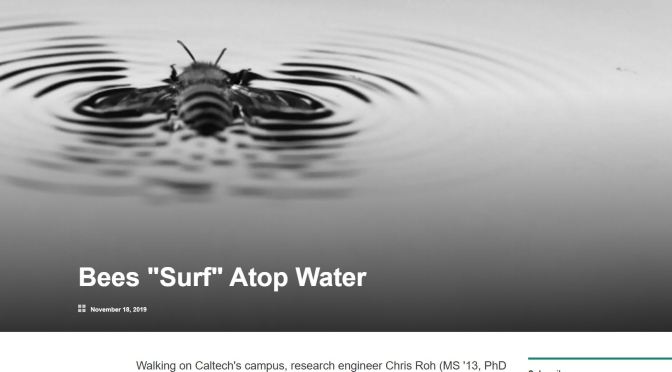
Engineering In Nature: “Honeybees Use Their Wings For Water Surface Locomotion” (Caltech)
From a Caltech online article:
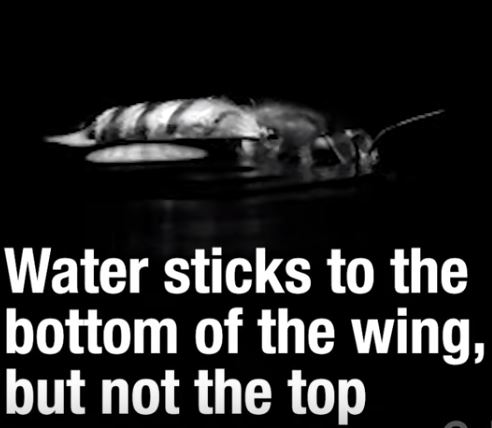 When a bee lands on water, the water sticks to its wings, robbing it of the ability to fly. However, that stickiness allows the bee to drag water, creating waves that propel it forward. In the lab, Roh and Gharib noted that the generated wave pattern is symmetrical from left to right. A strong, large-amplitude wave with an interference pattern is generated in the water at the rear of the bee, while the surface in front of the bee lacks the large wave and interference. This asymmetry propels the bees forward with the slightest of force—about 20 millionths of a Newton.
Walking on Caltech’s campus, research engineer Chris Roh (MS ’13, PhD ’17) happened to see a bee stuck in the water of Millikan Pond. Although it was a common-enough sight, it led Roh and his advisor, Mory Gharib (PhD ’83), to a discovery about the potentially unique way that bees navigate the interface between water and air.
To read more: https://www.caltech.edu/about/news/bees-surf-atop-water
 Boomers Daily