

What we eat needs to be nutritious and sustainable. Researchers are trying to figure out what that looks like around the world. https://t.co/epWJyzHxRz
— nature (@Nature) December 1, 2021
Tag Archives: Nature.com
Science: Research Salary Survey, Jumping Spiders, NASA Smashing Asteroids
The Nature salary and satisfaction survey reveals researchers’ outlook, and NASA’s test of planetary defenses.
In this episode:
00:45 Salary and satisfaction survey
Like all aspects of life, scientific careers have been impacted by the pandemic. To get an insight into how researchers are feeling, Nature has conducted a salary and satisfaction survey. We hear from some of the respondents.
Careers Feature: Stagnating salaries present hurdles to career satisfaction
09:07 Research Highlights
The physics of a finger snap, and the surprisingly strong silk of jumping spiders.
Research Highlight: It’s a snap: the friction-based physics behind a common gesture
Research Highlight: High-speed spinning yields some of the toughest spider silk ever found
11:23 Briefing Chat
We discuss some highlights from the Nature Briefing. This time, the plans to smash a spacecraft into an asteroid, and how baby formula is changing to better resemble breast milk.
Nature News: NASA spacecraft will slam into asteroid in first planetary-defence test
Chemistry World: The science of breast milk and baby formula
Front Covers: Nature Magazine – November 18
Science: Sea Squirts And Vertebrate Evolution, Iodine-Powered Satellites
Spineless sea squirts shed light on vertebrate evolution, and an iodine-fuelled engine powering a satellite in space.
In this episode:
00:45 A story of sea squirts, ancient vertebrates and missing genes
When a PhD student set out to study the developmental pathways of a strange sea creature, he hoped to shed light on the origins of vertebrate animals. Instead, researchers found themselves investigating a strange case of missing genes. We hear why gene loss could be a more significant factor in evolutionary processes than was previously thought.
Research article: Ferrández-Roldán et al.
08:17 Research Highlights
The unusual crystal that gives a beetle its glittering green sheen, and the genetics of a fish’s 200 year lifespan.
Research Highlight: Weird crystal makes beetle a living jewel
Research Highlight: Some of Earth’s longest-lived fish show how to reach extreme ages
10:43 An iodine-fuelled engine for satellites
In space, many satellites use xenon-fuelled ‘electric propulsion systems’ to maneuver. However, xenon is rare and requires high-pressure storage systems, so researchers have been working to develop alternative fuels. This week, a team publish details of the first in-space test of an iodine-powered electric propulsion system, which they say has many advantages over xenon systems.
Research article: Rafalskyi et al
16:37 Briefing Chat
We discuss some highlights from the Nature Briefing. This time, issues aboard the Hubble Space Telescope, and what the discovery of a theorised mineral reveals about processes deep within the Earth.
Wired: NASA Tries to Save Hubble, Again
Nature: Diamond delivers long-sought mineral from the deep Earth
Front Covers: Nature Magazine – November 11
Climate Science: Young People Voice Concerns Onboard The COP26 Train
Last weekend, hundreds of young people boarded a specially chartered train in Amsterdam to travel to Glasgow ahead of the United Nations COP26 climate summit.
Among them were scientists, activists and policy makers. In a Nature Podcast special, we boarded the train to catch up with some of them – to talk about their science, their motivations and their message.
Science: 4000-Year-Old Mummies, Digital-Hygiene Checks, Ancient Snakes
The unexpected origins of a 4000-year-old people, protecting your ‘digital presence’ and what to expect from COP26.
In this episode:
00:48 The origins of the mysterious Tarim mummies
For decades there has been debate about the origins of a group of 4000-year-old individuals known as the Tarim Basin mummies. Their distinct appearance and clothing has prompted scientists to hypothesise they had migrated from the North or West. Now, a team of researchers have used modern genomics to shed new light on this mystery and reveal that migration was not the mummies’ origin.
Research article: Zhang et al.
News and Views: The unexpected ancestry of Inner Asian mummies
08:59 Research Highlights
Making wood mouldable, and how ancient snakes diversified their diets.
Research Highlight: Moulded or folded, this wood stays strong
Research Highlight: Finicky no more: ancient snakes ate their way to success
11:09 How a regular ‘digital-hygiene’ check can protect your reputation
Attaching a researcher’s name to a paper without them knowing is an unscrupulous practice that can have serious repercussions for the unwitting academic. To prevent this, computer scientist Guillaume Cabanac is advocating a once-a-month ‘digital-hygiene’ check, to identify incorrect acknowledgements, and help prevent research malpractice.
World View: This digital-hygiene routine will protect your scholarship
18:51 What to expect from COP26
This week sees the start of the 26th UN Climate Change Conference (COP26), with an estimated 20,000 people — including world leaders, scientists and activists — expected to be in attendance. Jeff Tollefson, senior reporter at Nature, joins us to explain what’s on the agenda for the conference.
News Explainer: COP26 climate summit: A scientists’ guide to a momentous meeting
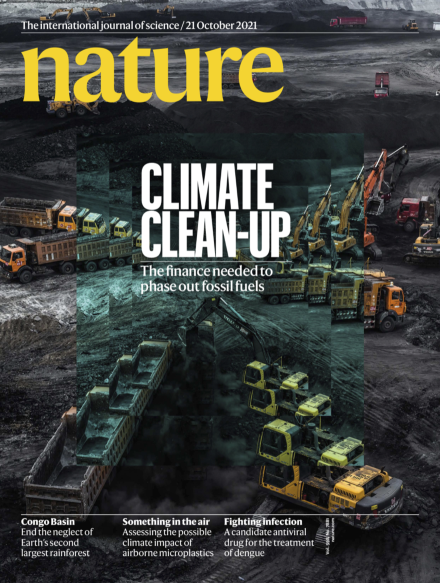
Front Covers: Nature Magazine – October 21
Science: Vikings In North America, Magnets Moving Non-Magnetic Metals
An ancient solar storm helps pinpoint when Vikings lived in the Americas, and using magnets to deftly move non-magnetic metals.
In this episode:
00:53 Pinpointing Viking presence in North America
It’s well-understood that Vikings went to North America around a thousand years ago. However, working out a precise date has proven difficult. Now, thanks to an ancient solar storm, researchers have been able to identify an individual year when Vikings were definitely living on the continent.
Research article: Kuitems et al.
14:57 Research Highlights
How shoulder muscles gave Pterosaurs an aerodynamic edge, and mysterious radio waves coming from near the centre of the Milky Way.
Research Highlight: How ancient reptiles were streamlined for flight
Research Highlight: A mysterious radio signal object is beaming radio waves into the Milky Way
17:45 Magnets move non-magnetic metals
Scientists have created an array of magnets capable of moving non-metallic objects in 6 dimensions. They hope their new approach could one day be used to clean up debris in space.
Research article: Pham et al.
News and Views: Non-magnetic objects induced to move by electromagnets
27:06 What Francis Collin’s retirement means for the US NIH
After 12 years, Francis Collins announced plans to retire from his role as Director of the United States National Institutes of Health. We discuss his legacy and what this means for the world’s biggest public funder of biomedical research.
Editorial: COVID, racism, China: three tests for the next NIH leader
News: Francis Collins to step down at NIH: scientists assess his legacy
 Boomers Daily