Tag Archives: NASA

Economics Of Nature: ‘Mapping The Ecosystems Of Liberia, Africa’ (Video)

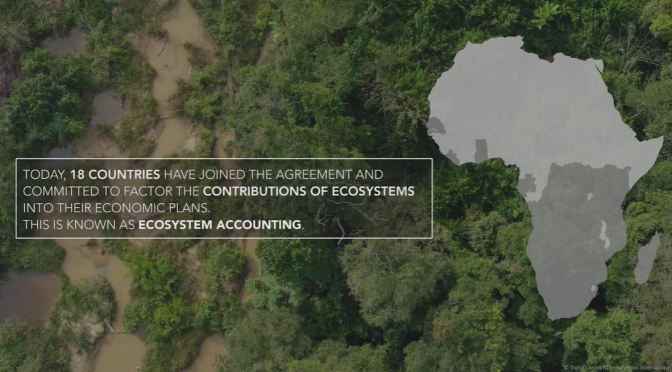
NASA is working alongside Conservation International and the Liberian Government through the Environmental Protection Agency (EPA) to pilot an innovative and replicable approach to more accurately map ecosystems to support effective planning and sustainable decision-making. NASA’s satellite data and expert analysis will provide a country-wide picture of Liberia’s hardwood forests, mangroves, and other ecosystems; Conservation International and the Liberian Government through the EPA will augment that data with their expertise in ecosystem accounting, field studies, and local knowledge to quantify the value of the country’s natural resources and related ecosystem services.

Liberia is a country in West Africa, bordering Sierra Leone, Guinea and Côte d’Ivoire. On the Atlantic coast, the capital city of Monrovia is home to the Liberia National Museum, with its exhibits on national culture and history. Around Monrovia are palm-lined beaches like Silver and CeCe. Along the coast, beach towns include the port of Buchanan, as well as laid-back Robertsport, known for its strong surf. 

Read more: https://www.nasa.gov/feature/goddard/…
NASA: Landing On Mars, Spacewalks & Venus Views

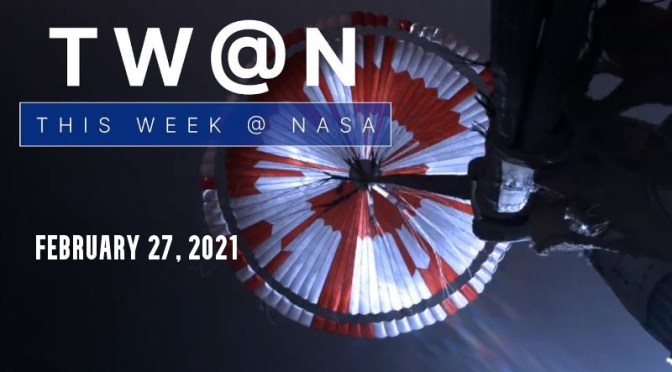
How it looks to land on Mars, previewing space station spacewalks, and supplies and cargo delivered for the station crew … a few of the stories to tell you about – This Week at NASA!

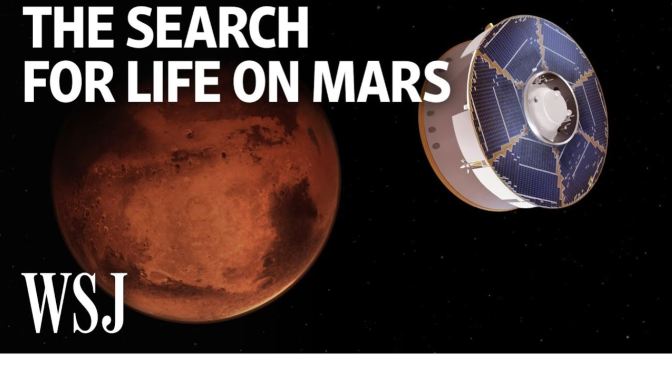
Space Programs: ‘The Search For Life On Mars’

China, the UAE and the U.S. all have spacecraft visiting Mars in February to study the Red Planet. WSJ explains how out-of-this-world technology is being used by NASA’s Perseverance and China’s Tianwen-1 in the search for evidence of life beyond our planet. Photo: NASA

Astronomy: ‘Skywatching Tips – January 2021’ (Video)

What are some skywatching highlights in January 2021? Mark Earth’s closest approach to the Sun for the year, called perihelion, at the start of the month, then spot a couple of elusive planets: Uranus on Jan. 20th and Mercury throughout the second half of the month. Additional information about topics covered in this episode of What’s Up, along with still images from the video, and the video transcript, are available at https://solarsystem.nasa.gov/whats-up….

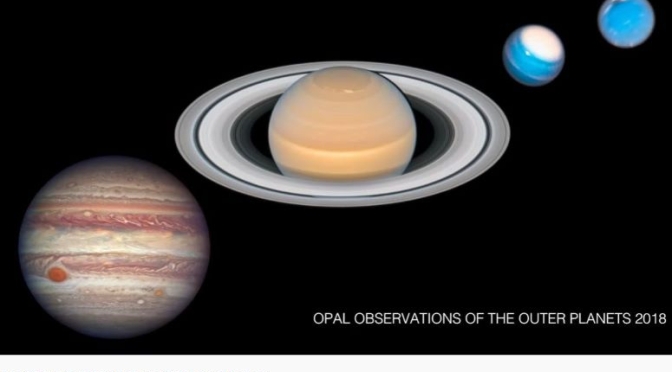
Astronomy: ‘The Outer Planets’ From Hubble Space Telescope (Video)

What is OPAL? OPAL (Outer Planet Atmospheres Legacy) is a project to obtain long time baseline observations of the outer planets in order to understand their atmospheric dynamics and evolution as gas giants. The yearly observations from OPAL throughout the remainder of Hubble’s operation will provide an important legacy of time-domain images for use by planetary scientists. Viewers might notice that some of the images of the same planets appear to be different colors. This is due to the fact that over the years, from Voyager to Hubble, many different instruments, and many different filters have been used.

History Of Satellites: NASA’s ‘Landsat’ Program – “Getting Off The Ground”

Every legacy has a compelling origin. The soon-to-be-launched Landsat 9 is the intellectual and technical product of eight generations of Landsat missions, spanning nearly 50 years.

Episode One answers the question “why?” Why did the specific years between 1962 and 1972 call for a such a mission? Why did leadership across agencies commit to its fruition? Why was the knowledge it could reveal important to the advancing study of earth science?

In this episode, we’re introduced to William Pecora and Stewart Udall, two men who propelled the project into reality, as well as Virginia Norwood who breathed life into new technology. Like any worthwhile endeavor, Landsat encountered its fair share of resistance. Episode one explores how those challenges were overcome with the launch of Landsat 1, signifying a bold step into a new paradigm.

Additional footage courtesy of Gordon Wilkinson/Texas Archive of the Moving Image and the US Geological Survey. The Landsat Program is a series of Earth-observing satellite missions jointly managed by NASA and the U.S. Geological Survey (USGS). Landsat satellites have been consistently gathering data about our planet since 1972. They continue to improve and expand this unparalleled record of Earth’s changing landscapes for the benefit of all.

Music: “The Missing Star,” “Brazenly Bashful,” “Light Tense Weight,” “It’s Decision Time,” “Patisserie Pressure,” from Universal Production Music Credit: NASA’s Goddard Space Flight Center Matthew R. Radcliff (USRA): Lead Producer Ryan Fitzgibbons (USRA): Lead Producer Kate Ramsayer (USRA): Lead Producer LK Ward (USRA): Lead Writer Ryan Fitzgibbons (USRA): Lead Editor Jeffrey Masek (NASA/GSFC): Lead Scientist Marc Evan Jackson: Narrator Terry Arvidson (Lockheed Martin): Interviewee Aaron E. Lepsch (ADNET): Technical Support

Astronomy: Saturn’s Moon ‘Titan’ (Nasa Video)

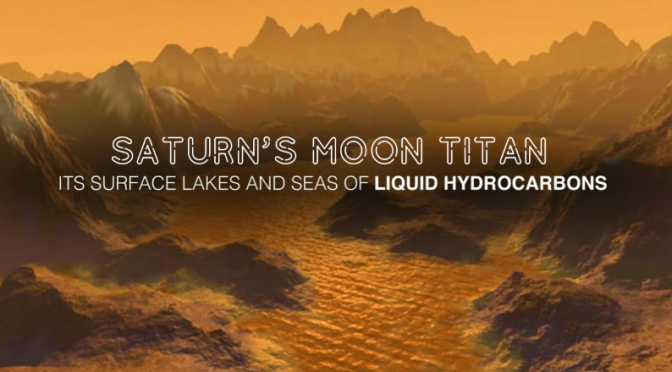
Earth is not the only place in the solar system with rain, rivers, lakes and seas. Saturn’s moon Titan has them, too — not of water, but of liquid methane and ethane. This Earth-like world even hides an ocean of liquid water deep beneath its surface! Find out what you need to know about Titan.

Space Program: November Marks 20 Years Of Humans Abord The Space Station

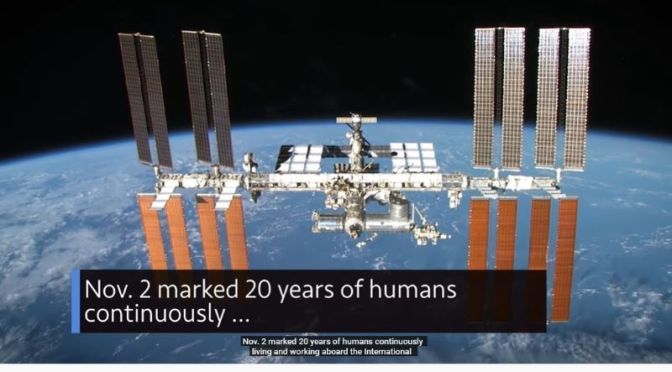
Marking 20 years of humans aboard the space station, getting out the vote from space, and preparations continue for NASA and SpaceX’s next crew launch … a few of the stories to tell you about – This Week at NASA!

Download Link: https://images.nasa.gov/details-Marki…

Morning News Podcast: Fake News & Election, Roe V. Wade And NASA Mission

Foreign and domestic actors are no longer using bots and fake accounts to influence the 2020 election. Now, bad actors are trying to trick journalists intro amplifying fake storylines.

  • Plus, life after Roe vs. Wade.
  • And, NASA is launching a new toilet to the International Space Station.

Guests: Axios’ Sara Fischer and Margaret Talev