Tag Archives: Literature

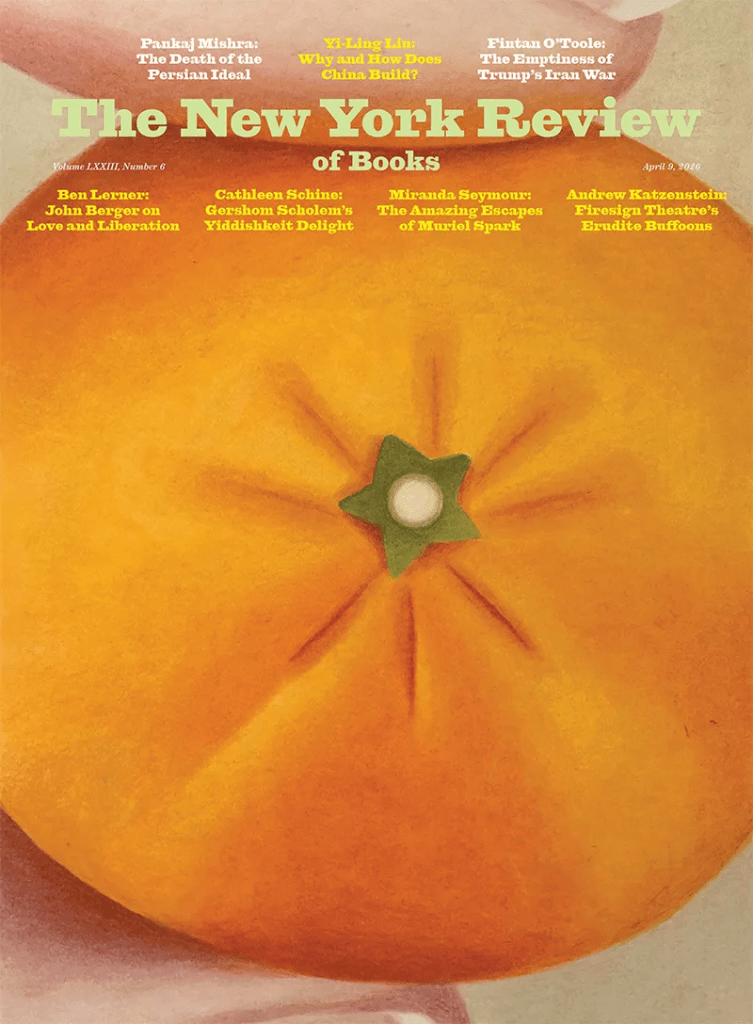
THE NEW YORK REVIEW OF BOOKS – APRIL 9, 2026

THE NEW YORK REVIEW OF BOOKS: The latest issue features geopolitical analyses of the Iran conflict by Fintan O’Toole and Pankaj Mishra, alongside cultural explorations of literature and art. Key contributions include discussions on the economic dualities of Shenzhen, China, and critiques of historical narratives regarding the Allied firebombing of Japan. 

A Bitter Education

In its quiescence to the West’s war on Iran, India is squandering a precious legacy.

Shenzhen Express

In Shenzhen, the successes and failures of China’s remarkable new economy are on full display.

Breakneck: China’s Quest to Engineer the Future by Dan Wang

House of Huawei: The Secret History of China’s Most Powerful Company by Eva Dou

Who Built France?

A new history explores France’s empire from the perspective of the indigenous and enslaved people who participated, willingly or not, in its creation.

By Flesh and Toil: How Sex, Race, and Labor Shaped the Early French Empire by Mélanie Lamotte

A Man-Made Disaster

There has never been a moral and historical reckoning with the horrors inflicted by the Allied firebombing of Japan during World War II.

Black Snow: Curtis LeMay, the Firebombing of Tokyo, and the Road to the Atomic Bomb by James M. Scott

The Bomber Mafia: A Dream, a Temptation, and the Longest Night of the Second World War by Malcolm Gladwell
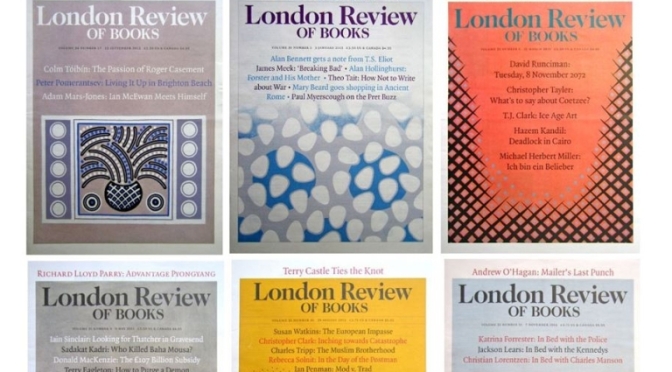
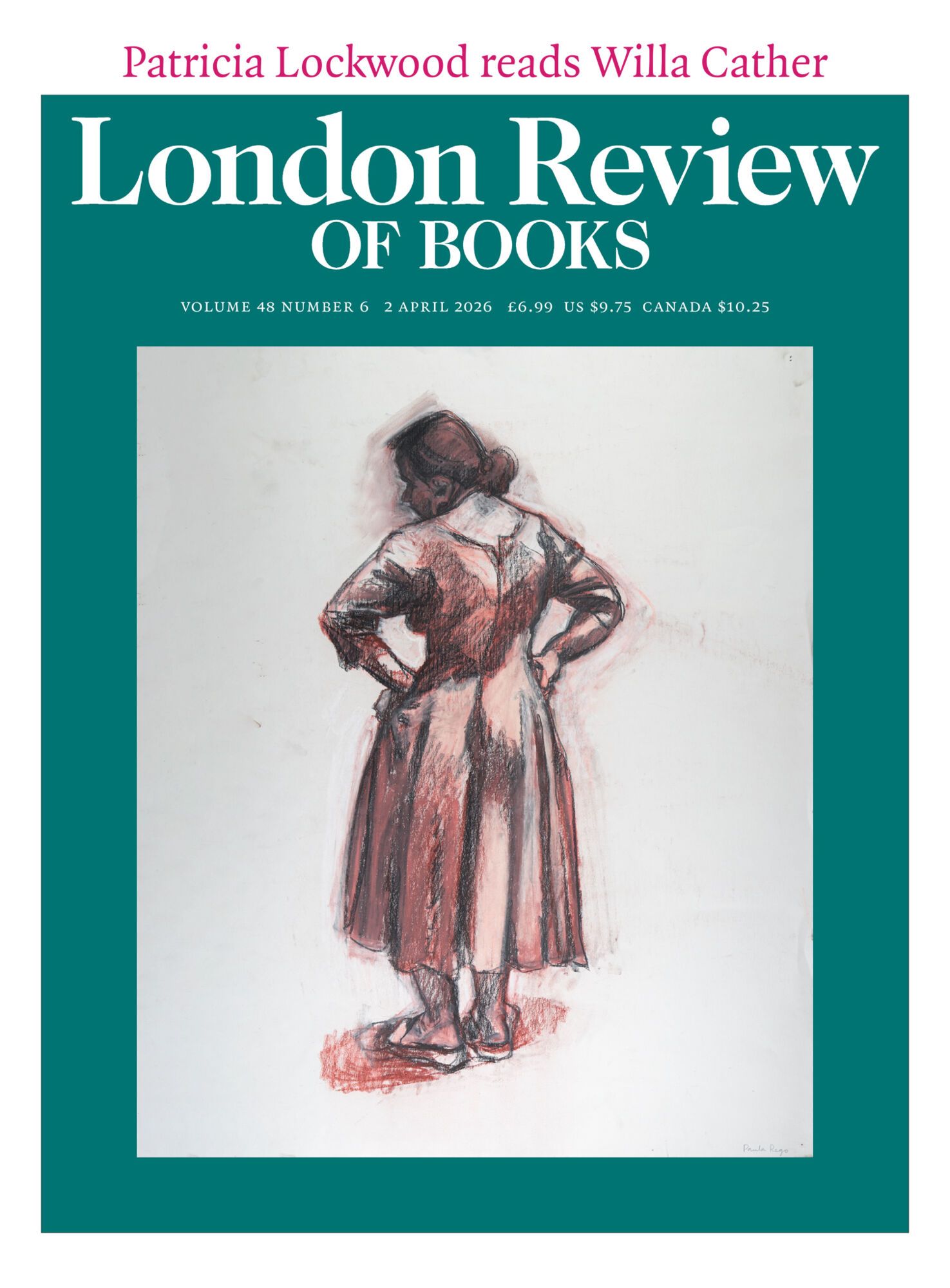
LONDON REVIEW OF BOOKS – APRIL 2, 2026 PREVIEW

Contents · Vol. 48 No. 6 · 02 April 2026

LONDON REVIEW OF BOOKS: The latest issue features ‘Patricia Lockwood on Willa Cather, Tom Johnson on early modern work, various political analyses, reviews, poetry, and a diary entry on Serbian student movements. 

The Bright Edges of the World: Willa Cather and Her Archbishop by Garrett Peck

Death Comes for the Archbishop by Willa Cather


The Experience of Work in Early Modern England 
by Jane Whittle, Mark Hailwood, Hannah Robb and Taylor Aucoin


Caillebotte: 
Painting Is a Serious Game by Amaury ChardeauGustave Caillebotte: Painting Men edited by Scott Allan, Gloria Groom and Paul Perrin

THE NEW YORKER MAGAZINE – MARCH 30, 2026 PREVIEW

A portrait of New York City as a pattern of subway cars firehydrants water towers rats alligators a few people and one...

THE NEW YORKER MAGAZINE: The latest issue cover features ‘Roz Chast’s “City Beasts” – Where the wild things are. Also, Jon Lee Anderson on Cuba’s crumbling regime, Jia Tolentino on Robyn, Jill Lepore on entrusting A.I. with moral judgment, and more.

The First Casualty of Trump’s War in Iran Was the Truth

The cruellest irony is that of a President who addresses the Iranian people in the language of liberation and then threatens freedom of the press back home. By David Remnick

Does A.I. Need a Constitution?

A new set of precepts is meant to make the chatbot Claude wise, decent, and safe. It also marks a striking transfer of public responsibility from constitutional government to private tech firms. By Jill Lepore

Is Cuba Next?

Trump’s campaign to topple foreign adversaries encounters a battered but defiant regime. By Jon Lee Anderson

TIMES LITERARY SUPPLEMENT – MARCH 20, 2026 PREVIEW

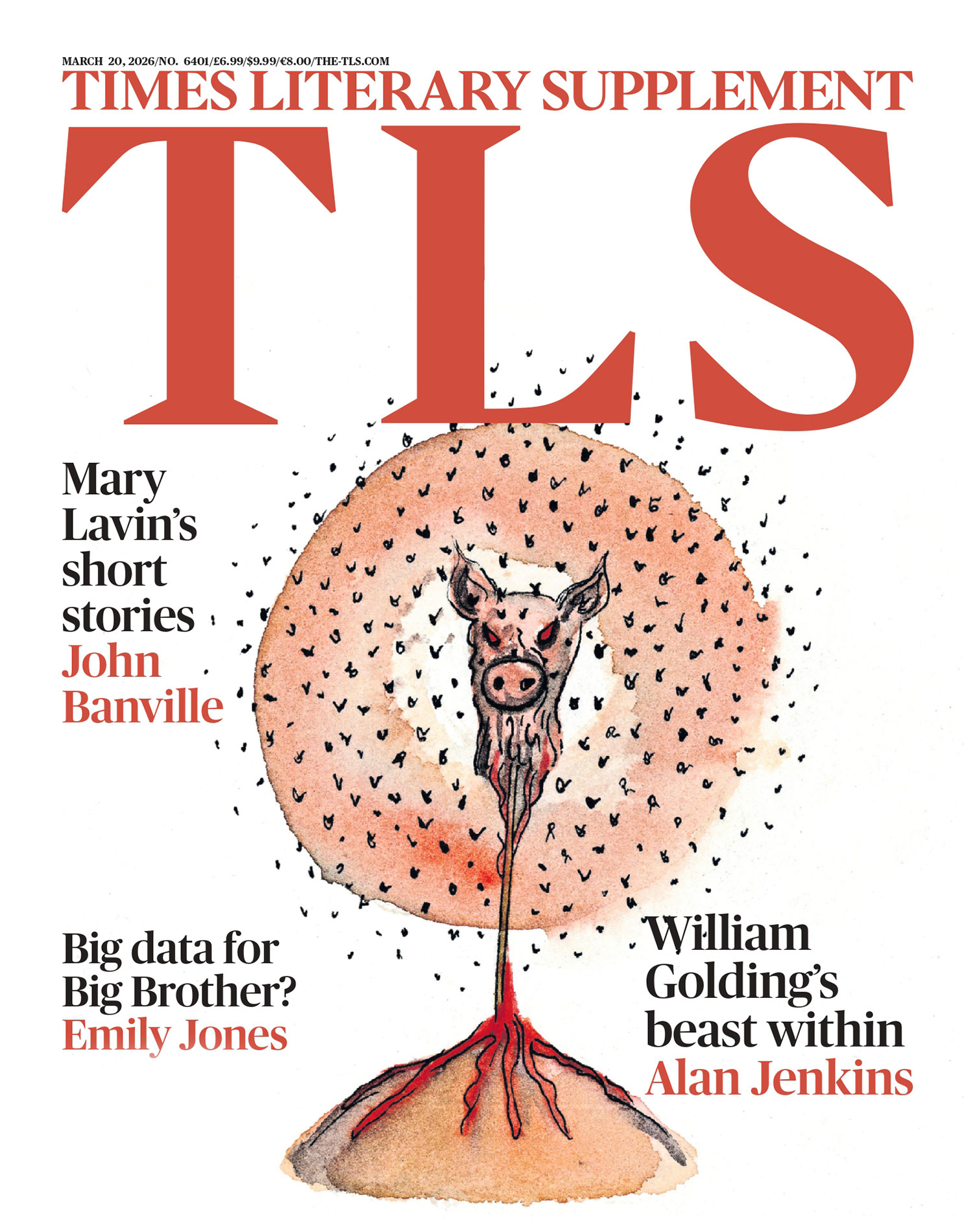
The TLS - Current Issue Cover

TIMES LITERARY SUPPLEMENT: The latest issue features William Golding’s beast within; the many lives of W. H. Auden; Palantir spreads; the spirit of the Risorgimento; Ishiguro on film; experiencing consciousness – and much more.

Darkness visible

The struggle between good and evil in William Golding’s fiction By Alan Jenkins

Clock stopper

The many lives of W. H. Auden By Ian Sansom

All-seeing eye

Alex Karp, CEO of Palantir, the controversial US tech company By Emily Jones

The feeling of being alive

Why do we experience consciousness?

THE NEW YORKER MAGAZINE – MARCH 23, 2026 PREVIEW

An explosive bouquet of colorful flowers.

THE NEW YORKER MAGAZINE: The latest issue features ‘Maira Kalman’s “Amid It All” – The blooms burst forth.

Trump’s Mass-Detention Campaign

Even with Kristi Noem gone, the Administration’s immigration agenda shows no signs of flagging—in fact, it is leading toward a new humanitarian and legal crisis. By Jonathan Blitzer

What’s Behind Trump’s New World Disorder?

A foreign policy freed of liberal pretenses and imperial ambitions could lead to restraint—or, as the Iran attack shows, simply license hit-and-run belligerence. By Daniel Immerwahr

Who Bankrolled the American Revolution?

Our history too often sidesteps the question of finances. But sonorous ideals don’t keep an army supplied with uniforms, guns, and grub. By Adam Gopnik

THE PARIS REVIEW-SPRING ’26

THE PARIS REVIEW : The Spring 2026 issue features Interviews, Prose, Poetry and Art….

  • Sarah Schulman on the Art of Nonfiction: “I like to have my say, obviously. And if people would have just let me talk, some of these books wouldn’t have had to be written.”
  • Darryl Pinckney on the Art of Nonfiction:  “There are moments when you run up against a white wall—there’s a white man, white man, white man, white man—and the story somehow has to be uncovered.”
  • Prose by Ingeborg Bachmann, Dan Bevacqua, Patrick Cottrell, Zans Brady Krohn, Tao Lin, David Szalay, and Yu Hua.
  • Poetry by Inger Christensen, Rachel Lapides, Enrique Lihn, Joyelle McSweeney, Nakahara Chuya, and Asiya Wadud.
  • Art by Cecily Brown, Tom Fairs, and Cauleen Smith; cover by Cecily Brown.

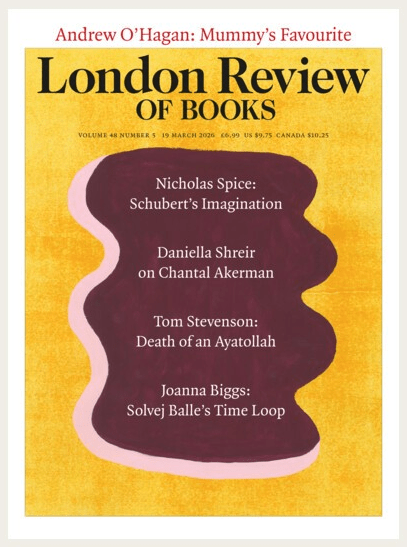
LONDON REVIEW OF BOOKS – MARCH 19, 2026 PREVIEW

LONDON REVIEW OF BOOKS: The latest issue features Nicholas Spice – Schubert’s Imagination; Daniella Shreir on Chantal Akerman; Tom Stevenson – Death of an Ayatollah; Joanna Biggs – Solvej Balle’s Time Loop….

Iran, Week One

The attack launched on Iran by the US and Israel on 28 February was a textbook case of international aggression, justified in only the most cursory fashion by fictional Iranian threats and undertaken with no clear aims and no clear demands or terms. In announcing the war Donald Trump described it as a wholesale attack on both government and state. The US and Israel would ‘raze their missile industry to the ground’ and ‘annihilate their navy’. Benjamin Netanyahu called on Iranians to ‘come out to the streets and finish the job’. By Tom Stevenson

Mummy’s Favourite

 The late queen can be held responsible for much, but nobody could accuse her of seeming to enjoy her role. For the Yorks, however, enjoyment was everything, and the notion of royal sacrifice, argu­ably a red herring in the House of Saxe-Coburg and Gotha, was finally obliterated by their act­ions. By Andrew O’Hagan

Marlowe’s Betrayals

As Stephen Greenblatt’s Dark Renaissance shows despite itself, it is not Marlowe’s life story that we still need, but his plays and poems: we might well want to avert our eyes from the bathetically dismal life of the man who wrote them. By Michael Dobson

Entitled: The Rise and Fall of the House of York by Andrew Lownie

Nobody’s Girl: A Memoir of Surviving Abuse and Fighting for Justice by Virginia Roberts Giuffre

Andrew O’Hagan

THE NEW YORKER MAGAZINE – MARCH 16, 2026 PREVIEW

Trump is standing in his golf card dressed in military clothes.

THE NEW YORKER MAGAZINE: The latest issue features ‘Barry Blitt’s “War-a-Lago” – No Nobel Peace Prize in sight.

Where Is the Iran War Headed?

President Trump has both called for Iranians to rise up and oust the ruthless theocracy and then said that he’s fully prepared to deal with a new religious leader. By Robin Wright

The Zombie Regulator

As the cost of living continues to spiral upward, the Trump Administration is gutting the government agency built to protect Americans from financial ruin. By E. Tammy Kim

The Unmaking of the American University

For decades, research universities have relied on federal funding, with no guarantee that it will last. Now their survival may depend on compliance with the government. By Nicholas Lemann

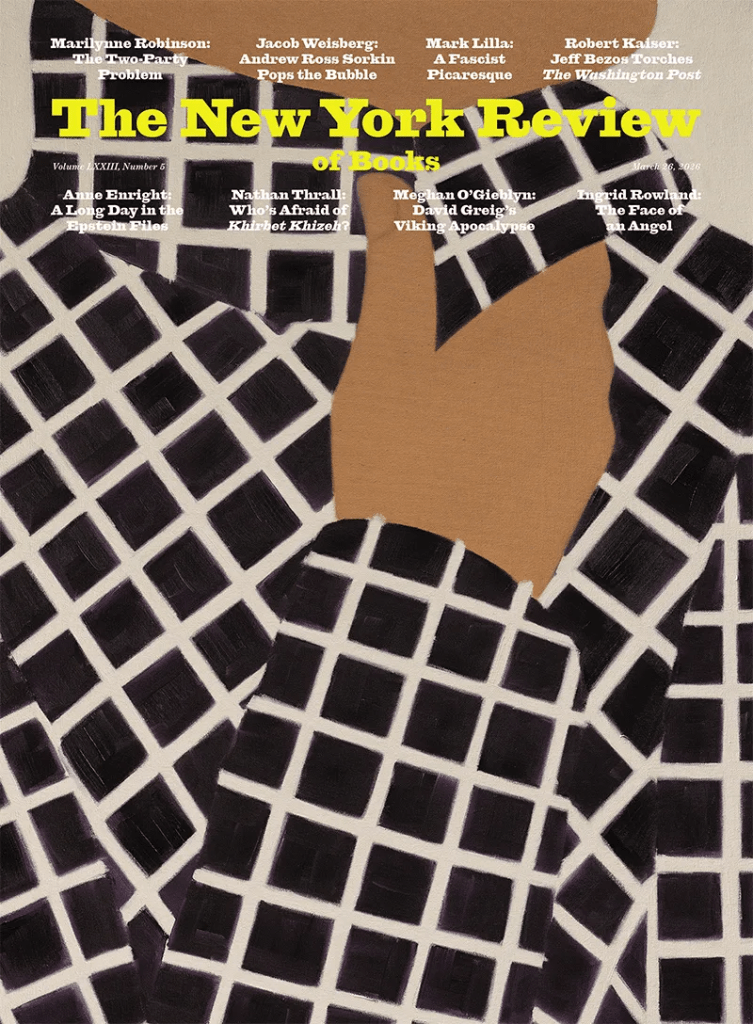
THE NEW YORK REVIEW OF BOOKS – MARCH 26, 2026

THE NEW YORK REVIEW OF BOOKS: The latest issue features Anne Enright on a day in Jeffrey Epstein’s life, Jacob Weisberg on the Great Crash, Ingrid D. Rowland on Giorgia Meloni alla fresco, Robert G. Kaiser on Citizen Bezos, Marilynne Robinson on two-party tyranny, Catherine Nicholson on the first diarist, Nathan Thrall on a lost Hebrew classic about the Nakba, David Cole on the fate of affirmative action, Aaron Matz on satire, Orville Schell on Chiang Kai-shek, Mark Lilla on a nineteenth-century protofascist, a poem by Patricia Lockwood, and much more.

‘The Devil Himself’

Sifting through a single day of Jeffrey Epstein’s emails reveals a surprising amount about the man and his many enablers.

Tick, Tick…Boom!

Andrew Ross Sorkin’s history of the 1929 stock market crash reminds us that financial bubbles are inevitable—and that another one may be about to pop.

1929: Inside the Greatest Crash in Wall Street History—and How It Shattered a Nation by Andrew Ross Sorkin

Post Mortem

When Jeff Bezos bought The Washington Post in 2013 and promised to find inventive ways to make journalism profitable in the digital age, he seemed like a godsend. He wasn’t.

Rembrandt’s DNA

The Leiden Collection—one of the largest private collections of Dutch art in the world—was conceived as a “lending library for Old Masters,” animated by the humanist spirit found in Rembrandt’s paintings.

Art and Life in Rembrandt’s Time: Masterpieces from the Leiden Collection – an exhibition at the H’ART Museum, Amsterdam, April 9–August 24, 2025, and the Norton Museum of Art, West Palm Beach, Florida, October 25, 2025—March 29, 2026

The Leiden Collection Online Catalogue, Fourth Edition edited by Arthur K. Wheelock Jr. and Elizabeth Nogrady

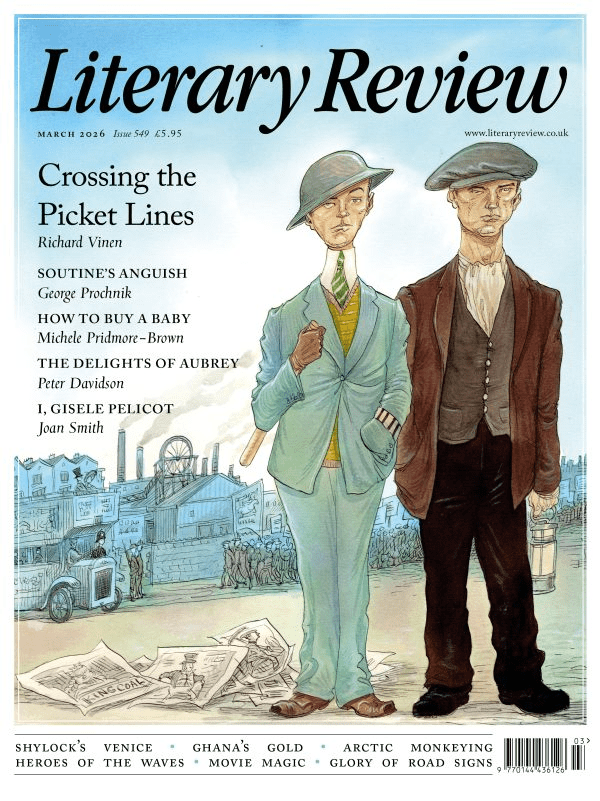
LITERARY REVIEW ———- MARCH 2026 PREVIEW

LITERARY REVIEW : The latest issue features Richard Vinen on the General Strike * George Prochnik on Chaim Soutine * Michele Pridmore-Brown on the fertility industry * Peter Davidson on John Aubrey * Joan Smith on Gisèle Pelicot * Piers Brendon on Kathleen Harriman * Jonathan Keates on the Venetian Ghetto * Erik Linstrum on Asante gold * Zoe Guttenplan on road signs * Holly E J Black on illustration * Michael Burleigh on the Arctic * Frances Cairncross on corporate scandals * Andrew Seaton on wind power

Not Funny, Not Forgotten

The historian A J P Taylor was at Oxford during the general strike of 1926. After it, he later recalled, relations between the minority of undergraduates, such as himself, who had gone to help the strikers and those who had signed on as special constables or volunteer strike-breakers were cordial. Only those sensible men who had stuck to their books and essays were disdained. The whole episode seemed funny in a stereotypically English way – like a Punch cartoon brought to life.

Chaim Soutine: Genius, Obsession, and a Dramatic Life in Art

By Celeste Marcus

The artist Chaim Soutine was obsessed with Rembrandt’s painting of a flayed and headless ox. After managing at the age of twenty, in 1913, to get from Smilovichi, a shtetl in present-day Belarus, to Paris, Soutine made many visits to the Louvre to study the canvas. In the mid-1920s, he decided to translate it into his own idiom: a voluminous impasto, churning with deep, febrile … 

Cash Cow: How the Maternal Body Became a Global Commodity – and the Hidden Costs for Women

By Alev Scott

Fuelled by desire and desperation, and considerable hucksterism, the global fertility industry is sometimes seen as having kinship with the sex trade. Its critics are keen to point out that it’s saturated with eugenicist values and geographic exploitation. In a not atypical scenario, a handful of ‘white eggs’ are purchased … 

John Aubrey at four hundred

Whenever I approach the blind corner on the path south of my house in Oxford, I ring my clear-toned bicycle bell and think of John Aubrey, who noted in the 17th century that church bells sound clearer after rain (which was true for my little bell today). I have often also passed on to tense students approaching their final exams Aubrey’s excellent advice that you are ‘more apt to study’ if you’ve played a gentle game of real tennis (or some less real modern equivalent). And whenever I find…