The Globalist Podcast (October 26, 2023) – Neighbouring countries respond to the Israel-Gaza conflict and how Russia is capitalising on the situation. We also have a look through the morning’s papers and hear from president and CEO of Arctic360, Jessica Shadian.
Plus: China’s youngest-ever space crew and the latest in television news
The Globalist Podcast (October 25, 2023) – We discuss the relationship between the US and Israel, French president Emmanuel Macron’s proposition for an anti-Islamic State coalition and Germany’s newest political party.
Plus: China’s bizarre propaganda TV series ‘When Marx Met Confucius’.
Carsan Choong Films (June 13, 2023) – Jordan, an Arab nation on the east bank of the Jordan River, is defined by ancient monuments, nature reserves and seaside resorts.
It’s home to the famed archaeological site of Petra, the Nabatean capital dating to around 300 B.C. Set in a narrow valley with tombs, temples and monuments carved into the surrounding pink sandstone cliffs, Petra earns its nickname, the “Rose City.”
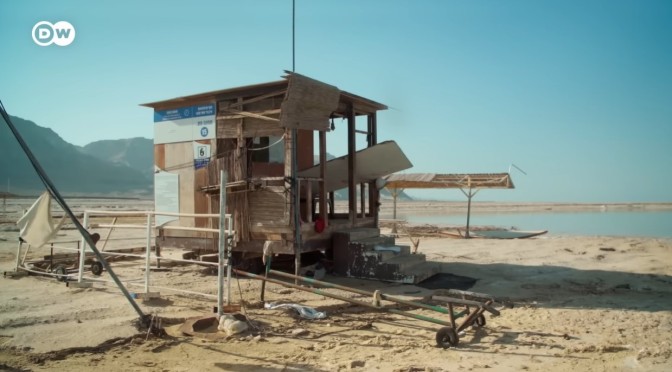
DW Documentary (May 1, 2023) – The Dead Sea, shared by Israelis, Jordanians and Palestinians, is drying up. The salt lake, famous for its exceptional geographical location and its healing properties, is the deepest of its kind on earth.
The drying up of the Dead Sea is causing widespread damage, from huge sinkholes to abandoned beaches and collapsed roads. This is not an act of nature. It is the result of overconsumption and poor water management. If something is not done soon, very little of the Dead Sea will remain. In a region marked by ongoing conflict, natural resources are being depleted. To save the Dead Sea, surrounding countries must work together.
Three individuals — a Jordanian, an Israeli and a Palestinian — feel they can’t just sit idly by. They decide to draw the world’s attention to the problem with a heroic act. In an unprecedented and extremely dangerous undertaking, the three decide to swim across the Dead Sea, from Jordan to Israel, to highlight the plight of the dying waters.
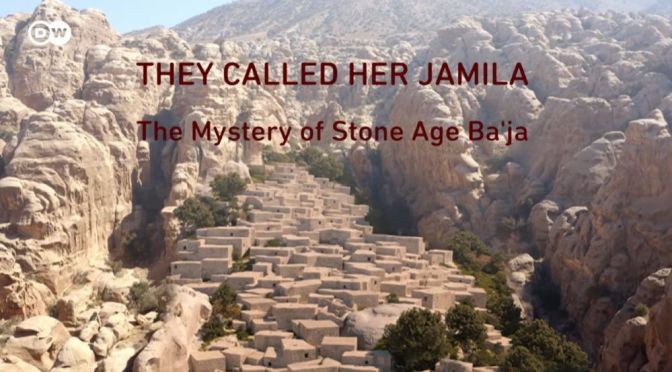
DW Documentary – The Neolithic village of Ba’ja in Jordan
is a famous archaeological site. It was one of the world’s first known settlements, founded some 9,000 years ago. The site has produced magnificent finds including an ancient necklace made of 2,500 beads. What prompted our Neolithic ancestors to settle down? Why did they change their nomadic, hunter-gatherer lives so radically?
As is so often the case in archaeology, it is tombs that tell us the most, while also raising new questions. One of the most magnificent finds at the Ba’ja archaeological site is the richly furnished tomb of a young girl. In 2018, as the excavation team was about to depart, beads emerged from beneath the slab of a nondescript tomb. The team kept working until they finally recovered around 2,500 beads.
Further research showed the beads belonged to an elaborately crafted necklace that had been buried with the girl. The team affectionately christened her Jamila, “the beautiful one.” Jamila’s necklace is a sensation, and has been put on display at the new Petra Museum. There, the entire history of the country is presented, beginning with Ba’ja and humankind’s decision to leave behind the hunter-gatherer lifestyle.
Along with other finds from Ba’ja, Jamila’s finely wrought necklace calls into question much of what we thought we knew about the Stone Age. In recent decades, the burial site in Jordan has helped us see Neolithic people through different eyes. One thing seems clear: They were able to invest time in aesthetics, jewelry and furnishings because their food supply was secure.
Amman, the capital of Jordan, is a modern city with numerous ancient ruins. Atop Jabal al-Qala’a hill, the historic Citadel includes the pillars of the Roman Temple of Hercules and the 8th-century Umayyad Palace complex, known for its grand dome. Built into a different downtown hillside, the Roman Theater is a 6,000-capacity, 2nd-century stone amphitheater offering occasional events.
Petra is a famous archaeological site in Jordan’s southwestern desert. Dating to around 300 B.C., it was the capital of the Nabatean Kingdom. Accessed via a narrow canyon called Al Siq, it contains tombs and temples carved into pink sandstone cliffs, earning its nickname, the “Rose City.” Perhaps its most famous structure is 45m-high Al Khazneh, a temple with an ornate, Greek-style facade, and known as The Treasury.
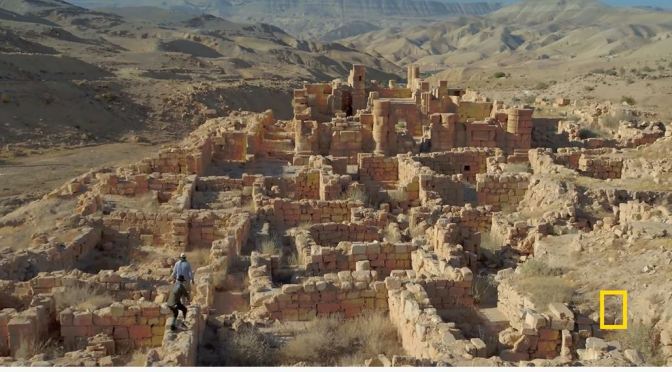
Dr. Albert Lin is exploring the ancient architecture of the Nabateans, and recreates one of their lost cities using lidar.
The Nabataeans, also Nabateans, were an ancient Arab people who inhabited northern Arabia and the southern Levant. Their settlements—most prominently the assumed capital city of Raqmu —gave the name Nabatene to the Arabian borderland that stretched from the Euphrates to the Red Sea.
President Daniel Ortega of Nicaragua is using a new law to detain more of his potential adversaries in November’s election—and is coming under international pressure. And how Jordan’s gas-delivery-truck jingles jangle nerves.
Pressure on the king’s half-brother may represent a mere family feud, but Prince Hamzah’s complaints resonate with the country’s people. We ask what will happen next.
Study the fast-growing list of India’s billionaires: who has joined it and who has left are signs of the country’s shifting economy. And an indigenous group’s tall order in Vancouver’s property market.
News, Views and Reviews For The Intellectually Curious





 DW Documentary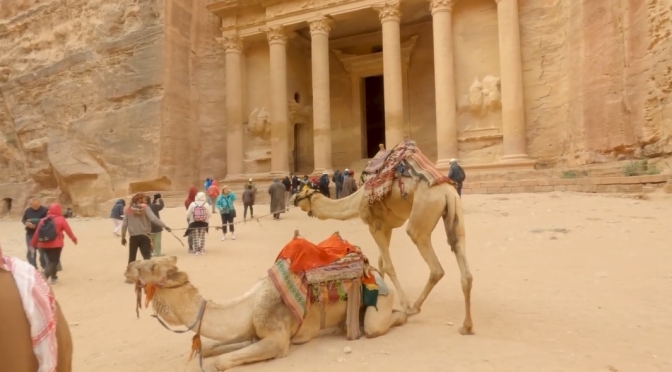


 Boomers Daily