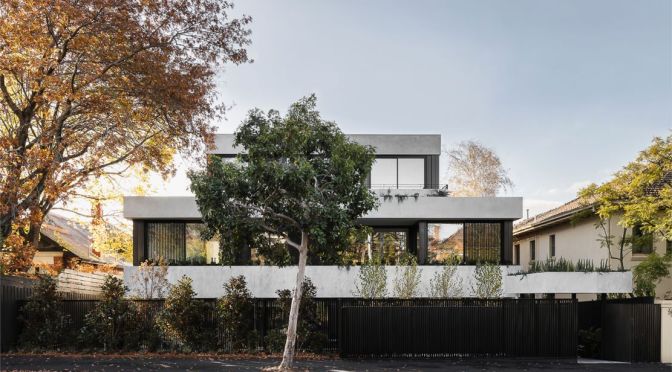
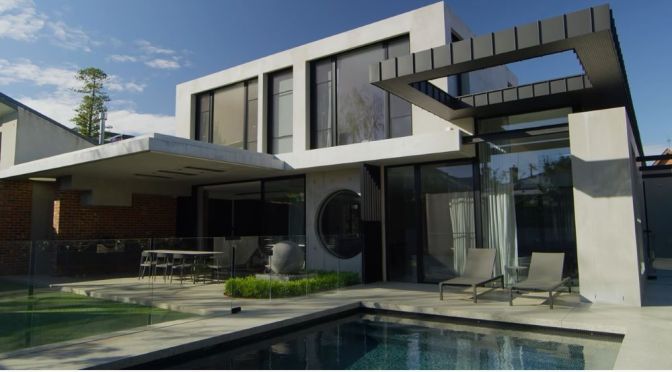
Tag Archives: Homes

Australia Architecture: House Bondi Beach Tour

House Bondi Beach accurately represents an original design by Carla Middleton Architecture. Inside a home featuring saw-toothed geometry, the interior design is effortlessly unique, incorporating the challenges of distinct, angular architecture.

Video timeline: 00:00 – A Private Retreat in the City 00:21 – Introduction to the Home 00:44 – Entering the Home 01:11 – Bringing the Vision to Life 01:54 – The Concept 02:39 – Creating a Happy Space 03:08 – External Finishes 03:54 – European Oak in the Home 04:14 – Bathroom Tiles 04:34 – What the Architect is Most Proud of

Constructed by M&G Building, House Bondi Beach is a modern suburban home. The design emerges from a rigorous analysis of the brief, which detailed the clients’ desired experience for inside a home, focusing on work, entertainment and retreat.

The design of House Bondi Beach was influenced by its gently sloping site. The bedroom, bathroom and living room – key amenities inside a home – are placed in a specific layout, defined by the act of stepping down into the rear of the property. Stairs delineate the more private areas of the family home. Carla Middleton Architecture manages the interior experience inside a home by using carefully chosen furniture and comforting materials.

In House Bondi Beach, a natural materiality creates the relaxing environment associated within a coastal setting. European oak features in the floor, timber staircase and refined balustrades, forming a point of material consistency throughout the home. To enter House Bondi Beach is to venture inside a home that is conceptually pure. Thoroughly expressing the vision of Carla Middleton Architecture, the residence is a rare feat of residential design.
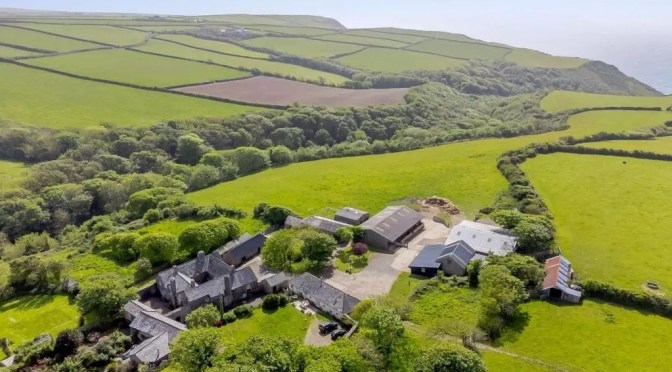
Cornwall View: Marsland Manor At Morwenstow

Described in its listing as ‘an unusually complete survival of a double courtyard house’ and by the historian Charles Henderson in his Parochial History of East Cornwall as ‘one of the most interesting and picturesque old houses in Cornwall’, the substantial stone farmhouse was remodelled as a manor house for the Atkin family on a double courtyard plan between 1656 and 1662.

The bright and cheerful main house offers more than 4,000sq ft of comfortable living space, including three reception rooms, a traditional farmhouse kitchen and six double bedrooms, with a further sitting room, dining room, kitchen, bedroom and bathroom in the attached cottage.

The complex includes two further cottages, one having five bedrooms, the other one bedroom. It comes with extensive barns and outbuildings, with footpaths leading across the fields to the South West Coast Path and the unspoilt beaches and dramatic rock formations around Morwenstow.

Architecture: ‘Clifftop House’ On Coromandel Peninsula, New Zealand

A holiday home with a dual focus, Clifftop House maximises coastal views whilst maintaining a sense of privacy. Created by Ponting Fitzgerald Architects with appliances from Fisher & Paykel, the holiday house has a surprising relationship to its context.

Chapters: 00:00 – Introduction to the Holiday House 00:39 – The Client Brief 01:12 – Entering the House 02:16 – Designing the Kitchen 03:09 – The Master Bedroom 03:25 – Design Inspired by Context 04:21 – Connection to Nature 04:59 – A Unique Perspective

Settled into a coastal community on the Coromandel Peninsula, Clifftop House sits on a ledge overlooking Hahei Beach. While the holiday house has access to striking vistas, including views to Mercury Islands, the unusual topography also leaves the home within eyeshot of other properties. To foster a sense of privacy, Ponting Fitzgerald Architects purposefully restricts access to the surrounding context in some parts of the home.

The atmospheric interior of the holiday house distinctly contrasts the coastal scene outside – however, the top floor of the residence sees a large, covered deck flow out to the view, re-establishing the connection to nature in dramatic fashion. As an interior element of the design, the kitchen of Clifftop House contributes to the feeling of retreat from the outdoors. Dark American oak cabinetry establishes a modest and unimposing space, complemented by the seamless insertion of appliances by Fisher & Paykel.

The result sees the internal architecture play a dominant role in the holiday house, guiding occupants through the home and towards the view. A gentle imposition on its context, Clifftop House is defined by its architectural discretion. Ponting Fitzgerald Architects ensures that, despite having access to incredible views, the holiday house appears as a mere canopy from the perspective of the beach.

Architecture: The Gallery House, Toorak, Australia

The exact sum of its parts, The Gallery House features spaces both grand and small, each expressing their own narrative. Crafted by Workroom, the super house stands as an exemplary piece of interior design and architecture. Situated in the well-established suburb of Toorak,

00:00 – The Local Project Print Publication 00:10 – Introduction to the Super House 01:27 – Creating Continuity with Materials 02:30 – Use of Stone in the House 02:47 – Landscape Design 03:21 – Natural Light 03:50 – A Sense of Timelessness 04:27 – What the Architect is Most Proud Of

The Gallery House sits amongst other large family homes and gardens. Despite its spatial openness, the super house is designed in allusion to experiences yet to come, flowing towards other aspects of itself and its context. A house tour of the property reveals the extent of its size. A true super house, the residence contains 4 bedrooms, 2 lounge rooms and vast, double-height voids. Workroom purposely conceals the size of the home from the street, creating anticipation and intrigue, using a curved concrete wall to the entry as a reveal of what is to come. The modern materials of concrete, terrazzo, timber and stone feature consistently in the super house. Subverting expectations, Workroom uses the characteristically heavy concrete to craft an elegant staircase that appears effortlessly lightweight, whilst timber and green stone facilitate an open connection to the lush landscaping. Embracing a raw materiality, Workroom creates a super house that will gracefully express the passage of time. With the capacity to visually evolve with age, The Gallery House is a successful interpretation of modern refinement.

Australian Architecture: ‘Round Choreography’

Evolving from a symmetrical design, Round Choreography is a playful geometric home with a familial tenor. With the architecture, interior design and build undertaken by mckimm, the forever house sees a clear design intent rigorously executed.

00:00 – Introduction to the Forever Home 00:38 – Designing with Unique Geometries 01:08 – In-Situ Concrete 01:40 – Intuitive Design 02:14 – Wellness and Gym Area 02:31 – Collaborative Approach to Design 03:28 – The Material Palette 04:07 – What the Architect’s Are Most Proud Of

Settled into the leafy suburb of Malvern, Round Choreography is named in homage to the original floorplan of the home that flourished into the completed forever house. Geometric in nature, the interiors celebrate a circular motif, visible from the kitchen to the ensuite and the internal courtyard of the home’s lower level.

As architect, interior designer and builder, mckimm’s construction team had intimate knowledge of the design intent, enabling efficiency to undertake strenuous tasks to deliver the desired forever house. The unique frameless window in the living area is a particular triumph. The practical nature of the forever house extends to its materiality. mckimm chooses a durable palette comprised of concrete, timber and stone to express a commitment to longevity whilst celebrating aesthetic rawness.

Polished concrete flooring with hydronic heating meets walls of the same material, creating an architecturally consistent envelope. Designed in the knowledge that the clients are growing their family, Round Choreography captures the excitement of embedding oneself in a location. The light-filled forever house marks the beginning of family life.

Home Tour: Brighton East 4 In Melbourne, Australia

Complementing the Australian climate, Brighton East 4 is a mid-century inspired home crafted to meet the demands of a young family. Designed and built by Inform with architecture by Pleysier Perkins, the house takes inspiration from Palm Springs.

00:00 – Introduction to the Mid-Century Inspired Home 00:56 – The Client Brief 01:20 – Walking Through the Home 02:02 – Interior Design Style 02:43 – The Island Bench 03:04 – Colour Palette and Materiality 03:36 – Collaboration between the Client, Architect and Builder 04:06 – The Feel of the Home 04:41 – Successfully Meeting the Client Brief

Settled into the same-named Melbourne suburb, Brighton East 4 articulates quintessential Australian living. As a mid-century inspired home, the residence has an informal, open-plan layout and natural materiality, including the use of stone and timber.

Architecturally, Brighton East 4 curves, further evidencing its existence as a mid-century inspired home. Present in both the external and internal architecture, curves effortlessly unify the outdoor and indoor aspects of the home, creating fluidity and softness. Natural materials are a key feature of a mid-century inspired home and are incorporated throughout the project.

Behind the staircase sits a feature wall of stack-bond brickwork, whilst the bathroom sees terrazzo used generously. In the kitchen, the island bench sports an elegant stone top, with slatted timber battens at its base. Showcasing their proficiency in architecture and interiors, Inform and Pleysier Perkins craft a comfortable residence with a strong sense of spatial flow. As a mid-century inspired home, Brighton East 4 testifies to its Palm Springs influence through a natural and restrained materiality.

Design: Seymour House In Melbourne, Australia

An Architect’s own home, Seymour House is inserted as a respectful addition to its neighbourhood, openly embracing the streetscape lined with heritage-listed properties and modernist gems. In crafting the dwelling, Lani Fixler of Lani Fixler Studio has created a place that is private and personal whilst also engaging in an open conversation with the surrounds.

Timeline: 00:00 – The Local Project Print Publication 00:10 – Creating a Family Home 00:40 – Introduction to the Home 01:25 – Entering the Modernist Home 02:04 – Walking through the Home 02:47 – The Bedrooms and Bathrooms 03:19 – Landscaping 03:40 – Courtyard Sculpture 03:54 – Artwork Throughout the Home 04:29 – What the Architect is Most Proud Of 05:00 – Subscribe to The Local Project Print Publication

Located in a south-eastern suburb of Melbourne, Seymour House is an architect’s own home that draws from Lani Fixler Studio’s long-standing familiarity with the built environment. The project is one that expertly merges personal responses with the contextual. In the construction of Seymour House, a connection to the street was important, as well as embracing the constricted site instead of challenging it. Sitting adjacent to Harleston Park, Seymour House is an architect’s own home crafted to be a continuation of its natural setting, with only two concrete plinths defining the barrier between the public and the private. Throughout the building, modernism is championed through a natural and restrained materiality with the use of concrete, terrazzo, timber and slate. The consistency with which the palette is applied – with blockwork featuring as both an internal and external architectural element – celebrates the environment surrounding an architect’s own home. Expressing considered detail and the characteristics of an architect’s own home, Seymour House is imbued with a sense of personality that uplifts its understated aesthetic. Crafted to complement the history and culture of the surrounding neighbourhood, Lani Fixler Studio graciously allows past narratives to continue as new chapters unfold.

Australian Architecture: A Tour Of Courtyard House Near Melbourne

Working with its signature material base, FGR Architects creates Courtyard House – a concrete dream house with a functional and airy interior. Shielded from the street, the minimalistic home enables natural ventilation and a sunlit landscape.

Timeline: 00:00 – The Client Brief for the Home 00:46 – Surprising Entryway 01:09 – A Sense of Intimacy from the Street 01:31 – Entering the Home 02:34 – Concrete Features 03:20 – Other Materials Used in the Home 04:03 – The Architect’s Favourite Part of the Home

A low-profile building, Courtyard House represents a structural shift from the local built environment; an intriguing blur in the pattern of gable-roof constructions. Set back in its site, the dream house embraces its contextual standing, opening its grounds to the natural northern sunlight.

Upon approach, the architecture of the dream house outlines a sequence of 90 degree turns that leads residents from the footpath to the front gate, then to the main entry of the home. The journey serves to introduce the idea of connectivity, echoed within the interior design. The layout of Courtyard House intentionally fosters passive solar heating and natural ventilation. A sightline directly connects the entrance of the dream house to the backyard, whilst large sliding doors join the living-kitchen-dining area to the outdoor space. Though unique and compelling, Courtyard House is ultimately understated. Demonstrating skill in concrete and light play, FGR Architects creates a practical and elegant dream house that enables an immersive natural connection.

Tours: Harborview House In Manly Cove, Sydney

Combining old and new, Harbourview House is a modern home that retains elements of its federation-style heritage. Situated in Sydney’s Manly Cove – a location associated with swimming, boating and surfing – Harbourview House is inspired by both its scenic location and residing family.

Timeline: 00:00 – The Feeling of the Timeless and Modern Home 00:27 – Introduction to the Home 00:55 – Collaboration Between the Designers 01:35 – Walking Through the Home 02:49 – Material Choice 03:22 – Juxtaposition Between the Old and New 03:53 – The Kitchen 04:24 – The Master Bedroom and Ensuite 05:08 – Inspiration for the Home

The modern home is designed to express appreciation for natural beauty, reflecting the warm and energetic nature of the clients. Approaching the modern home, the pre-existing, federation-style structure remains as the primary façade whilst the new, minimalist architecture can be seen beyond. Internally, the master suite occupies a heritage element of the home, positioned at the front of the build and benefitting from broad bay windows. Further in, the open-plan lounge and kitchen lead to the landscaped garden. The material palette of Harbourview House makes for a texturally-dense experience that maintains a sense of refinement, aligning with the vision of a modern home. Hand-glazed tiles, honed marble and brass features are purposefully chosen for their aesthetically pleasing and organic natures. In the kitchen, a robust and non-porous surface on the rear bench is complemented by an elegant marble splashback and island. Working within a monochromatic colour palette, Penman Brown Interior Design crafts a modern home that enriches the senses through texture. Interacting with the work of Collins Pennington Architects and landscape by Jamie Durie, the design of Harbourview House embraces the difference between the old home and the new.

Homes: Anderson Road, Hawthorn, Australia

When an architect designs a home, the idea of balance is keenly considered. Testifying to this notion is Anderson Road, which sees B.E Architecture use custom flooring and landscape architecture to control the impact of a raw material palette.

00:00 – Introduction to the Home 00:41 – Utilising Raw and Natural Materials 01:22 – Strong Features and Elements in the Home 01:57 – Unique Connection of Buildings and Spaces 03:06 – Landscape Architecture 03:32 – Customised, Natural Timber Flooring 04:58 – Low Maintenance Living 05:19 – What the Architect is Most Proud Of 05:39 – What Made by Storey is Most Proud Of

A house tour of the resulting residence reveals a harmonious pairing of brickwork and natural timber. Located in the Melbourne suburb of Hawthorn, Anderson Road embraces the spatial opportunities afforded by its site. Externally, the architect designs a home that is staggered in levels; a series of buildings, separated by surprising pockets of landscape architecture. To the rear of the property, an expanse of greenery leads to the swimming pool. Internally, the architect designs a home with a dynamic spatial arrangement. Whilst the soaring ceiling of the living room interacts with the compressed hallway space, a statement ribbon staircase flows smoothly into an open kitchen that is centred on a concrete island bench. Responding to the brickwork of the house, timber flooring by Made by Storey softens the material character of the dwelling. When an architect designs a home, Made by Storey is on-hand to provide bespoke flooring solutions that embrace the desire for customisation. Selected in the warming colour of Sesame, the flooring of Anderson Road is comprised of narrow boards, with each echoing the profile of the brickwork. Pushing the boundaries of residential interior design, the architect designs a home that serves as a lesson in materiality. By balancing the impactful brickwork with timber flooring, B.E Architecture creates a sense of harmony within a dynamic and custom-made project.