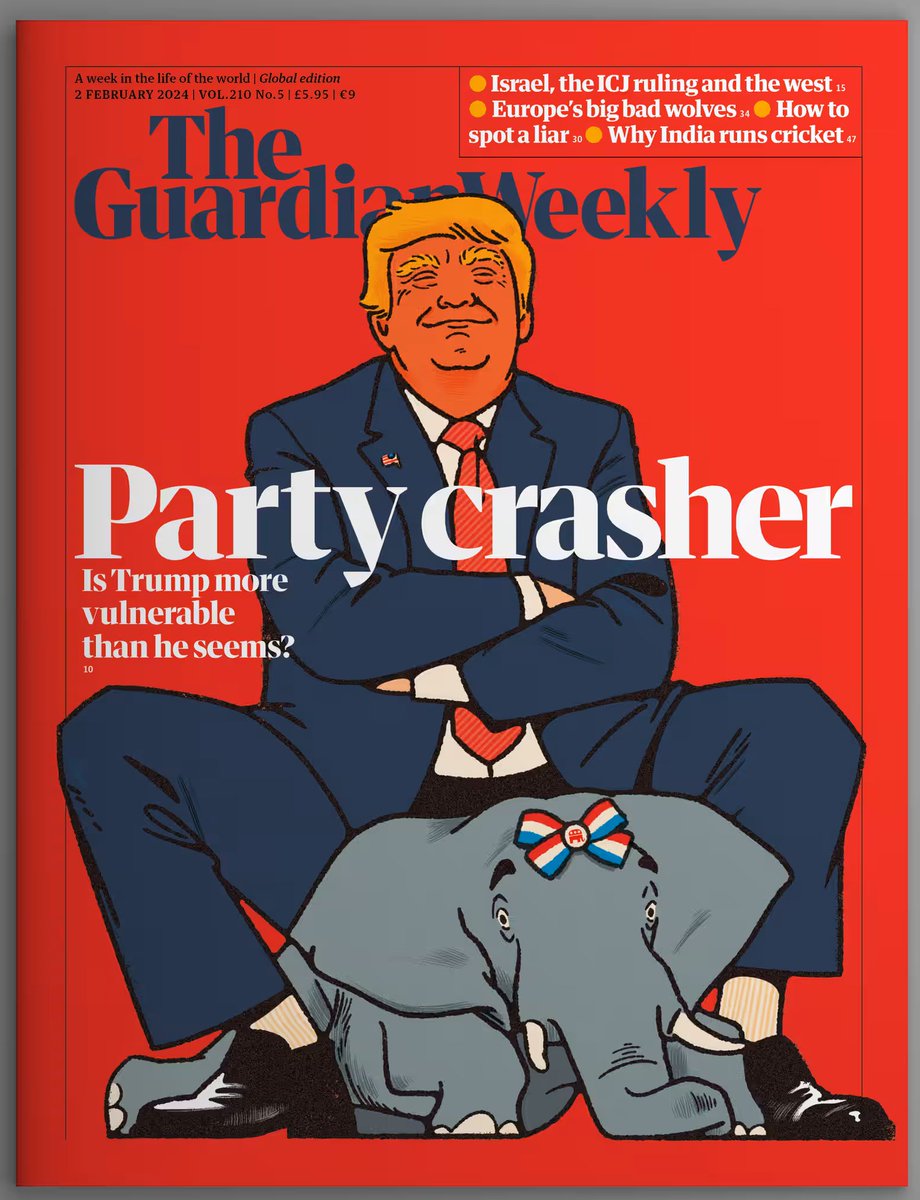
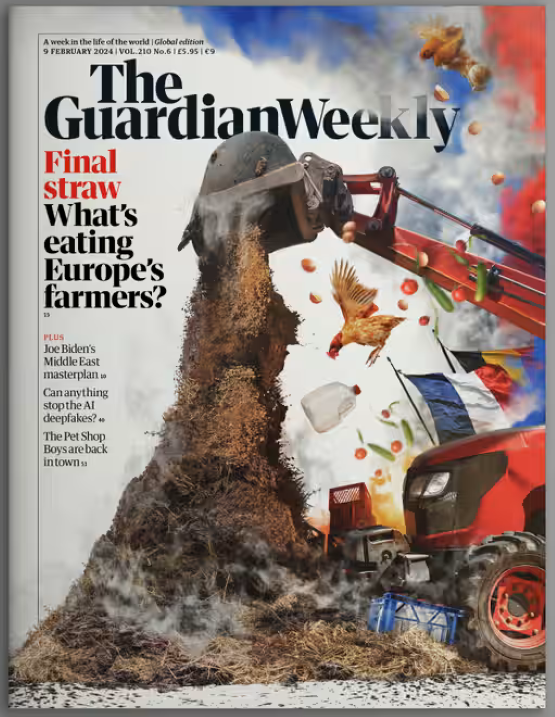
The Guardian Weekly (February 1, 2024) – The new issue features ‘Party Crasher’ – Is Trump more vulnerable than he seems?; Israel, the ICJ ruling and The West; Europe’s Big Bad Wolves and more….
It had all seemed like business as usual for Donald Trump in the aftermath of last week’s New Hampshire Republican primaries, where he scored a comfortable victory over his only remaining challenger, Nikki Haley. And yet … was there something in his subsequent outburst towards Haley that suggested all was not well in Trumpworld?
Barring the mother of all reversals, Trump will soon be confirmed as the Republican presidential nominee. But, as David Smith and Jonathan Freedland outline in this week’s big story, Trump remains a deeply polarising figure in American politics, not least within his own party.
And his petulant irritation at Haley over her refusal to concede the race was a visible reminder to American floating voters of the unhinged personality that lurks beneath the orange veneer, something his campaign team will be desperate to avoid more of.
“The shadow of Trump is long, and his return seems closer than ever,” explains illustrator Alberto Miranda on his cover art for this week’s Guardian Weekly. “He is a controversial figure with a dangerous side and, at the same time, has an utterly comical aspect. That’s why we wanted to portray his influence in the Republican party in an almost grotesque manner.”
The Globalist Podcast (February 1, 2024) – We ask Ukrainian journalist Nataliya Gumenyuk about the fate of the country’s armed-forces commander, General Valery Zaluzhny.
Also in the programme: we assess the situation in Myanmar as the junta-imposed state of emergency comes to an end and we find out why the Catalan amnesty bill has failed to pass in the Spanish congress. Plus: we speak to Eszter Áron, creative director of Aeron, at Copenhagen International Fashion Fair.
The Globalist Podcast (January 31, 2024) – We bring the latest on the Israel-Hamas hostage talks as Qatar’s prime minister meets US officials in Washington.
Plus: Javier Milei’s economic bill is debated in Argentina’s parliament, a round-up of art news, and is the future of the department store in danger?
The Globalist Podcast (January 30, 2024) – We discuss how Israel’s war in Gaza is increasing tensions between Iran and Pakistan.
Plus: the annual Corruption Perceptions Index, why three coup-hit nations have left the Economic Community of West African States and why Boeing is losing market share to Airbus. We also meet Jeffrey Wright, star of the Oscar-nominated ‘American Fiction’.
The Globalist Podcast (January 29, 2024) – Will the director of the CIA, William Burns, be able to negotiate a truce and hostage deal when he meets his Egyptian and Israeli counterparts, as well as Qatar’s prime minister, Mohammed bin Abdulrahman bin Jassim Al Thani?
Following Finland’s presidential election on Sunday, we look at the future of the country. And with layoffs and strikes across the country, we examine what’s happening in the US media. Plus: why Guggenheim Bilbao is halting its expansion into a Basque nature reserve.
Monocle on Sunday, January 28, 2024– Florian Egli and Marcus Schögel join Monocle’s editorial director, Tyler Brûlé, to discuss the weekend’s hottest topics.
We also speak to Monocle’s Helsinki correspondent, Petri Burtsoff, about Finland’s presidential election and Guy De Launey gives us the latest news from the Balkans. Plus: we’re joined by our senior news editor in London, Chris Cermak, and Isabella Smith, owner and founder of Books and Company.
The Globalist Podcast (January 26, 2024) – As Israel considers a buffer zone inside Gaza and criticises Qatar, is it at risk of pushing away allies?
Also in the programme: the US says that it’s ready to send Turkey a shipment of F-16 fighter jets and we look ahead to the Finnish elections. Plus: why 2024 is set to be a good year for champagne.
Prospect Magazine (March 2024) – The latest issue features ‘How The Government Captured The BBC’ – A faceless fixer – and a broadcaster in a state of ‘permanent cringe’…
We do not choose where we are born. That creates rights—and obligations—that we should all seek to honour
Conflict, human rights abuses and climate change have led to a doubling of the global refugee population in the last seven years, and yet the response of many wealthy countries has become increasingly insular and myopic. Constant demands to slash international aid, along with punitive immigration policies and hateful rhetoric, mark a shift away from humanitarian values. The UK’s Rwanda scheme epitomises this trend: it would normalise the mass deportation of asylum seekers and undermine prohibitions on returning refugees to dangerous countries. At the same time, citizens of wealthy countries appear increasingly indifferent to the plight of those who perish in the Mediterranean or along other perilous routes.
How the government captured the BBC
Ukraine’s fate, Europe’s choice
News, Views and Reviews For The Intellectually Curious