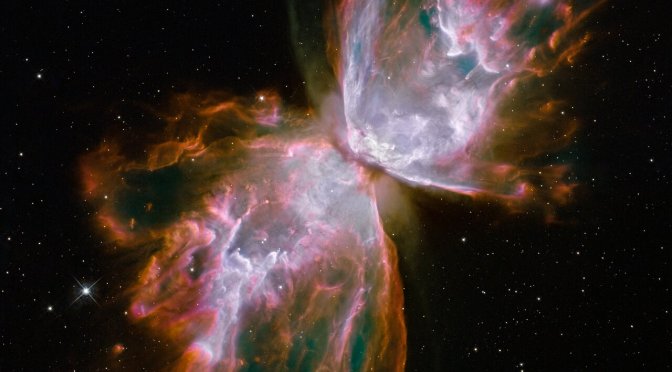
This celestial object looks like a delicate butterfly. But it is far from serene. What resemble dainty butterfly wings are actually roiling cauldrons of gas heated to nearly 20 000 degrees Celsius. The gas is tearing across space at more than 950 000 kilometres per hour — fast enough to travel from Earth to the Moon in 24 minutes! A dying star that was once about five times the mass of the Sun is at the centre of this fury. It has ejected its envelope of gases and is now unleashing a stream of ultraviolet radiation that is making the cast-off material glow. This object is an example of a planetary nebula, so-named because many of them have a round appearance resembling that of a planet when viewed through a small telescope. The Wide Field Camera 3 (WFC3), a new camera aboard the NASA/ESA Hubble Space Telescope, snapped this image of the planetary nebula, catalogued as NGC 6302, but more popularly called the Bug Nebula or the Butterfly Nebula.
WFC3 was installed by NASA astronauts in May 2009, during the Servicing Mission to upgrade and repair the 19-year-old Hubble. NGC 6302 lies within our Milky Way galaxy, roughly 3800 light-years away in the constellation of Scorpius. The glowing gas is the star’s outer layers, expelled over about 2200 years. The “butterfly” stretches for more than two light-years, which is about half the distance from the Sun to the nearest star, Proxima Centauri. The central star itself cannot be seen, because it is hidden within a doughnut-shaped ring of dust, which appears as a dark band pinching the nebula in the centre. The thick dust belt constricts the star’s outflow, creating the classic “bipolar” or hourglass shape displayed by some planetary nebulae. The star’s surface temperature is estimated to be over 220 000 degrees Celsius, making it one of the hottest known stars in our galaxy. Spectroscopic observations made with ground-based telescopes show that the gas is roughly 20 000 degrees Celsius, which is unusually hot compared to a t
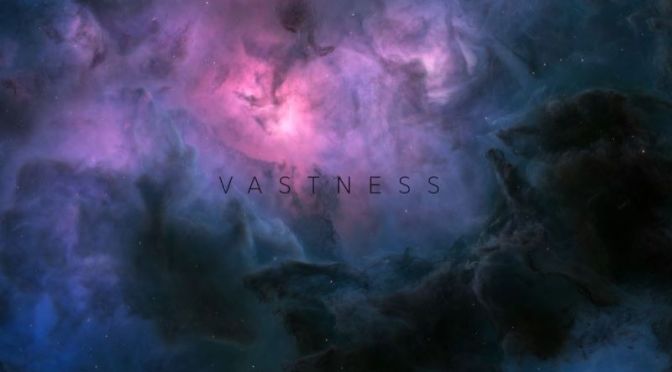
VASTNESS is a short film where we explore new designed nebulas with more detail, scale and color variations.
To achieve this I developed a new process that pushes the hardware memory limit. By using more particles than before, I tried to get more detail, light/color variations and scale still maintaining the overall natural feeling.
An instrument on the International Space Station is providing new insights into some of the Universe’s most baffling objects. Neutron stars have puzzled scientists for decades. It’s known that these ultra-dense objects are born from the remnants of supernovae, yet what’s under their surface, and what processes that go on within them, remain a mystery.
Now, an instrument called the Neutron Star Interior Composition Explorer is providing new information to help answer these questions, ushering in a new era of research into these strange stars.
On April 24, 2020, the Hubble Space Telescope celebrates its 30th year in orbit by premiering a never-before-seen view of two beautiful nebulas named NGC 2020 and NGC 2014.
Hubble’s senior project scientist, Dr. Jennifer Wiseman, takes us on a tour of this stunning new image, describes the telescope’s current health, and summarizes some of Hubble’s contributions to astronomy during its 30-year career.
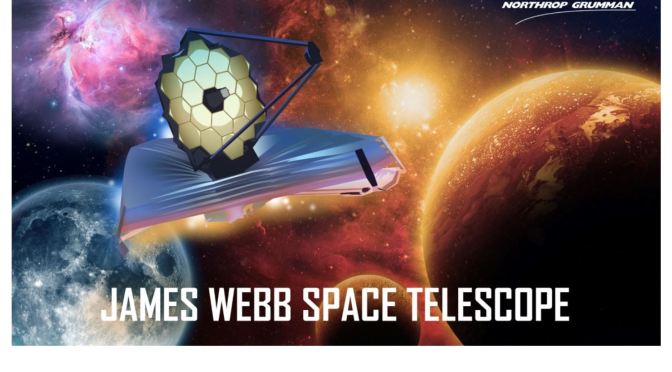
A look at the James Webb Space Telescope, it’s mission and the incredible technological challenge this mission presents.
Music credit: Universal Production
Music tracks: Future Generation Alternative Version by Dury; Moment of Anticipation Instrumental by Connolly; Dark Matter Instrumental by Beits
Credit: NASA’s Goddard Space Flight Center
Michael McClare (KBRwyle): Lead Producer
Michael McClare (KBRwyle): Lead Writer
Adriana Manrique Gutierrez (USRA): Animator
Jonathan North (USRA): Animator
Walt Feimer (KBRwyle): Animator
Michael Lentz (USRA): Animator
Bailee DesRocher (USRA): Animator
Michael McClare (KBRwyle): Lead Editor
Michael McClare (KBRwyle): Lead Videographer
This video is public domain and along with other supporting visualizations can be downloaded from the Scientific Visualization Studio






 An instrument on the International Space Station is providing new insights into some of the Universe’s most baffling objects. Neutron stars have puzzled scientists for decades. It’s known that these ultra-dense objects are born from the remnants of supernovae, yet what’s under their surface, and what processes that go on within them, remain a mystery.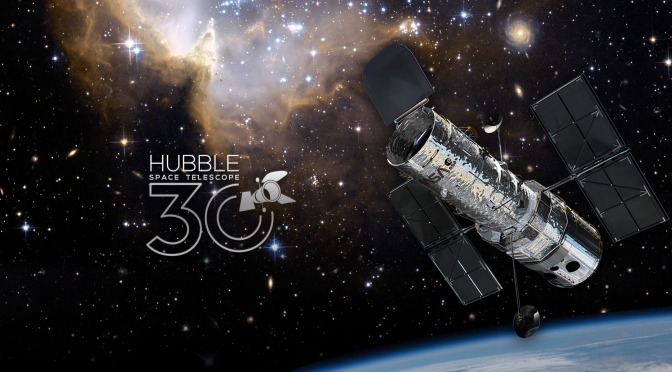
 Boomers Daily