

 Contributing Correspondent Gretchen Vogel talks about what can be learned from schools around the world that have reopened during the coronavirus pandemic. Unfortunately, few systematic studies have been done, but observations of outbreaks in schools in places such as France or Israel do offer a few lessons for countries looking to send children back to school soon.
The United Kingdom and Germany have started studies of how the virus spreads in children and at school, but results are months away. In the meantime, Gretchen’s reporting suggests small class sizes, masks, and social distancing among adults at schools are particularly important measures.
Also this week, Sarah talks with Kiristie Thompson, a Ph.D. student in the Georgia Institute of Technology’s Department of Chemistry and Biochemistry, about increasing the efficiency of petroleum processing. If all—or even some—petroleum processing goes heat free, it would mean big energy savings. Around the world, about 1% of all energy use goes to heating up petroleum in order to get useful things such as gas for cars or polymers for plastics. These days, this separation is done through distillation, heating, and separating by boiling point. Kirstie describes a heat-free way of getting this separation—by using a special membrane instead. Read a related Insight.
 Probing the superconducting properties of graphene and a bacteria that can use manganese to grow. If you sandwich two sheets of graphene together and twist one in just the right way, it can gain some superconducting properties. Now, physicists have added another material to this sandwich which stabilises that superconductivity, a result that may complicate physicists’ understanding of magic angles.
 Buildings are getting tested for coronavirus, too. Research teams in Oregon are conducting real-time coronavirus tests on ventilation systems in buildings that could be essential for returning to the office or school.
 The Economist Morning Briefing, July 14th, 2020: Coronavirus cases surpass 13m and China and America trade insults.
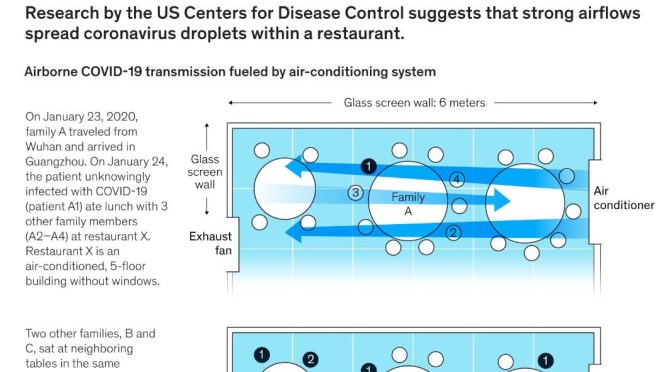
 The World Health Organization recently acknowledged that some evidence about in-room transmission is worrisome. In addition, after analyzing a transmission event at a restaurant in China, the US Centers for Disease Control and Prevention (CDC) concluded that an asymptomatic patient transmitted the virus to families at two nearby tables.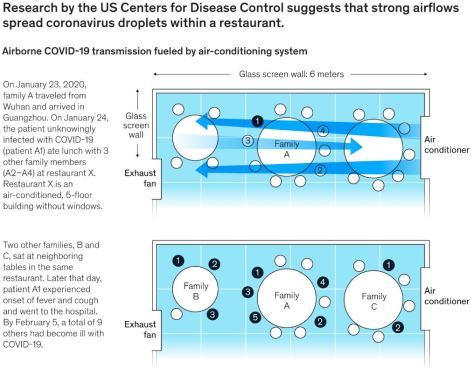




 Boomers Daily