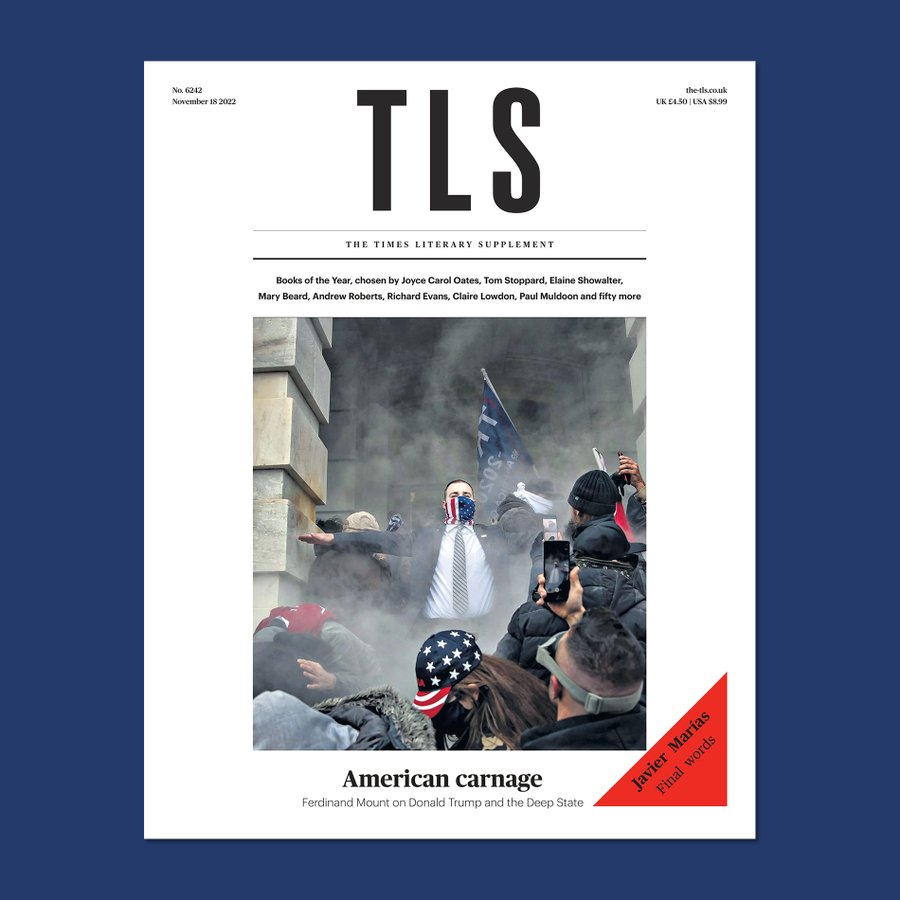
This week’s @TheTLS , featuring André Aciman on Proust; Margaret Drabble on Robert Aickman; @LucyHH on Naples; @AnnPettifor on climate refugees; @scheffer_pablo on Nona Fernández; @IsabelleBaafi on the poetry of June Jordan, Wanda Coleman and Rita Dove – and more.
Tag Archives: Book Reviews
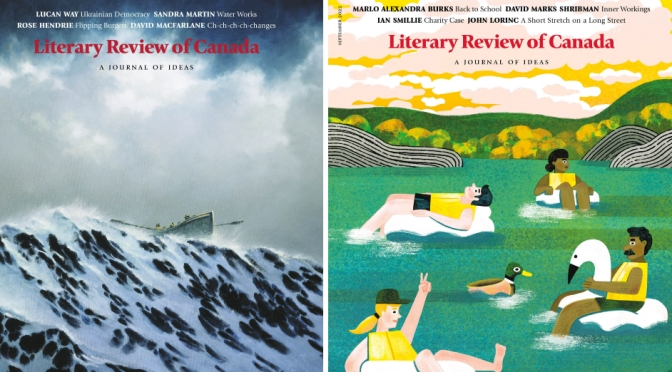
Books: Literary Review Magazine – Nov 2022
Inside the Literary Review – November 2022:
A Tale of Two Cities
London: The Great Transformation 1860–1920
Think of the Live Models!
The Artist’s Studio: A Cultural History
THE STATE WE’RE IN
Was Lockdown Lawful? – Emergency State: How We Lost Our Freedoms in the Pandemic and Why It Matters
Damned Statistics – Bad Data: How Governments, Politicians and the Rest of Us Get Misled by Numbers
Books: The Top Ten Best Reviews Of October 2022
PHOTO: HARPER
Abominations: Selected Essays From a Career of Courting Self-Destruction
By Lionel Shriver | Harper
With a restless imagination and an instinct to take on progressive orthodoxies, the novelist and essayist Lionel Shriver brings her “smart, plain-spoken and unpredictable” style to subjects that many writers prefer to shy away from. Review by Meghan Cox Gurdon.
PHOTO: LIBRARY OF AMERICA
Bruce Catton: The Army of the Potomac Trilogy
Edited by Gary W. Gallagher | Library of America
In a trilogy of narratives that “broke the mold” in Civil War history, Bruce Catton told the story of the Eastern theater with an eye to the sacrifices and sufferings of the ordinary soldiers who fought and died on both sides. Review by Harold Holzer.
PHOTO: HARPER
The Escape Artist: The Man Who Broke Out of Auschwitz to Warn the World
By Jonathan Freedland | Harper
Walter Rosenberg did not make it easy for the Nazi-allied regime in his native Slovakia to deport him—along with thousands of other Slovak Jews—to extermination camps like Auschwitz. But once he wound up there, he was determined to get out and spread the word of the ongoing genocide. Review by Diane Cole.
PHOTO: KNOPF
The Extraordinary Life of an Ordinary Man
By Paul Newman | Knopf
A long-awaited, posthumously published memoir from the star of “Cool Hand Luke,” “The Verdict” and other classics reveals the inner world of a hard-working actor who “breathed in insecurity and exhaled doubt.” Review by Michael O’Donnell.
PHOTO: DOUBLEDAY
The Grandest Stage: A History of the World Series
By Tyler Kepner | Doubleday
What was for many years the center of the American sports calendar has lost some of its grip on the collective imagination. But a journey through October Classics past proves that the magic of the World Series still has a potent charm. Review by David M. Shribman.
Advertisement – Scroll to Continue
PHOTO: KNOPF
Martha Graham: When Dance Became Modern
By Neil Baldwin | Knopf
The pioneering figure of modern dance was a daring innovator, a technical perfectionist and a preternaturally gifted performer. While she transformed the way a generation of dancers thought about movement, she looked for ways to claim her art firmly as an American one. Review by Hamilton Cain.
PHOTO: ABRAMS PRESS
The Oldest Cure in the World: Adventures in the Art and Science of Fasting
By Steve Hendricks | Abrams Press
Fasting has a long history of use as a spiritual aid—a ritual of purification and turning away from indulgence—and as a tool for protest. But emerging science suggests that its positive effects on physical health can no longer be overlooked. Review by Matthew Rees.
PHOTO: LIBRARY OF AMERICA
The Ray Bradbury Collection
Edited by Jonathan R. Eller | Library of America
Ray Bradbury’s unique science fiction owed more to Nathaniel Hawthorne’s darkly symbolic stories than to H.G. Wells’s rationalist visions. On a Mars that held curious correspondences to the Midwestern country of Bradbury’s youth, fathers and sons negotiated the strange spaces between them. Review by Brad Leithauser.
PHOTO: LITTLE, BROWN
The Revolutionary: Samuel Adams
By Stacy Schiff | Little, Brown
The “stage manager” of the American Revolution has resisted attempts by historians to pin down the details of his life. Stacy Schiff finds a potential key to Samuel Adams’s enigmatic character in the financial tumult of his family’s business. Review by Mark G. Spencer.
PHOTO: PANTHEON
The Sassoons: The Great Global Merchants and the Making of Empire
By Joseph Sassoon | Pantheon
The business empire of the Sassoon dynasty began in Bombay, where the family of Iraqi Jews had fled to escape persecution, and flourished in the opium trade with China. The “Rothschilds of Asia” kept a low profile—and when the tides of fortune turned against them, their once-global enterprise became a distant memory. Review by Norman Lebrecht.
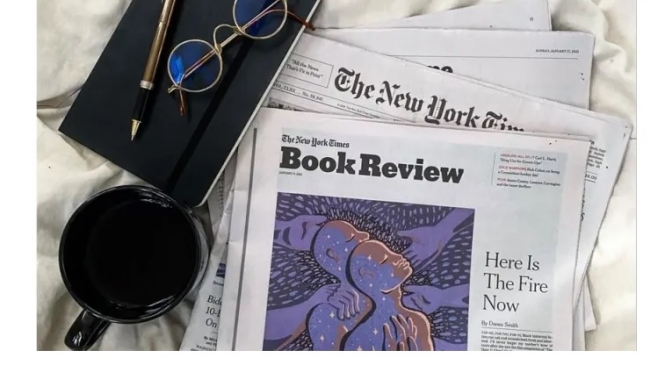
Books: The New York Times Book Review – Oct 30, 2022

In Barbara Kingsolver’s New Novel, an Appalachian David Copperfield
“Demon Copperhead” reimagines Dickens’s story in a modern-day rural America contending with poverty and opioid addiction.
A Literary Caper Across the Dining Rooms of Belfast and New York
“The Lemon” is the satirical debut by a team of three authors writing under the pseudonym S.E. Boyd.
Emily Dickinson, at Home in Her ‘Full-Color Life’
The poet’s house museum in Amherst, Mass., gets a vibrant, historically correct makeover, underlining that she was not just a reclusive woman in white.
Books: TLS/Times Literary Supplement – Oct 28, 2022
Preview: London Review Of Books – Nov 3, 2022

London Review of Books (LRB) – November 3, 2022:
Kissinger’s Duplicity
Charles Glass – Although World War Three had come perilously close, Martin Indyk absolves Henry Kissinger: Soviet actions were ‘yet again characterised by an ultimate timidity in the face of American resolve’. ‘Resolve’ is one way of describing the risk of nuclear Armageddon. Another is ‘recklessness’.
Wartime Objectors
Susan Pedersen – The problem with individual conscientious objection is that we are mutually dependent whether we acknowledge it or not. You may refuse to get vaccinated on grounds of conscience but will benefit from herd immunity if others do; you may refuse to pay taxes but will still get your rubbish collected; you may refuse to take up arms in war but will be protected from harm if others serve.
Droning Things
James Meek – If an innocuous merchant ship passing through the Baltic or the North Sea had a handful of ordinary, secretly armed trucks lashed to its deck, would any Nato country notice? Would the drones be detected or intercepted? If they were launched and hit their targets, could it ever be proven where they originated? As a threat to Europe, this is creative licence. But using swarms of Shahed-136s and other forms of missile to destroy a country’s energy system, on the eve of winter, is exactly what Russia is doing to Ukraine.
Book Previews: The Review Of Politics – Fall 2022


The Review of Politics – Fall 2022
Caleb J. Basnett, Adorno, Politics, and the Aesthetic Animal
Sara Brill, Aristotle on the Concept of Shared Life
Stuart Elden, The Early Foucault
David Graber and David Wingrow, The Dawn of Everything: A New History of Humanity
Ioanna Tourkochoriti, Freedom of Expression: The Revolutionary Roots of American and French Legal Thought
The Review of Politics publishes high-quality original research that advances scholarly debates in all areas of political theory. We welcome manuscripts on the history of political thought, analytical political theory, canonical political thought, contemporary political thought, comparative political thought, critical theory, or literature and political thought.
Books: The New York Times Book Review – Oct 23, 2022

Cormac McCarthy’s New Novel: Two Lives, Two Ways of Seeing
The New York Times – In “The Passenger,” a pair of siblings contend with the world’s enigmas and their own demons. The term “Janus word” was coined in the 1880s by the English theologian Thomas Kelly Cheyne to describe a word that can express two, more or less opposite meanings. Cheyne gave it the name of the two-faced Roman god who looks forward and back at the same time.
Ken Burns Wishes More People Would Call Willa Cather a Great American Novelist
“What about ‘O Pioneers!’ or ‘My Ántonia’?” asks the documentarian and author of the forthcoming photo book “Our America.” “For that matter, what about Gabriel García Márquez? We do not have a copyright on the word ‘American.’”
Paul Newman’s Humanity and Star Power
When the actor appeared in the movie version of “Nobody’s Fool,” Richard Russo saw another side of him.
Books: TLS/Times Literary Supplement – Oct 21, 2022
This week’s issue of the TLS, featuring @George_Berridge , Claire Lowdon and Edmund Gordon on new books by Cormac McCarthy, Barbara Kingsolver and George Saunders, respectively; Gabriel Josipovici on Cézanne; @15thcgossipgirl on Chaucer’s innocence; @rinireg on hatred – and more.
Times Literary Supplement – TLS Website

Nature Reviews: Top New Science Books (Oct 2022)

Geopedia
Marcia Bjornerud Princeton Univ. Press (2022)
This is a garnet of a geology book: rooted in the planet, jewel-like and multicoloured. “To geoscientists, rocks are not nouns but verbs — far more than inert curios, they are evidence of Earth’s ebullient creativity,” writes geoscientist Marcia Bjornerud. Her brief A–Z ranges idiosyncratically through landforms, rocks and minerals, geologists, geological terms and time periods, including the Anthropocene, the epoch of human influence. Oddly, it omits the Gaia hypothesis that the planet is a self-regulating system.

The Facemaker
Lindsey Fitzharris Farrar, Straus and Giroux (2022)
Following her award-winning 2017 biography of surgeon Joseph Lister, medical historian Lindsey Fitzharris tackles Harold Gillies, a pioneer of plastic surgery. She focuses on his First World War attempts to reconstruct the bullet-butchered faces of British soldiers who had become “strangers even to themselves”. From French battlefields, Fitzharris’s vividly thrilling account moves to the Queen’s Hospital in Sidcup, UK, which Gillies founded in 1917. An epilogue notes that he was knighted only in 1930, long after the war’s military generals.

Security and Conservation
Rosaleen Duffy Yale Univ. Press (2022)
The military, intelligence services and tech companies were barely visible at the 2014 London Conference on the Illegal Wildlife Trade, recalls scholar of international politics Rosaleen Duffy. By the 2018 conference, they were prominent. This “security turn” in conservation — since intensified by the COVID-19 pandemic’s links to a Chinese wildlife market — drives her timely analysis of a complex phenomenon. A violent approach to tackling poaching might boost elephant numbers, for example, but could also cause human-rights abuses.

The Illusionist Brain
Jordi Camí & Luis M. Martínez (transl. Eduardo Aparcico) Princeton Univ. Press (2022)
The science behind audience perception of magic tricks intrigued late-nineteenth-century researchers. But since then, there have been fewer than 100 research papers on the subject, note pharmacologist Jordi Camí and neuroscientist Luis Martínez in their tantalizing study. Rather than using the brain to explain conjuring tricks, they focus on using illusions to elucidate the brain and behaviour. “When magicians trick us, they are interfering with all of the brain’s strategies for inferring reality.”

Plantation Crisis
Jayaseelan Raj UCL Press (2022)
Kerala in India has a reputation for egalitarianism, literacy and high life expectancy. Yet Tamil-speaking Dalit communities are oppressed and marginalized on tea plantations in the state, following a 1990s collapse in the international price of the crop. Jayaseelan Raj, who works in development studies, was born and raised in a Tamil Dalit plantation household. Plantation workers share with him “stories of poverty that they would not share even with their close relatives or neighbours”, as described in his academic study.