

Mining on asteroids sounds like the stuff of science fiction, but it could soon become a reality. Nations and powerful corporations already have plans for such ventures and are hard at work staking their claim to resources from space. How can economic growth continue unfettered once all the earth’s resources have been consumed?
Major companies and governments have long been working on plans to exploit the resources to be found in the vastness of space. How far are humans from achieving this? This documentary examines the technological requirements of space mining. It also assesses how great the desire is to find new sources of raw materials. The film touches on scientific and fundamental societal issues – including humanity’s craving for new territories and our degradation of the Earth as we attempt to exploit all our planet has to offer.
The World in 2021 will start to look beyond covid-19: to the launch of an asteroid-smashing space probe, the next step in the fight against climate change and China’s supremacy at the box office. Here are five stories to watch out for.
Video timeline: 00:00 – Top five stories for 2021 00:39 – Democracy under threat 04:17 – The electric revolution revs up 06:55 – A chance to turn a corner on climate change 10:39 – China v Hollywood: battle of the box offices 14:40 – Defending the planet

How water chemistry is shifting researchers’ thoughts on where life might have arisen, and a new model to tackle climate change equitably and economically.
In this episode:
00:46 A shallow start to life on Earth?
It’s long been thought that life on Earth first appeared in the oceans. However, the chemical complexities involved in creating biopolymers in water has led some scientists to speculate that shallow pools on land were actually the most likely location for early life.
News Feature: How the first life on Earth survived its biggest threat — water
07:44 Coronapod
The COVID-19 pandemic has massively shifted the scientific landscape, changing research and funding priorities across the world. While this shift was necessary for the development of things like vaccines, there are concerns that the ‘covidization’ of research could have long-term impacts on other areas of research.
News: Scientists fear that ‘covidization’ is distorting research
20:45 Research Highlights
The Hayabusa2 mission successfully delivers a tiny cargo of asteroid material back to Earth, and a team in China claims to have made the first definitive demonstration of computational ‘quantum advantage’.
Nature News: Physicists in China challenge Google’s ‘quantum advantage’
22:38 Calculating carbon
Limiting carbon emissions is essential to tackling climate change. However, working out how to do this in a way that is fair to nations worldwide is notoriously difficult. Now, researchers have developed a model that gives some surprising insights in how to equitably limit carbon.
Research Article: Bauer et al.
News and Views: Trade-offs for equitable climate policy assessed
29:08 Briefing Chat
We discuss some highlights from the Nature Briefing. This time, bioluminescent Australian animals, and the collapse of the Arecibo telescope.

Radio News 24/7 reports: Russia rolls out its Sputnik vaccine, a 6-year Japanese space mission returns sample from an asteroid, and other top world news.
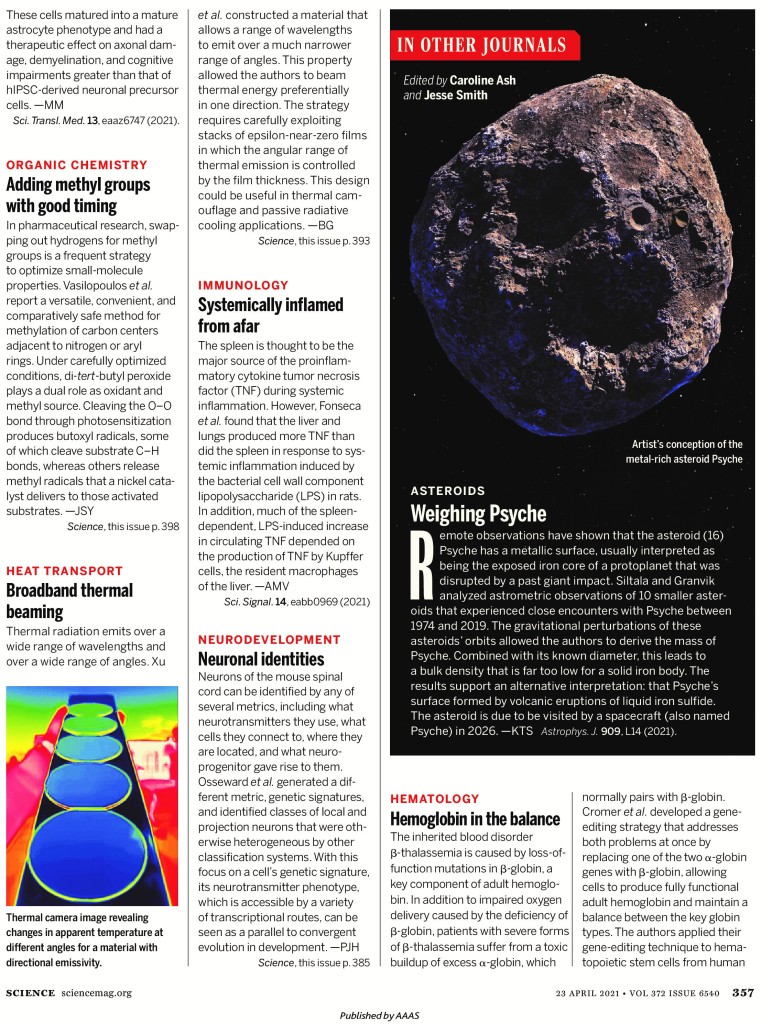
Stephen Hawking thought an asteroid impact posed the greatest threat to life on Earth.
Asteroids are small, rocky objects that orbit the Sun. Although asteroids orbit the Sun like planets, they are much smaller than planets. Asteroids are small, rocky objects that orbit the sun. Although asteroids orbit the sun like planets, they are much smaller than planets.
 After their life as research subjects, what happens to lab monkeys? Some are euthanized to complete the research, others switch to new research projects, and some retire from lab life. Should they retire in place—in the same lab under the care of the same custodians—or should they be sent to retirement home–like sanctuaries? Online News Editor David Grimm joins host Sarah Crespi to discuss recently penned legislation that pushes for monkey retirements and a new collaboration between universities and sanctuaries to create a retirement pipeline for these primates.
Sarah also talks with Dante Lauretta, principal investigator for NASA’s Origins, Spectral Interpretation, Resource Identification, Security, Regolith Explorer (OSIRIS-REx) and a professor at the University of Arizona in Tucson, about the latest news from the asteroid Bennu. Within 1 week of beginning its orbit of the asteroid, OSIRIS-REx was able to send back surprising images of the asteroid ejecting material. It’s extremely rocky surface also took researchers by surprise and forced a recalculation of the sample return portion of the craft’s mission.
To read more: https://www.sciencemag.org/podcast/debating-lab-monkey-retirement-and-visiting-near-earth-asteroid








 Boomers Daily