Category Archives: Politics

THE NEW YORK TIMES – SUNDAY, JULY 13, 2025

Trump’s Tariffs Are Shaping New World Trade Order, Minus the U.S.

Facing growing chaos, the European Union and numerous countries are seeking to forge a global, rules-based trading nexus, one less centered on America.

Trump Is Gutting Weather Science and Reducing Disaster Response

As a warming planet delivers more extreme weather, experts warn that President Trump is dismantling the government’s disaster capabilities.

What to Know About the Secret Service, a Year After It Failed to Protect Trump

The agency withstood criticism and a reckoning after a lone assassin grazed Donald Trump on the campaign trail. Today, recruiting is up.

The Quiet Unraveling of the Man Who Almost Killed Trump

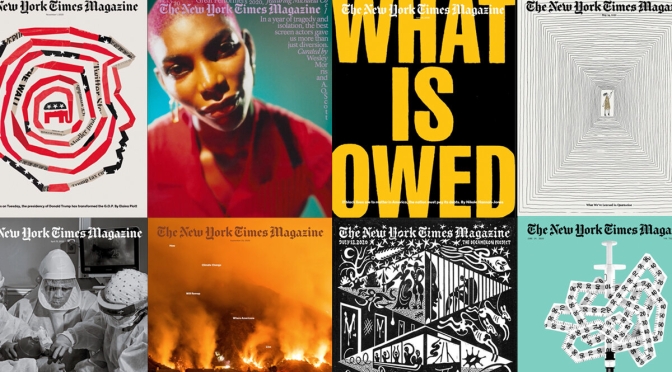
THE NEW YORK TIMES MAGAZINE – JULY 13, 2025

Current cover

THE NEW YORK TIMES MAGAZINE: The 7.13.25 Issue features Emily Bazelon and Mattathias Schwartz on Amir Ali’s first months as a federal judge under the Trump administration; Ted Conover on the truth of the gang problem in Aurora, Colorado; M.H. Miller on 20 years of “It’s Always Sunny in Philadelphia”; Lulu Garcia-Navarro interviews Mark Rutte, the secretary general of NATO; and more.

How Netanyahu Prolonged the War in Gaza to Stay in Power

Secret meetings, altered records, ignored intelligence: the inside story of the prime minister’s political calculations since Oct. 7.

Inside the Collapse of the F.D.A.

How the new health secretary, Robert F. Kennedy Jr., is dismantling the agency. By Jeneen Interlandi

What to Know About the Collapse of the F.D.A.

The regulatory agency confronts a future determined by a health secretary hostile to its mission. By Jeneen Interlandi

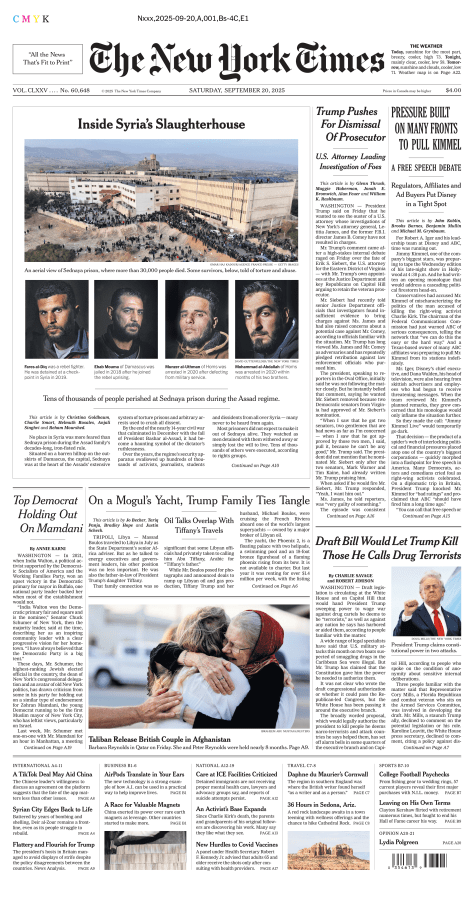
THE NEW YORK TIMES – SATURDAY, JULY 12, 2025

Tariffs or Deals? Trump Seems Content With Punishing Levies.

President Trump’s supporters portray him as a top dealmaker. But, at least for now, far more trading partners have gotten stiff tariffs than trade deals.

Around the World, Flash Flood Disasters Are the ‘Hardest Kind to Prevent’

Scholars and designers of early warning systems say that there are still huge gaps in the ability to predict flash floods and warn those at risk.

An Army of Searchers Combs the Banks of the Guadalupe for the Missing

Judge Blocks Trump Administration Tactics in L.A. Immigration Raids

A federal judge temporarily halted the administration from making indiscriminate arrests based on race and denying detainees access to lawyers.

President Trump’s Birthright Citizenship Ban Faces New Threat: Class Actions

In last month’s decision limiting one judicial tool, universal injunctions, the court seemed to invite lower courts to use class actions as an alternative.

THE NEW YORK TIMES – FRIDAY, JULY 11, 2025

How Netanyahu Prolonged the War in Gaza to Stay in Power

Secret meetings, altered records, ignored intelligence: the inside story of the prime minister’s political calculations since Oct. 7.

Before Tragedy, Texas Repeatedly Rejected Pleas for Flood Alarm Funding

Kerr County repeatedly failed to secure a warning system, even as local officials remained aware of the risks and as funds were available for similar projects.

Trump’s Seesawing on Tariffs Gives the World Whiplash

Blunt letters dictating terms posted to social media and changes late in negotiations have left trading partners wondering what President Trump will do next.

THE ECONOMIST MAGAZINE – JULY 12, 2025 PREVIEW

THE ECONOMIST MAGAZINE: The latest issue features ‘Scrap the asylum systemAnd build something better…

Scrap the asylum system—and build something better

Rich countries need to separate asylum from labour migration

America cannot dodge the consequences of rising tariffs for ever

Their economic impact has been delayed but not averted

After another leader is brought low, Thailand’s voters need a real choice

The kingdom is stagnating while its elites squabble

Sex hormones could be mental-health drugs too

If they can be liberated from ignorance and hucksterism

THE NEW YORK TIMES – THURSDAY, JULY 10, 2025

Texas Camp’s Cabins Stood in an ‘Extremely Hazardous’ Floodway

An analysis of Camp Mystic shows that several buildings were in known hazard zones. A $5 million expansion in 2019 did nothing to alleviate the problem.

As Texas Flood Raged, Camp Mystic Was Left to Fend for Itself

Flash floods hit during the night, but many local officials appeared unaware of the unfolding catastrophe, initially leaving people near the river on their own.

China Surveys Seabeds Where Naval Rivals May One Day Clash

Research ships are studying the seas for science and resources, but the data they gather could also be useful in a conflict with Taiwan or the U.S.

U.K. and France Agree to First-Ever Nuclear Weapons Pact to Fend Off Threat to Europe

Prime Minister Keir Starmer of Britain and President Emmanuel Macron of France are set to confirm a strengthened defense relationship at a summit today.

THE NEW YORK TIMES – WEDNESDAY, JULY 9, 2025

With Taxes and Tariffs in Place, Trump Takes Reins of U.S. Economy

President Trump has achieved much of his agenda, leaving the fate of the economy squarely in his hands.

At Least 173 People Remain Missing After Texas Floods

Officials said the search for remains would continue until all victims were accounted for. In the hardest-hit county, no survivors have been found since Friday.

Trump Got the Green Light to Fire Federal Workers. Now, They Wait.

A court-ordered pause in May had covered nearly two dozen federal agencies at different stages of executing President Trump’s directive for mass layoffs.

The ‘Trump Pump’: How Crypto Lobbying Won Over a President

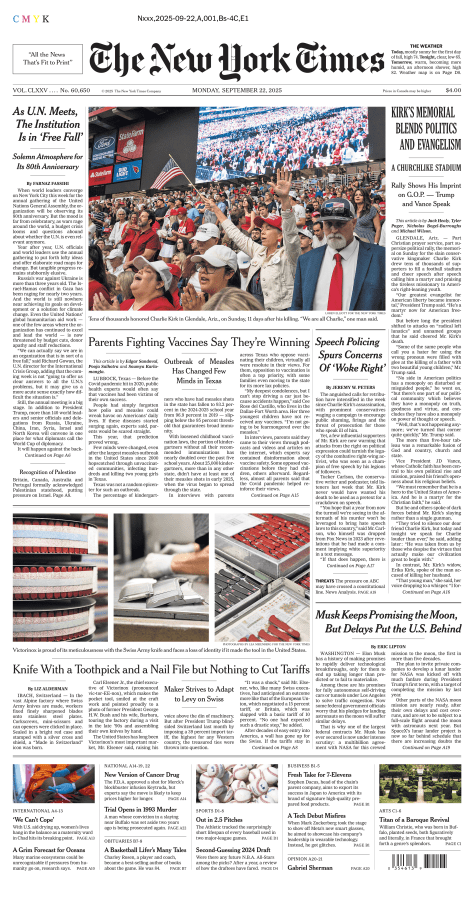
THE NEW YORK TIMES – TUESDAY, JULY 8, 2025

Image

Trump’s New Trade Threats Set Off Global Scramble to Avoid Tariffs

Many countries thought they were negotiating in good faith. President Trump renewed his tariff plan anyway, giving them until Aug. 1 to make offers.

Rescuers Scour Flood Debris in Texas as Hope Fades for Survivors

The chances of finding anyone alive five days after the deluge tore through Central Texas are remote. The death toll climbed to more than 100 people.

See When Federal and Local Officials Issued Warnings About the Texas Floods

Trump and Netanyahu Trade Praise as Gaza Cease-Fire Talks Unfold

President Trump and Prime Minister Benjamin Netanyahu of Israel confronted an array of high-stakes Middle East issues. But first they took a victory lap.

“Why Socialism”: Albert Einstein’s Resplendent Impertinence of Genius

The following essay was written by ChatGPT, and edited by Intellicurean, through the creative filter of Oscar Wilde’s barbed wit and George Bernard Shaw’s moral seriousness, of a review of John Bellamy Foster’s “Albert Einstein’s ‘Why Socialism?’: The Enduring Legacy of His Classic Essay” as it would appear in an esteemed magazine or journal.

In an era where celebrity chatter often drowns out meaningful discourse—ephemeral as the pixels that transmit it—it is both refreshing and necessary to recall that Albert Einstein was not merely a demigod of science, floating above the affairs of humankind. He was a thinker with moral conviction and intellectual courage. John Bellamy Foster’s timely volume, Albert Einstein’s “Why Socialism?”: The Enduring Legacy of His Classic Essay (Monthly Review, July 2025), excavates an overlooked manifesto whose radical clarity remains provocatively undiminished by time.


Unpacking Einstein’s Socialist Vision

More than seventy-five years have passed since Einstein contributed his essay Why Socialism? to the inaugural issue of Monthly Review in May 1949—right in the throes of America’s Red Scare. In that climate of ideological hysteria, even reason itself was suspect. Yet Einstein, with characteristic directness, named capitalism as the source of modern spiritual and economic malaise. “The economic anarchy of capitalist society,” he wrote, “is, in my opinion, the real source of the evil.”

This was no armchair abstraction. It was an act of moral and intellectual defiance in an era of conformity. Rather than tempering his critique to placate the political climate, Einstein diagnosed capitalism as a system that cripples the individual, erodes social cohesion, and mistakes profit for purpose. His socialism, then, was not bureaucratic dogma, but a humane vision: a call for solidarity, responsibility, and human dignity.

Foster’s introduction accomplishes three critical feats. First, it confirms Einstein’s consistent—if unfashionable—commitment to socialist ideals. Second, it situates Why Socialism? within a contemporary moment of deepening ecological and geopolitical crisis, not unlike the postwar anxieties Einstein addressed. Third, and most compellingly, Foster refuses to treat Einstein’s words as nostalgic artifacts. Instead, he reads them as instruments of moral interrogation for the present.


Einstein’s Moral Urgency in a Cynical Age

A powerful moment recounted in Foster’s commentary draws from a recently unearthed interview transcript titled, YES, ALBERT EINSTEIN WAS A SOCIALIST. In it, Einstein recounts a chilling conversation: a friend, contemplating nuclear annihilation, casually asks why Einstein is so concerned about humanity’s extinction. The question is as nihilistic as it is sincere—eerily prefiguring today’s fatalism disguised as realism.

Einstein’s response was telling. He saw this resignation not as philosophical sophistication, but as a symptom of capitalism’s emotional deadening. A world driven by profit, he argued, had alienated people not only from one another but from their very capacity to find joy. “The naive, simple and unsophisticated enjoyment of life,” he mourned, had become a casualty. The resulting solitude, he observed, was not noble introspection but a prison built of egotism and insecurity.

In Why Socialism?, Einstein extends this observation: “Man is, at one and the same time, a solitary being and a social being… As a social being, he seeks to gain the recognition and affection of his fellow human beings… and to improve their conditions of life.” The essay thus offers not just an economic critique, but a portrait of the spiritual crisis induced by capitalism.


A Socialism of Decency, Not Dogma

Einstein did not envision socialism as the rigid apparatus of state control feared by his critics. Instead, he imagined a cultural and moral transformation—one that would replace competition with cooperation, and empty success with meaningful contribution. “In addition to promoting his own innate abilities,” he wrote, “education would attempt to develop in [the individual] a sense of responsibility for his fellow man in place of the glorification of power and success in our present society.”

This human-centered socialism bears more resemblance to George Bernard Shaw’s ethical idealism than to any centralized Leninist command structure. It’s a socialism that asks not only how society is organized, but what kind of people it produces.


Economic Insecurity and the Specter of Waste

Foster’s commentary reaches its most powerful moments when it highlights the relevance of Einstein’s critique in light of today’s contradictions. Technological progress has not delivered leisure or security—it has exacerbated anxiety. “The worker is constantly in fear of losing his job,” Einstein observed. “Technological progress frequently results in more unemployment rather than an easing of the burden of work for all.”

The implications are strikingly modern. The rise of AI, automation, and gig economies has done little to stabilize human life. Meanwhile, the grotesque spectacle of billionaires launching vanity rockets while basic needs go unmet seems to fulfill Einstein’s warning: “Private capital tends to become concentrated in few hands… at the expense of smaller ones.”

Einstein’s insights cut deeper than economics. He warned that unbridled competition produces “a huge waste of labor and… crippling of the social consciousness of individuals.” Foster echoes this, showing how the very mechanisms that promise efficiency often produce alienation and redundancy. In a world where millions remain hungry while supply chains overflow, the diagnosis of “planned chaos” is tragically apt.


The Courage to Imagine a Better World

To Foster’s credit, the book does not shy away from the difficulties of implementing socialism. It acknowledges Einstein’s own candor: that centralized systems can create new forms of domination. “How can the rights of the individual be protected,” he asked, “and therewith a democratic counterweight to the power of bureaucracy be assured?”

Foster does not offer easy answers, nor does he romanticize Einstein’s views. But what he recovers is the philosopher’s refusal to retreat into cynicism. Einstein, like Shaw, understood that history does not advance through comfort or caution. It advances through the courage to propose—and live by—dangerous ideals.

This moral clarity is what makes Why Socialism? enduring. In an era when capitalism insists that no alternatives exist, Einstein reminds us that alternatives are always possible—so long as we preserve the moral imagination to conceive them.


No Middle Ground—And That’s the Point

If one criticism can be leveled at Foster’s approach, it is that he leaves little room for ambiguity. This is no quiet meditation on gradual reform. It is a call to judgment. In a time when readers often seek the past as comfort, Foster compels us to read it as confrontation. The result is not a nostalgic ode to Einstein’s politics but a provocation: What kind of civilization do we want?

Einstein wrote, “I am convinced there is only one way to eliminate these grave evils, namely through the establishment of a socialist economy, accompanied by an educational system which would be oriented towards social goals.” The boldness of that sentence still stings in a society that treats cooperation as utopian and hoarding as genius.

Foster’s restraint is notable throughout—he avoids both hagiography and polemic. He invites the reader to wrestle with Einstein’s ideas, not worship them. The book’s greatest achievement is that it makes us take Einstein seriously—not just as a physicist, but as a moral thinker who challenged the logic of his time and, perhaps, still ours.


Conclusion: A Dangerous Hope

To read Why Socialism? in 2025 is to hear a still-resonant signal from a thinker who refused to let go of the future. Einstein’s socialism was never about bureaucracies—it was about the possibility of decency, of cooperation, of lives lived without fear. And if that vision sounds naive today, then perhaps the problem lies not in the vision, but in the world that has taught us to dismiss it.

As Foster’s book makes clear, the choice remains what it was in 1949: between solidarity and atomization, between a society built on care or one cannibalized by competition. It is, at bottom, a choice between life and extinction.

One imagines Einstein, ever the pragmatist with a poet’s soul, would have approved.

THE NEW YORK TIMES – MONDAY, JULY 7, 2025

Image

Summer Camp Says 27 Girls and Staff Killed in Texas Floods

Camp Mystic, an all-girls Christian summer camp, confirmed that at least 27 campers and counselors had died, calling it an “unimaginable tragedy.”

What’s at Stake as Benjamin Netanyahu and Trump Meet in Washington

President Trump is considering whether to pursue a new nuclear agreement with Tehran. He is also urging a new cease-fire deal to end the fighting in Gaza.

Israel’s Deadly Assault on Iran Prison Incites Fury, Even Among Dissidents

U.S. Trading Partners Are on Edge as Tariff Deadline Nears

President Trump is set to once again put economic pressure on other nations, as a deadline for making trade deals elapses this week.