Category Archives: Literature

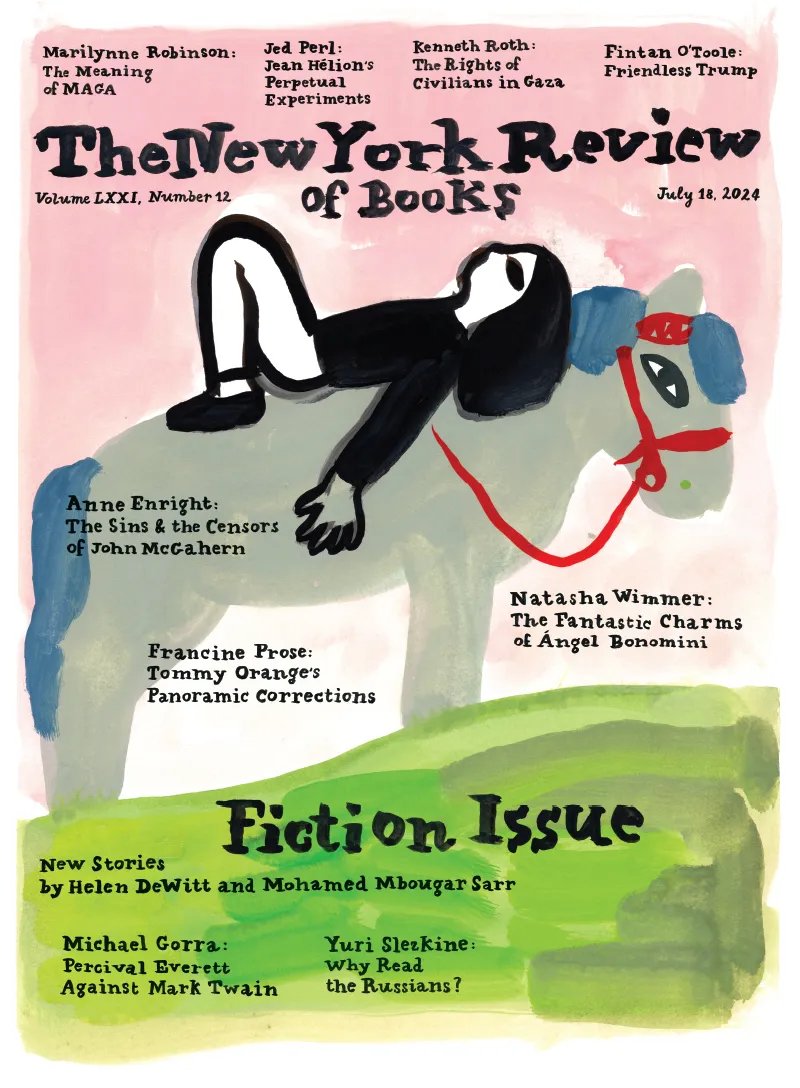
The New York Review Of Books – July 18, 2024

Image

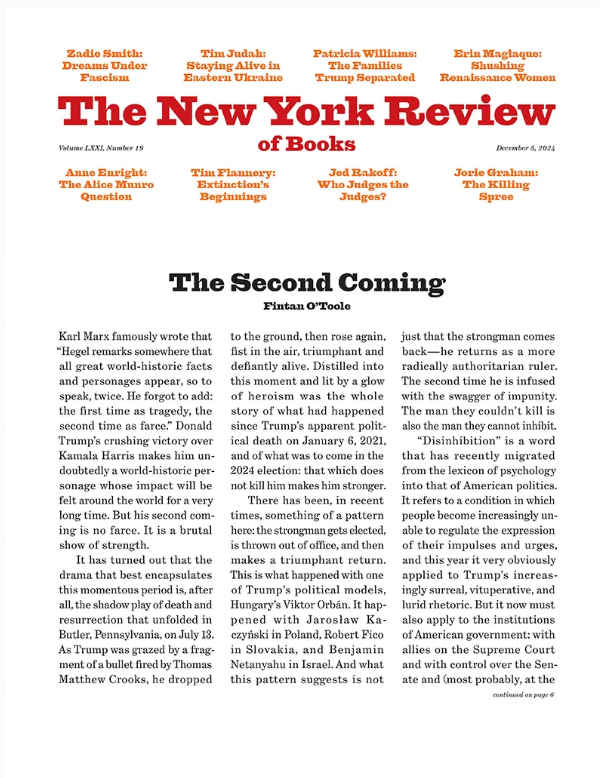
The New York Review of Books (June 27, 2024)The latest issue features:

Reimagining the Ordinary

The French artist Jean Hélion approached painting with a philosophical precision, each style a hypothesis to be investigated and tested.

By Michael Gorra

Jean Hélion: La Prose du monde – an exhibition at the Musée d’Art Moderne de Paris, March 22–August 18, 2024


A Story of His Own

In James, Percival Everett’s smart, funny, brutal retelling of The Adventures of Huckleberry Finn, Everett takes readers deeper into the capricious yet certain violence of American slavery, giving the characters a life that seems to lift off the page.

James by Percival Everett

The Watercolorist

The short fiction of Ángel Bonomini possesses a lightness that sets him apart from contemporaries like Borges and Cortázar.

The Novices of Lerna by Ángel Bonomini, translated from the Spanish by Jordan Landsman
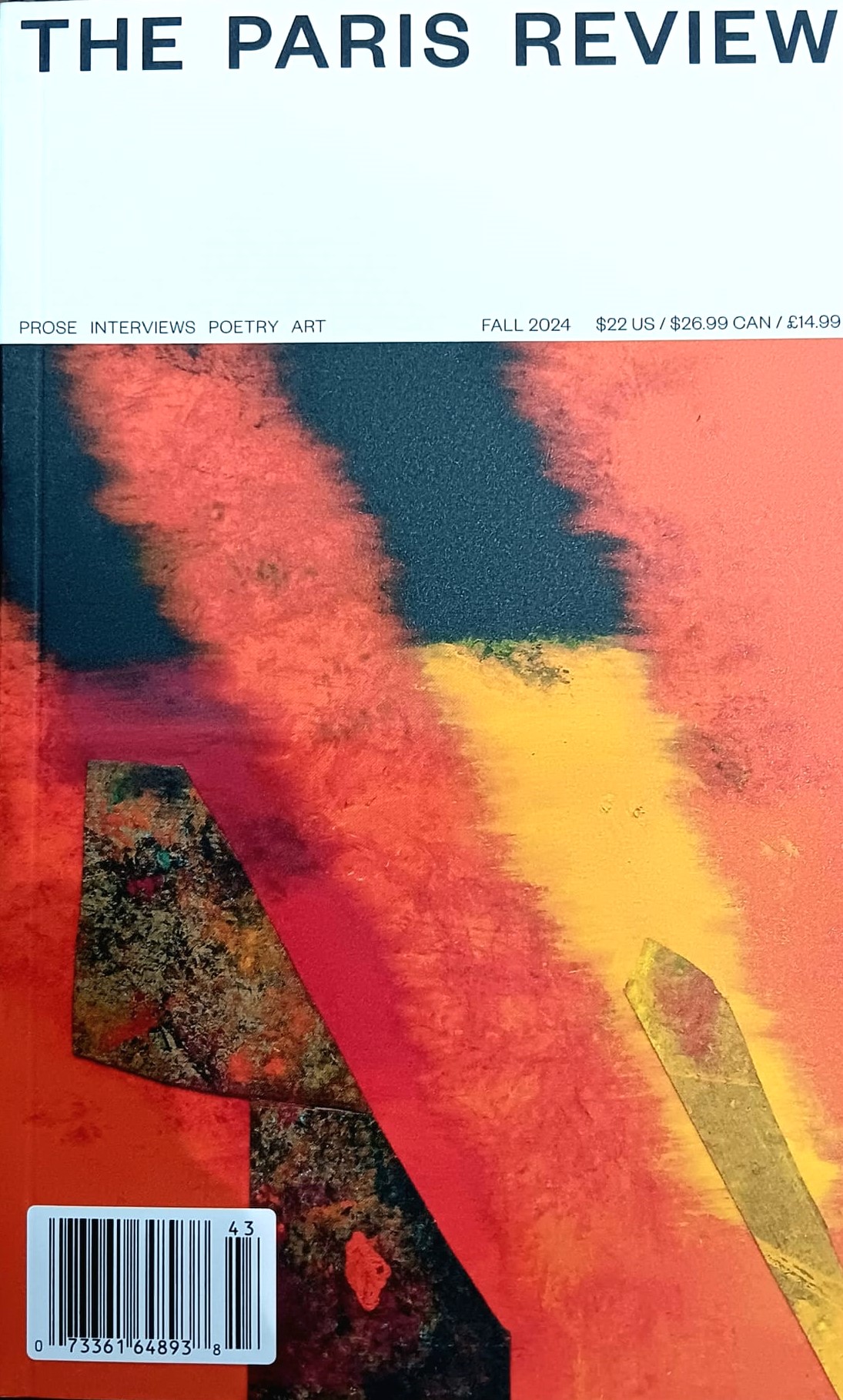
Literary Previews: The Paris Review – Summer 2024

The Paris Review No. 248, Summer 2024

Paris Review Summer 2024 — The new issue features:

Mary Robison on the Art of Fiction: “The first thing they’d say was ‘This is a nice story—where’s your novel?’ And I would just lie my head off. ‘Oh, it’s at home. It’s almost there!’”

Elaine Scarry on the Art of Nonfiction: “A lot of my troubles in life have come from taking literally what I should have understood as figurative.”

Prose by Peter Cornell, Rodolfo Enrique Fogwill, Renee Gladman, Nancy Lemann, Banu Mushtaq, K Patrick, and Anne Serre.

Jhumpa Lahiri on the Art of Fiction: “My question is, What makes a language yours, or mine?”

Alice Notley on the Art of Poetry: “Writing is not therapy. That’s the last thing it is. I still have my grief.”

Prose by Elijah Bailey, Julien Columeau, Joanna Kavenna, Samanta Schweblin, Eliot Weinberger, and Joy Williams.

Poetry by Gbenga Adesina, Elisa Gabbert, Jessica Laser, Maureen N. McLane, Mary Ruefle, Julian Talamantez Brolaski, and Matthew Zapruder.

Art by Farah Al Qasimi and Chris Oh.

TABLE OF CONTENTS

The New York Review Of Books – June 20, 2024

Image

The New York Review of Books (June 9, 2024)The latest issue features:

Livelier Than the Living

In the Renaissance, reading became both a passion and a pose of detachment—for those who could afford it—from the pursuits of wealth and power.

A Marvelous Solitude: The Art of Reading in Early Modern Europe by Lina Bolzoni, translated from the Italian by Sylvia Greenup

Untold Futures: Time and Literary Culture in Renaissance England

Black Atlantics

The scholar Louis Chude-Sokei does the urgent work of reimagining the African diaspora as multiple diasporas.

Floating in a Most Peculiar Way by Louis Chude-Sokei

The Last “Darky”: Bert Williams, Black-on-Black Minstrelsy, and the African Diaspora by Louis Chude-Sokei

The Sound of Culture: Diaspora and Black Technopoetics by Louis Chude-Sokei

Literary Previews: The Paris Review – Spring 2024

The Paris Review No. 247, Spring 2024—Subscriber Cover

Paris Review Spring 2024 — The new issue features interviews with Jhumpa Lahiri and Alice Notley, prose by Joy Williams and Eliot Weinberger, poetry by Mary Ruefle and Jessica Laser, art by Chris Oh and Farah Al Qasimi, two covers by Nicolas Party, and more…

Jhumpa Lahiri on the Art of Fiction: “My question is, What makes a language yours, or mine?”

Alice Notley on the Art of Poetry: “Writing is not therapy. That’s the last thing it is. I still have my grief.”

Prose by Elijah Bailey, Julien Columeau, Joanna Kavenna, Samanta Schweblin, Eliot Weinberger, and Joy Williams.

Poetry by Gbenga Adesina, Elisa Gabbert, Jessica Laser, Maureen N. McLane, Mary Ruefle, Julian Talamantez Brolaski, and Matthew Zapruder.

Art by Farah Al Qasimi and Chris Oh.

TABLE OF CONTENTS

The New York Review Of Books – February 22, 2024

Image

The New York Review of Books (February 6, 2024) The latest issue features:

The Case for Disqualification

The Supreme Court must decide if it will honor the original meaning of the Fourteenth Amendment and bar Donald Trump from holding public office or trash the constitutional defense of democracy against insurrections.

In Search of the Rare and Strange

In Dürer’s Lost Masterpiece, Ulinka Rublack traces the global connections of the merchants who were the creative agents of the European art market in the sixteenth and early seventeenth centuries.

Dürer’s Lost Masterpiece: Art and Society at the Dawn of a Global World by Ulinka Rublack

The Forest Eaters

In 2017, the Brazilian journalist Eliane Brum moved from São Paulo to a small city in the Amazon. Her new book vividly uncovers how the rainforest is illegally seized and destroyed.

Banzeiro Òkòtó: The Amazon as the Center of the World by Eliane Brum, translated from the Portuguese by Diane Whitty

The New York Review Of Books – February 8, 2024

Image

The New York Review of Books (January 18, 2024)The latest issue features Crime Fiction Addiction; Chantal Akerman’s Proust & Albertine; Toward and Ethics of Spycraft; Regarding the Pain of Avatars; Was Weimar Doomed to Fail? and The Truth About Tampons….

Ethical Espionage

What moral principles should guide our intelligence-gathering agencies?

By Tamsin Shaw

Spies: The Epic Intelligence War Between East and West by Calder Walton

Spying Through a Glass Darkly: The Ethics of Espionage and Counter-Intelligence by Cécile Fabre

On October 7, as Hamas fighters roared into southern Israel from Gaza, bringing terror and death to anyone they encountered—Israeli soldiers, Bedouins, young people dancing and getting high together, kibbutzniks scooping up small children into desperate arms—I was sleeping in a comfortable hotel room in Georgia. All around me in the sultry darkness of a beautiful resort, many of the US intelligence community’s finest minds were also slumbering. We awoke with the expectation that we would be addressed by CIA director William Burns at the opening of the Cipher Brief’s annual Threat Conference, a yearly gathering of national security professionals from the private and public sectors, plus a few academics and journalists.

The New York Review Of Books – January 18, 2024

Image

The New York Review of Books (December 28, 2023)The latest issue features Ben Tarnoff on Elon Musk, Julian Bell on Peter Paul Rubens, Fintan O’Toole on the American gerontocracy, Anjum Hasan on recent Sri Lankan fiction, Matthew Desmond on America’s Covid-era experiment with a social safety net, Francine Prose on a vampiric celluloid Pinochet, James Gleick on the science of free will, Frances Wilson on Tove Jansson and the Moomintrolls, Álvaro Enrique on indigenous Americans in Europe, Katie Trumpener on Alexander Kluge, two poems by Jack Underwood, and more.

The Fate of Free Will

By James Gleick

In Free Agents, Kevin Mitchell makes a scientific case for the existence of human agency.

Free Agents: How Evolution Gave Us Free Will by Kevin J. Mitchell

Nobody was holding a gun to your head when you started reading this. You made a choice. Surely it felt that way, at least. A sense of agency—of control over our actions, of continual decision-making—is part of the experience of being human, moment by moment and day by day. True, we sometimes just drift, like robots or zombies, but at other times we gird our loins and exert our will. David Hume defined will nearly three centuries ago as “the internal impression we feel and are conscious of, when we knowingly give rise to any new motion of our body, or new perception of our mind.” The feeling was universal then and it’s universal now.

Tools to End the Poverty Pandemic

Why have Americans not fought to sustain the unprecedented Covid-era expansion of aid to children, renters, and gig workers?

By Matthew Desmond

The Pandemic Paradox: How the Covid Crisis Made Americans More Financially Secure by Scott Fulford

The Viral Underclass: The Human Toll When Inequality and Disease Collide by Steven W. Thrasher

Poverty in the Pandemic: Policy Lessons from Covid-19 by Zachary Parolin

Literary Previews: The Paris Review – Winter 2023

Image

Paris Review Winter 2023 — The new issue features Louise Glück on the Art of Poetry – “You want a poem to register in every mind the way it did in yours. Then you discover this never happens.”; Yu Hua on the Art of Fiction: “If I’d taken another two or three years to start writing, I’d still be a dentist.”; Prose by Ananda Devi, Fiona McFarlane, and Sean Thor Conroe and more…

TABLE OF CONTENTS

The New York Review Of Books – December 21, 2023

Image

The New York Review of Books (December 21, 2023 Issue)The latest issue features the Holiday Issue—with Susan Tallman on William Kentridge, David Shulman on violence in the West Bank, Neal Ascherson on Timothy Garton Ash’s Europe, Elaine Blair on what we talk about when we talk about porn, Rebecca Giggs on the return of dinosaurs, Kathryn Hughes on Jane Austen’s fashion, Mark O’Connell on Werner Herzog, Linda Greenhouse on Covid in the courts, Gabriel Winslow-Yost on Bill Watterson’s first book since Calvin and Hobbes, John Banville on liberalism after Hobbes, poems by Lindsay Turner and Greg Delanty, and much more.

A Leaf or Two from Whitman

Ben Lerner, Walt Whitman, and Tom Piazza
Ben Lerner, Walt Whitman, and Tom Piazza; illustrations by John Brooks

The promises and failures of the American twentieth century suffuse Ben Lerner’s new book of poems and Tom Piazza’s new novel.

Christopher Benfey

The Lights by Ben Lerner

The Auburn Conference by Tom Piazza

Imagine a festive dinner near Topeka during the fall of 1879 to celebrate the twenty-fifth anniversary of the founding of the Kansas Territory, with Walt Whitman as a featured speaker. Partially paralyzed by a stroke and described as “reckless and vulgar” by The New York TimesLeaves of Grass was soon to be banned for indecency by the Boston district attorney—Whitman, who had just turned sixty, may well have wondered why he, instead of some respectable graybeard like Emerson, was invited. Was it because he had defended John Brown, the hero of free-soil Kansas? Or was it hoped that a visit might inspire something like his 1871 “Song of the Exposition,” in which Whitman admonished the Muse:

Migrate from Greece and Ionia,
Cross out please those immensely overpaid accounts,
That matter of Troy and Achilles’ wrath…
For know a better, fresher, busier sphere, a wide, untried domain awaits, demands you.

The Lost World

Hatzegopteryx, a giant pterosaur that lived around 66 million years ago on a subtropical island in what is now Romania
Hatzegopteryx, a giant pterosaur that lived around 66 million years ago on a subtropical island in what is now Romania; from Prehistoric Planet

Nature documentary has of late become a haunted genre. Not so Prehistoric Planet, which revels in portraying that which is already dead and gone, no longer our responsibility.

Rebecca Giggs

Prehistoric Planet a BBC Studios series streaming on Apple TV+

Otherlands: A Journey Through Earth’s Extinct Worlds by Thomas Halliday

One early myth about the dinosaurs was that they would return. In 1830 Charles Lyell—earth scientist, Scot—gazed into the far future and posited as much in his Principles of Geology, arguing that since the planet’s climate was cyclical (or so he believed), vanished creatures could yet be revived, along with their habitats, when the right conditions came back around: “The huge iguanodon might reappear in the woods, and the ichthyosaur in the sea, while the pterodactyl might flit again through umbrageous groves of tree-ferns.” As to whether people would get to witness the spectacle of this resurrected bestiary—well, if Lyell was never drawn to that question, it was because the answer was not up for debate. His was an age in which the prospect of Earth bereft of human occupancy was too abominable, too sacrilegious, to contemplate.

The New York Review Of Books – December 7, 2023

Image

The New York Review of Books (December 7, 2023 Issue)The latest features A Fallen Artist in Mao’s China – Ha Jin’s The Woman Back from Moscow; Gut Instincts – Recent books about the importance of the microbiome have driven many patients to fixate on the idea of “gut health.” Are they right to do so?; Prelude to Empire – Abdulrazak Gurnah’s novels, whether set in German East Africa or the United Kingdom, never cease to demonstrate how the minutiae of people’s lives have been affected by European colonialism…

A Fallen Artist in Mao’s China

Ha Jin’s The Woman Back from Moscow, a fictionalized account of the life of the actress Sun Weishi, depicts the hypocrisy of the Communist elites and the fate of those who embraced new ideals after the revolution.

Perry Link

The Woman Back from Moscow: In Pursuit of Beauty by Ha Jin

This book will be denounced in Beijing. Ha Jin’s The Woman Back from Moscow is a novel based on the life of Sun Weishi, an adopted daughter of Chinese premier Zhou Enlai, whose brilliant mind and intensive study in Moscow of the Stanislavski acting method brought her to the pinnacle of China’s theatrical world during the Mao years. Her beauty and effervescent personality attracted powerful men—not only Zhou, who doted on her, but also Lin Biao, the Chinese Communist Party’s leading general, who divorced his wife in order to propose marriage to her (unsuccessfully), and Mao, who apparently raped her during a long rail trip. She had several other suitors and eventually married the film star Jin Shan.

Gut Instincts

Recent books about the importance of the microbiome have driven many patients to fixate on the idea of “gut health.” Are they right to do so?

Nitin K. Ahuja

Reviewed:

A Silent Fire: The Story of Inflammation, Diet, and Disease by Shilpa Ravella

Flush: The Remarkable Science of an Unlikely Treasure by Bryn Nelson

The Anti-Viral Gut: Tackling Pathogens from the Inside Out by Robynne Chutkan

Right before their colonoscopies, with the stress of a bowel prep still rumbling in their bellies and a mental image of the procedure beginning to sharpen, some patients will ask me why I chose a career in gastroenterology: “What made you interested in this?” The reason I usually give is that you could go all your life without a heart problem, or a lung problem, or a kidney problem, but not without a bit of nausea, constipation, or abdominal pain. The work of digestion is part of the rhythm of our daily lives, I tell them, which helps my work feel similarly immediate.