Category Archives: Environment

Conservation: ‘Tides Of Trash’ In The Maldives

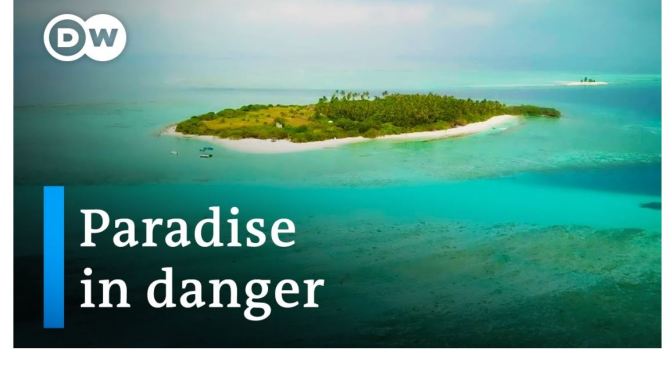
Thilafushi, an island of floating rubbish island in the Maldives, grows by a square meter a day. But diving instructor Shaahina Ali is trying to slow that growth by recycling and using floating barriers to hold back the rising seas.

For decades, the Maldives simply dumped the trash the tourists and the island country’s 400 thousand residents generated. Yet Shaahina Ali says that has to stop. Almost every day, the diving instructor and her allies go from island to island in the Indian Ocean. Working with an environmental organization, they have obtained trash compactors that make plastic waste transportable, allowing it to be shipped abroad for recycling. Ali also advocates avoiding disposable plastic. She gives lectures, advises hotel managers and even bends the ear of the Maldives’ president himself.

When she has time, Shaahina Ali goes scuba diving. Beneath the waves she sees environmental degradation – dying corals and fish caught up in plastic waste. She says, “We can’t afford to address just one problem. We’ve got to take care of everything at once because everything is connected to the sea.” But the island paradise is not only threatened by rubbish. Climate change is also causing the sea levels to rise, and the Maldives are at risk of sinking beneath the water.

That’s why conservationists are using floating barriers made of recycled plastic to help prevent flooding. In addition to the environmental group “Parley for the Oceans,” Ali has also won politicians to her cause. Last year saw a democratic change of government in the Maldives. “The new government no longer views environmentalists as annoying troublemakers. They see us as partners instead,” Ali says. But those trying to save the island are in a race against time. “If we don’t succeed,” says Shaahina Ali, “far more than a vacation paradise will be lost. We will lose our homeland.”
Analysis: Global Battles For ‘Water’ – A Necessity Or Commodity? (Video)

Water is fundamental to life, yet it’s also a scarce commodity. In many cases, greed and mismanagement are causing this life-giving essential to run dry. What happens when water is monetized? From Australia to California, from New York to London and Brussels, this investigative documentary tells the story of the global struggle over water.

Following rushes to secure gold and oil, the age of the water rush is now here. As well as growing populations and expanding agriculture, there are the problems of environmental degradation and climate change. Global demand for water is skyrocketing. By 2050, at least one in four people will live in a country with a chronic water shortage. The situation has awakened the greed of giant financial institutions, which are going on the offensive, investing billions in the sector. Goldman Sachs, HSBC, UBS, Allianz, Deutsche Bank and BNP are among those pouncing on the commodity known as “blue gold.”

But can fresh water really be considered a commodity on par with oil, coal or wheat? Should the players in these markets – banks and investment funds – be allowed to bet on the value of water? Will concern for profits undermine water’s essential function? Or should this precious resource be declared off-limits to financial speculators? A battle has broken out between those who advocate the monetization of water, and those who defend it as a human right. It’s a battle being fought on many fronts: ideological, political, environmental and, of course, economic. And the fate of the nearly ten billion inhabitants of our planet hinges on its outcome.

Documentary: ‘Fukushima – The Age Of Radioactivity’

The USS Ronald Reagan cruised into a radioactive cloud from the Fukushima nuclear power plant in March 2011. Sailors on the aircraft carrier were exposed to radiation. This documentary looks at the event and what came before it. The discovery of the atom and radioactivity are among the most important advances in 20th Century science. This film provides a comprehensive, historical examination of a century of radioactivity. At the same time it remembers the victims – from the Curies to Fukushima.

The film-makers visit Japanese families who sued Tepco, the operator of the Fukushima reactor, after their children developed thyroid cancer following the tsunami and subsequent nuclear disaster. Sent to help tsunami victims, sailors from the USS Ronald Reagan give detailed accounts of what happened on board the carrier. Radiation victims on both sides of the Pacific recount their difficulties in getting information. The film also introduces others harmed by industrial and military secrecy over the issue. Among them are fishermen and veterans exposed to radiation during the nuclear bomb tests on Bikini Atoll, Hiroshima survivors and young women who worked with radium in US factories in the 1920s. Radioactivity is invisible and odorless, yet very harmful to life. A Japanese doctor tells viewers how radioactivity affects the human body, why it causes cancer, and what can be done to shield people against it.

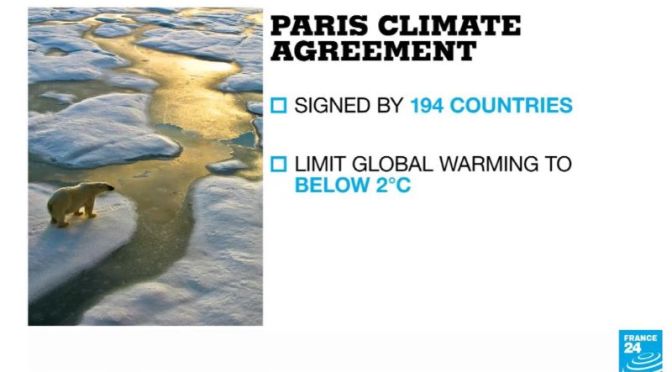
News: U.S. Rejoins The Paris Climate Agreement (Video)

Hours after being sworn in as US 46th President, Joe Biden kicked off his mandate by signing 17 executive orders. Among those, some were destined to undo the legacy of his predecessor Donald Trump, including rejoining the Paris Climate Agreement. The new president seems to keep climate as his administration’s priority, as promised.

Green Investment: ‘Can It Stop Global Warming?’

A new generation of investors wants to force businesses to become environmentally-friendly. Even climate conservationists know that money talks, but can green investments really save the world? Green investment rewards companies that use sustainable production practices and protect the environment. At the same time, companies that pollute or contribute to global warming are deprived of funds.

The strategy converts the once secondary issue of the environment into hard, cold cash. Antonis Schwarz is 30 years old — and an investor, philanthropist, and activist. His slogan is “cash against climate change.” Schwarz, like many other wealthy millennials, sees climate change as the key variable when it comes to investing money. These people intentionally put their cash into companies and projects that protect the environment. Schwarz believes that those who are well-off have a special responsibility to follow this strategy. He says, “When you are able to change something and you don’t, you’re complicit. We all have to become fully involved, so we can prevent a climate disaster.”

This philosophy can be summed up with the following question: “What’s the point of having loads of money if it becomes worthless because you’re living on a planet that’s becoming increasingly chaotic?” Institutional investors have more money at their disposal than wealthy private individuals do. Their approach is also changing — and not out of pure idealism. Extreme weather events caused by climate change, for example, are bad for business. They can force corporations to write off billions in damages.

This documentary goes behind the scenes to take a closer look at the financial markets. How well does “impact investing” work? Can investors really move large, powerful corporations to change their strategies? Politicians have so far failed to do precisely that.

Business: ‘The Costs Of Climate Change’ (Video)

Climate change is about to upend the corporate world through weather-related disasters, regulation and lawsuits. Can businesses react and adapt in time? Read more here: https://econ.st/3slTXIE

Profile: ‘Ocean Cleanup’ – Ridding The World’s Oceans Of Plastic (Video)

The Ocean Cleanup, a non-profit organization, is developing advanced technologies to rid the world’s oceans of plastic.

Every year, millions of tons of plastic enter the oceans primarily from rivers. The plastic afloat across the oceans – legacy plastic – isn’t going away by itself. Therefore, solving ocean plastic pollution requires a combination of stemming the inflow and cleaning up what has already accumulated.

FOUNDED 2013

Dutch inventor Boyan Slat founded The Ocean Cleanup at the age of 18 in his hometown of Delft, the Netherlands.

NON-PROFIT FOUNDATION

We are a registered charity as a ‘Stichting’ in the Netherlands, and a 501(c)(3) in the US.

HQ ROTTERDAM

The Ocean Cleanup’s team consists of more than 90 engineers, researchers, scientists and computational modelers working daily to rid the world’s oceans of plastic.

Website

Climate Change: What Are Covid-19’s Impacts? (Video)

When Covid-19 sparked lockdowns around the world, emissions of one of the greenhouse gases responsible for climate change, atmospheric carbon dioxide, plummeted. But is this record drop a short-term effect of the 2020 pandemic or a ‘new normal’? BBC Weather’s Ben Rich explores the impact of coronavirus on the global climate.

Motion graphics by Jacqueline Galvin

Produced by Soraya Auer