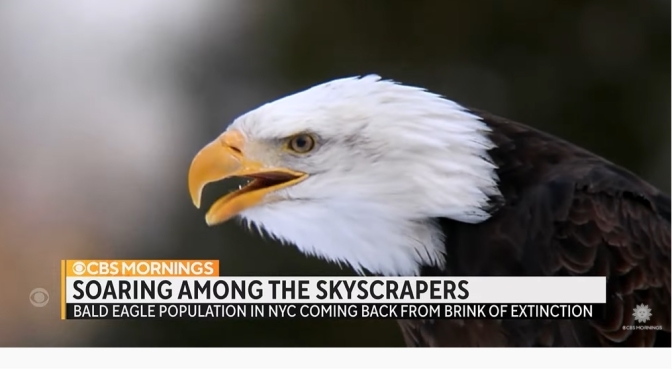
Bald eagles were nearly extinct in New York City due to environmental factors such as pollution and pesticides. Michael George spoke to an urban park ranger sergeant who participated in the two-decade effort to bring the birds back to the city.
The bald eagle is a bird of prey found in North America. A sea eagle, it has two known subspecies and forms a species pair with the white-tailed eagle, which occupies the same niche as the bald eagle in the Palearctic.
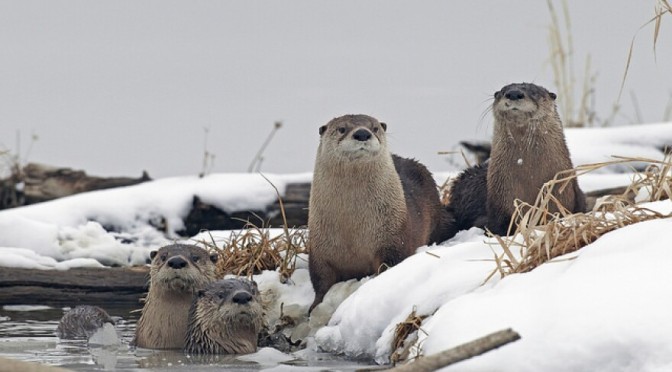
“Sunday Morning” visits otters on the hunt for fish at a pond in Portland, Maine. Videographer: Mauricio Handler.
The North American River Otter (Lontra canadensis) is the species of otter found in Maine, and you’ll find lots of them along the entire coast (and probably inland as well). River otters are mostly nocturnal members of the weasel family (Mustelidae) and rather large, growing up to 3.5 feet long and weighing around 30 pounds. They are referred to as “semi-aquatic,” since they spend most of their waking hours in water and come to land when denning, moving from one body of water to another, or marking a territory.
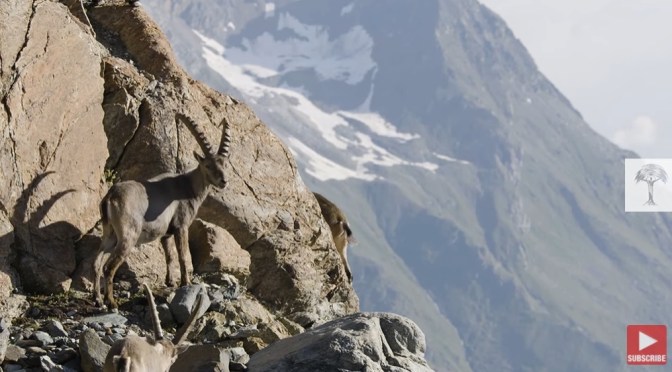
The ibex is the king of the Alps, famed for its curved horns and extreme climbing skills. But for centuries, these mountain goats were hunted by humans – to the very brink of extinction. A royal hunting reserve in Italy saved the Alpine ibex, but is climate change now threatening them all over again? We tell the story of their remarkable comeback and ask what the future might hold.
The Alpine ibex, also known as the steinbock, bouquetin, or simply ibex, is a species of wild goat that lives in the mountains of the European Alps. It is a sexually dimorphic species: males are larger and carry longer, curved horns than females. Its coat colour is typically brownish grey.
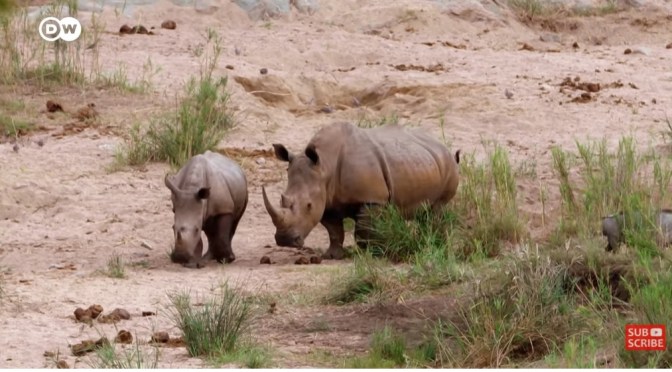
Poachers kill at least one rhino a day in South Africa. Their horns are in huge demand on the black market, and are worth more than gold. Anti-poaching squads are now increasingly better equipped: with night-vision equipment, drones and thermal imaging cameras.
Covering some 20,000 km2, Kruger National Park is one of the largest game reserves in Africa. It’s home to the biggest population of white rhinos in South Africa – and also the highest number of rhinos killed by poachers. One major problem for ranger teams is their small size in comparison to the vast area of territory involved. Another is the widespread poverty in the many villagers bordering the park – and it’s here that you ultimately have to begin if you want to win the battle to save the rhinos.
Vince Barkas has 30 years’ experience working in wildlife conservation, and little confidence in the current system’s effectiveness in protecting rhinos. In 1992 he founded the anti-poaching unit “Protrack”. Its teams operate in the Greater Kruger, which includes private wildlife reserves neighboring the national park.
Over the decades he says he’s seen no change, despite rangers being better armed and equipped, and wants to see new options: “We’ve shot poachers, arrested poachers, beaten up poachers. Everything. But we’ve never sat down and spoken.” Vince Barkas believes in the power of dialog rather than violence. He and his son Dylan made their way to Mozambique – where many of the poachers who kill rhinos in the Kruger National Park hail from.
Their journey takes them to the town of Massingir, where Barkas Snr. first began talking to poachers a number of years ago. The problem, he says, is rooted in the very concept of wildlife conservation: “We’ve made wildlife a rich white man’s thing – where white people hunt and benefit from it, and go to lodges etc. And we’ve kept black people out of it – behind a fence. We’ve got to change that approach.”
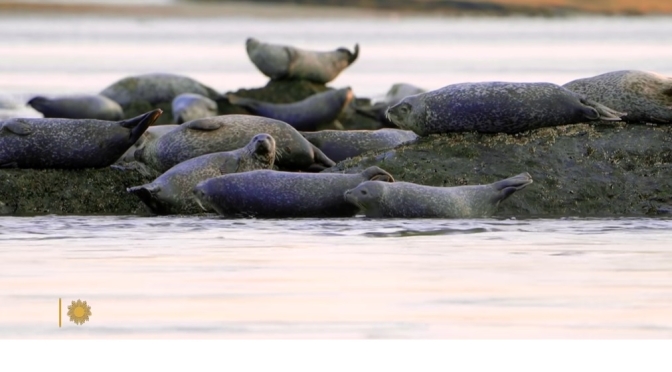
“Sunday Morning” leaves you today with seals sunning at the Parker River National Wildlife Refuge in Newburyport, Massachusetts (with some snowy owls looking on). Videographer: Michael Clark.
Parker River National Wildlife Refuge is a wildlife sanctuary encompassing the majority of Plum Island in northeastern Essex County, Massachusetts, 5 miles southeast of Newburyport. It was established in 1942 primarily to provide feeding, resting, and nesting habitats for migratory birds.
The harbour seal, also known as the common seal, is a true seal found along temperate and Arctic marine coastlines of the Northern Hemisphere. The most widely distributed species of pinniped, they are found in coastal waters of the northern Atlantic, Pacific Oceans, Baltic and North Seas.
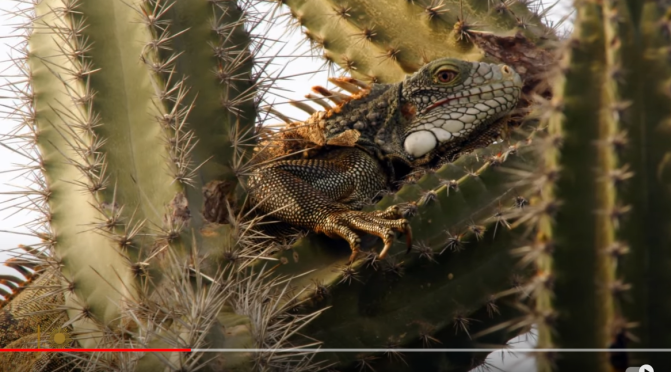
Christoffelpark is the largest national park of Curacao and a must see for everyone. The park has a rich variety of local flora and fauna. Nature lovers will find the park teeming with local birds and plants, including species, which are not easily seen elsewhere on the island. For example wild orchids, the Palabrua, the rare native barn owl. The Curacao White Tailed deer (of which there are only about 250 left) and much more.
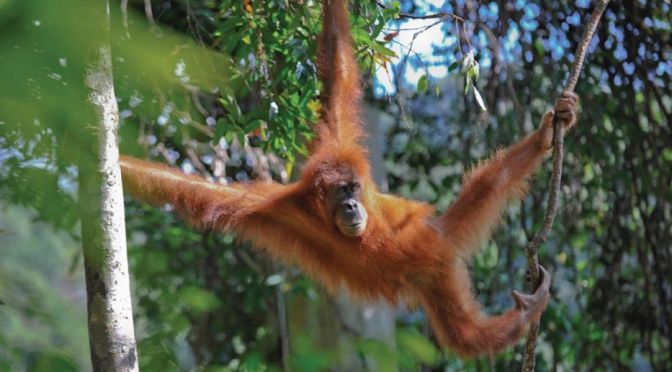
Learning survival skills is a must for baby orangutans to live in the rainforest among their predators, however, not all of them are natural acrobats!
The Bornean orangutan is a species of orangutan endemic to the island of Borneo. Together with the Sumatran orangutan and Tapanuli orangutan, it belongs to the only genus of great apes native to Asia.
Borneo, a giant, rugged island in Southeast Asia’s Malay Archipelago, is shared by the Malaysian states of Sabah and Sarawak, Indonesian Kalimantan and the tiny nation of Brunei. It’s known for its beaches and ancient, biodiverse rainforest, home to wildlife including orangutans and clouded leopards. In Sabah is 4,095m-tall Mount Kinabalu, the island’s highest peak, and, offshore, the famed dive site Sipadan Island.
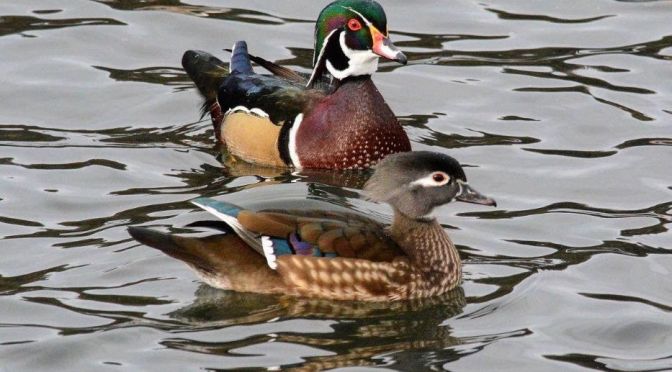
“Sunday Morning” takes us among some wood ducks in Lewiston, Idaho, by the confluence of the Clearwater and Snake Rivers. Videographer: Hank Heusinkveld.
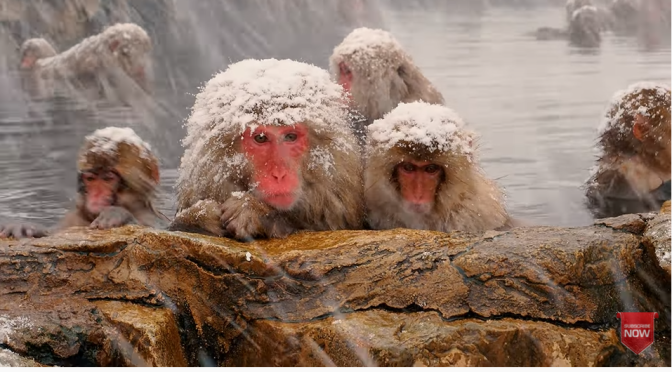
Located at the base of Joshinetsu Kogen National Park, the Jigokudani Monkey Park – often referred to as the Snow Monkey Park – is home to a very special troop of monkeys. Created in 1964, the park was established as a conservation area in which the monkeys, Japanese macaques to be exact, would have a refuge within what was already their natural habitat. Once in the park, the naturally-curious monkeys observed humans using the hot spring of a nearby guesthouse and before long, started copying the behaviour. The rest as they say, is history.
Narrated by Kate Winslet, Snow Chick – A Penguin’s Tale tells the story of an emperor penguin chick’s first precarious months of life as it grows up in the world’s most extreme nursery.
Emperor penguins are the only animals to breed in the Antarctic winter, and after months of blizzards and temperatures of -60C, male emperor penguins are watching and waiting for their chicks to hatch. Snow Chick is the last to emerge into this harsh, frozen world.
As he takes his first steps, he tries to fit in with the baby penguin gang, but when you’re so small it’s hard to be accepted by the bigger chicks. Soon he ventures too far from his mother for comfort and gets lost in a storm. Later, he’s chased by chick-snatching penguins and escapes a scavenging petrel by the fluff of his back – all the while slipping and skating on treacherous ice. With the arrival of the comical and pugnacious adelie penguin, colony life is turned upside down. But it signals a bigger change – the parents who braved long and treacherous journeys across the sea ice to bring back food eventually return no more. With his band of penguin brothers, Snow Chick has no choice but to make his own way to the sea. A few more adventures lie ahead before he gets tossed unceremoniously into the open ocean – his new home for the next four years.
An enchanting and action-packed dramatised Christmas treat, featuring one of the cutest and toughest creatures on Earth. Filming over a whole Antarctic year, the crew endured some of the toughest conditions on earth to capture these astonishing moments of intimate behaviour.
News, Views and Reviews For The Intellectually Curious


 Boomers Daily