Tag Archives: U.S. Elections

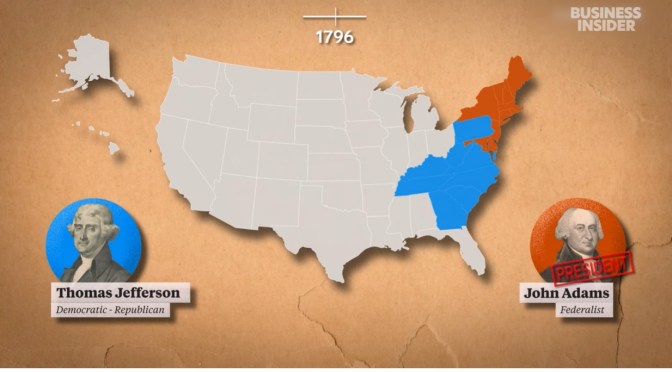
How U.S. Voted In Every Election From 1789 – 2024

Business Insider (November 15, 2024): The United States has had 60 presidential elections starting in 1789. New parties have come and gone, while new states expanded the electoral map.

Video timeline: 0:00 – Intro 0:28 – First Party System (1792-1824) 1:30 – Second Party System (1828-1854) 2:40 – Third Party System (1854-1895) 5:46 – The Early 1900s (Progressive Era) 7:14 – Fifth Party System – FDR/New Deal Coalition 9:48 – Sixth Party System (1964-present) 16:42 – Credits

Maps show us how each state has voted over time — and who have been the winners and losers along the way.

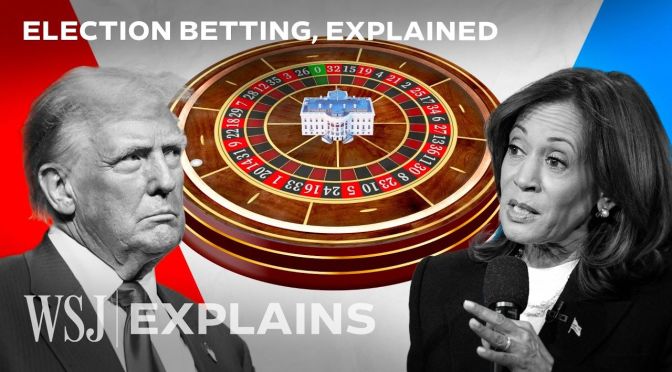
Politics: Inside The World Of ‘Legal’ Election Betting

The Wall Street Journal (October 29, 2024): While polls show former President Donald Trump and Vice President Kamala Harris in a dead heat in the final stretch of the 2024 election, the GOP nominee is dominating the Democratic candidate in the betting markets.

Chapters: 0:00 Election betting is legal 0:36 How it works 2:39 Prediction markets vs. polls 3:58 The reliability of betting markets

Once banned by federal regulators, Americans can now legally gamble on elections in prediction markets. Platforms like Kalshi and Polymarket have emerged as websites to place yes-or-no contracts. WSJ reporter Alexander Osipovich explains how these markets work, what they could tell us about the outcome of the election and the implications of trading on the future of the country.

Politics: The Guardian Weekly – February 9, 2024

Image

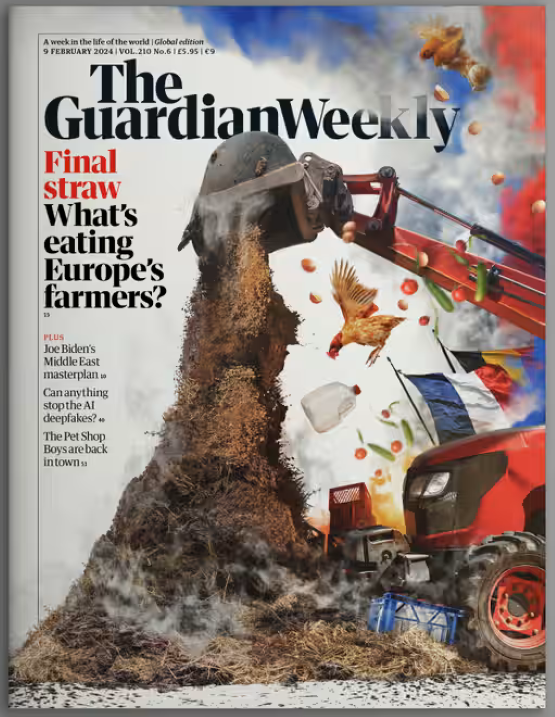
The Guardian Weekly (February 8, 2024) – The new issue features ‘Final Straw’ – What’s eating Europe’s Farmers?; Joe Biden’s Middle East masterplan; Can anything stop the AI deepfakes? and The Pet Shop Boys are back in town…

If you live in France, Germany, Belgium, the Netherlands, Poland or Greece, you may well have already run into one of the numerous roadblocks or protests formed in recent weeks by furious farmers. If you’re in Spain and Italy, take cover – because they are coming to you soon, if not already.

In this week’s cover story, we explore what has proved to be the final straw for Europe’s farmers. A combination of rising costs, environmental rules and grievances over EU policies, coupled with more localised complaints, seem to be the factors driving the convoys of tractors. But far-right and anti-establishment parties, who could make major gains in forthcoming European parliament elections, have also picked up on the protests as part of their agenda against EU influence.

Paris correspondent Angelique Chrisafis and Europe correspondent Jon Henley delve into the protests (if not the piles of steaming dung being dumped on the continent’s roads, as illustrated wonderfully by Neil Jamieson on this week’s cover), and ask what can be done to placate them.

Politics: The Guardian Weekly – February 2, 2024

Image

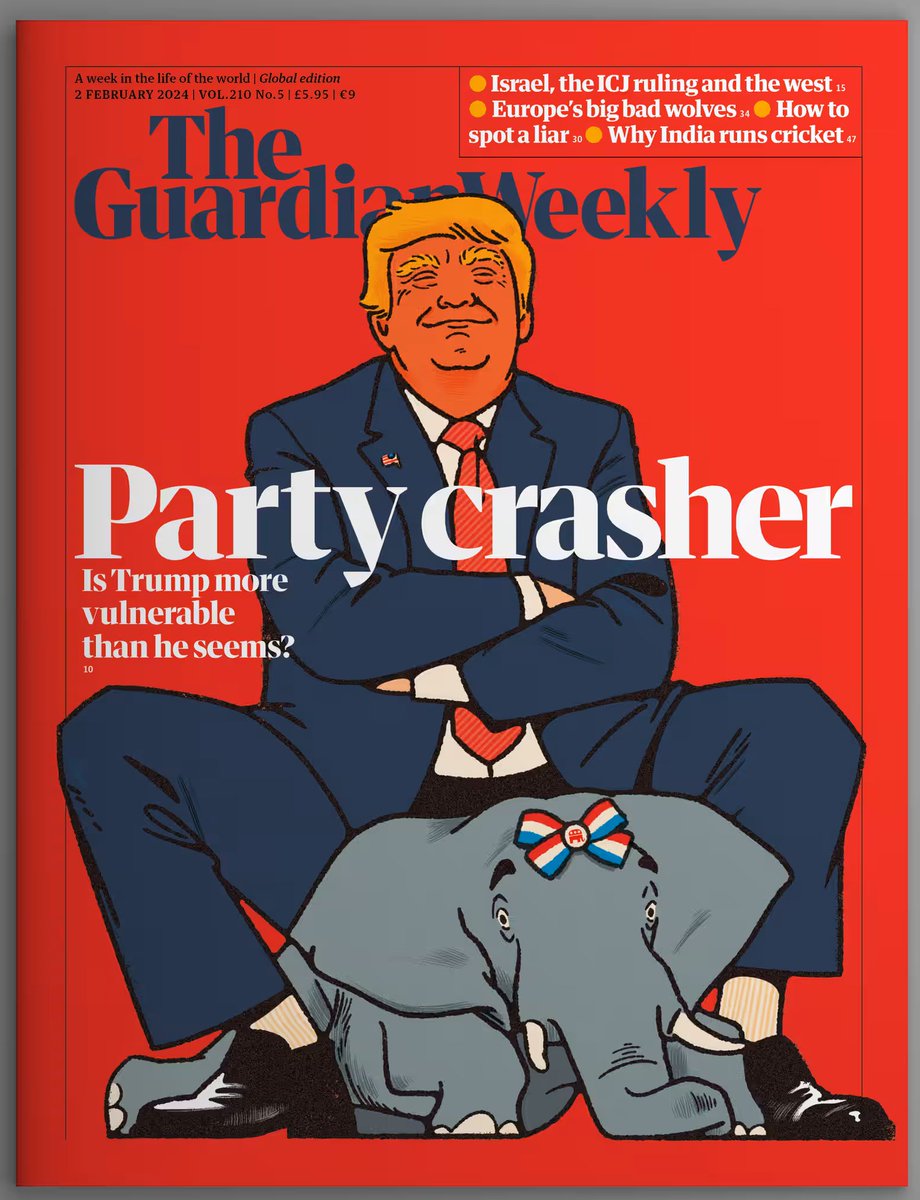
The Guardian Weekly (February 1, 2024) – The new issue features ‘Party Crasher’ – Is Trump more vulnerable than he seems?; Israel, the ICJ ruling and The West; Europe’s Big Bad Wolves and more….

It had all seemed like business as usual for Donald Trump in the aftermath of last week’s New Hampshire Republican primaries, where he scored a comfortable victory over his only remaining challenger, Nikki Haley. And yet … was there something in his subsequent outburst towards Haley that suggested all was not well in Trumpworld?

Barring the mother of all reversals, Trump will soon be confirmed as the Republican presidential nominee. But, as David Smith and Jonathan Freedland outline in this week’s big story, Trump remains a deeply polarising figure in American politics, not least within his own party.

And his petulant irritation at Haley over her refusal to concede the race was a visible reminder to American floating voters of the unhinged personality that lurks beneath the orange veneer, something his campaign team will be desperate to avoid more of.

“The shadow of Trump is long, and his return seems closer than ever,” explains illustrator Alberto Miranda on his cover art for this week’s Guardian Weekly. “He is a controversial figure with a dangerous side and, at the same time, has an utterly comical aspect. That’s why we wanted to portray his influence in the Republican party in an almost grotesque manner.”

Politics: The Guardian Weekly – January 26, 2024

The Guardian Weekly (January 25, 2024) – The new issue features ‘True Colours’ – What the AFD really wants for Germany; The fading hopes for Middle East Peace; Trump’s victory and DeSantis’s doomed campaign…

Events in the Middle East continue to unfold at a bewildering pace, with pockets of conflict opening up across the region. Diplomatic editor Patrick Wintour rounds up a week of flashpoints and assesses increasingly slim hopes for controlling the situation. And Oliver Holmes provides a revealing profile of Yemen, one of the most unchanging and least visited countries in the Middle East.

The Weekly went to press before news of Donald Trump’s victory in the New Hampshire Republican primary on Tuesday night, but you can catch up with all the latest Guardian coverage and reaction here. In the magazine, David Smith delivers a postmortem on Ron DeSantis’s doomed campaign, while Jonathan Freedland argues that Trump’s march to the White House can still be stopped.

Our long-read features take somewhat divergent paths this week. First, Charlotte Edwardes meets Gary Lineker, the former England footballer turned TV presenter whose penchant for regularly airing his liberal worldviews has made him public enemy No 1 for Britain’s anti-woke brigade.

Then, Chananya Groner unearths a remarkable story of factionalism and messianic fervour within New York’s Hasidic Jewish community, stretching back 30 years, which led to secret tunnels recently being discovered beneath a Brooklyn synagogue.

And in Culture, Charlotte Higgins meets the classical musicians Dalia Stasevska and Joshua Bell, who are resurrecting a long-forgotten Ukrainian concerto as a gesture of defiance to Russia.

Finally, we’re on the lookout for your best photographs of the world around us. For a chance for your picture to feature in the magazine, send us your best shot, telling us where you were in the world when you took it and why the scene resonated with you at that particular time.

Politics: The Guardian Weekly – January 19, 2024

Image

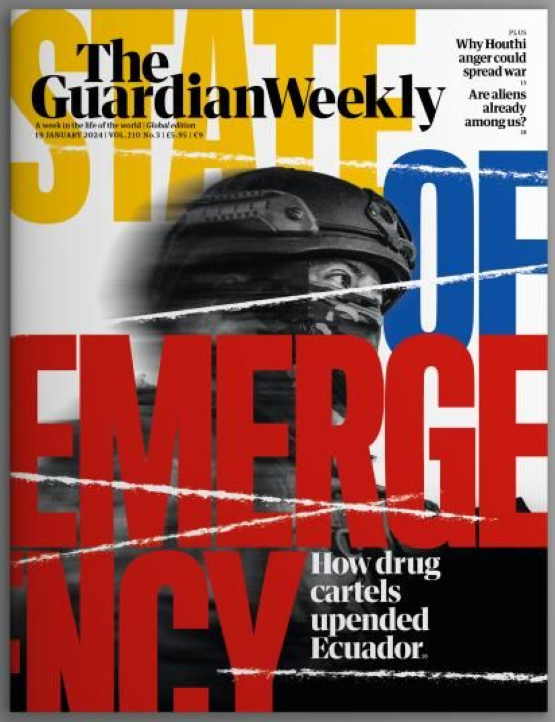
The Guardian Weekly (January 18, 2024) – The new issue features ‘State Of Emergency’ – How drug cartels upended Ecuador; Why Houthi anger could spread war; Are aliens already among us?…

Not long ago, Ecuador was chiefly known for its volcanoes, wildlife and eco-tourism. It’s an image that may now need some rehabilitation after chaos and bloodshed sparked by the prison escape last week of Adolfo Macías, the country’s most notorious gang leader and drug lord.

With cartels from Peru and Colombia routinely funnelling narcotics through Ecuador’s ports en route to Europe, Latin America correspondent Tom Phillips reports on a rising problem that threatens to tear apart the once-peaceful Andean state.

In the Middle East, Yemen’s Houthi rebels could stymie the increasingly slim chances of preventing a regional war. With the US and UK bombing Houthi bases in response to attacks on commercial shipping, diplomatic editor Patrick Wintour recounts the Houthis’ rise and why military strikes against them may not lead to the desired outcome.

Politics: The Guardian Weekly – January 11, 2024

Image

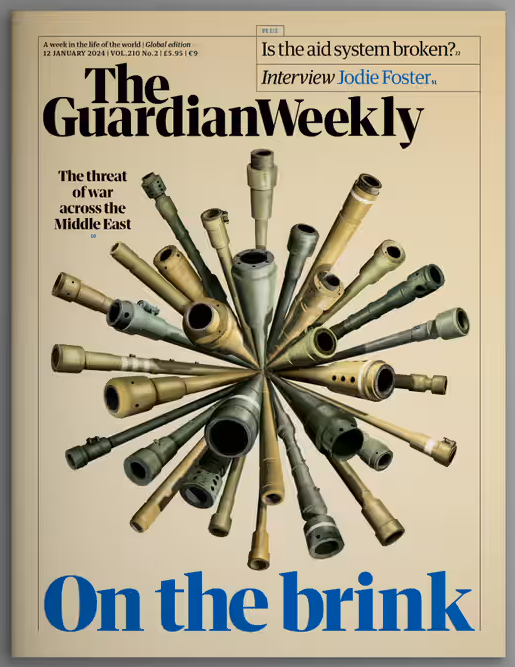
The Guardian Weekly (January 10, 2024) – The new issue features ‘Middle East on the brink’ – The threat of a regional war. Also, Inside the Post Office Horizon IT scandal…

The assassination of a Hamas chief in Lebanon. A terror attack on mourners of an Iranian former general. Commercial shipping in the Red Sea targeted by Yemeni rebels, and a US airstrike in Iraq. All were separate events in the Middle East last week but all were linked, in one way or another, to the presence of autonomous but Iranian-backed militia forces in the region.

When asked to visualise the threat of war engulfing the Middle East, for this week’s cover, illustrator Carl Godfrey took a literal approach. “I wanted to convey the tense and unpredictable situation,” says Carl, “and there’s nothing more tense than looking down the barrel of a gun. Especially when those barrels are pointing in all directions, and the risk of war is expanding in all directions.”

Politics: The Guardian Weekly – January 5, 2024

Image

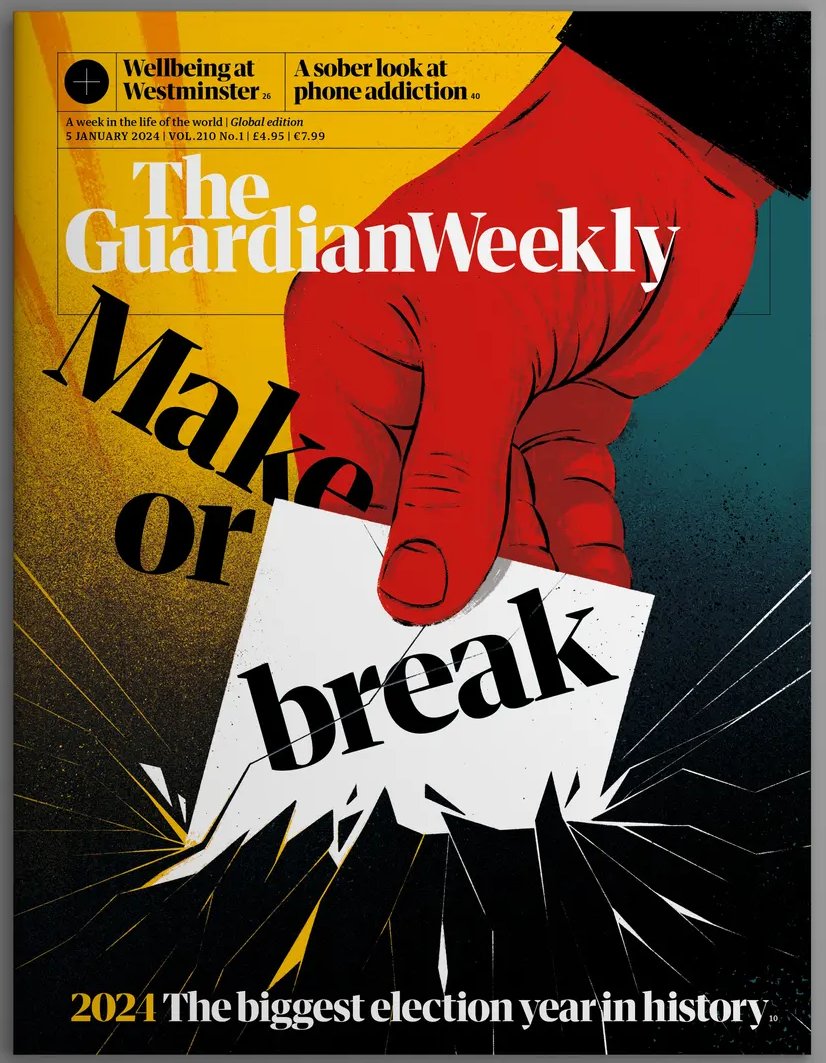
The Guardian Weekly (January 4, 2024) – The new issue features ‘Make or Break 2024’ – The biggest election year in history.

About 2 billion people have the opportunity to cast their ballots in polls that span the globe from the United States to Taiwan, and India to Mexico in 2024. The outcomes, as our analysts and correspondents explain in our big story, have implications for us all.

Washington bureau chief David Smith looks at the likely rerun of 2020’s Biden v Trump contest in November and explores what has changed and what has not in the US as the old adversaries square up. It is an almost foregone conclusion that Narendra Modi will be back for a third term as Indian prime minster, reports Hannah Ellis-Petersen from Delhi where analysts fear his victory will further imperil the country’s Muslim minority. And while Vladimir Putin will certainly continue as president in Russia, Pjotr Sauer explains why the man about to become fifth-time president might allow other candidates onto the ballot list. From Taiwan’s poll on 13 January to the 27-state European elections in June, how citizens vote will influence the geopolitical landscape for us all, while the conduct of campaigns will reveal how vulnerable democracies now are to misinformation and cyber interference from malign actors.

News Stories: New Russia Military Strategy, Vietnam President Resigns, 2023 Art

January 18, 2023: How does Russia plan to change its military strategy in Ukraine? Plus: the resignation of Vietnam’s president, the latest art news and why a US county is still recounting ballots from the 2020 election.

Politics: ‘The U.S. Elections Explained’ (Video)

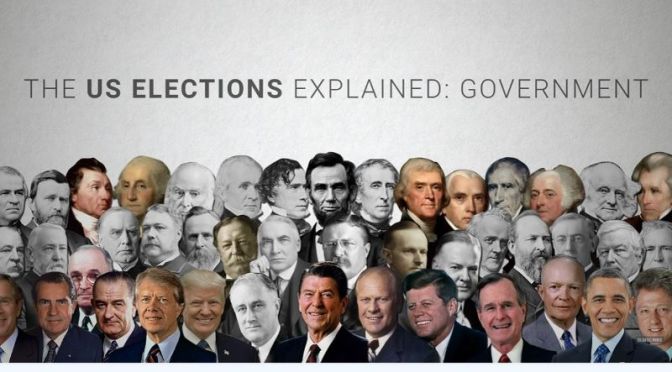
Dr Thomas Gift, Visiting Fellow at the LSE United States Centre, provides explanation and commentary on some the key questions about government in America: what are the separate branches of government, their responsibilities, and how do they work (and not work) together?