
Tag Archives: The Economist Special Report

Analysis: The World Ahead In 2026 – The Economist

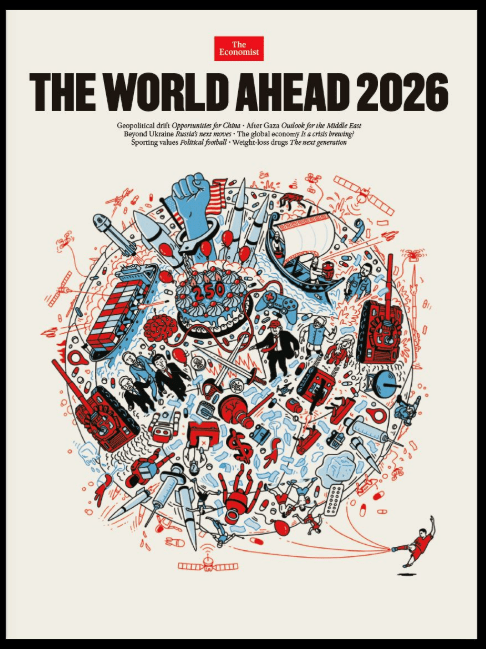
The Economist The World Ahead 2026 (November 13, 2025):

This is Donald Trump’s world—we’re all just living in it. The disruptor-in-chief was the biggest factor shaping global affairs in 2025, and that will be the case for as long as he remains in the White House. His norm-shattering approach has caused turmoil in some areas (as in trade) but has also delivered diplomatic results (as in Gaza) and forced necessary change (as with European defence spending). As the Trumpnado spins on in 2026, here are ten trends and themes to watch in the coming year.

1. America’s 250th.

Expect to hear wildly diverging accounts of America’s past, present and future, as Republicans and Democrats describe the same country in irreconcilably different terms to mark the 250th anniversary of its founding. Voters will then give their verdict on America’s future in the midterm elections in November. But even if the Democrats take the House, Mr Trump’s rule by bullying, tariffs and executive orders will go on.

2. Geopolitical drift.

Foreign-policy analysts are divided: is the world in a new cold war, between blocs led by America and China, or will a Trumpian deal divide the planet into American, Russian and Chinese “spheres of influence”, in which each can do as they please? Don’t count on either. Mr Trump prefers a transactional approach based on instinct, not grand geopolitical paradigms. The old global rules-based order will drift and decay further. But “coalitions of the willing” will strike new deals in areas such as defence, trade and climate.

3. War or peace? Yes.

With luck, the fragile peace in Gaza will hold. But conflicts will grind on in Ukraine, Sudan and Myanmar. Russia and China will test America’s commitment to its allies with “grey-zone” provocations in northern Europe and the South China Sea. As the line between war and peace becomes ever more blurred, tensions will rise in the Arctic, in orbit, on the sea floor and in cyberspace.

4. Problems for Europe.

All this poses a particular test for Europe. It must increase defence spending, keep America on side, boost economic growth and deal with huge deficits, even though austerity risks stoking support for hard-right parties. It also wants to remain a leading advocate for free trade and greenery. It cannot do all of these at once. A splurge on defence spending may lift growth, but only slightly.

5. China’s opportunity.

China has its own problems, with deflation, slowing growth and an industrial glut, but Mr Trump’s “America First” policy opens up new opportunities for China to boost its global influence. It will present itself as a more reliable partner, particularly in the global south, where it is striking a string of trade agreements. It is happy to do tactical deals with Mr Trump on soyabeans or chips. The trick will be to keep relations with America transactional, not confrontational.With rich countries living beyond their means, the risk of a bond-market crisis is growing

6. Economic worries.

So far America’s economy is proving more resilient than many expected to Mr Trump’s tariffs, but they will dampen global growth. And with rich countries living beyond their means, the risk of a bond-market crisis is growing. Much will depend on the replacement of Jerome Powell as chair of the Federal Reserve in May; politicising the Fed could trigger a market showdown.

7. Concerns over AI.

Rampant spending on infrastructure for artificial intelligence may also be concealing economic weakness in America. Will the bubble burst? As with railways, electricity and the internet, a crash would not mean that the technology does not have real value. But it could have wide economic impact. Either way, concern about AI’s impact on jobs, particularly those of graduates, will deepen.

8. A mixed climate picture.

Limiting warming to 1.5°C is off the table, and Mr Trump hates renewables. But global emissions have probably peaked, clean tech is booming across the global south and firms will meet or exceed their climate targets—but will keep quiet about it to avoid Mr Trump’s ire. Geothermal energy is worth watching.

9. Sporting values.

Sport can always be relied upon to provide a break from politics, right? Well, maybe not in 2026. The football World Cup is being jointly hosted by America, Canada and Mexico, whose relations are strained. Fans may stay away. But the Enhanced Games, in Las Vegas, may be even more controversial: athletes can use performance-enhancing drugs. Is it cheating—or just different?

10. Ozempic, but better.

Better, cheaper GLP-1 weight-loss drugs are coming, and in pill form, too. That will expand access. But is taking them cheating? GLP-1s extend the debate about the ethics of performance-enhancing drugs to a far wider group than athletes or bodybuilders. Few people compete in the Olympics. But anyone can take part in the Ozempic games.
Analysis: The World Ahead In 2025 – The Economist

Image

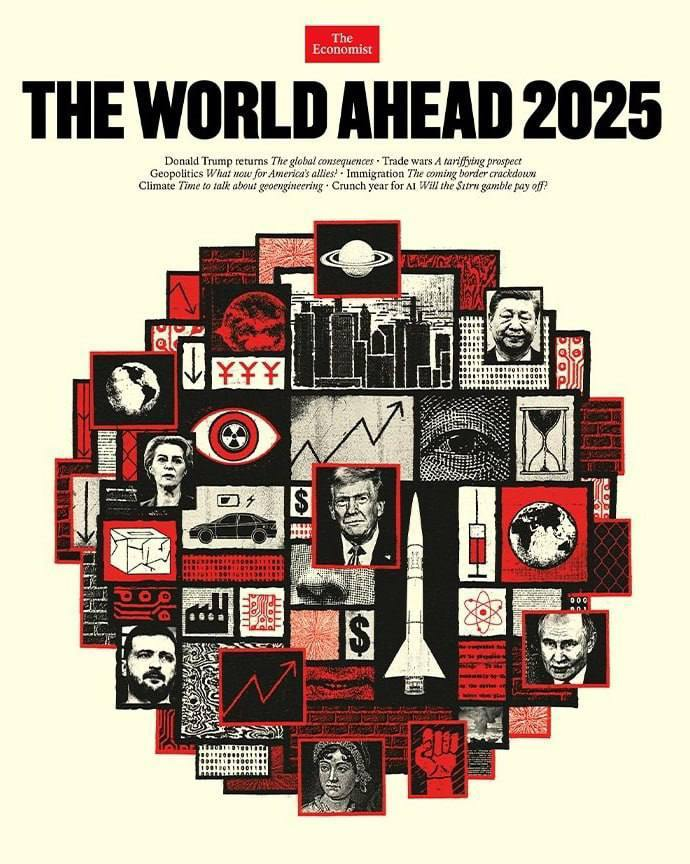
The Economist The World Ahead 2025 (November 20, 2024) : In 2025, as seen on the cover, the main event is Trump’s return to the White House and the global consequences of his policies, such as a new wave of trade wars with China. There is also an expected rise in technologies such as artificial intelligence and autonomous vehicles.

Tom Standage’s ten trends to watch in 2025

A letter from the editor of The World Ahead

The three forces that will shape 2025

Watch the interplay between Donald Trump, technology and radical uncertainty

The cover mentions climate issues and hints at a new phase in the fight for social equality, especially among women. Last year, the cover predicted geopolitical instability, an economic crisis, climate disasters, and the g

Analysis: ‘The American Economy’ (Oct. 19, 2024)

Special reports: The envy of the world

The Economist SPECIAL REPORTS (October 15, 2024): The latest special report features “The American Economy” – The envy of the world…

The envy of the world

The American economy has left other rich countries in the dust. Expect that to continue, argue Simon Rabinovitch and Henry Curr

The American economy has left other rich countries in the dust

American productivity still leads the world

Is higher inequality the price America pays for faster growth?

The shale revolution helped make America’s economy great

Why the American stockmarket reigns supreme

China’s yuan is nowhere close to displacing the greenback

What can stop the American economy now?

Technology Quarterly: ‘Chipmaking & AI’ (Fall 2024)

Technology Quarterly: Silicon returns to Silicon Valley

The Economist (September 19, 2024): The latest issue of TECHNOLOGY QUARTERLY is focused on:

Silicon returns to Silicon Valley

AI has returned chipmaking to the heart of computer technology, says Shailesh Chitnis

The semiconductor industry faces its biggest technical challenge yet

Node names do not reflect actual transistor sizes

How to build more powerful chips without frying the data centre

AI has propelled chip architecture towards a tighter bond with software

Researchers are looking beyond digital computing

The end of Moore’s law will not slow the pace of change

Education: “Schooling’s Stagnation” – July 13, 2024

Special reports: Must try harder

The Economist SPECIAL REPORTS (July 8, 2024): The latest special report features “Schooling’s Stagnation” – Must try harder…

Must try harder

Schools in rich countries are making poor progress. They need to get back to basics, argues Mark Johnson

Schools in rich countries are making poor progress

Hanging on to the best of them is getting harder

The rich world’s teachers are increasingly morose

Will artificial intelligence transform school?

Efforts to teach character bring promise and perils

England’s school reforms are earning fans abroad

Technology Report: “Spycraft” – July 6, 2024

Technology Quarterly: Watching the watchers

The Economist SPECIAL REPORTS (July 2, 2024): The ‘Watching The Watchers’ issue features Tools of the spy trade have changed and so has the world in which they are used, says Shashank Joshi

The tools of global spycraft have changed

Illustration of two magnifying glasses with eyes inside on a background of digital files and pointing cursors.
illustration: claire merchlinsky

And so has the world in which they are used, says Shashank Joshi

Afew years ago intelligence analysts observed that internet-connected cctv cameras in Taiwan and South Korea were inexplicably talking to vital parts of the Indian power grid. The strange connection turned out to be a deliberately circuitous route by which Chinese spies were communicating with malware they had previously buried deep inside crucial parts of the Indian grid (presumably to enable future sabotage). The analysts spotted it because they were scanning the internet to look for “command and control” (c2) nodes—such as cameras—that hackers use as stepping stones to their victims.

Ubiquitous technical surveillance has made spying more difficult

Signals intelligence has become a cyber-activity

Sometimes the old ways of espionage are the best

Artificial intelligence can speed-sort satellite photos

Private firms and open sources are giving spies a run for their money

Report: “Deglobalization Of Finance” – May 11, 2024

Special reports: Worlds apart

The Economist SPECIAL REPORTS (May 8, 2024): The ‘Deglobalization of Finance’ issue features

Worlds apart

The American-led financial order is giving way to a more divided one

Ten years ago your correspondent was fidgeting nervously in a meeting room at vtb Capital, the investment-banking arm of Russia’s second-biggest bank, just across the road from the Bank of England. During the recruitment process for a graduate job, things had taken a worrying turn. A Russian missile had shot down mh17, a passenger flight from Amsterdam to Kuala Lumpur, while it was passing over Ukraine. Plenty of Russian firms were already under Western sanctions owing to the annexation of Crimea earlier that year. Now sanctions were being ramped up, and vtb Capital’s parent bank was a prime target. Hence the fidgeting: how to ask the slightly alarming man across the table whether there would even be a vtb in a few months’ time?

The global financial system is in danger of fragmenting

How crises reshaped the world financial system

The movement of capital globally is in decline

National payment systems are proliferating

The fight to dethrone the dollar

How the financial system would respond to a superpower war

Sources and acknowledgments

Special Report: “India’s Economy” – April 27, 2024

Special reports: The India express

The Economist SPECIAL REPORTS (April 22, 2024): The latest issue features The India express – With the right changes, it can continue as an engine of global growth, say Arjun Ramani and Thomas Easton….

For its next phase of growth, India needs a new reform agenda

An illustration showing a modern train pulling old carriages.

With the right changes, it can continue as an engine of global growth, say Arjun Ramani and Thomas Easton

The consecration of the Ram temple in Ayodhya, a city in Uttar Pradesh, in January was a matter of supreme importance to Narendra Modi, India’s prime minister; attendance was thus de rigueur for those seeking his approval. The attendant courtiers included not just politicians, officials and foreign dignitaries but also India’s biggest corporate bosses. Uttar Pradesh is not their normal stamping ground, and Ayodhya has not until recently been much of a destination for tycoons. Now it has 115 hotels under construction, and some of those January visitors may soon be finding reasons to return.

India’s financial system has improved dramatically in the past decade

India’s difficult business environment is improving

India’s leaders must deal with three economic weaknesses

Going green could bring huge benefits for India’s economy

Technology Quarterly: ‘Health And AI’ (April 2024)

Technology Quarterly: A new prescription

The Economist (April 1, 2024): The latest issue of THE ECONOMIST TECHNOLOGY QUARTERLY is focused on:

A new prescription

AIs will make health care safer and better, reports Natasha Loder. It may even get cheaper too

AIs will make health care safer and better

Artificial intelligence has long been improving diagnoses

Medical AIs with human faces are on their way

Artificial intelligence is taking over drug development

Can artificial intelligence make health care more efficient?

Read full report

The Economist Special Report: ‘The Oil Industry’

Special reports: The long goodbye

The Economist SPECIAL REPORTS (March 17, 2024): The latest issue features ‘The long goodbye’ – The next 50 years will be different, argues Vijay Vaitheeswaran in a special report…

For 50 years the story of oil has been one of matching supply with increasing demand

Oil well in the desert

Fly west across the United Arab Emirates from Fujairah, a tanker-filled port on the Gulf of Oman, towards the Persian Gulf and you get a sense of the vulnerability arid lands have to climate change. The farms around Dhaid provide a splash of green, but homegrown food is scarce, homegrown staples next to non-existent. Drinkable water comes mostly from desalination plants. The heat is growing inhumane; outside work is banned during the hottest hours of summer afternoons.

Why oil supply shocks are not like the 1970s any more

The end of oil, then and now

Oil’s endgame will be in the Gulf

Can Big Oil run in reverse?

Sources and acknowledgments