

 In an engaging, deeply reported book, the authors travel to mobility hotspots, from Helsinki to Shanghai, to scout out this future. And they visit the companies putting it together. One, Divergent3d, is devising a system to manufacture cars with robots and 3D printers. PonyAI, a Chinese-Silicon Valley startup, builds autonomous software that perceives potholes, oncoming trucks, and wayward pedestrians, and guides the vehicle around them. Voom, an Airbus subsidiary, is racing with dozens of others to operate fleets of air taxis that fly by themselves.
Urban expert John Rossant and business journalist Stephen Baker look beyond the false promises of the past to examine the real future of transportation and the repercussions for the world’s cities, the global economy, the environment, and our individual lives.
Human mobility, dominated for a century by cars and trucks, is facing a dramatic transformation. Over the next decade, new networked devices, from electric bikes to fleets of autonomous cars, will change the way we move. They will also disrupt major industries, from energy to cars, give birth to new mobility giants, and lead to a redesign of our cities. For Rossant and Baker, this represents the advance of the Information Revolution into the physical world.
To read more: https://www.amazon.com/Hop-Skip-Go-Revolution-Transforming/dp/0062883062

 Shoppers have to use a debit card at the door to gain entry to the store. Then they can shop for products and just walk out. Upon exit, customers can verify their purchases against the receipt. No cash is accepted.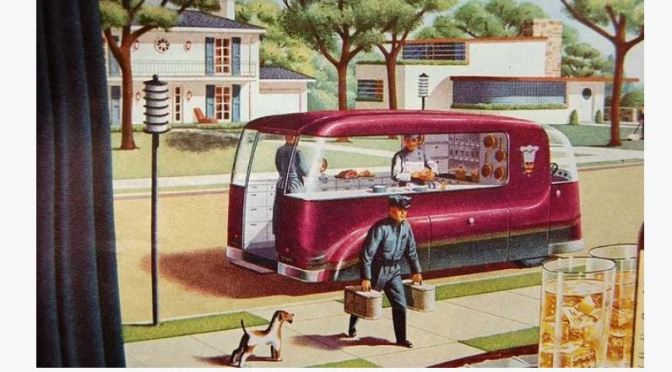

 It is unclear why people in the 1950s thought this was a practical way to travel; not only it looks like it is impossible to breathe in there, who would want to stand upright while driving? It would definitely ease the traffic; however, probably no one would want to use it.
 Towering transmitters in the city and private-jet traffic in the sky… This is a prediction that was made probably too early and it is definitely not so far from reality. Today, we paint a similar future for smart-cities and sci-fi movies depict the future cities in the same manner. It seems that older generations and we have a similar vision of the future look of the world.
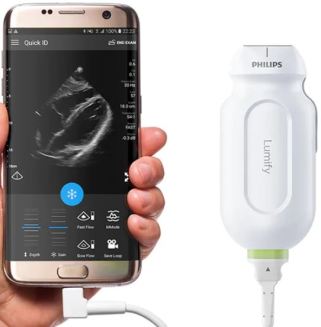 Philips Lumify ultrasound technology is an important component of the mobile ECMO unit. Members of the ECMO team use Lumify for real-time visual guidance when inserting tubes in veins and arteries in a process called ECMO cannulation.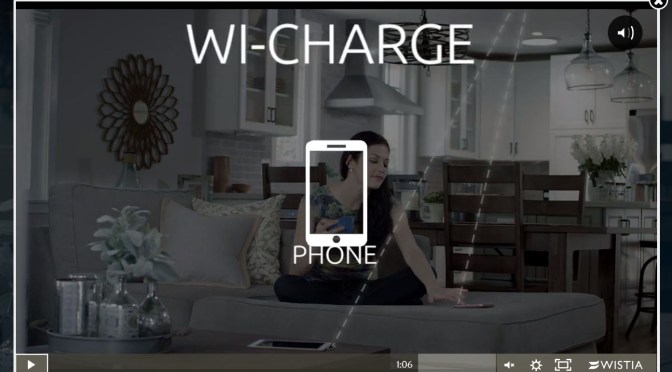
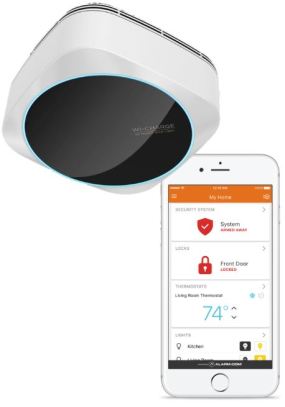 Wi-Charge says it has a solution to the problem. Its technology allows users to power small devices, such as smartphones, smart fire alarms, and smart locks, from several feet away without any wires.

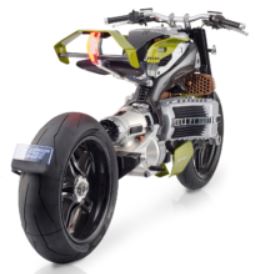 Well, with this extraordinary electric bike, I think I finally understand what Terblanche has been trying to get at all these years, and I absolutely love it. Designed and built in partnership with South African carbon wheel specialists BST, meet the all-electric Hypertek.
 The SC-1 is designed to transform what was a mere means of mobility into an all-new opportunity for entertainment. Sony and Yamaha Motor will deploy it to provide fun new diversions at venues such as golf courses, amusement parks, and commercial facilities.
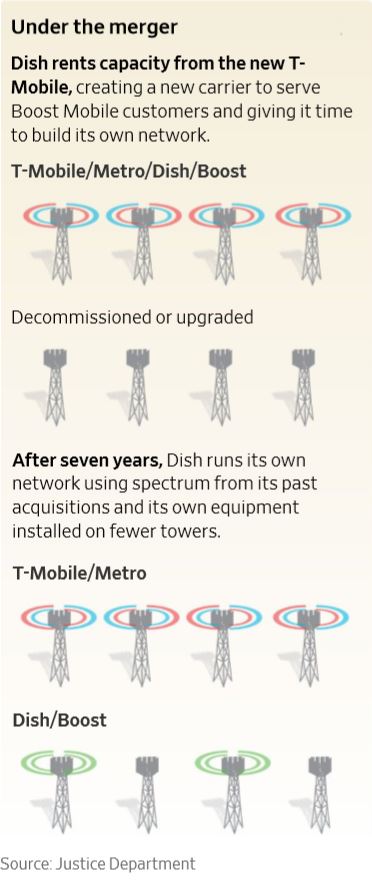 Mr. Ergen also argues wireless pricing is broken. He says U.S. carriers have many customers paying for unlimited data plans they don’t need, much as cable companies long forced subscribers to pay for big bundles of TV channels.
 Boomers Daily