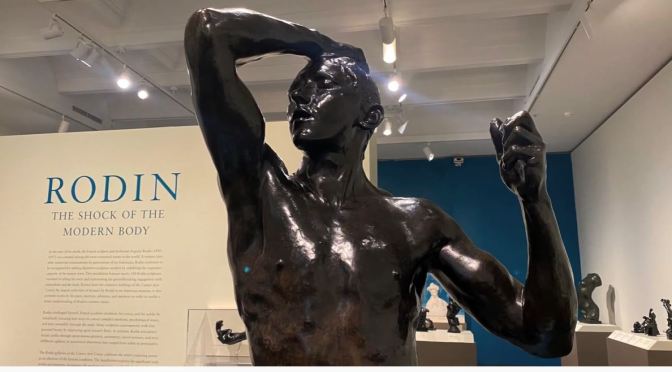
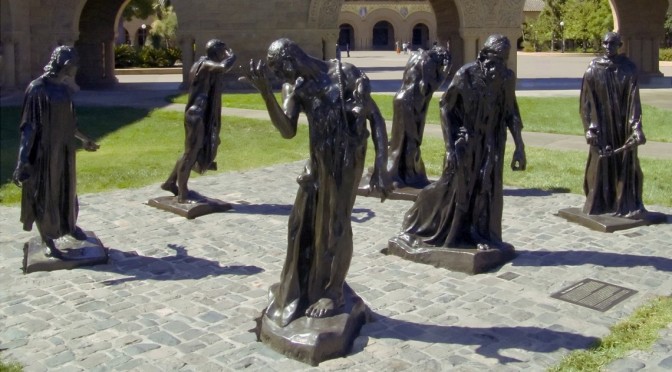
At the time of his death, Auguste Rodin (France, 1840-1917) was counted among the most renowned artists in the world. A century later, after numerous reassessments by generations of art historians, Rodin continues to be recognized for making figurative sculpture modern by redefining the expressive capacity of the human form. This installation spans three galleries and features nearly 100 Rodin sculptures essential to telling his story and representing his groundbreaking engagement with the body. Drawn from the extensive holdings of the Cantor Arts Center, the largest collection of sculptures by Rodin in an American museum, it also presents comparative works by his rivals, mentors, admirers, and imitators.
Check out the Cantor for publications about August Rodin and his works, available for purchase in the Cantor’s Atrium.
“He was the advisor everybody recommended you should have,” says Paul Milgrom of Robert Wilson, his PhD supervisor and now near neighbour in Palo Alto and co-Laureate in Economic Sciences. In this conversation with Adam Smith, recorded 20 minutes after Milgrom had learned of his prize, he describes how it was Wilson who actually delivered the news, in person: “He and his wife just walked over and rang the doorbell.”
Not only are the 2020 Economics Science Laureates long-time collaborators, they are also neighbours in Palo Alto, and so when Robert Wilson heard the news of his prize from Stockholm, he simply crossed the street and knocked on Paul Milgrom’s door to wake him! “It sounds like something from the nineteenth century,” says Wilson in this conversation with Adam Smith, recorded shortly after the news became public. He describes his pride at the fact that Milgrom is the third of his students, after Alvin Roth and Bengt Holmström, to be awarded the prize, a perfect combination of events that he calls his “trifecta”.
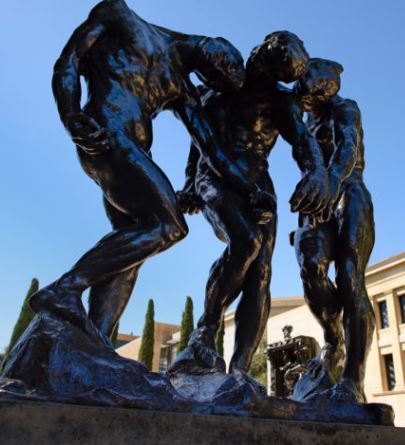
The Three Shades is among the works in the Rodin Sculpture Garden, adjacent to the Cantor Arts Center. The sculpture uses three separate casts of the same figure that has been rotated into different positions. (Image credit: L.A. Cicero)
The enduring appeal of Rodin, the modernity of his work, has to do with the way in which he makes visible an aesthetic of process – how, in other words, he takes traditional sculpture apart and puts it back together again in new and daring ways. Strategies of multiplication, scalability, fragmentation and recombinatory modes of assembly and display constitute some of the hallmarks of Rodin’s artistic practice.
Works by Rodin on view at the Cantor are often utilized by students and scholars from a range of disciplines, including medicine. In this moment, with outbreak of disease across the globe, what can Rodin’s works teach us about the relationship between art and nature?
It’s interesting that Rodin attracts so much attention from medical experts, especially here at Stanford, who have used his hands for diagnostic purposes. It’s true that Rodin was intensely interested in exploring pathologies of the body, especially now-discredited understandings of female hysteria. But there is also the irony that Rodin became furious after a critic accused him of making his first life-size figure through life casting, rather than modeling it himself. It should go without saying, but Rodin’s hands are not hands – not real ones, anyway – and their expressive forms don’t align neatly with the anatomical reality of hands in flesh and blood or even their more naturalistic counterparts. But the very fact that they elicit such responses demonstrates the power of art to provoke challenging questions that drive innovative paths of research that cut across disciplines, particularly in a university setting.


 It’s interesting that Rodin attracts so much attention from medical experts, especially here at Stanford, who have used his hands for diagnostic purposes. It’s true that Rodin was intensely interested in exploring pathologies of the body, especially now-discredited understandings of female hysteria. But there is also the irony that Rodin became furious after a critic accused him of making his first life-size figure through life casting, rather than modeling it himself. It should go without saying, but Rodin’s hands are not hands – not real ones, anyway – and their expressive forms don’t align neatly with the anatomical reality of hands in flesh and blood or even their more naturalistic counterparts. But the very fact that they elicit such responses demonstrates the power of art to provoke challenging questions that drive innovative paths of research that cut across disciplines, particularly in a university setting.
 Boomers Daily