Did monkeys really sail the oceans on floating rafts of vegetation? Is there a grand unified theory of snowflakes? What can fragrant whale excretions tell us about ancient oceans?
— New Scientist (@newscientist) December 17, 2021
All in our famous Christmas issue, available on newsstands now! 🐒https://t.co/MqmZbnHioz pic.twitter.com/7FIfCoXntt
Tag Archives: Science
Technology: Caltech In 2021 – The Year In Review

In January, researchers developed a cage-like vaccine platform called a mosaic nanoparticle that could help protect against multiple strains of coronavirus; obtained new insights into human decision-making using AI-trained networks playing video games; learned how tiny plants changed the planet nearly half a billion years ago; and studied chaotic systems using a camera that can take up to 70 trillion frames per second.
Meanwhile, the Institute announced that it would remove the names of known eugenics proponents from its buildings, honors, and assets.
February saw the historic landing of NASA’s Mars rover Perseverance on the Red Planet. The 2,263-pound rover, designed and operated by JPL, which Caltech manages for NASA, will spend two years investigating Mars’s Jezero crater, and will collect and cache samples of rocks and sediment for recovery by a subsequent mission.
Here on Earth, seismologists worked with optics experts to develop a method to use existing underwater telecommunication cables to detect earthquakes; physicists advanced the use of exotic materials for future ultrafast computers; and engineers perfected methods to place molecules in particular orientations at specific locations—work that paves the way for the integration of molecules with computer chips.
In March, Caltech researchers announced a non-invasive method that uses ultrasound to read and interpret brain activity related to the intent to move, a major step toward the creation of noninvasive brain–machine implants that can restore movement to paralyzed individuals; located Mars’s missing water; described a long-sought solution to “one of the most stubborn problems in math”; and explained how bacteria evolve resistance to antibiotics and how antibiotics help bacteria eat when nutrients are scarce.
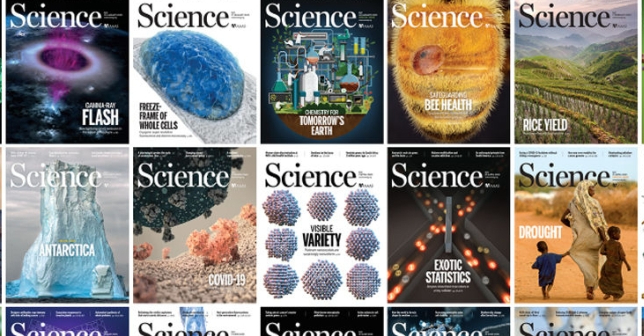
Cover Previews: Science Magazine – December 17
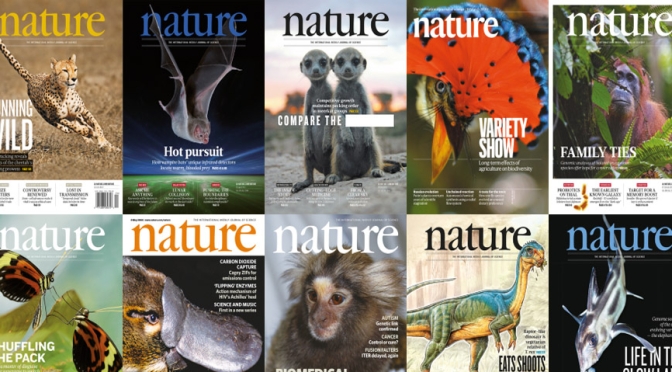
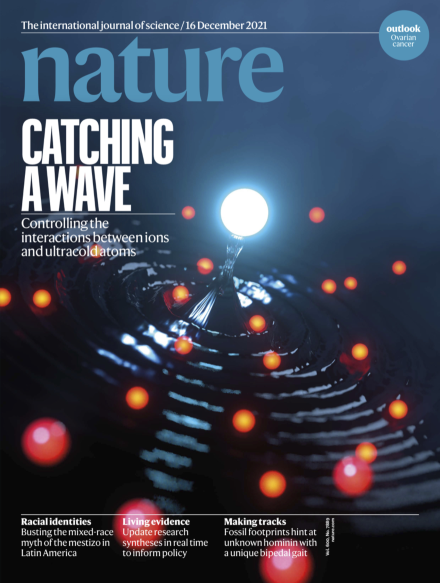
Front Covers: Nature Magazine – December 16
Science: Pluto’s Giant Ice Patterns, Pamplona’s Bull-Running Crowd Dynamics
An explanation for giant ice structures on Pluto, and dismantling the mestizo myth in Latin American genetics.
In this episode:
00:46 The frozen root of Pluto’s polygonal patterns
In 2015, NASA’s New Horizons probe sent back some intriguing images of Pluto. Huge polygonal patterns could be seen on the surface of a nitrogen-ice ice filled basin known as Sputnik Planitia. This week, a team put forward a new theory to explain these perplexing patterns.
Research article: Morison et al.
06:15 Research Highlights
How Pamplona’s bull-running defies the dynamics of crowd motion, and self-healing microbial bio-bricks.
Research Highlight: Running of the bulls tramples the laws of crowd dynamics
Research Highlight: It’s alive! Bio-bricks can signal to others of their kind
09:06 How the mixed-race ‘mestizo’ myth has fostered discrimination
The term ‘mestizo’ emerged during the colonial period in Latin America to describe a blend of ethnicities – especially between Indigenous peoples and the Spanish colonizers. But this label is a social construct not a well-defined scientific category. Now researchers are challenging the mestizo myth, which they say is harmful and has a troubling influence on science.
Feature: How the mixed-race mestizo myth warped science in Latin America
17:22 Briefing Chat
We discuss some highlights from the Nature Briefing. This time, how interrupted sleep could be a route to creativity, and the development of vaccines to target respiratory syncytial virus.
New Scientist: Interrupting sleep after a few minutes can boost creativity