Tag Archives: Science

Science: Longer Lives And Slower Mutations, The Largest Galaxy Structure

For biologists, a long-standing question has been why some animals live longer than others. This week a team have attempted to answer this, by measuring the rates that different animal species accumulate mutations. They show that longer-lived animals acquire mutations at a slower rate, which helps to explain why cancer risk does not scale with lifespan.

07:56 Research Highlights

A clinical trial suggests a change to the treatment of a pregnancy ailment, and astronomers identify the largest known structure produced by a single galaxy.

Research Highlight: Ambitious trial inspires a rethink on a common ailment of pregnancy

Research Highlight: Even among ‘giant’ galaxies this one is record-setting

10:43 The war in Ukraine’s effects on global energy

Many European countries are dependent on Russian fossil fuels for energy production. Following Russia’s unprovoked invasion of Ukraine, these countries are looking to wean themselves off these fuels, which could have short- and long-term impacts on emissions and food production.

Feature: What the war in Ukraine means for energy, climate and food

Editorial: The EU can simultaneously end dependence on Russia and meet climate goals

Editorial: The war in Ukraine is exposing gaps in the world’s food-systems research

19:58 A new measurement of a particle’s mass hints at new physics

Last week, a new estimate of the W boson’s mass caused much excitement among physicists. The result suggests that this particle is heavier than theory predicts, a finding that could be the first major breach in the standard model of particle physics. However, measuring W bosons is notoriously tricky, and further work will be needed to confirm the finding.

News: Particle’s surprise mass threatens to upend the standard model
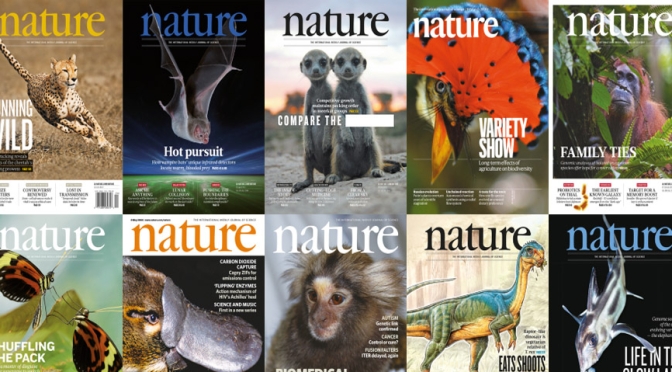
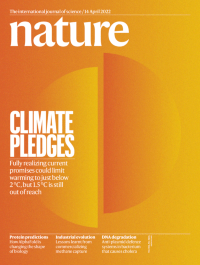
Cover Previews: Nature Magazine – April 14, 2022


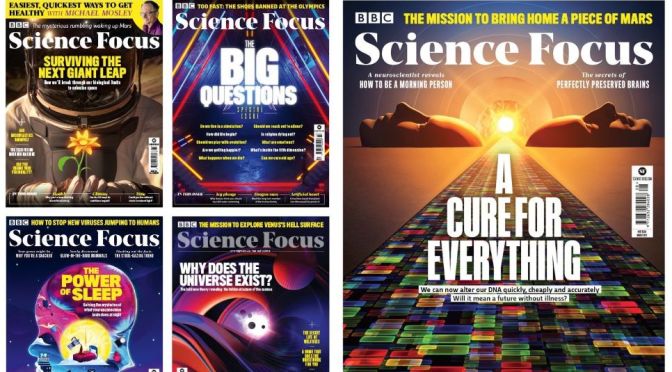
Previews: Science Focus Magazine – April 13, 2022

The race for the Moon

No human has set foot on the Moon for decades. But an armada of exciting new missions are set to explore the lunar surface once more.

The DNA detective

The consumer genetic testing kits hitting the shelves have allowed scientists to piece together our family trees better than ever before. Geneticist Prof Turi King tells us more.

Fit to burst

Inflation is a pretty useful tool in nature. Zoologist Jules Howard takes a closer look at some of the incredible animals that can blow themselves up like balloons.

The Hitchhiker’s Guide to the Metaverse

What is the metaverse, can anyone visit, and where’s the best place to go?

Read more

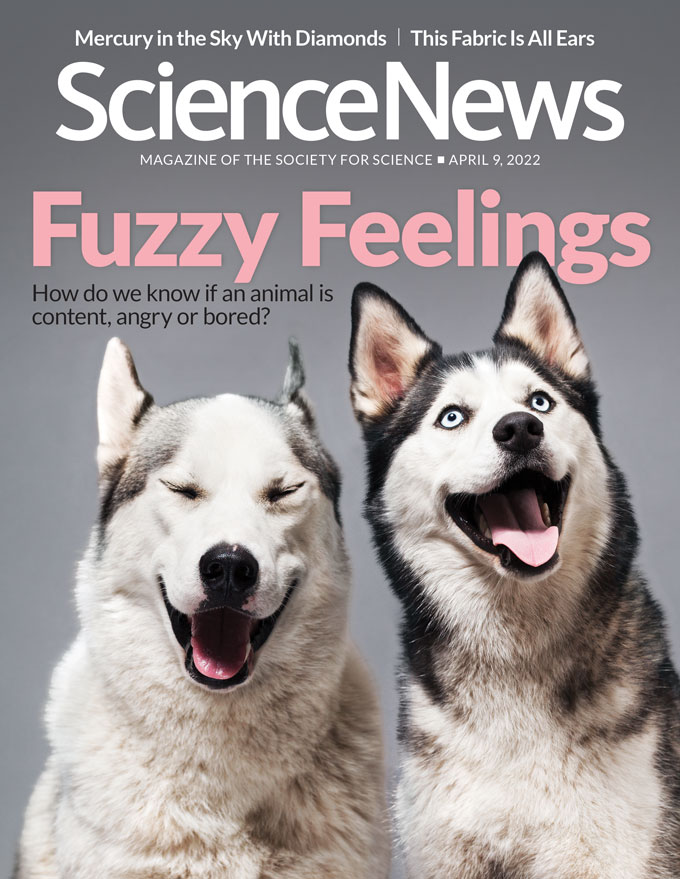
Previews: Science News Magazine – April 9, 2022


COVER STORY

How do we know what emotions animals feel?

Animal welfare researchers are studying the feelings and subjective experiences of horses, octopuses and more.

By Alla Katsnelson

NEWS

Diamonds may stud Mercury’s crust

By Nikk Ogasa

NEWS

This fabric can hear your heartbeat

By Carolyn Wilke

Science: New W Boson Particle Measurement, Marine RNA Viruses

On this week’s show: A new measurement of the W boson could challenge physicists’ standard model, and an abundance of marine RNA viruses.

Staff Writer Adrian Cho joins host Sarah Crespi to discuss a new threat to the standard model of particle physics—a heavier than expected measurement of a fundamental particle called the W boson. They chat about how this measurement was taken, and what it means if it is right.

Next, Sarah talks about the microscopic denizens of Earth’s oceans with Ahmed Zayed, a research scientist in the department of microbiology at Ohio State University, Columbus. They talk about findings from a global survey of marine RNA viruses. The results double the number of known RNA viruses, suggesting new classifications will be needed to categorize all this viral diversity.

Cover Preview: Science Magazine – April 8, 2022

Science: Probing Earth’s Inner Core, Complete Read Of Human Genome

On this week’s show: A journey to the center of the center of the Earth, and what was missing from the first human genome project.

Staff Writer Paul Voosen talks with host Sarah Crespi about the many mysteries surrounding the innermost part of our planet—from its surprisingly recent birth to whether it spins faster or slower than the rest of the planet.

Next, Sarah chats with Adam Phillippy about the results from the Telomere-to-Telomere (T2T) Consortium, an effort to create a complete and detailed read of the human genome. Phillippy, a senior investigator and head of the Genome Informatics Section at the National Human Genome Research Institute, explains what we can learn by topping up the human genome with roughly 200 more megabases of genetic information—practically a whole chromosome’s worth of additional sequencing.

See all the T2T papers.

This week’s episode was produced with help from Podigy.

[Image: V. Altounian/Science; Music: Jeffrey Cook]

[alt: An array of the human chromosomes showing newly sequenced parts from the Telomere-to-Telomere Consortium with podcast symbol overlay]

Authors: Sarah Crespi; Paul Voosen

Episode page: https://www.science.org/doi/10.1126/science.abq1885

Cover Preview: Science Magazine – April 1, 2022

Science: Navigating Life, Coastal Storminess, Boa Constrictors, Old Trees

Your ability to find your way may depend on where you grew up and how coastal storminess is changing.

00:47 Your ability to find your way may depend on where you grew up

Researchers have long been trying to understand why some humans are better at navigating than others. This week, researchers show that where someone grew up plays an important role in their ability to find their way; the more winding and disorganised the layouts of your childhood were, the better navigator you’ll be later in life.
Research article: Coutrot et al.

08:57 Research Highlights

How boas can squeeze without suffocating themselves, and why being far from humans helps trees live a long life.
Research Highlight: How boa constrictors squeeze and breathe at the same time

Research Highlight: Where are Earth’s oldest trees? Far from prying eyes

11:39 How coastal storminess is changing

Coastal flooding causes billions of dollars in damage each year. Rising sea levels are known to be a key driver, but the importance of another factor, storm surges, is less clear. Typically after accounting for increasing sea level, they’re not thought to make much of an impact. However new research suggests that this may not be the case.
Research article: Calafat et al.

16:10 Briefing Chat

We discuss some highlights from the Nature Briefing. This time, a brain implant allows a person who is completely paralysed to communicate, and penguin-like bone density suggests Spinosaurus may have hunted underwater.
Science: In a first, brain implant lets man with complete paralysis spell out thoughts: ‘I love my cool son.’

National Geographic: Spinosaurus had penguin-like bones, a sign of hunting underwater

Video: A swimming dinosaur: The tail of Spinosaurus

Preview: New Scientist Magazine – April 2, 2022

COVER STORIES

  • CULTURE Cow review: A moving and uncomfortable cow’s-eye-view of farming
  • FEATURES Martin Wikelski interview: Tracking animals reveals their sixth sense
  • FEATURES How do we decide what counts as trauma – and have we got it all wrong?