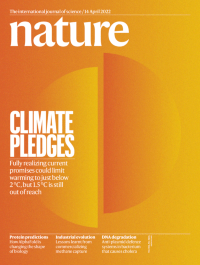
In Nature this week: Climate pledges – fully realizing current promises could limit warming to just below 2 °C , but 1.5 °C is still out of reach. Browse the full issue here: https://t.co/eEMf9XL8lBpic.twitter.com/GuaC5pdolG
No human has set foot on the Moon for decades. But an armada of exciting new missions are set to explore the lunar surface once more.
The DNA detective
The consumer genetic testing kits hitting the shelves have allowed scientists to piece together our family trees better than ever before. Geneticist Prof Turi King tells us more.
Fit to burst
Inflation is a pretty useful tool in nature. Zoologist Jules Howard takes a closer look at some of the incredible animals that can blow themselves up like balloons.
The Hitchhiker’s Guide to the Metaverse
What is the metaverse, can anyone visit, and where’s the best place to go?
On this week’s show: A new measurement of the W boson could challenge physicists’ standard model, and an abundance of marine RNA viruses.
Staff Writer Adrian Cho joins host Sarah Crespi to discuss a new threat to the standard model of particle physics—a heavier than expected measurement of a fundamental particle called the W boson. They chat about how this measurement was taken, and what it means if it is right.
Next, Sarah talks about the microscopic denizens of Earth’s oceans with Ahmed Zayed, a research scientist in the department of microbiology at Ohio State University, Columbus. They talk about findings from a global survey of marine RNA viruses. The results double the number of known RNA viruses, suggesting new classifications will be needed to categorize all this viral diversity.
A new, very-high-precision measurement of the W boson mass suggests that improvements to calculations or extensions to the standard model of particle physics might be needed.
On this week’s show: A journey to the center of the center of the Earth, and what was missing from the first human genome project.
Staff Writer Paul Voosen talks with host Sarah Crespi about the many mysteries surrounding the innermost part of our planet—from its surprisingly recent birth to whether it spins faster or slower than the rest of the planet.
Next,Sarah chats with Adam Phillippy about the results from the Telomere-to-Telomere (T2T) Consortium, an effort to create a complete and detailed read of the human genome. Phillippy, a senior investigator and head of the Genome Informatics Section at the National Human Genome Research Institute, explains what we can learn by topping up the human genome with roughly 200 more megabases of genetic information—practically a whole chromosome’s worth of additional sequencing.
A special section in this week's issue of Science presents research by the Telomere-to-Telomere (#T2T) Consortium, which has completed a challenging 8% of the human genome left unresolved by the initial Human Genome Project.
Your ability to find your way may depend on where you grew up and how coastal storminess is changing.
00:47 Your ability to find your way may depend on where you grew up
Researchers have long been trying to understand why some humans are better at navigating than others. This week, researchers show that where someone grew up plays an important role in their ability to find their way; the more winding and disorganised the layouts of your childhood were, the better navigator you’ll be later in life. Research article: Coutrot et al.
Coastal flooding causes billions of dollars in damage each year. Rising sea levels are known to be a key driver, but the importance of another factor, storm surges, is less clear. Typically after accounting for increasing sea level, they’re not thought to make much of an impact. However new research suggests that this may not be the case. Research article: Calafat et al.
In this week's issue: Is consciousness a fundamental property of the universe? Most physicists think not. But some are radically rethinking the relationship between matter and mind.
Precisely ageing subgiant stars gives new insight into the Milky Way’s formation, and uncovering Yellowstone’s hydrothermal plumbing system.
In this episode:
00:45 Accurately ageing stars reveals the Milky Way’s history
To understand when, and how, the Milky Way formed, researchers need to know when its stars were born. This week, a team of astronomers have precisely aged nearly a quarter of a million stars, revealing more about the sequence of events that took place as our galaxy formed.
Yellowstone National Park’s iconic geothermal geysers and volcanic landmarks are well studied, but very little was known about the ‘plumbing system’ that feeds these features. Now a team of researchers have mapped the underground hydrothermal system, showing the specific faults and pathways that supply the park.
We discuss some highlights from the Nature Briefing. This time, 0why an Australian university has been suspended from winning a research foundation’s fellowships, and the ongoing debate about the cause of ‘COVID toes’.


 Boomers Daily