

COVER STORIES

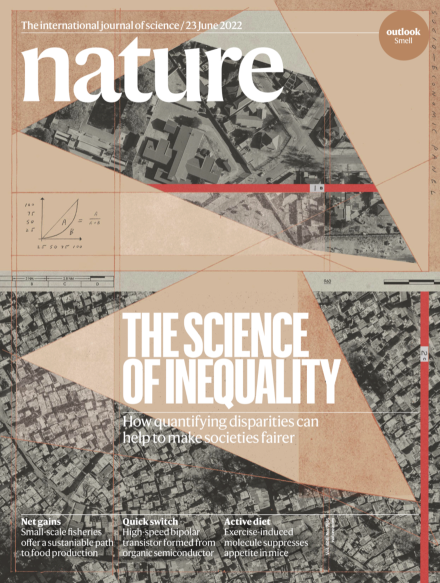
To study inequality is to confront a world of contrasts: excessive wealth next to palpable poverty; sickness abutting health. The COVID pandemic has exposed and worsened many such disparities. This week, Nature presents a special collection of articles focusing on the researchers trying to quantify and reduce inequality. Whether they are measuring the effects of the pandemic or testing interventions to lift people out of poverty, the message is simple: gathering the right information will help to mitigate the harm caused by inequality.
Cover image: Mike McQuade.
Table of Contents
Ten years ago, physicists found what they predicted. Little new has followed
Graves in Kyrgyzstan hold early victims of plague that swept medieval Europe
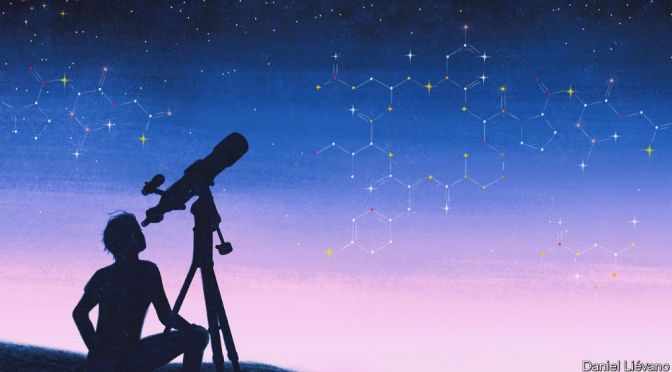
The thought of finding alien life has fascinated people since the time of the ancient Greeks—but developments in astrobiology could be about to turn this possibility into reality. How do you hunt for life beyond Earth—and might this be the decade when we find it?
Chapters: 00:00 – Is there life beyond Earth? 00:56 – How has the search for life evolved? 02:36 – What signs of life are scientists looking for? 03:48 – What are biosignatures? 04:28 – How to find intelligent life 06:03 – How telescopes today have improved our search 07:52 – Expanding the search beyond Earth
Read more of Alok Sharma’s coverage on the search for life in space: https://econ.st/3zw1Hxt

The nature of time is a tricky notion to pin down. But whether it is a fundamental part of our universe or just an illusion has huge implications
FEATURES Could we ever go back in time? Relativity does not rule it out
FEATURES How do we sense time? The brain cells that order our memories
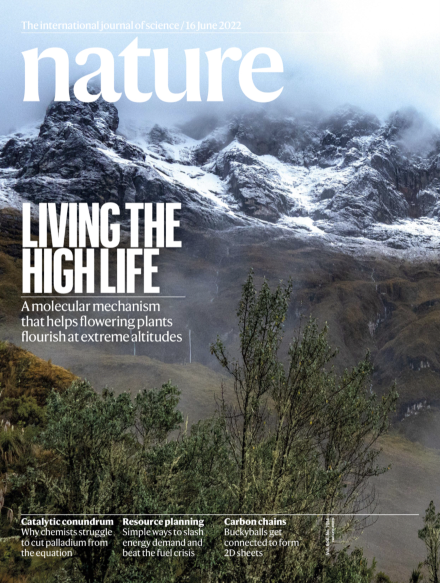
The cover image shows plants growing at altitude on Altar Volcano in Chimborazo, Ecuador. Extreme altitudes pose challenges for most forms of life, and flowering plants are no exception. But flowering plants have been found growing as high as 6,400 metres above sea level. In this week’s issue, Michael Holdsworth and his colleagues reveal a molecular mechanism that helps plants to adapt to the extremes of altitude. The researchers studied a range of plants, representing four diverse clades of flowering plants — thale cress (Arabidopsis thaliana), tomato, poppy and the grass
Brachypodium distachyon. They found that plants use genetic adaptations to adjust their sensitivity to atmospheric oxygen, whose partial pressure decreases with altitude. By decoding the ambient oxygen level, the plants are able to sense the altitude at which they grow and optimize internal biochemical processes.
Cover image: Cristian Miño, Ecuador.

REPORTS BY
REPORTS BY
RESEARCH ARTICLES BY
RESEARCH ARTICLES BY
A headbashing relative gives insights into giraffe evolution – How the giraffe got its long neck is a longstanding question in science. One possibility is that giraffes evolved longer necks for sexual competition, with males engaging in violent neck-swinging fights.
Now, a team have described fossils of an ancient giraffoid species with a thick headpiece adapted for fighting, which could add weight to this hypothesis.
Nature News: How the giraffe got its neck: ‘unicorn’ fossil could shed light on puzzle
Around the world, the ‘great resignation’ has seen huge numbers of workers re-evaluating their careers and lifestyles and choosing to leave their jobs following the pandemic. Academia is no exception, with many scientists deciding to leave the sector in the face of increased workloads, systemic biases and pressure to publish.
Nature Careers: Has the ‘great resignation’ hit academia?
Earlier this year, NASA’s MAVEN spacecraft, which has been orbiting Mars since 2014, developed some serious equipment issues that prevented it from keeping its correct orientation in space. In a race against time, a team on Earth fixed the problem by developing a system that allowed the spacecraft to navigate by the stars.
Space.com: NASA’s Mars MAVEN spacecraft spent 3 months on the brink of disaster
NASA’s Perseverance rover has arrived at an ancient Martian river delta where it will spend the next few months exploring, while scientists assess where to drill and extract rock samples. It’s thought that rocks from this region have the best chance of containing evidence of Martian life, and plans are being developed to return them to Earth in the future.
Nature News: NASA’s Perseverance rover begins key search for life on Mars
The Casarabe people lived in southwest Amazonia around AD 500–1400, but understanding of this culture has been limited because the archaeological remains are covered in dense forest. In this week’s issue, Heiko Prümers and his colleagues reveal the discovery of new Casarabe settlements in the Bolivian Amazon. The researchers used lidar to scan the forest, revealing 2 large settlements (each covering more than 100 hectares) and 24 smaller sites, 15 of which had previously been known to exist.

The cover image shows Cotoca, one of the two large settlements, in which earthen mounds (one more than 20 metres high) and long causeways can clearly be seen. The team suggests that these results are the first evidence of agrarian-based, low-density urbanism in western Amazonia. They conclude that the region was not as sparsely populated in pre-Hispanic times as was previously thought.
Cover image: Heiko Prümers/DAI.



 Boomers Daily