

 Listen to the latest science updated, brought to you by Nick Howe and Shamini Bundell. This week, delving into the results of the latest graduate student survey, and assessing ageism in science fiction literature.
In this episode:
00:45 The graduate student experience
The results of Nature’s 2019 PhD survey are in. David Payne, Nature’s Chief Careers Editor, takes us through them. Nature’s PhD survey collection
06:45 Research Highlights
Giant tortoises are quick learners, and colour-changing magic mushrooms. Research Article: Gutnick et al.; Research Highlights: Why magic mushrooms turn dark blue when picked
08:52 Where are the older women in sci-fi?
Author Sylvia Spruck Wrigley has been looking into the number of older women that appear in sci-fi novels, and the roles they play. Essay: Space ageing: why sci-fi novels shun the badass older woman
16:45 News Chat
A trove of mummified remains causes excitement in Egypt, and Italy plans a new science funding body. News: Rare mummified lions add to Egyptology buzz; News: Italy’s plan to create €300-million research agency draws fire



 Who among us hasn’t wished we could read someone else’s mind, know exactly what they’re thinking? Well that’s impossible, of course, since our thoughts are, more than anything else, our own. Private, personal, unreachable. Or at least that’s what we’ve always, well, thought.
 You may have seen the aftermath of a landslide, driving along a twisty mountain road—a scattering of rocks and scree impinging on the pavement. And up until now, that’s pretty much how scientists have tracked landslides—roadside observations and spotty satellite images. Now, researchers are hoping to track landslides systematically by instrumenting an entire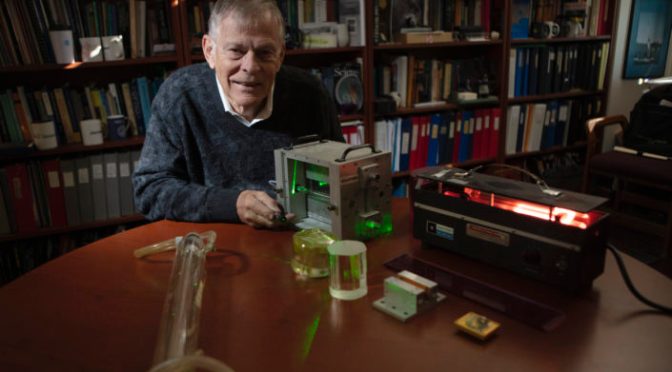
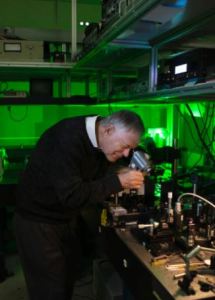 Byer also helped develop the quietest, most stable laser in the world, called the diode-pumped YAG laser. YAG lasers are today found in everything from communications satellites to green handheld laser pointers, which Byer co-developed with two of his graduate students and cites as one of his favorite inventions (he had joined Stanford in 1969). YAG lasers also form the main beams of the gravitational wave-detecting instrument, LIGO, which in 2015 achieved the most precise measurement ever made by humans when its antenna detected the tenuous spacetime fluctuations generated by two colliding black holes 1.3 billion light-years away.
 One summer morning in 1964, Byer drove the hour from Berkeley down to Mountain View for a job interview at a California company called Spectra Physics. He walked in to find an empty lobby but could hear clapping and cheering in the back of the building. After politely waiting for several minutes, he followed the commotion to a darkened room filled with men whose jubilant faces were illuminated by a rod of red-orange light that seemed to float above an instrument-strewn table

 Benjamin Thompson brings you the latest science news. This week, an antibiotic that targets difficult to treat bacteria, and a roundup of the latest science news.
 There was a massive shift in Roman residents’ ancestry, the researchers found, but that ancestry came primarily from the Eastern Mediterranean and Near East, possibly because of denser populations there relative to the Roman Empire’s western reaches in Europe and Africa.
 Boomers Daily